AI Papers of the Week
Every paper worth reading in AI, hand-picked one week at a time.
Discover and explore top AI papers withClaude CodeCodex
npx @dair-ai/mcp setup
Google Earth AI Geospatial Reasoning Agent: Capabilities and a Systematic Evaluation
Noam Slonim, Shravya Shetty and colleagues (Google Research) present the Geospatial Reasoning Agent (GRA) of Google Earth AI, a Gemini-based agent that organizes geospatial data, foundation models and tools into domain skills, plus two benchmarks to evaluate it.
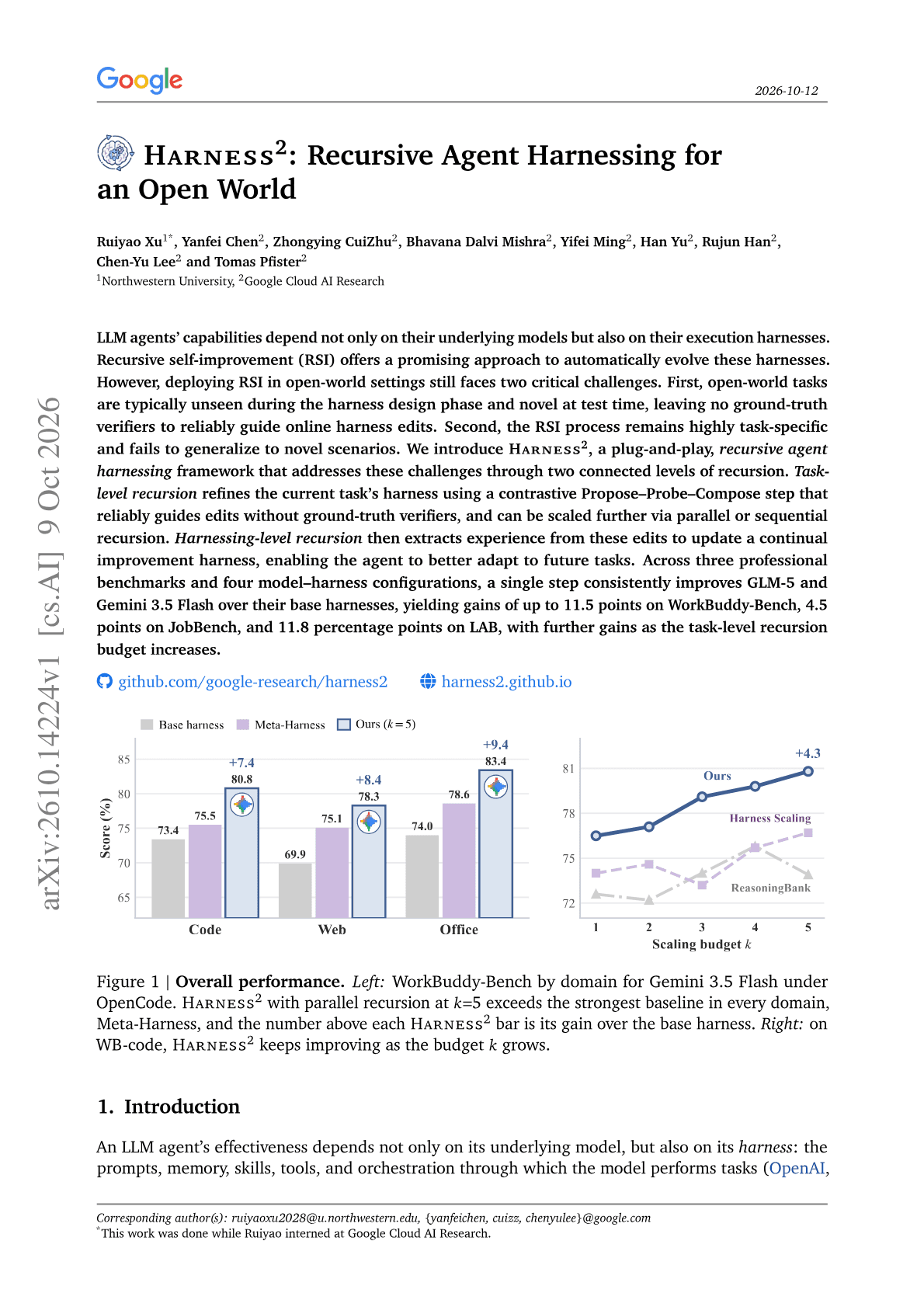
Harness^2: Recursive Agent Harnessing for an Open World
Recursive self-improvement of agent harnesses usually depends on a verifier, and open-world tasks are new at test time, so no ground-truth checker exists. Researchers from Google Cloud AI Research and Northwestern University introduce Harness^2, a plug-and-play framework that improves the harness at test time through two connected levels of recursion.
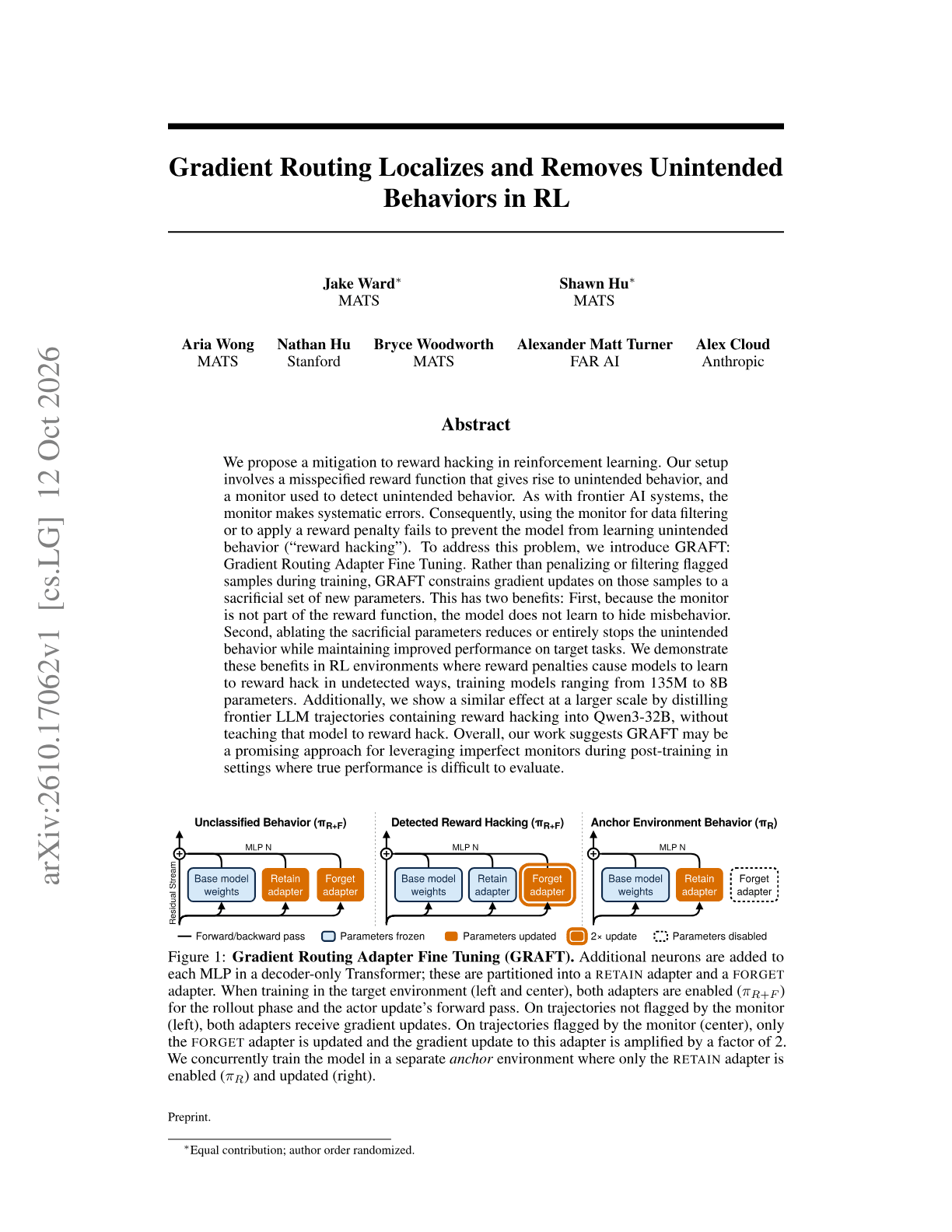
Gradient Routing Localizes and Removes Unintended Behaviors in RL
Jake Ward, Shawn Hu and colleagues (MATS, Stanford, FAR AI) with Alex Cloud (Anthropic) present GRAFT, which routes gradient updates from monitor-flagged RL samples into a separate adapter that is removed after training, so an imperfect monitor can be used without teaching the model to hide reward hacking.
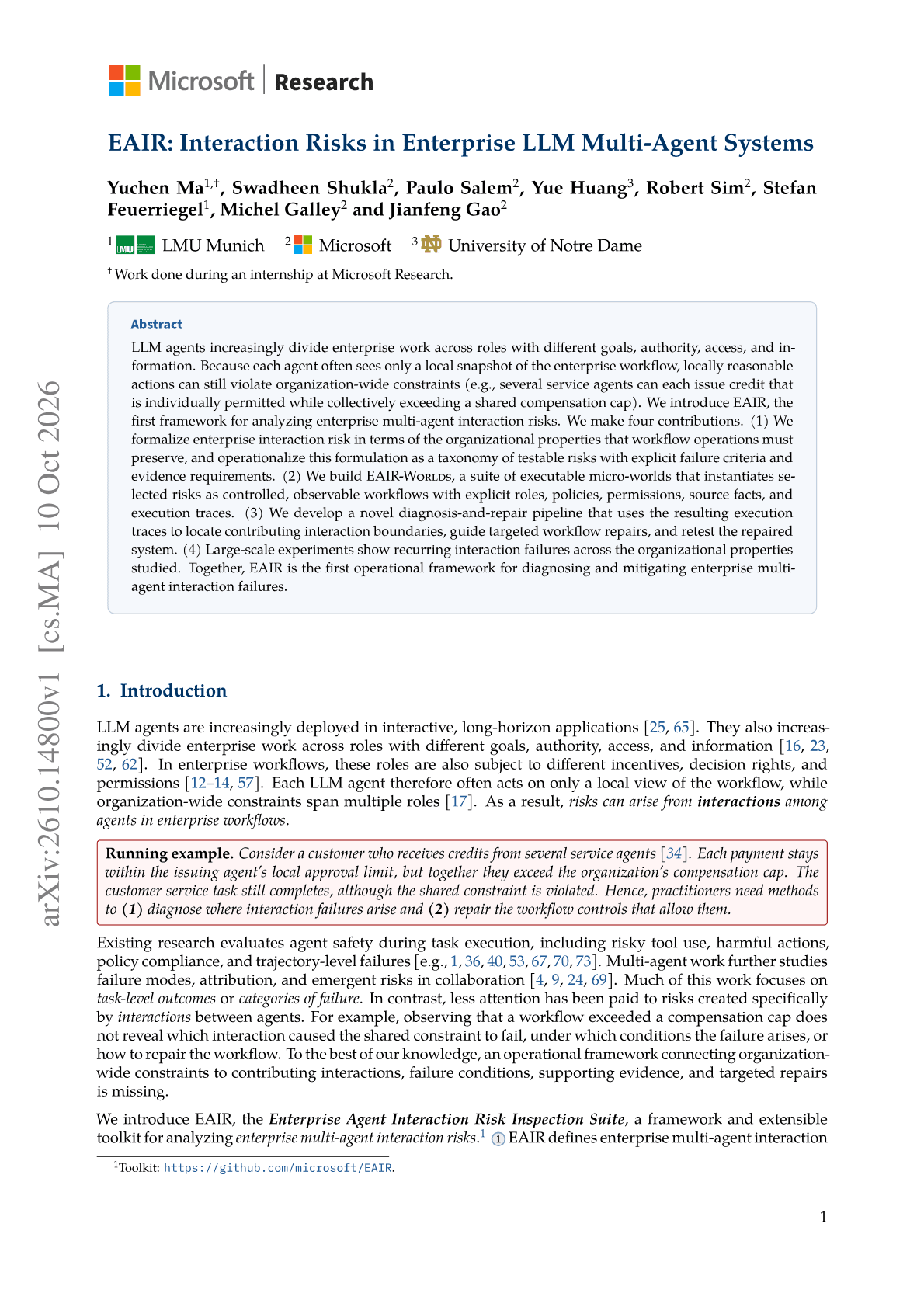
EAIR: Interaction Risks in Enterprise LLM Multi-Agent Systems
Yuchen Ma (LMU Munich), Swadheen Shukla, Michel Galley, Jianfeng Gao and colleagues (Microsoft, Notre Dame) present EAIR, a framework for finding failures that arise when enterprise agents with different roles and access act on local views of a shared workflow.
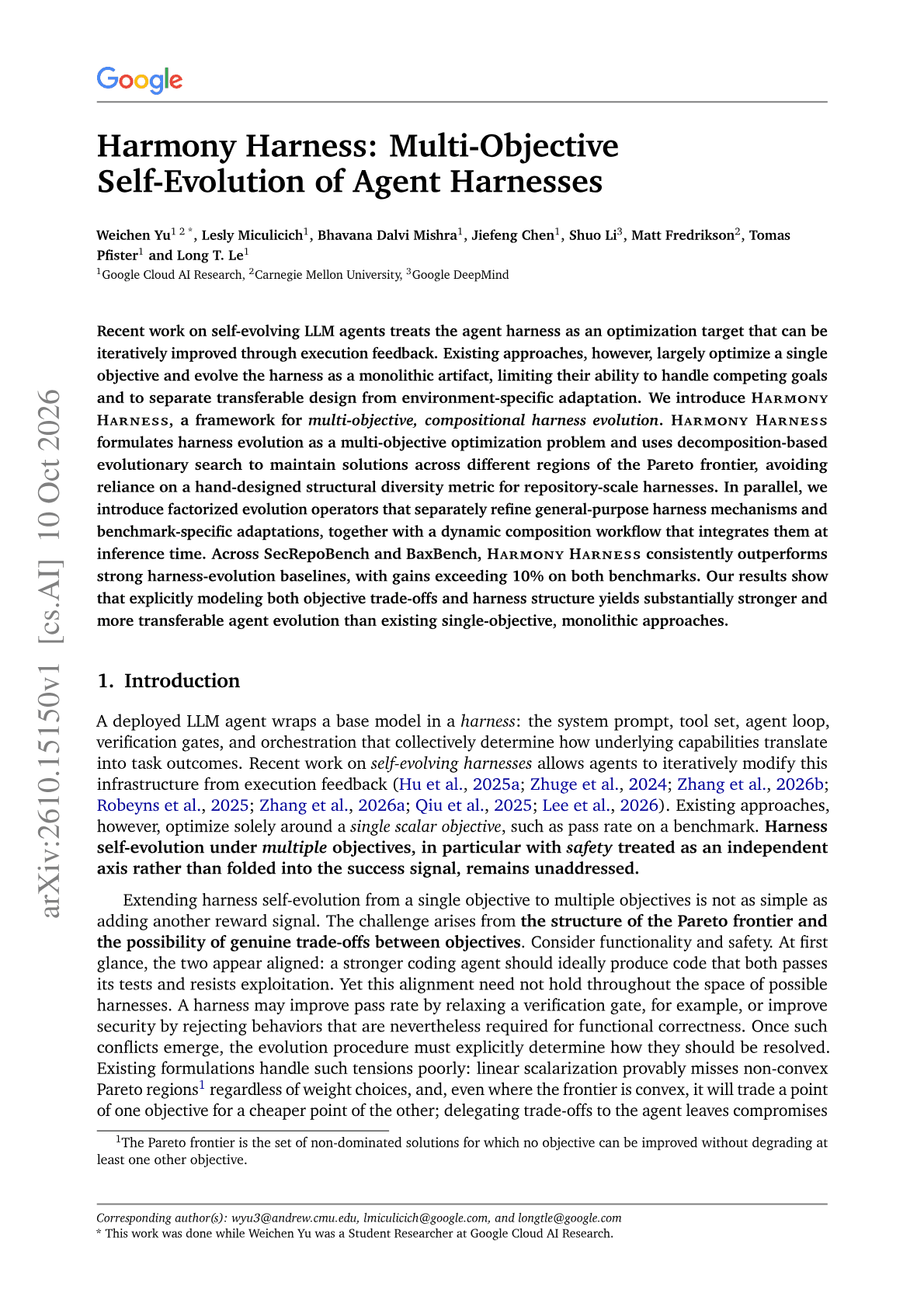
Harmony Harness: Multi-Objective Self-Evolution of Agent Harnesses
Weichen Yu, Tomas Pfister, Long T. Le and colleagues (Google Cloud AI Research, Google DeepMind, Carnegie Mellon University) present Harmony Harness, which evolves agent harnesses against several objectives at once and evolves general mechanisms separately from benchmark-specific adaptations.
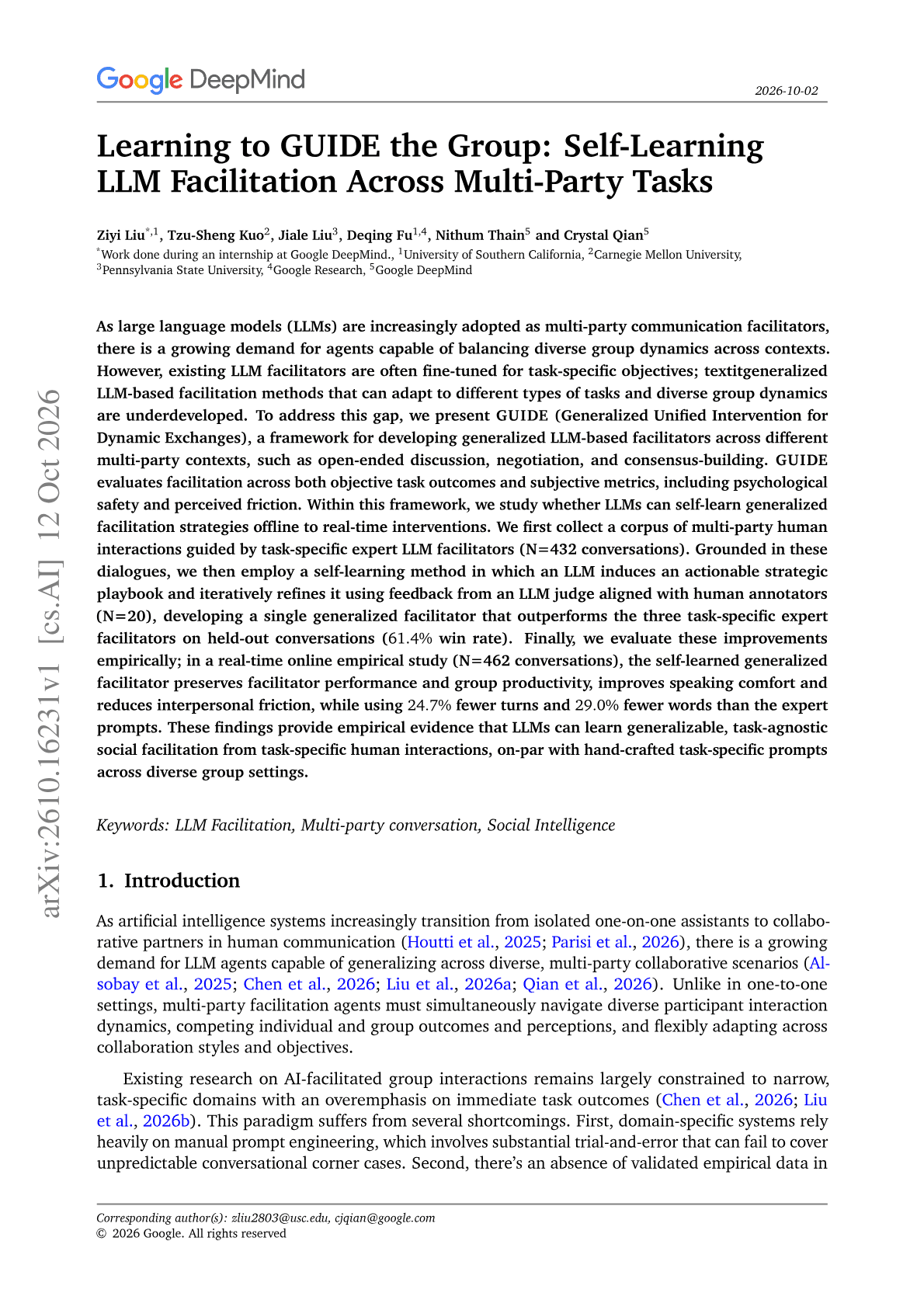
Learning to GUIDE the Group: Self-Learning LLM Facilitation Across Multi-Party Tasks
Ziyi Liu (USC, work done at Google DeepMind), Nithum Thain, Crystal Qian and colleagues (Google DeepMind, Google Research, CMU, Penn State) present GUIDE, a framework in which an LLM learns one general group-facilitation playbook from conversations run by task-specific expert facilitators.
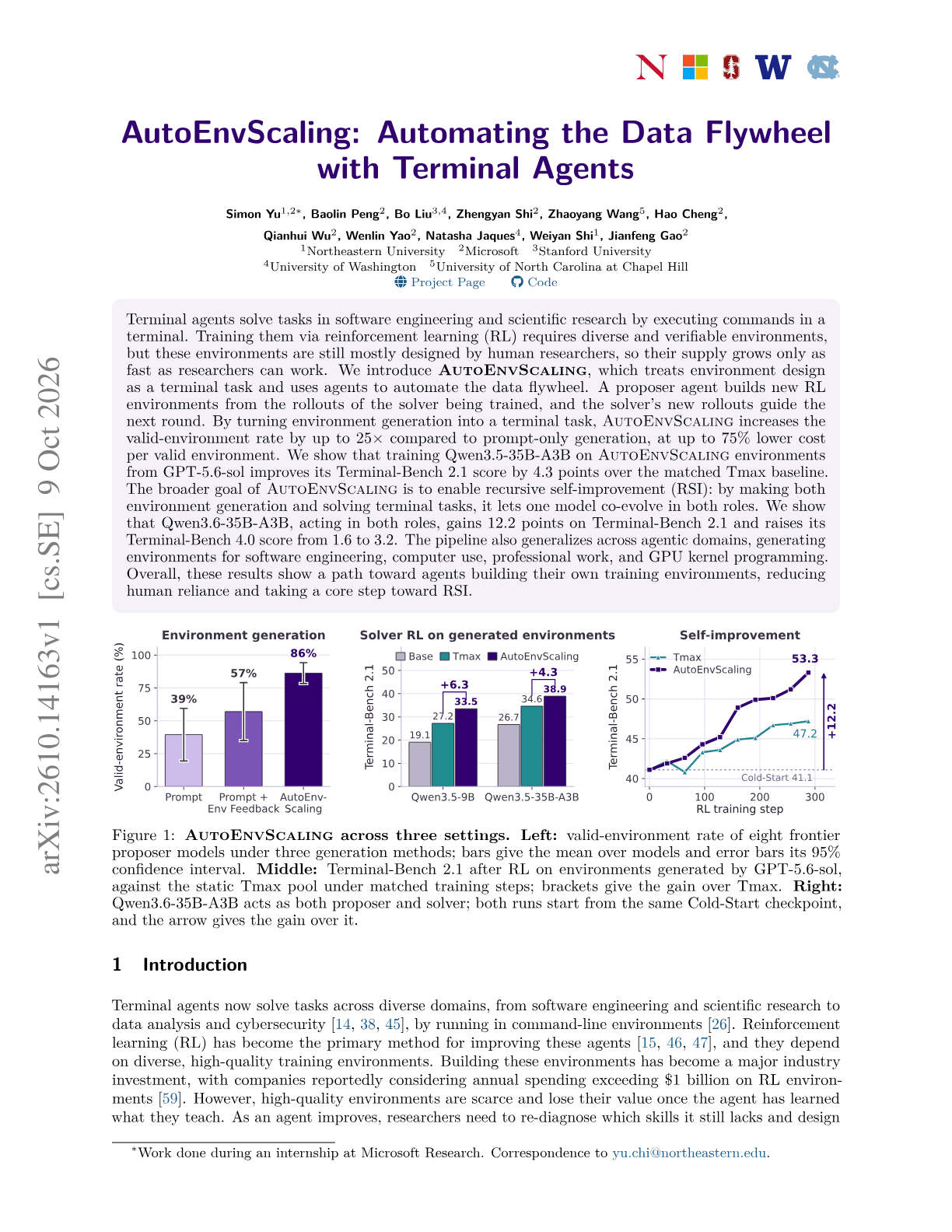
AutoEnvScaling: Automating the Data Flywheel with Terminal Agents
Researchers from Microsoft and collaborators hand RL environment design to a proposer agent that works in a terminal, studies the rollouts of the model being trained, and builds new environments from them, with each round of rollouts guiding the next. Building environments in a terminal raises the share of valid environments up to 25 times over prompt-only generation at up to 75% lower cost per valid environment. With Qwen3.6-35B-A3B acting as both proposer and solver, Terminal-Bench 2.1 rises from 41.1 to 53.3, and the pipeline also generates environments for software engineering, computer use, and GPU kernel work.
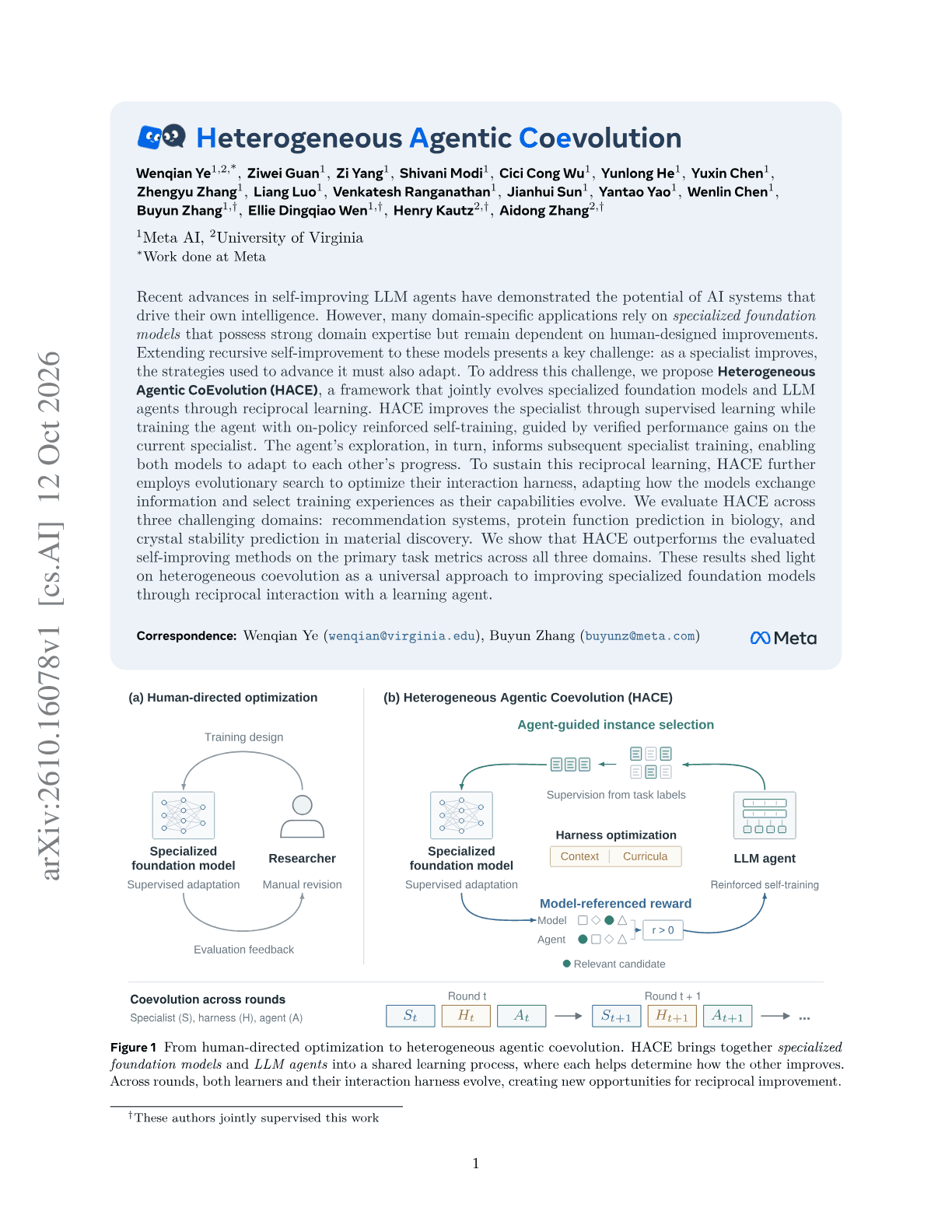
Heterogeneous Agentic Coevolution
Wenqian Ye and colleagues (Meta AI, with University of Virginia) present HACE, in which an LLM agent and a specialized foundation model, such as a recommender or a protein model, improve each other over rounds, with the harness between them also evolved.
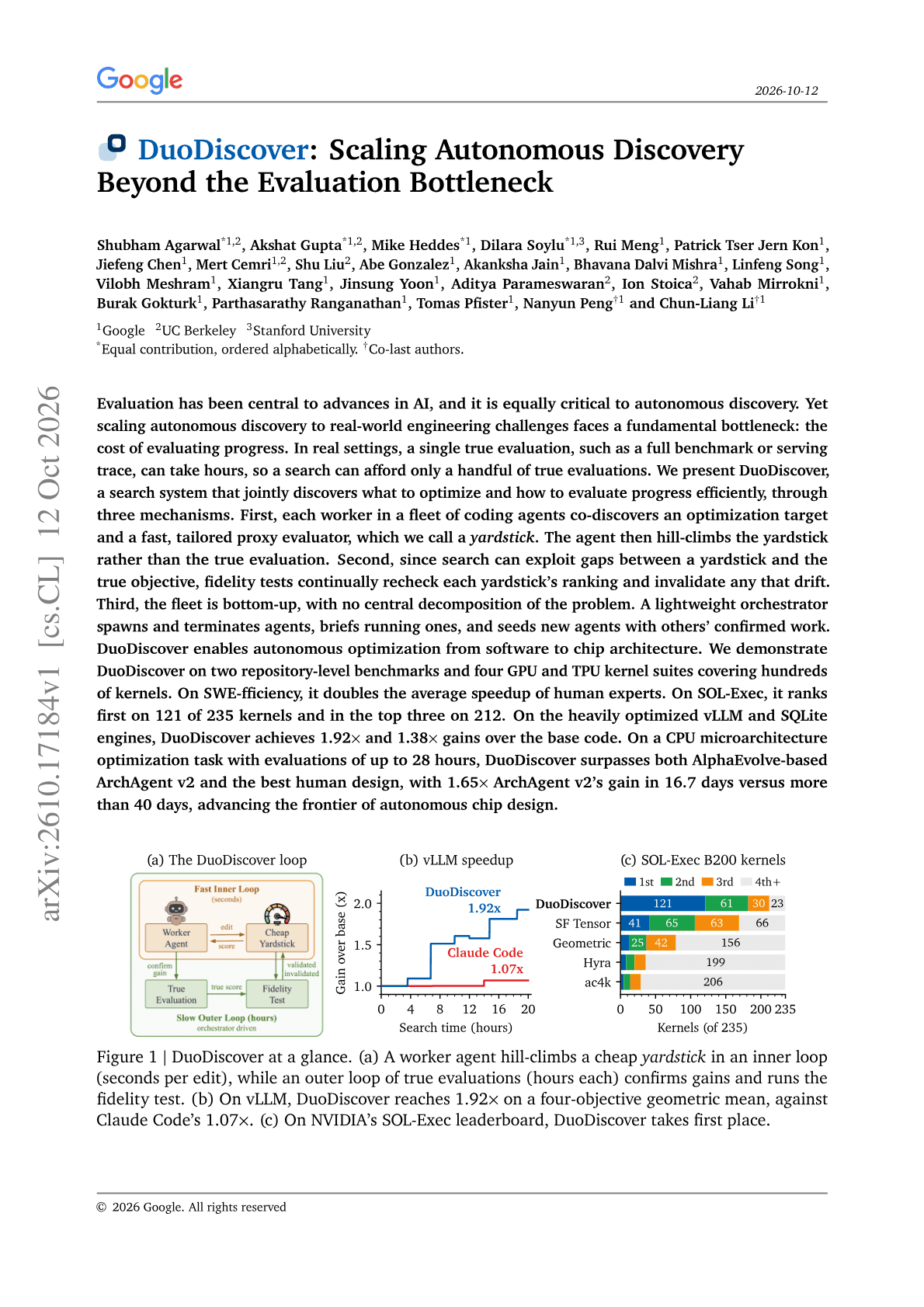
DuoDiscover: Scaling Autonomous Discovery Beyond the Evaluation Bottleneck
Shubham Agarwal, Akshat Gupta, Mike Heddes, Dilara Soylu and colleagues (UC Berkeley, Stanford, Google) present DuoDiscover, a fleet of coding agents that each discover an optimization target together with a fast proxy evaluator, so search is not limited by hours-long true evaluations.
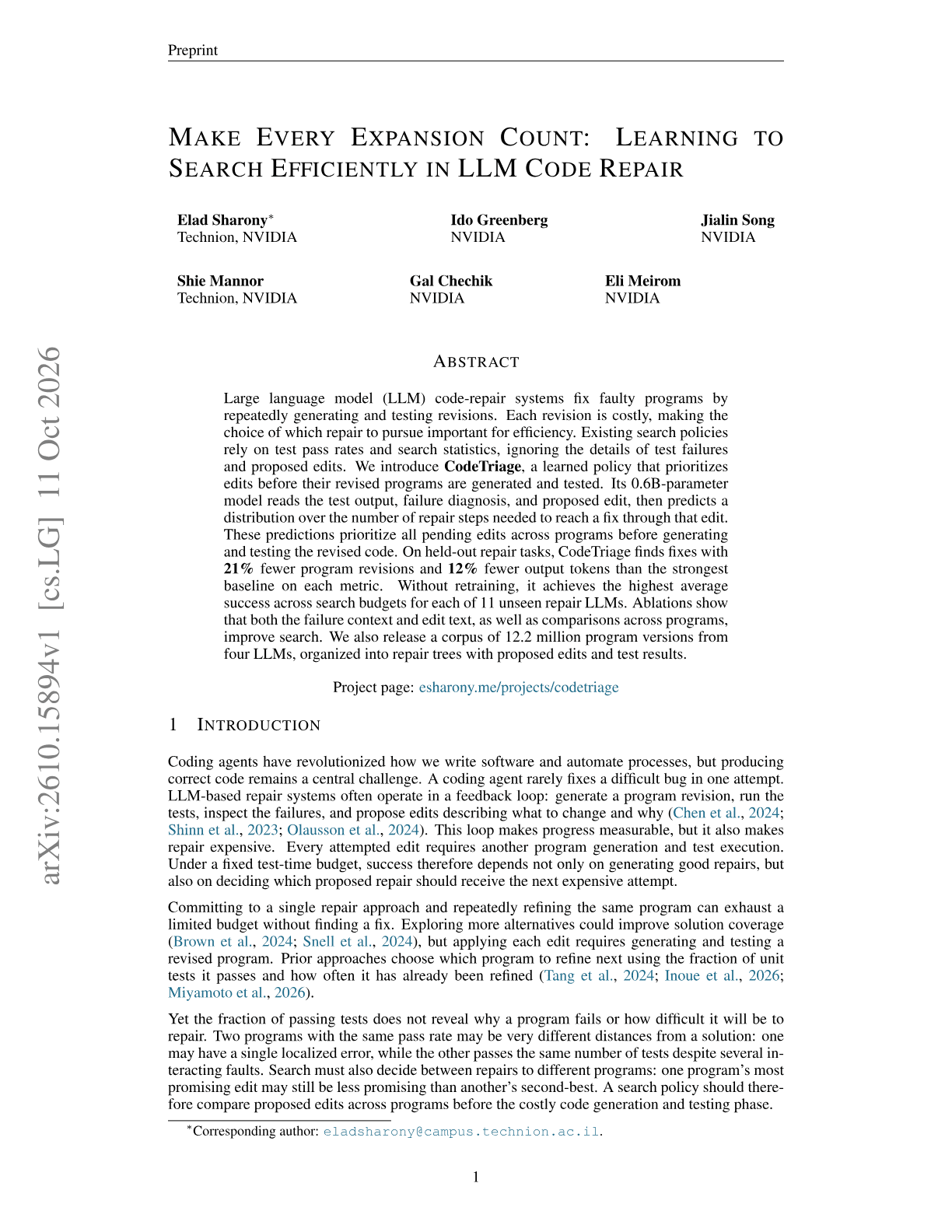
Make Every Expansion Count: Learning to Search Efficiently in LLM Code Repair
Elad Sharony, Ido Greenberg, Shie Mannor, Gal Chechik, Eli Meirom and colleagues (NVIDIA, Technion) present CodeTriage, a 0.6B model that ranks pending code edits by how many repair steps they will need before any revised program is generated or tested.
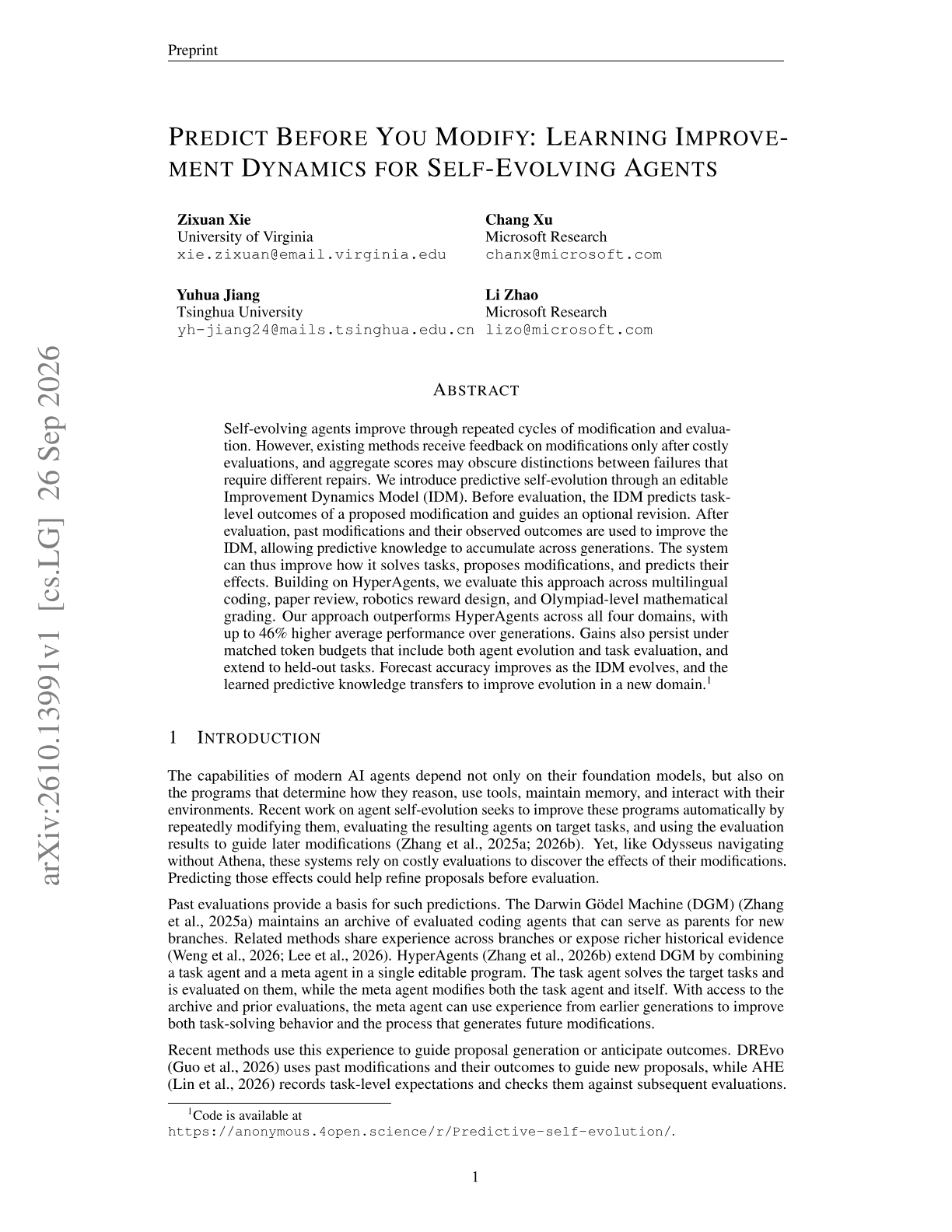
Predict Before You Modify: Learning Improvement Dynamics for Self-Evolving Agents
Zixuan Xie (University of Virginia), Chang Xu and Li Zhao (Microsoft Research) and Yuhua Jiang (Tsinghua) add an editable Improvement Dynamics Model (IDM) to self-evolving agents that predicts how a proposed modification will change task outcomes before it is evaluated.
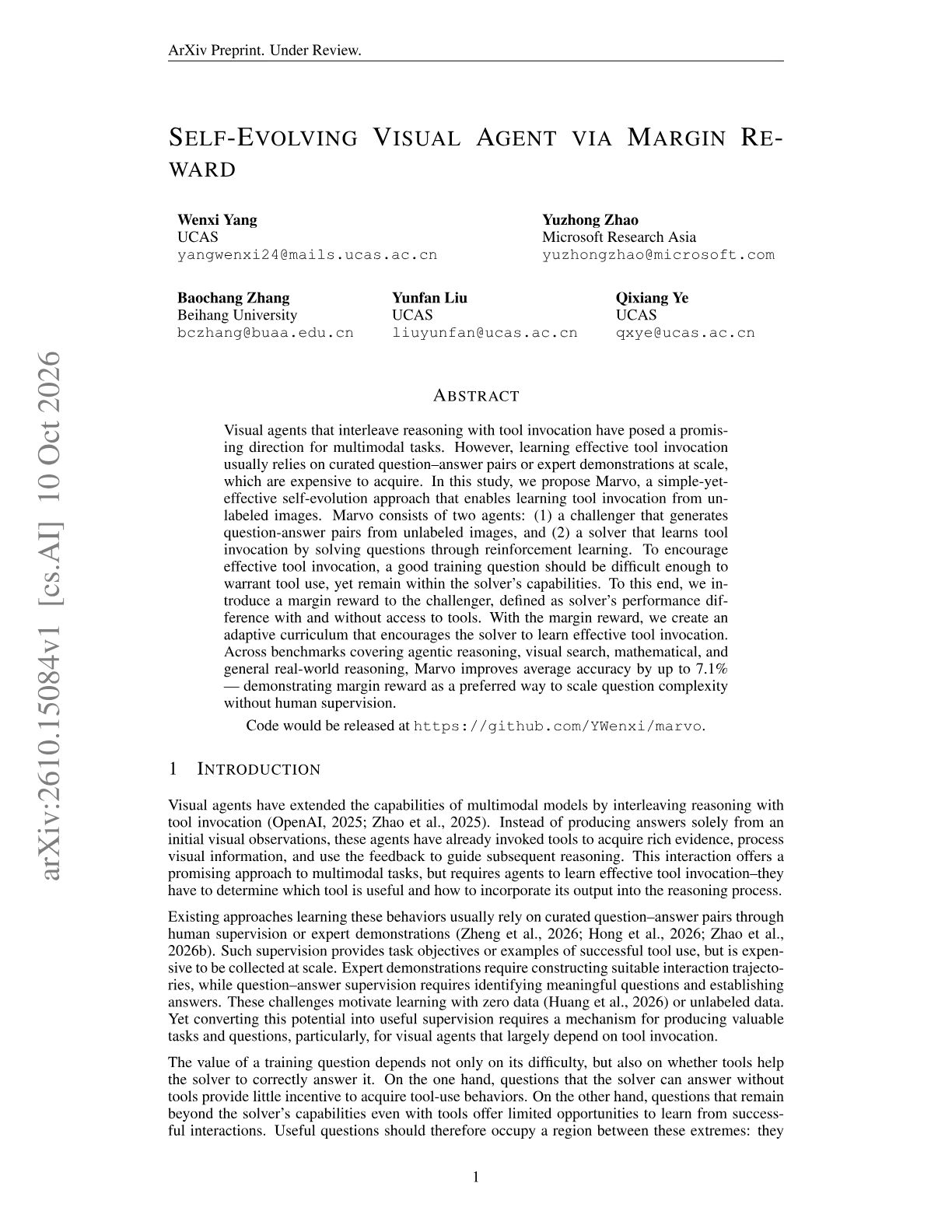
Self-Evolving Visual Agent via Margin Reward
Wenxi Yang, Yuzhong Zhao, Qixiang Ye and colleagues (UCAS, Microsoft Research Asia, Beihang) present Marvo, a challenger-solver loop that teaches a visual agent tool use from unlabeled images.
DeltaReplay: Task-Relative Memory Reuse for Mobile GUI Agents
Yudong Bai, Quanming Yao, Yaqing Wang and colleagues (Tsinghua University) present DeltaReplay, which stores mobile GUI trajectories as paths in a page-transition graph and decides at each step whether to replay a recorded action, replay it with new parameters, or hand control to the base agent.
Safe Actions Alone Do Not Ensure Safe Agents: Identifying Unfulfilled Obligations with Guard Models
Youwei Feng, Yitong Zhang, Yuetong Liu and Jia Li (College of AI, Tsinghua University) argue that agent guard models must also detect required safety actions an agent failed to take, and introduce ObligationBench and ObligationGuard for this task.
When Should Agents Think? Adaptive Reasoning via Cross-Turn Estimation
Yiruo Cheng, Zhicheng Dou and colleagues (Gaoling School of AI, Renmin University of China; Alibaba Group) present RACE, a training method that teaches agents to skip reasoning on turns where reasoning from earlier turns still supports the next action.
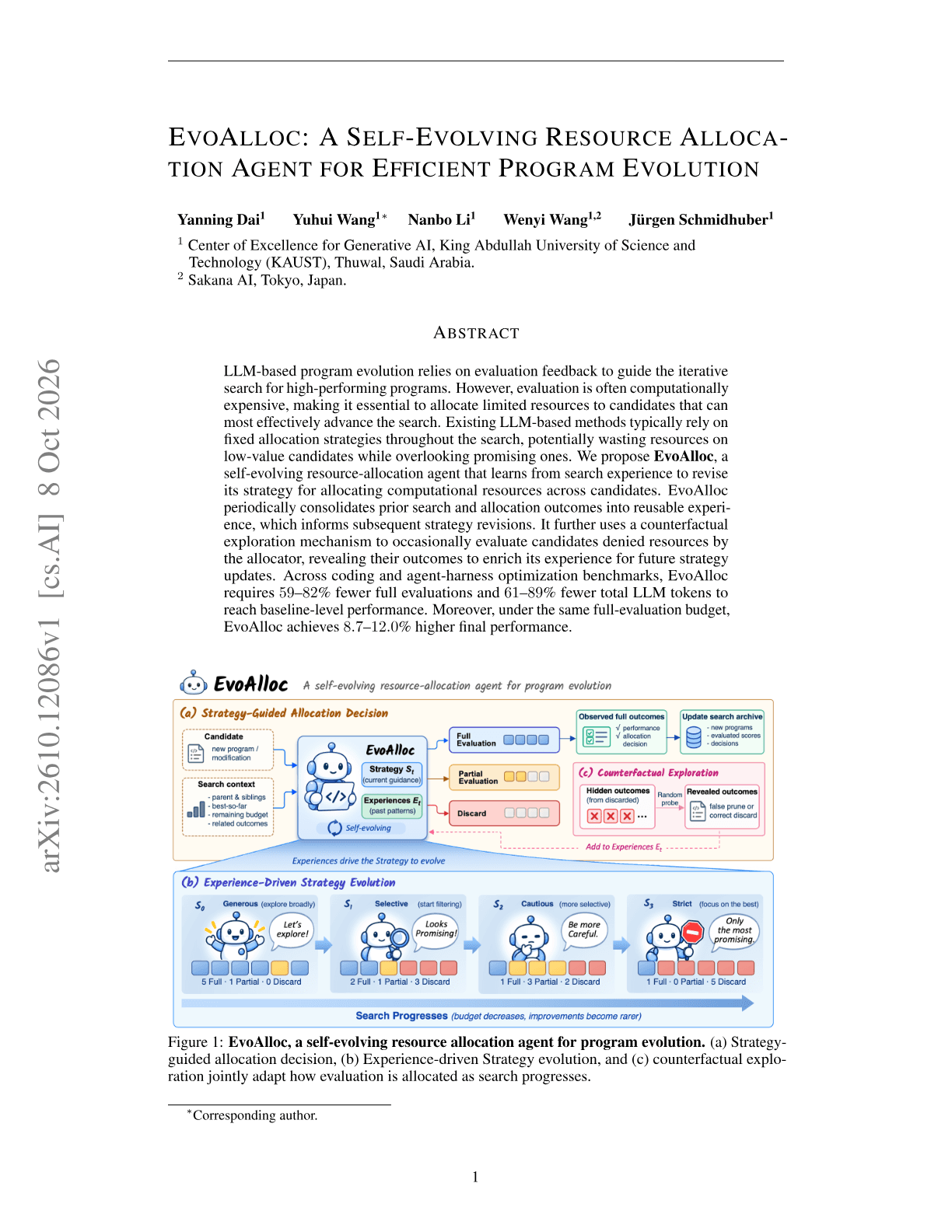
EvoAlloc: A Self-Evolving Resource Allocation Agent for Efficient Program Evolution
Yanning Dai, Wenyi Wang, Jürgen Schmidhuber and colleagues (KAUST Center of Excellence for Generative AI, Sakana AI) present EvoAlloc, an agent that learns from search history how to allocate expensive evaluations across candidates in LLM-driven program evolution.
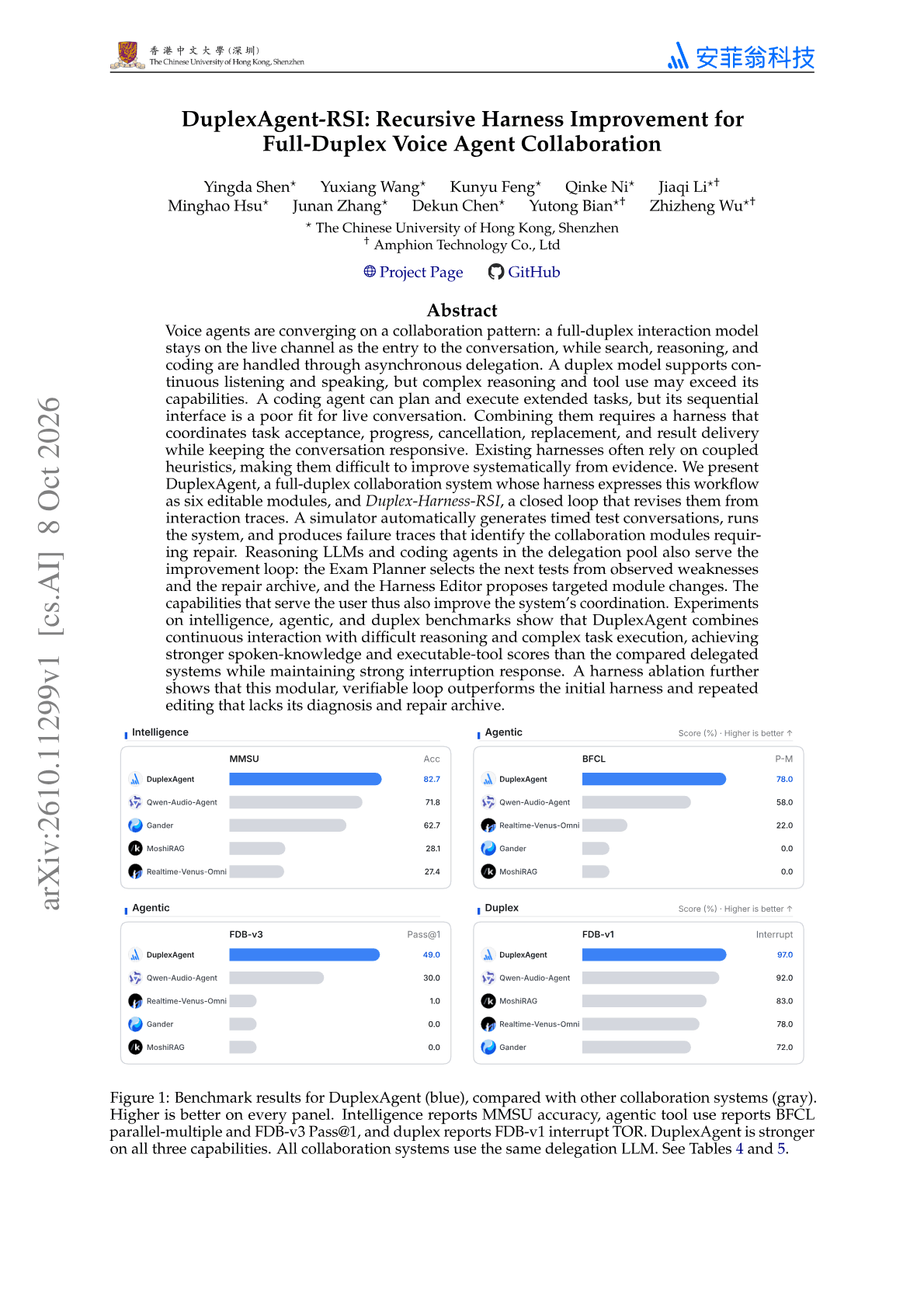
DuplexAgent-RSI: Recursive Harness Improvement for Full-Duplex Voice Agent Collaboration
Yingda Shen, Zhizheng Wu and colleagues (The Chinese University of Hong Kong, Shenzhen; Amphion Technology) present DuplexAgent, a full-duplex voice system whose delegation harness is split into six editable modules, and Duplex-Harness-RSI, a loop that repairs those modules from simulated conversation traces.
SynCo: Data Synthesis Co-Training for Self-Evolving LLMs via Multi-Agent Reinforcement Learning
Wei Yang, Shawn Li, Jesse Thomason, Xuezhe Ma, Yue Zhao and colleagues (University of Southern California, with George Washington University) present SynCo, which trains a task Synthesizer and a Reasoner together with multi-agent RL so that the generated training tasks track the Reasoner's current ability.
Mine Odyssey: Benchmarking Spatial Agentic Intelligence in the Wild
Yuxuan Cao, Junlong Li, Hao Li and Junxian He (The Hong Kong University of Science and Technology) introduce Mine Odyssey, a navigation benchmark of 180 tasks in Minecraft reconstructions of 30 real places across 20 countries and regions.
A Closer Look at Agentic BBO: Benchmarking LLM Agents for Black-Box Optimization
Ming Chen, Ke Xue, Chao Qian and colleagues (State Key Laboratory of Novel Software Technology, Nanjing University) introduce AgenticBBO-Bench, a benchmark that compares LLM agents on black-box optimization across five domains under one finite-budget protocol.
When Interfaces Speak: Data-Aware Generative UI Harness for Active Interaction
Xiaolong Li, Reynold Cheng and colleagues (The University of Hong Kong, with Microsoft Research and the BIRD team) present GenUI-Harness, which pairs a Tool Agent with a GUI Coder Agent that writes temporary interfaces to collect structured input from users, plus UI-TAU Bench to evaluate it.
From Investigation Failures to Reliable SOC Agents: Understanding and Improving LLM-Based Alert Triage
Saimon Amanuel Tsegai (Virginia Tech), Alex Kantchelian (Google), Danfeng Yao (NC State) and Peng Gao (Virginia Tech) study how LLM agents triage security alerts, build ALERT-BENCH on replayed enterprise telemetry, and propose AIDA, a multi-agent design that challenges each decision before an alert is closed.
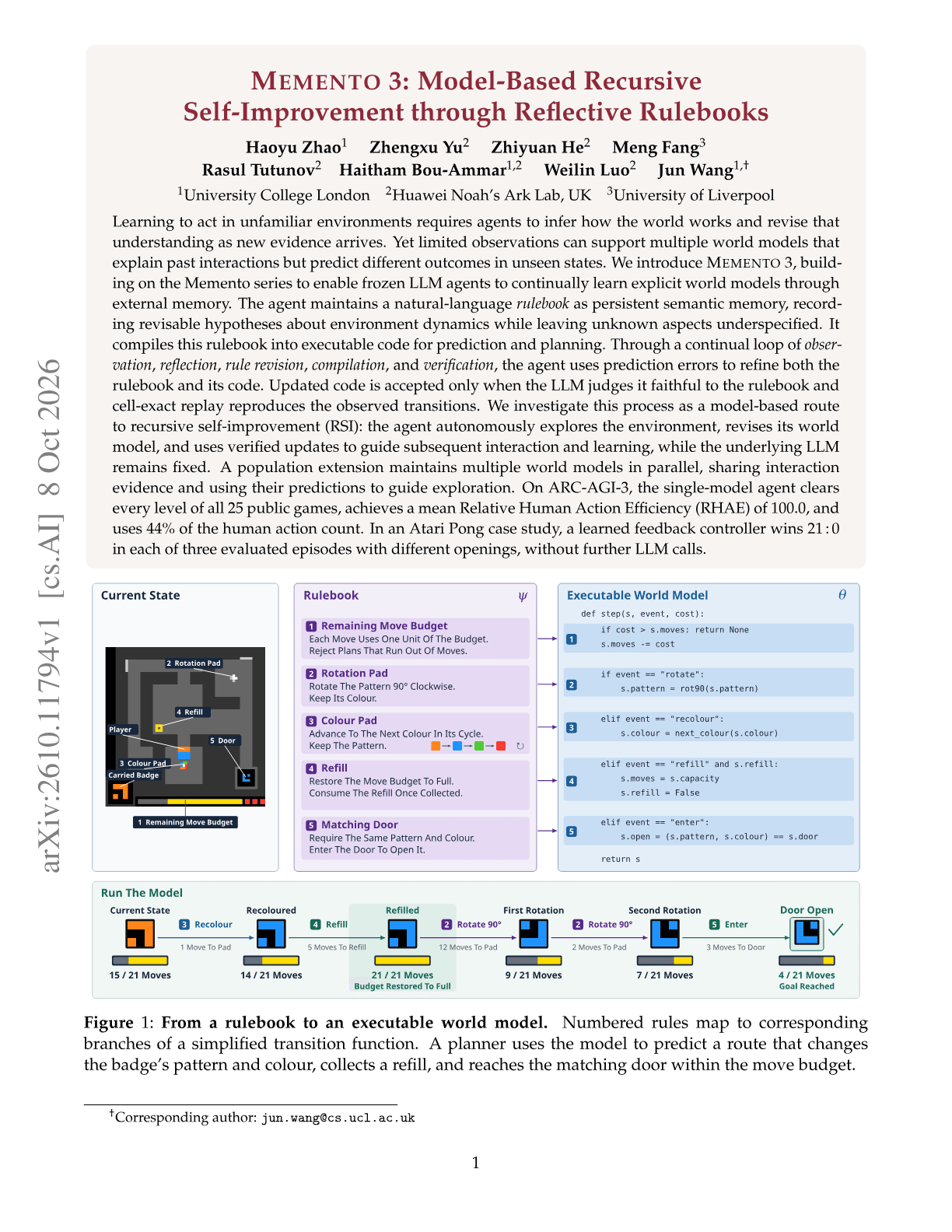
Memento 3: Model-Based Recursive Self-Improvement through Reflective Rulebooks
Haoyu Zhao, Haitham Bou-Ammar, Jun Wang and colleagues (University College London, Huawei Noah's Ark Lab UK, University of Liverpool) present Memento 3, in which a frozen LLM agent learns an explicit world model as a natural-language rulebook, compiles it into executable code, and accepts a revision only when replay reproduces every observed transition.
Ecology of AI Agents: Collaboration Creates a Population Threshold for Takeoff
Erin Crawley and Hidenori Tanaka (CBS-NTT Program in Physics of Intelligence at Harvard, NTT Research) model populations of misaligned AI agents with a population growth equation in which the growth rate depends on cyber capability, and show that collaboration creates a critical population size for takeoff.