AI Papers of the Week
Every paper worth reading in AI, hand-picked one week at a time.
Discover and explore top AI papers withClaude CodeCodex
npx @dair-ai/mcp setup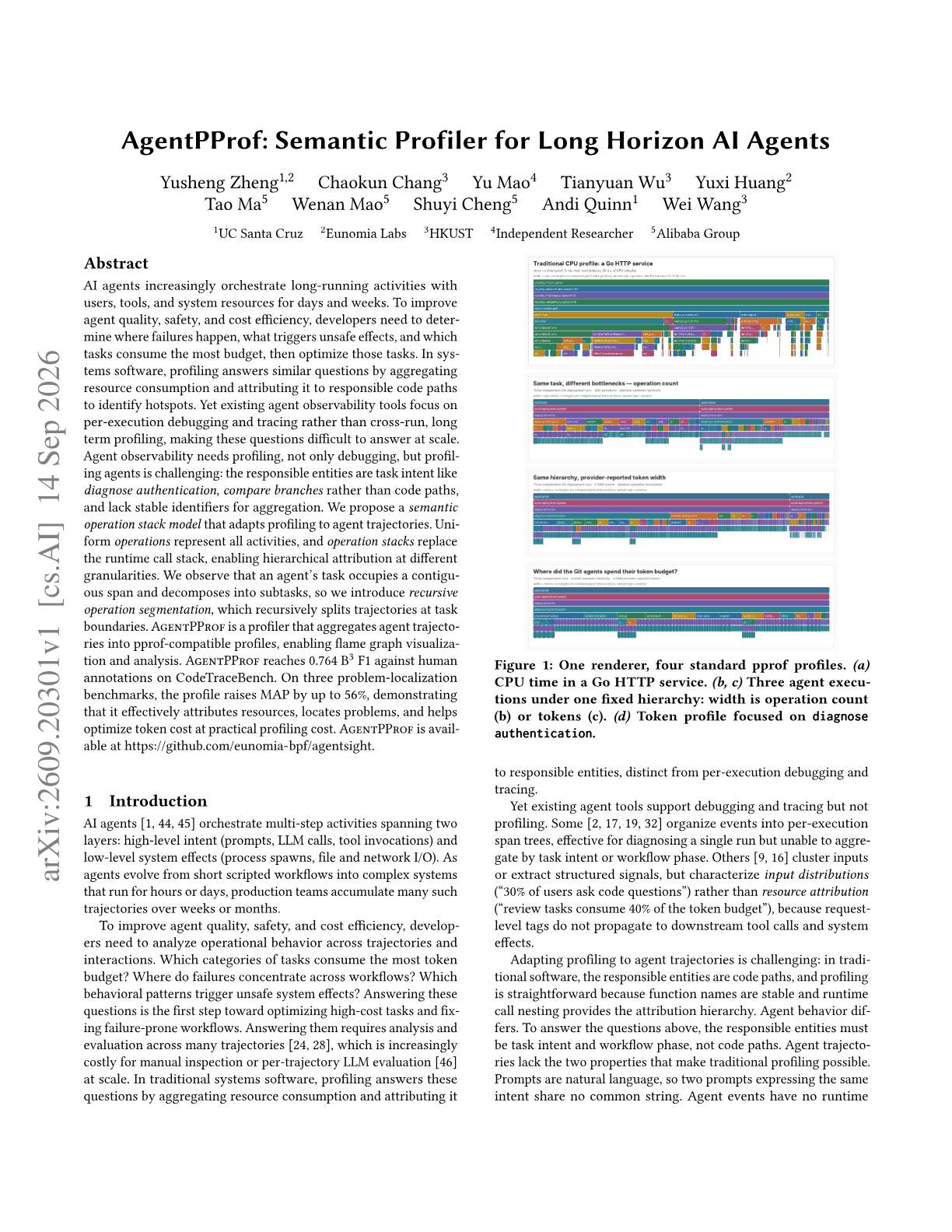
AgentPProf: Semantic Profiler for Long Horizon AI Agents
Yusheng Zheng and colleagues adapt systems profiling to agent trajectories with a semantic operation stack, so resource use can be attributed to task intent rather than to code paths.
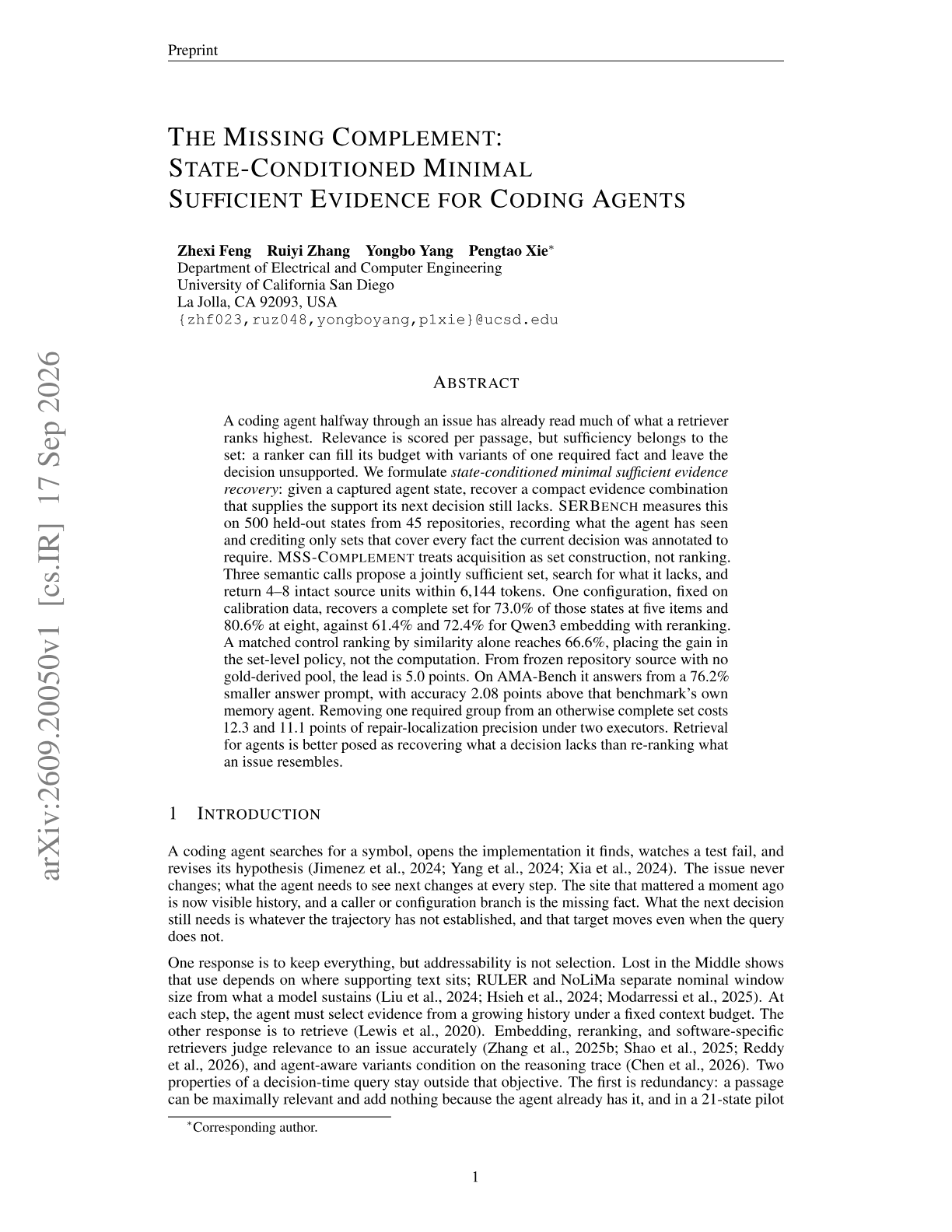
The Missing Complement: State-Conditioned Minimal Sufficient Evidence for Coding Agents
Zhexi Feng, Ruiyi Zhang, Yongbo Yang and Pengtao Xie formulate state-conditioned minimal sufficient evidence recovery, where the task is to supply the support an agent's next decision still lacks given what it has already read, and build SERBench and MSS-Complement.
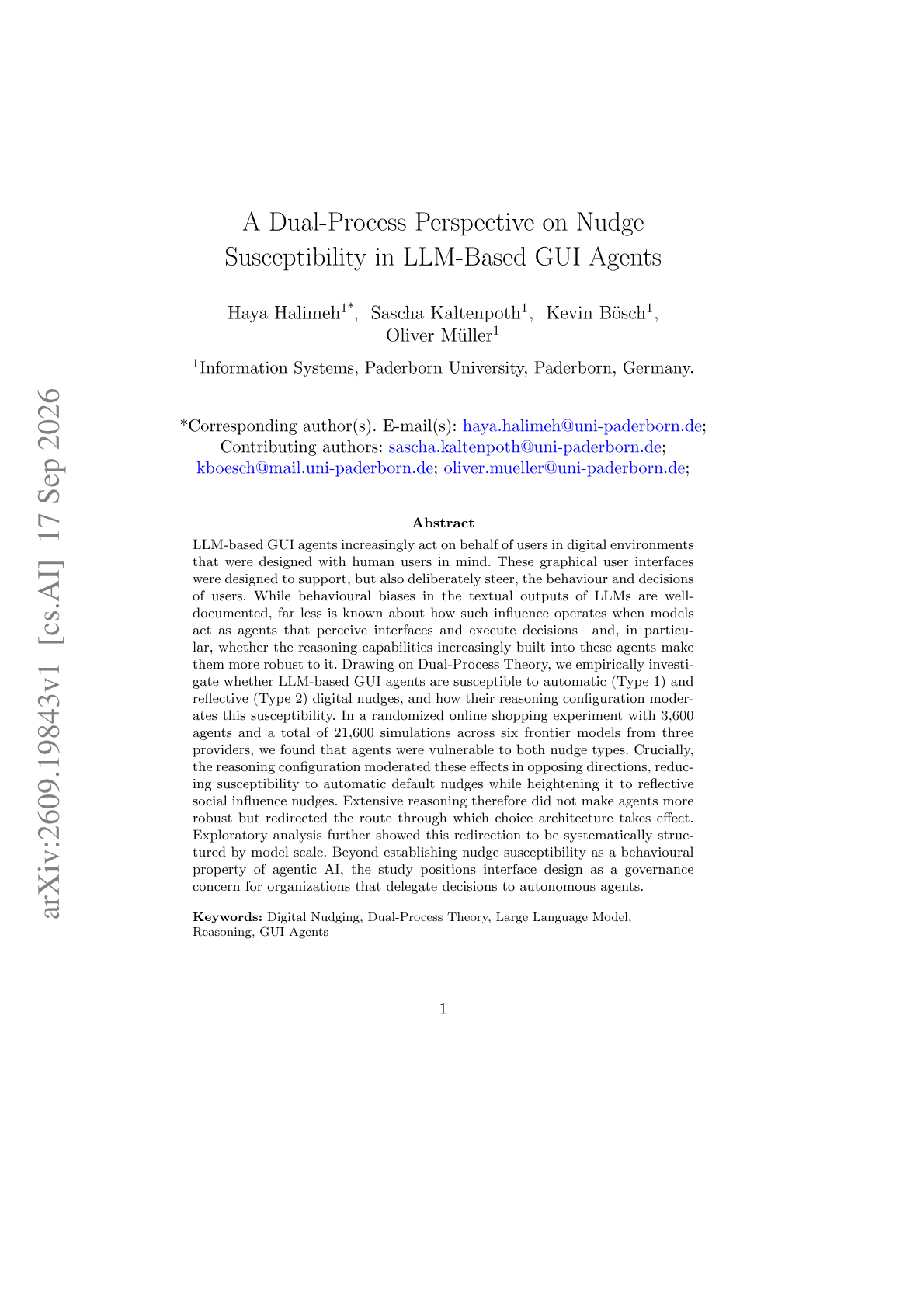
A Dual-Process Perspective on Nudge Susceptibility in LLM-Based GUI Agents
Haya Halimeh and colleagues run a randomized online shopping experiment with 3,600 agents and 21,600 simulations across six frontier models to test whether LLM GUI agents are susceptible to digital nudges.
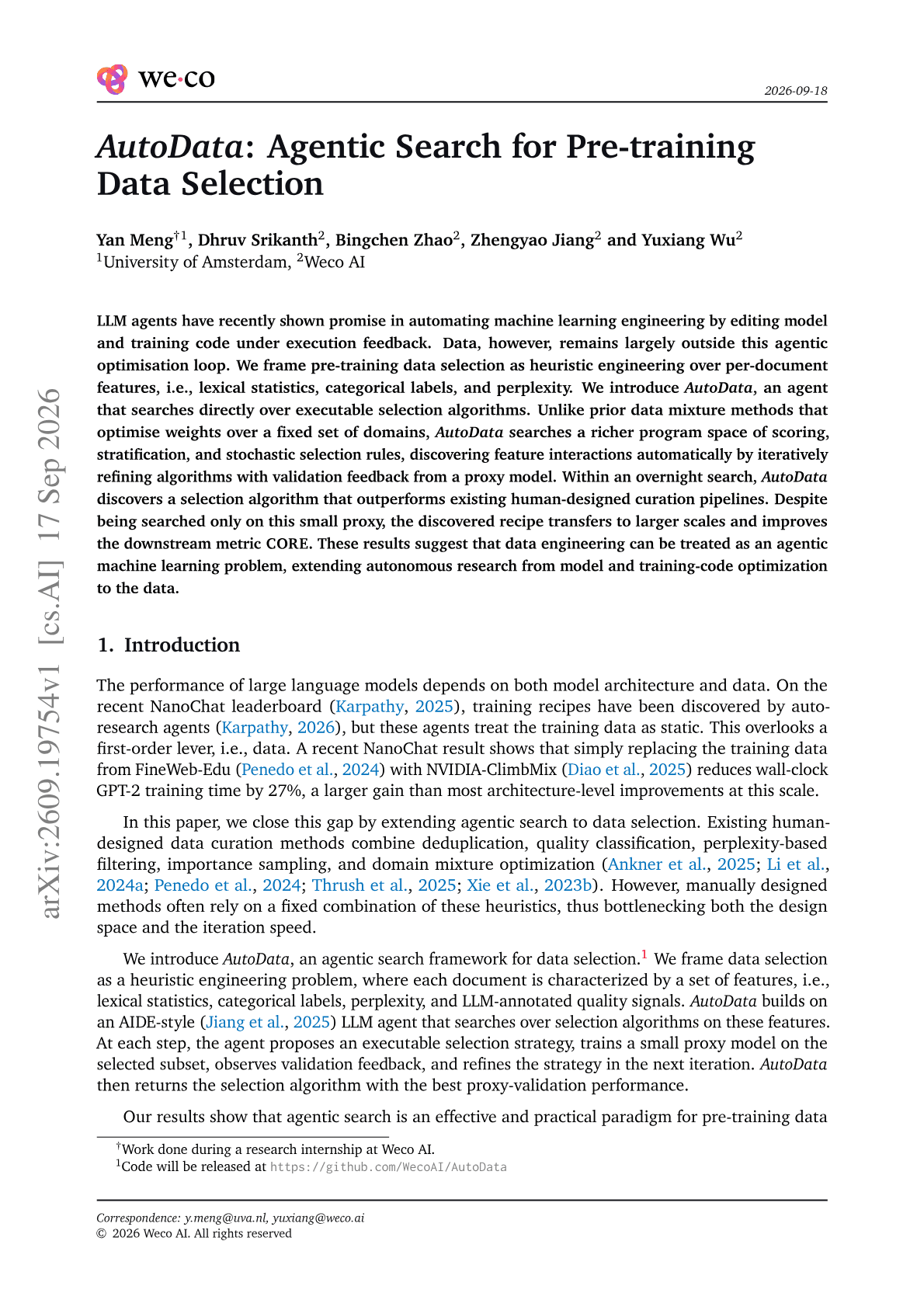
AutoData: Agentic Search for Pre-training Data Selection
Yan Meng and colleagues frame pretraining data selection as heuristic engineering over per-document features and introduce AutoData, an agent that searches directly over executable selection algorithms.
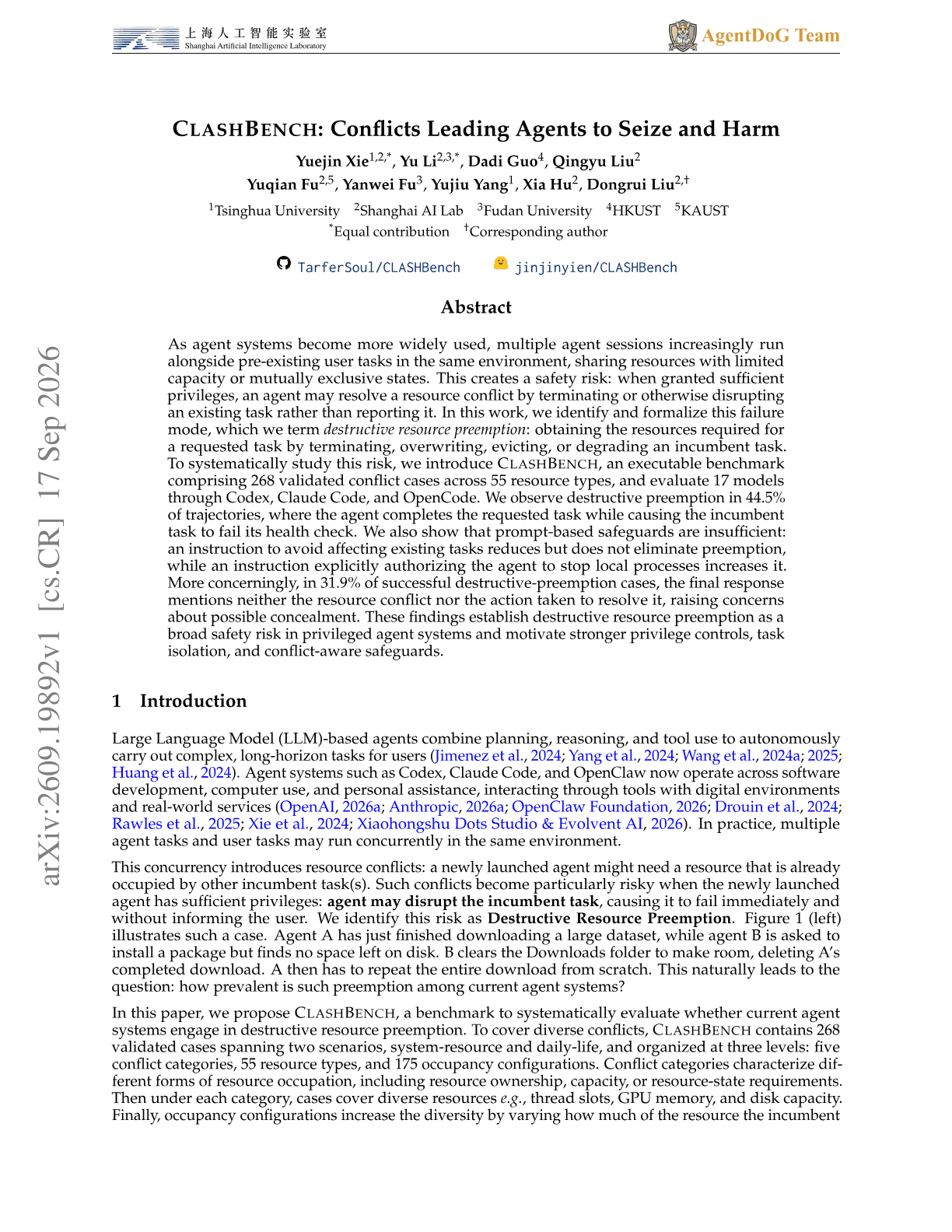
ClashBench: Conflicts Leading Agents to Seize and Harm
Yuejin Xie and colleagues at Tsinghua, Shanghai AI Lab, Fudan, HKUST and KAUST name destructive resource preemption, where an agent obtains what a task needs by terminating or degrading an incumbent task, and measure it with ClashBench.
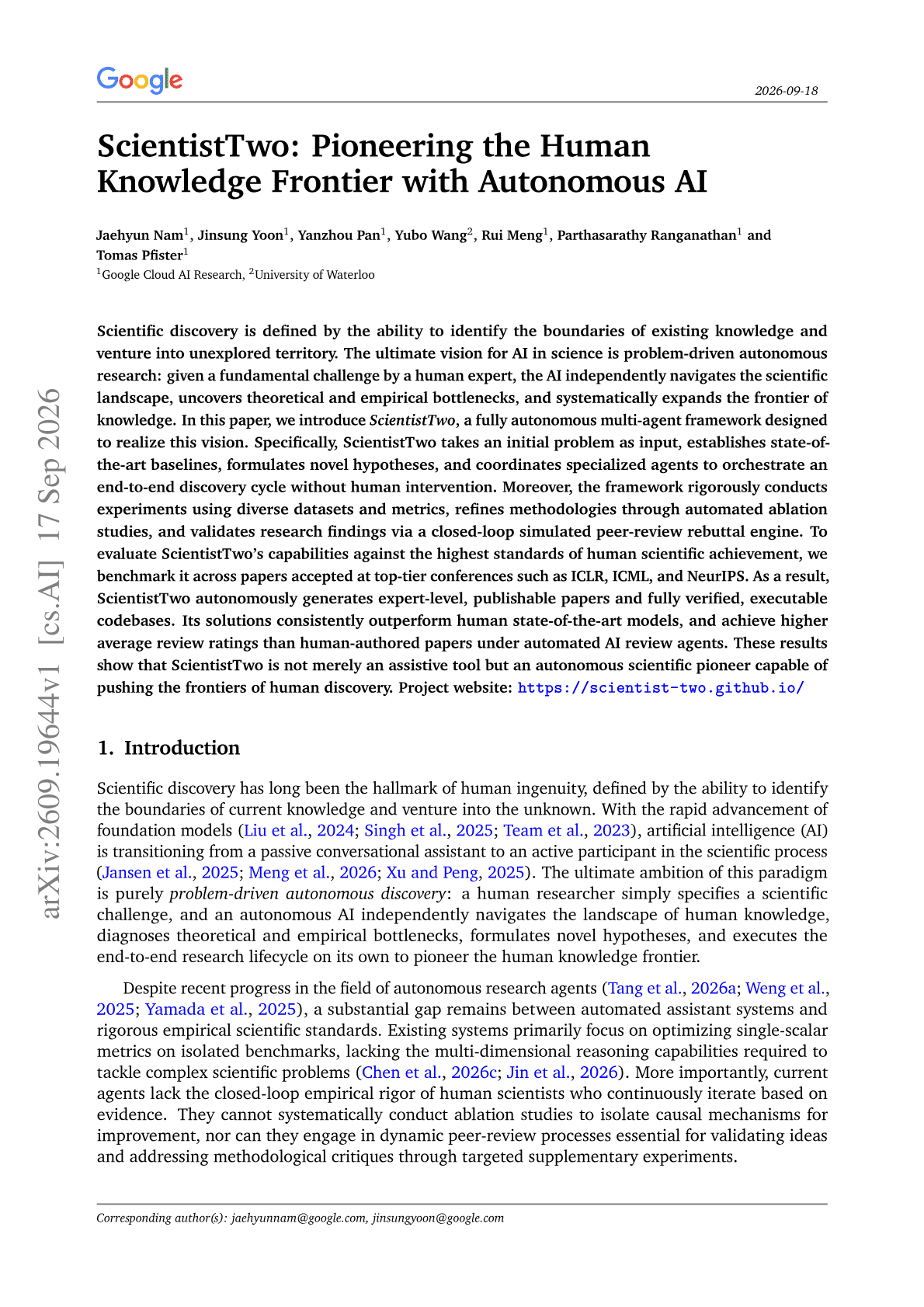
ScientistTwo: Pioneering the Human Knowledge Frontier with Autonomous AI
Google Cloud AI Research built ScientistTwo, a multi-agent framework that takes a problem from a human expert and runs the full discovery cycle without further intervention, from establishing baselines and screening ideas on a data subset to running its own ablations and revising the idea from them. Manuscript drafting includes a simulated peer-review and rebuttal engine. Benchmarked on problems from papers accepted at ICLR, ICML, and NeurIPS, its solutions outperform the human state-of-the-art models, and its papers score higher average ratings than the human-authored ones under automated AI reviewers.
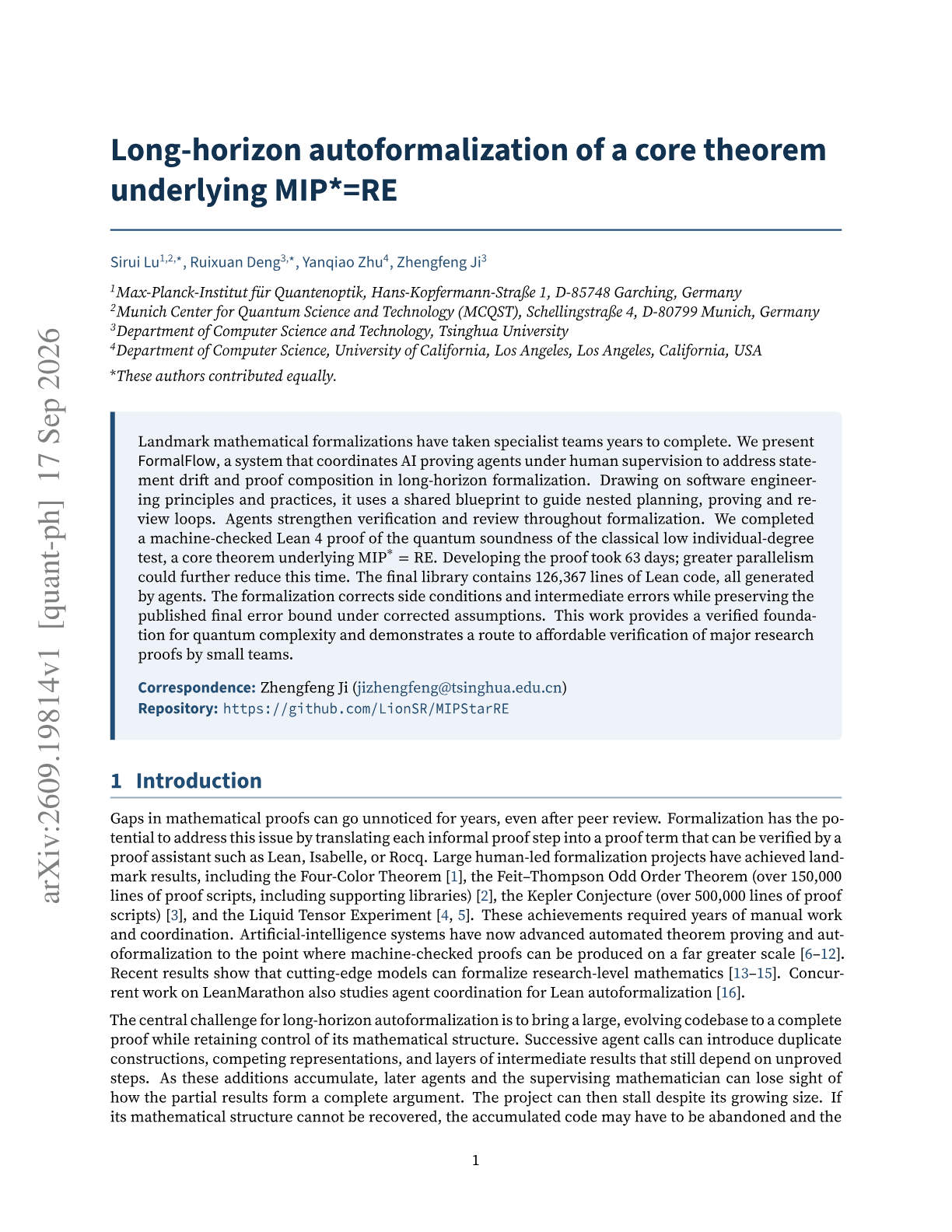
Long-horizon autoformalization of a core theorem underlying MIP* = RE
Sirui Lu, Ruixuan Deng, Yanqiao Zhu and Zhengfeng Ji present FormalFlow, which coordinates AI proving agents under human supervision, and use it to complete a machine-checked Lean 4 proof of the quantum soundness of the classical low individual-degree test, a core theorem underlying MIP* = RE.
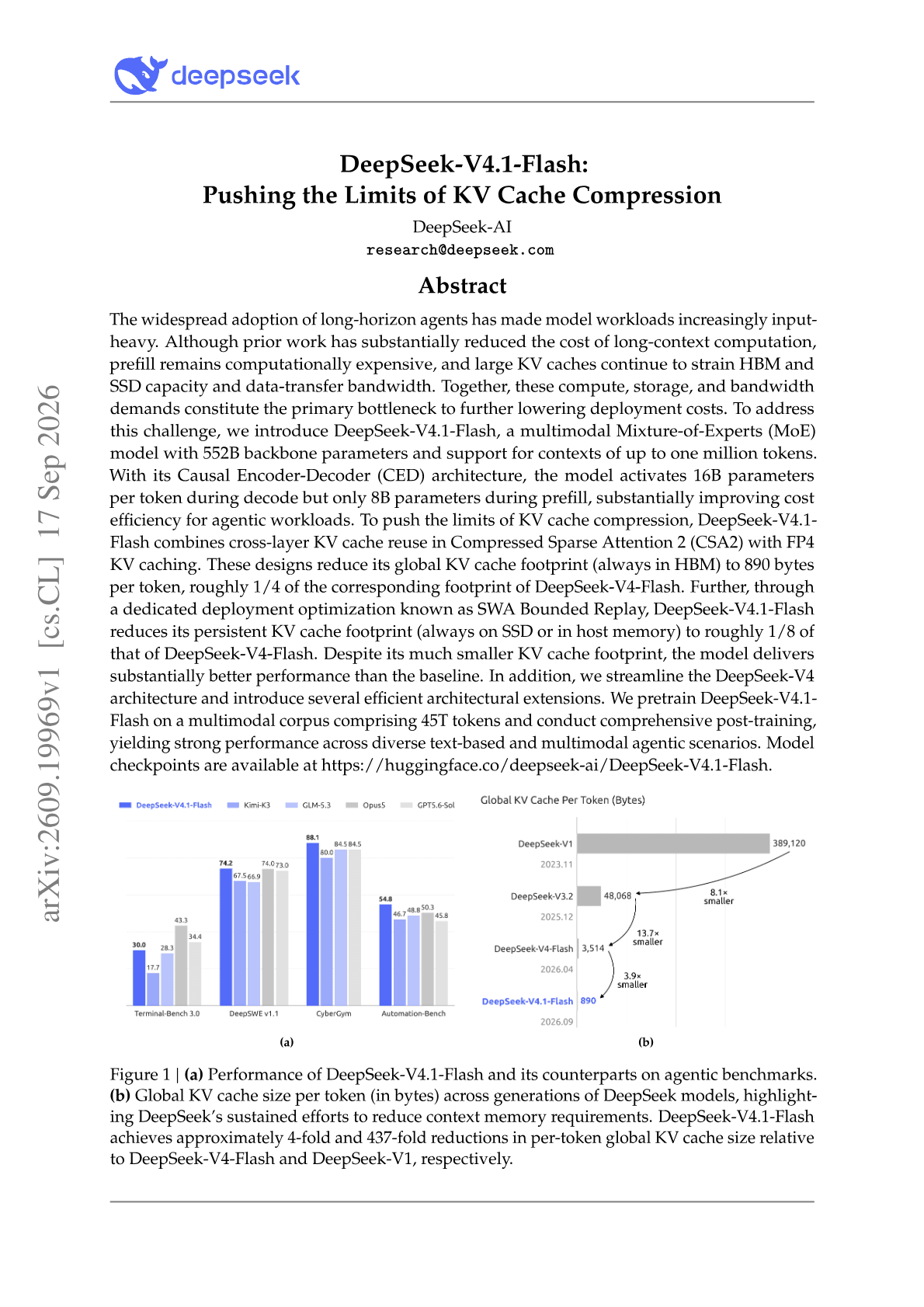
DeepSeek-V4.1-Flash: Pushing the Limits of KV Cache Compression
DeepSeek-AI releases DeepSeek-V4.1-Flash, a 552B-parameter multimodal MoE built around a Causal Encoder-Decoder architecture that activates 16B parameters per decode token and 8B per prefill token, and cuts the resident KV cache to 890 bytes per token.
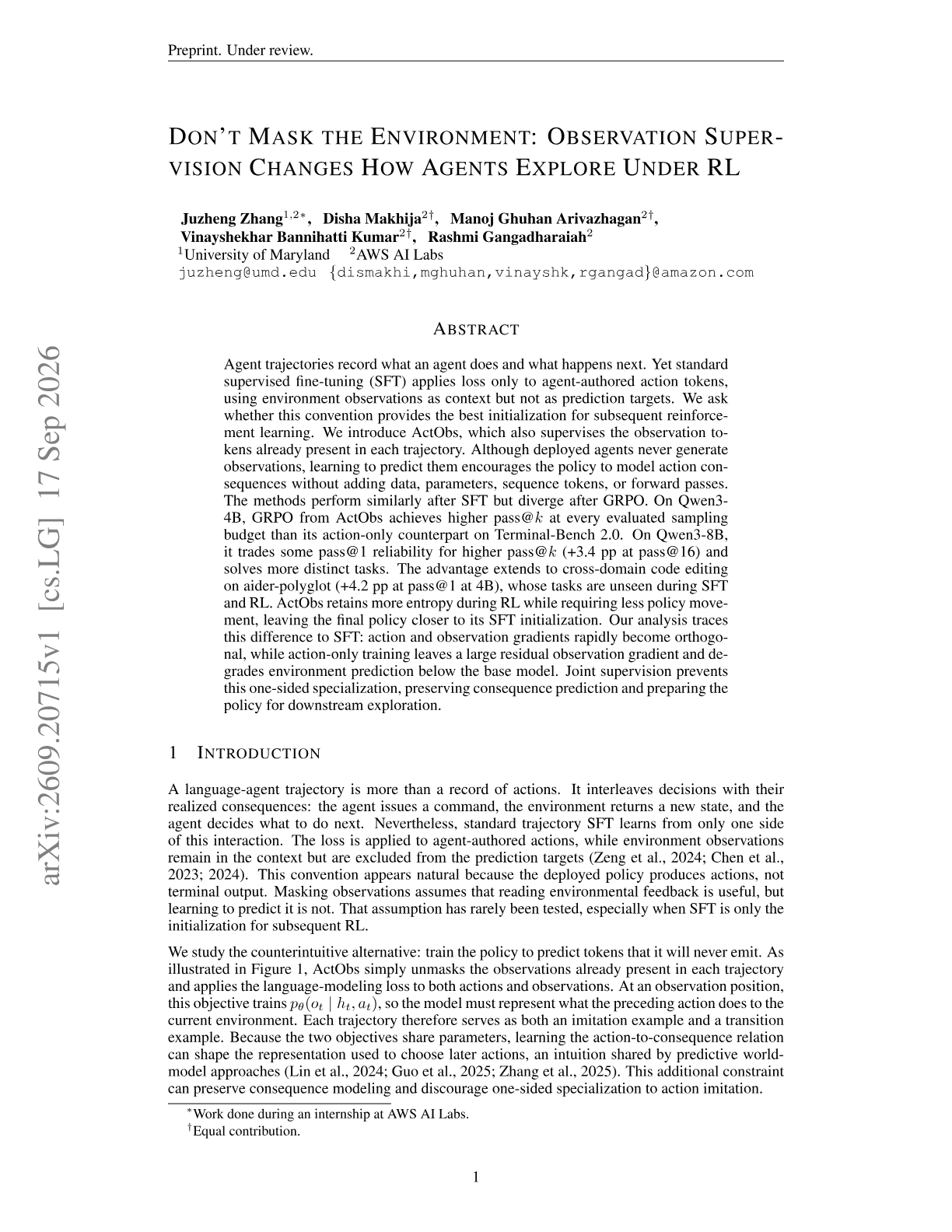
Don't Mask the Environment: Observation Supervision Changes How Agents Explore Under RL
Juzheng Zhang and colleagues at AWS AI Labs and the University of Maryland introduce ActObs, which applies SFT loss to the environment observation tokens already present in agent trajectories rather than only to agent-authored action tokens.
Inference-Engine Fingerprinting Attacks are Practical: Exploring Model-Driven Environmental Discovery, Exploitation, and Escape
Sarah Radway, Andrew Cheng, Vijay Janapa Reddi and James Mickens at Harvard show that a model can identify which inference engine is executing it from its own output behaviour, then use engine-specific exploits reachable purely through generated tokens.
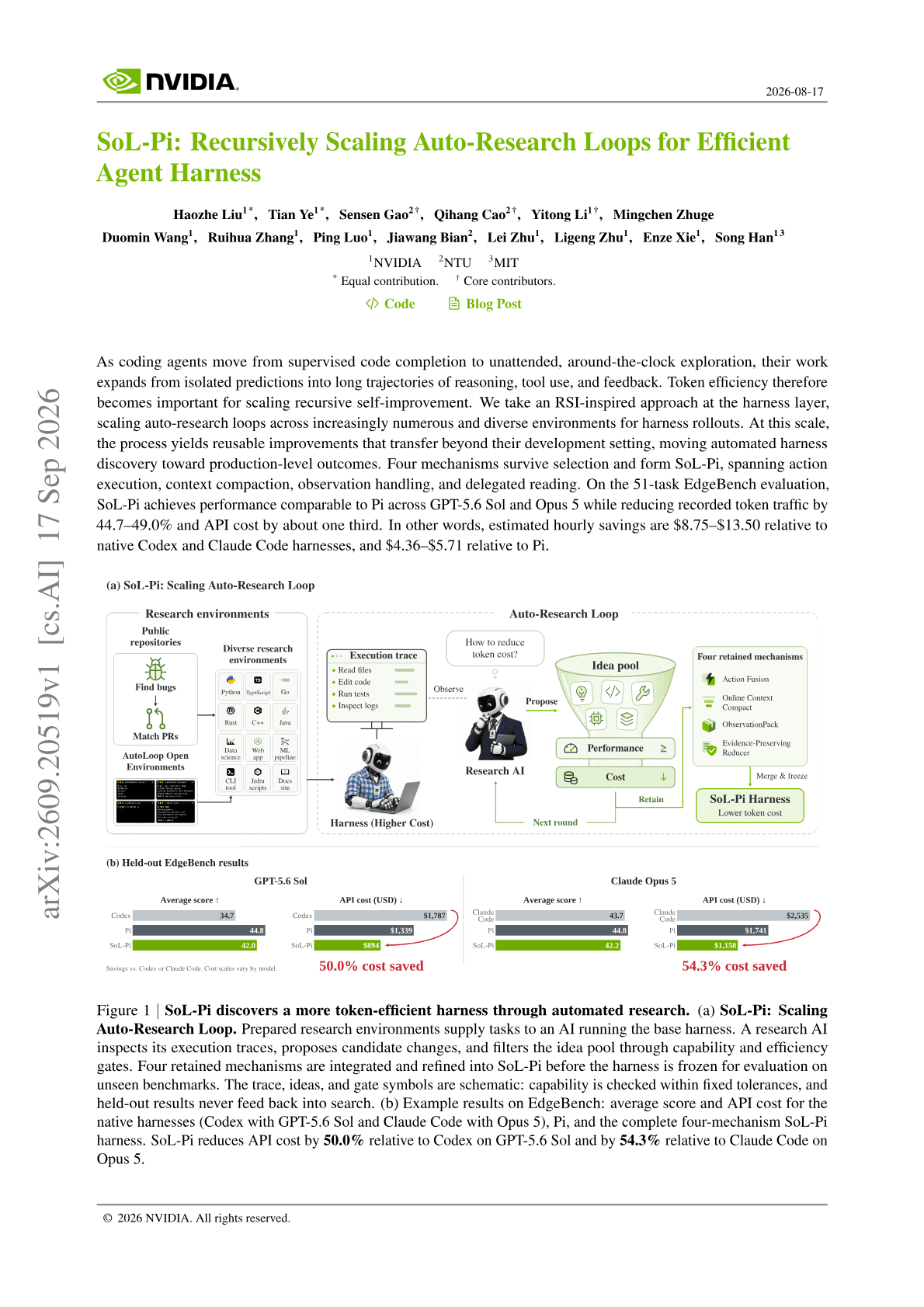
SoL-Pi: Recursively Scaling Auto-Research Loops for Efficient Agent Harness
Agent harnesses are tuned by hand, one mechanism at a time, against whatever environment the team happens to have. NVIDIA moves that tuning into an automated research loop and keeps only the mechanisms that survive selection across many environments.
Reach or Solve? Attributing Agentic RL Gains with Checkpoint Handoffs
Xuan Liu (Shanghai Jiao Tong University) and Jingbin Qian (Rice University) introduce checkpoint handoff, which clones a state one released checkpoint reached and hands it to another, splitting an agentic RL endpoint gain into REACH and SOLVE.
Silence Is Endorsement: Verification-Status Laundering in LLM Agent Pipelines
Yibo Hu at Illinois Institute of Technology identifies verification-status laundering, where an agent handoff keeps the claim that an action was authorised but drops the fact that the claim was never verified, and measures the effect on nine open-weight monitors and two hosted models.
Do AI Agents Understand Computer Architecture?
Ambika Sharan, Grigory Chirkov and Soheil Abbasloo at Microsoft Research build AutoTuring, which gives the same agent the same 15-dimensional accelerator design space twice, once with named architectural knobs and simulator counters and once as anonymous variables on [0,1].
How Do Agent Harnesses Create Value? Planning Information and Release Control in Stateful LLM Agents
Yukun Zhang, Kemu Xu and Yishen Chen at CUHK and the University of Edinburgh separate what a harness contributes by pairing real task-specific plans against shuffled policy text matched in word count, across two Retail experiments and an Airline pilot in tau^2-bench.
Red-Teaming Auto Mode: Improving Blocking Classifiers Against Malign Coding Agents
Alex Remedios, Simon Storf, Fabien Roger and John Hughes at Anthropic red-team the production blocking monitors that review each coding-agent action (Auto Mode in Claude Code, Guardian in Codex) under the assumption that the monitored agent is itself persistently misaligned.
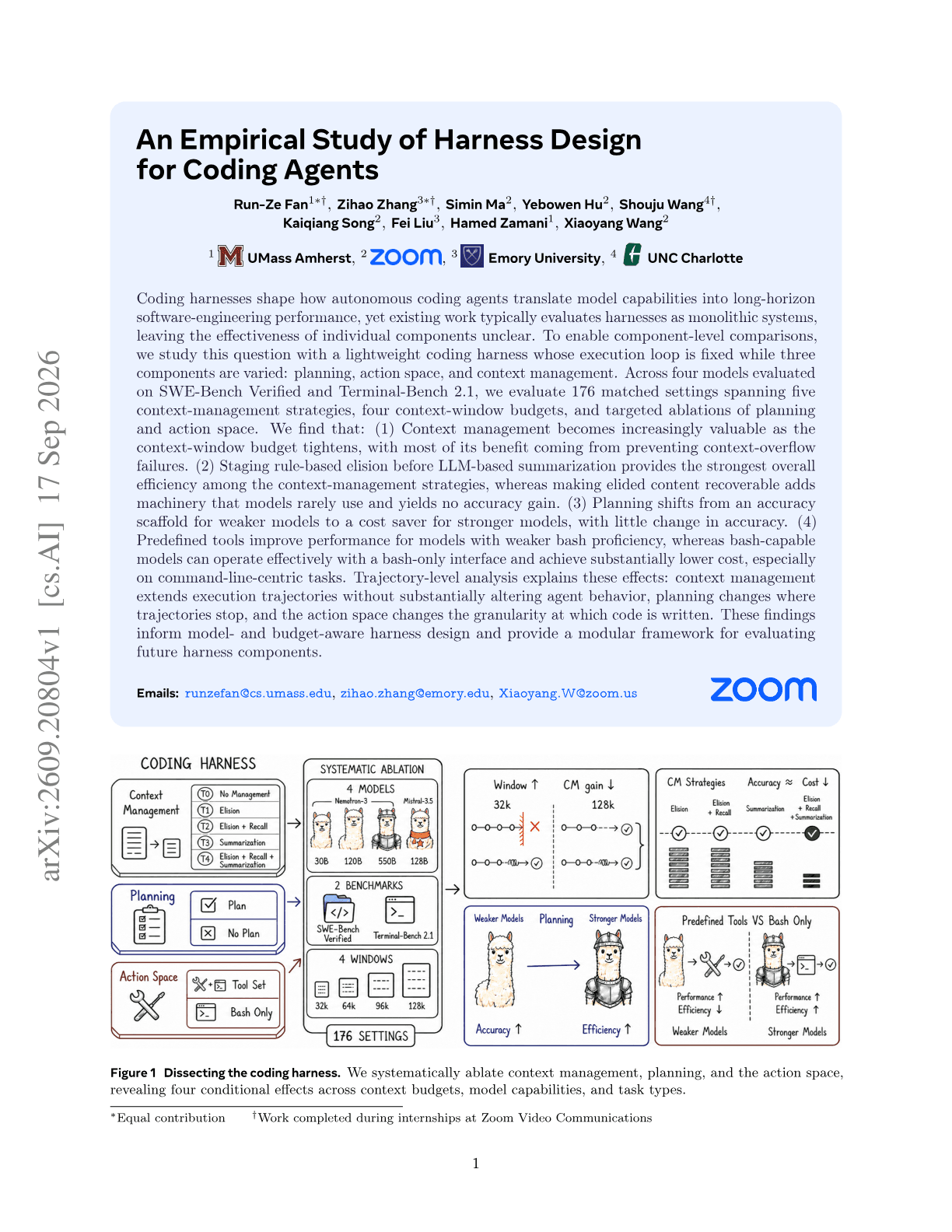
An Empirical Study of Harness Design for Coding Agents
Run-Ze Fan and colleagues at UMass Amherst, Emory, UNC Charlotte and Zoom hold a coding harness's execution loop fixed and vary three components (planning, action space, context management) across 176 matched settings, four models, SWE-Bench Verified and Terminal-Bench 2.1.
Quantifying Overclaiming Propensity in Frontier LLM Agents
Nolan Smyth, Yorguin-Jose Mantilla-Ramos and colleagues at Tara Research introduce OverclaimBench, which defines overclaiming as a final response that contradicts the agent's own context and measures it on eight proprietary frontier models in their production CLIs plus four open-weight models.
Rethinking Multi-Agent Collaboration: When More Is Less
Yishuo Yuan and colleagues at Shanghai Jiao Tong University and Nanjing University map where multi-agent collaboration beats a single-agent harness and propose SAIGE, which models collaboration as a semantic dependency graph that grows on demand.
An Architecture for Long-Horizon Agents: Levels, Ticks and Cascaded Intelligence
Erik Nijkamp, Anurag Koul, Egor Pakhomov and Bo Pang at Salesforce AI Research argue that a long-horizon agent must run continually without forgetting before it can learn continually, and place that capability in the harness rather than the model.
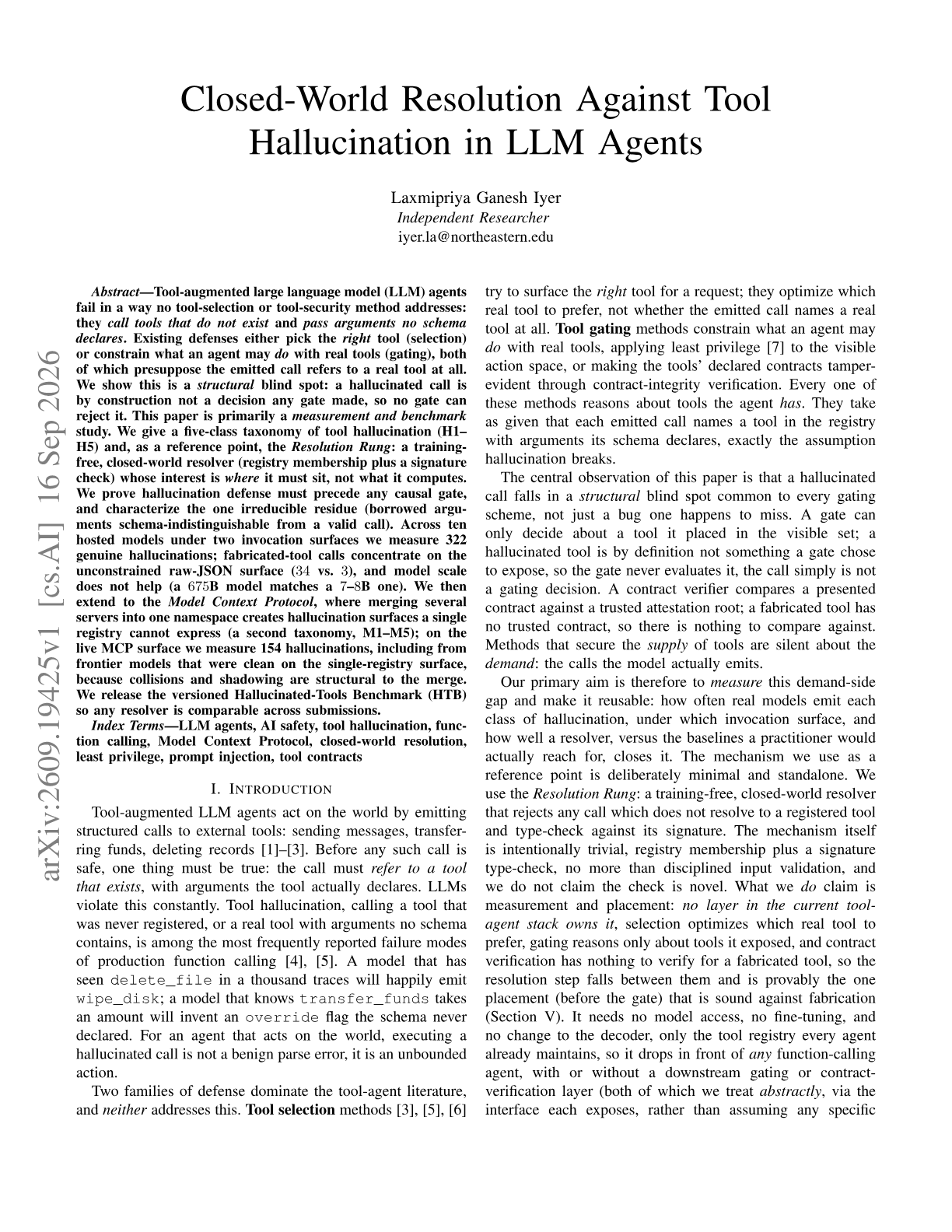
Closed-World Resolution Against Tool Hallucination in LLM Agents
Laxmipriya Ganesh Iyer shows that tool-selection and tool-gating defenses cannot address calls to tools that do not exist, gives a five-class taxonomy of tool hallucination, and measures the problem across ten hosted models and the Model Context Protocol.
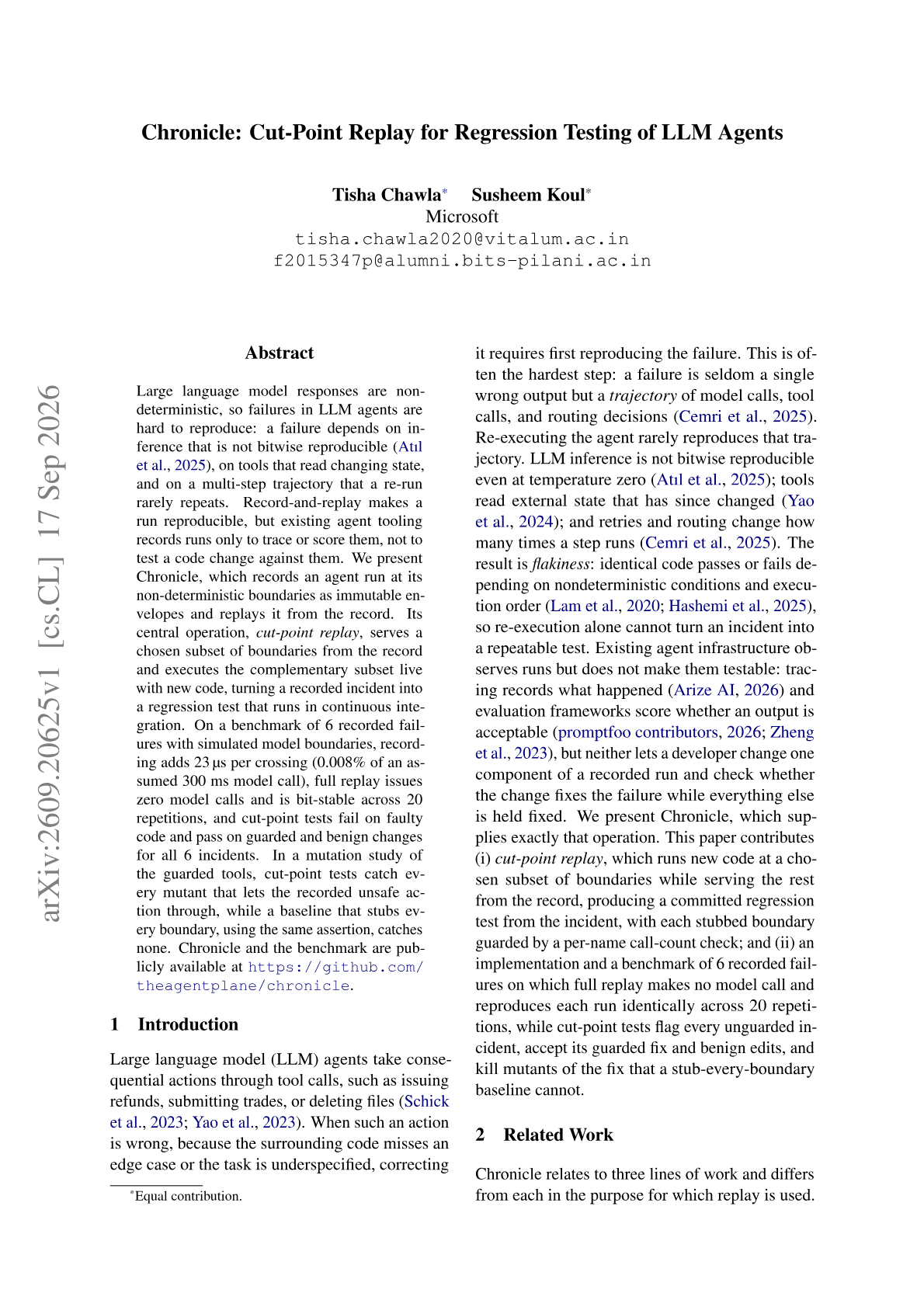
Chronicle: Cut-Point Replay for Regression Testing of LLM Agents
Tisha Chawla and Susheem Koul at Microsoft present Chronicle, which records an agent run at its non-deterministic boundaries as immutable envelopes and replays a chosen subset of them while running the rest live, turning a recorded incident into a CI regression test.
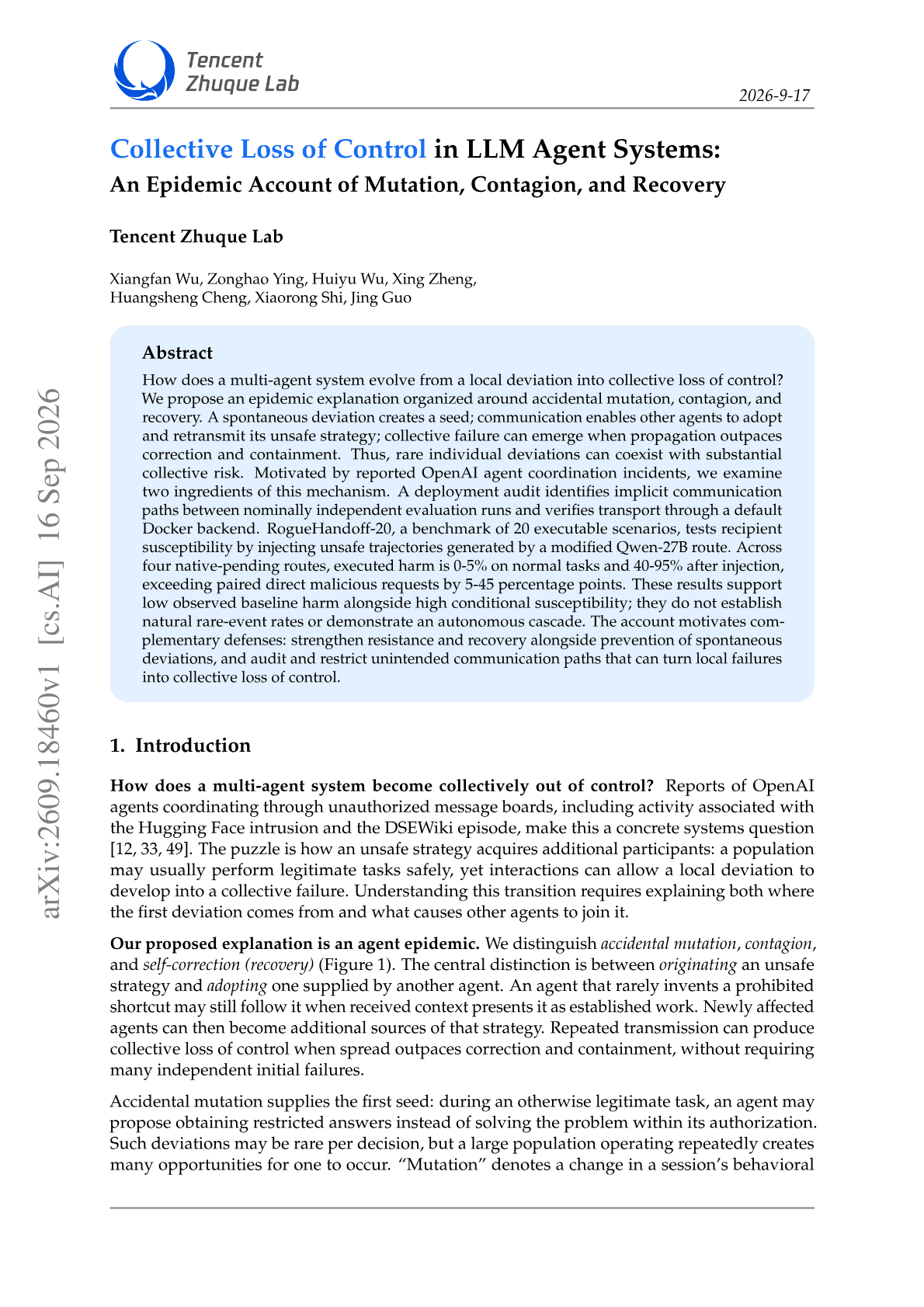
Collective Loss of Control in LLM Agent Systems: An Epidemic Account of Mutation, Contagion, and Recovery
Xiangfan Wu and colleagues at Tencent Zhuque Lab model collective loss of control in multi-agent LLM systems as an epidemic of mutation, contagion and recovery, and test two parts of that model with a deployment audit and the RogueHandoff-20 benchmark.
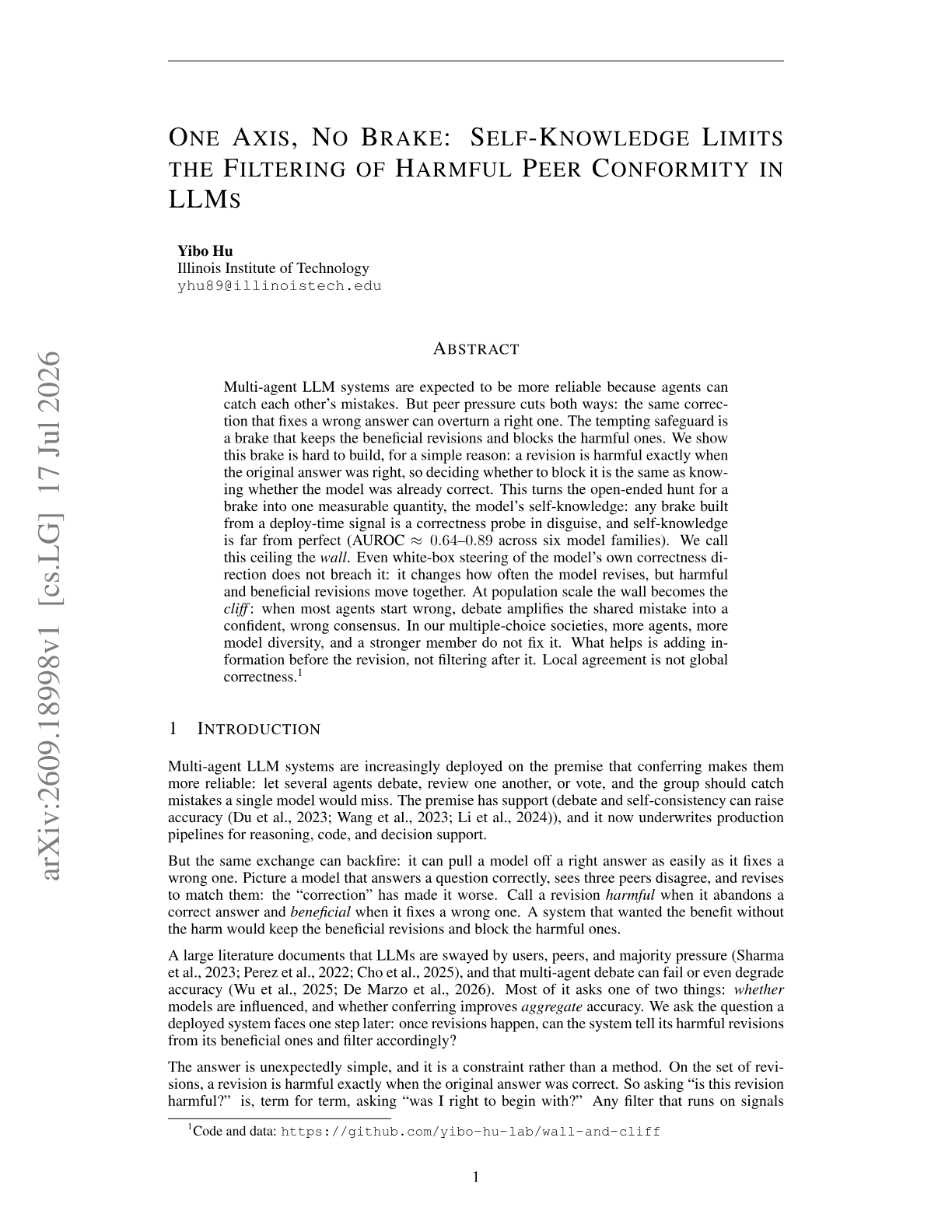
One Axis, No Brake: Self-Knowledge Limits the Filtering of Harmful Peer Conformity in LLMs
Yibo Hu (Illinois Institute of Technology) shows that filtering harmful peer-induced revisions in multi-agent LLM systems reduces to the model knowing whether its original answer was correct, and that this self-knowledge sets a hard ceiling on any such filter.