AI Papers of the Week
Every paper worth reading in AI, hand-picked one week at a time.
Discover and explore top AI papers withClaude CodeCodex
npx @dair-ai/mcp setup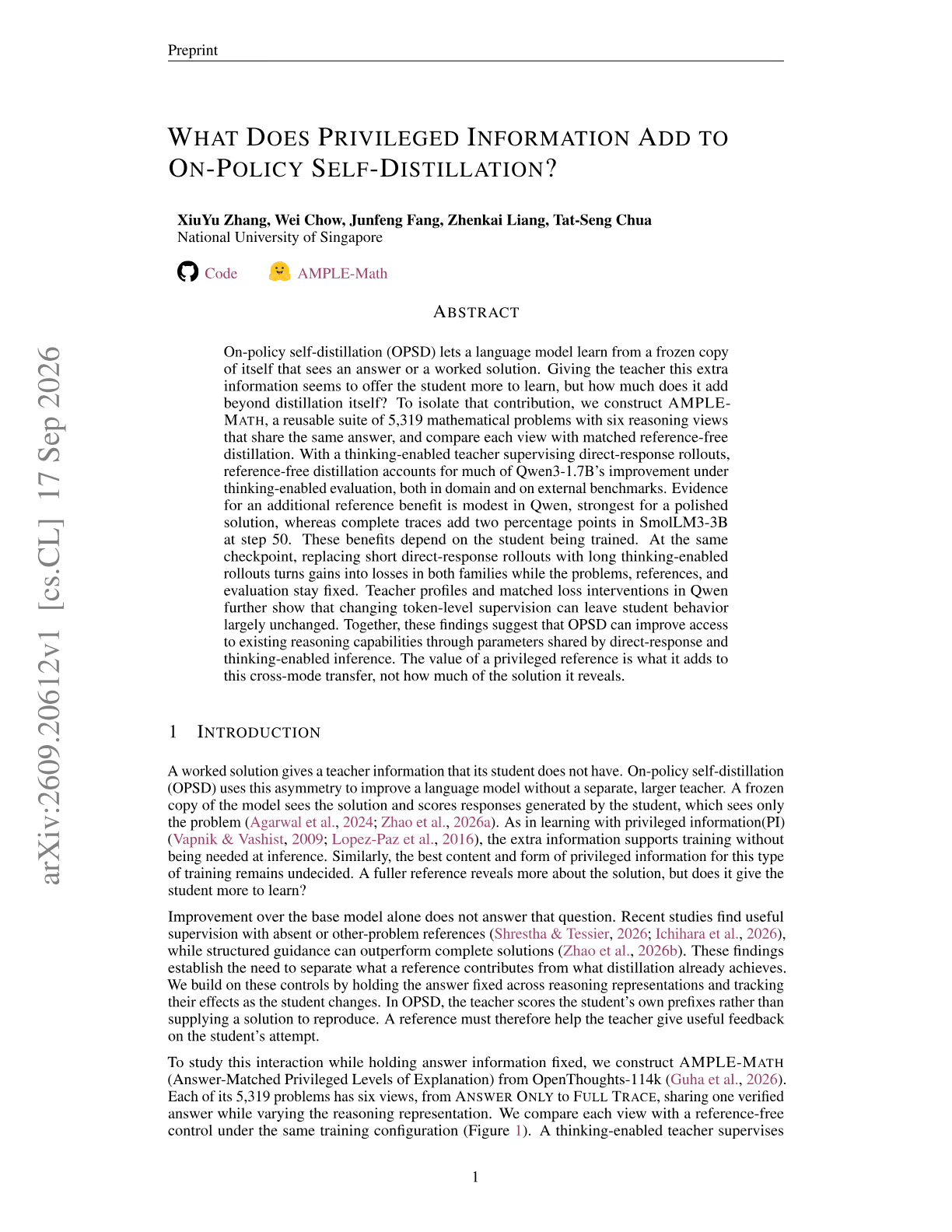
What Does Privileged Information Add to On-Policy Self-Distillation?
XiuYu Zhang, Wei Chow, Junfeng Fang, Zhenkai Liang and Tat-Seng Chua build a benchmark that holds the problem fixed while varying what the teacher sees, and find the privileged information adds much less than distillation itself.
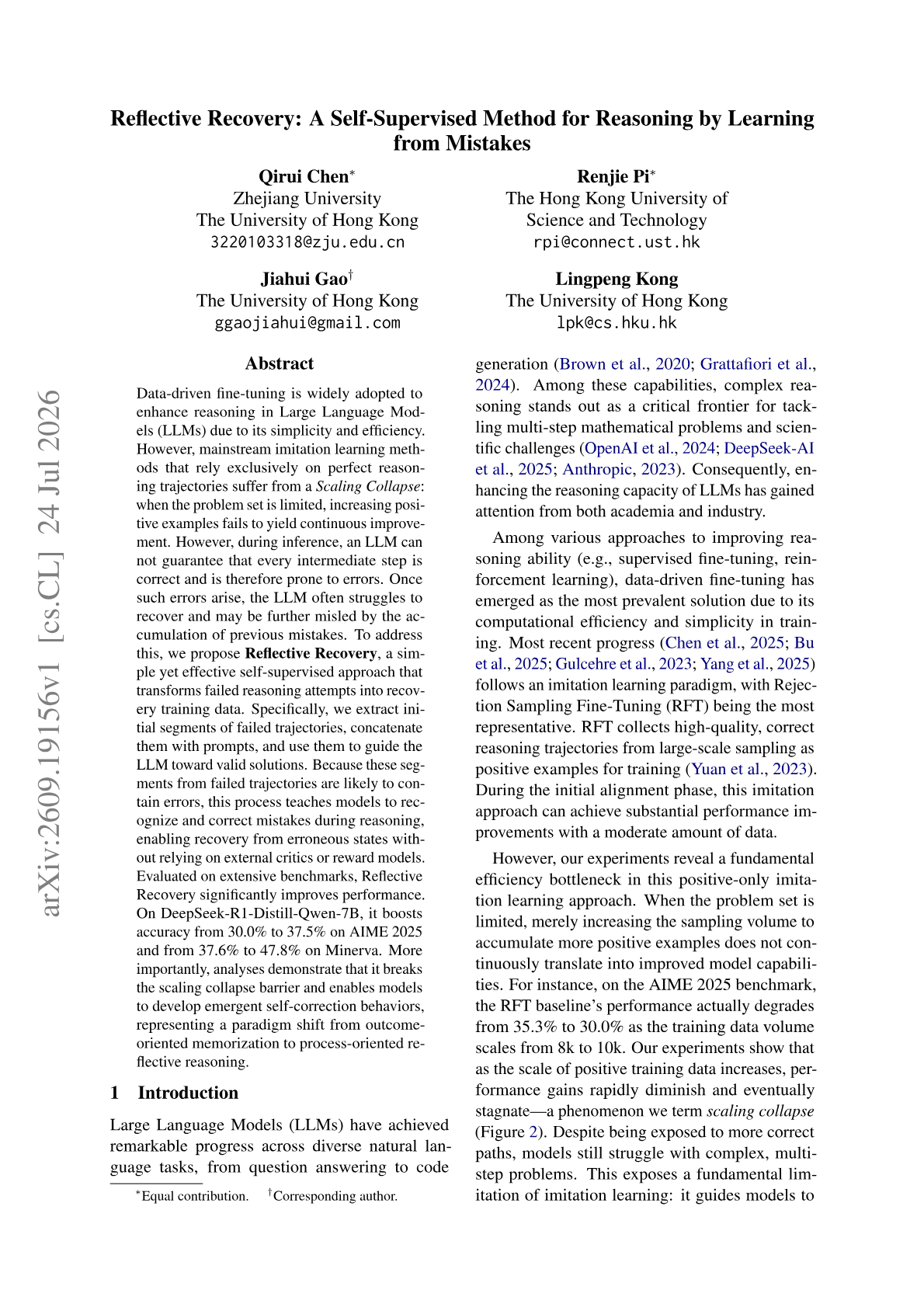
Reflective Recovery: A Self-Supervised Method for Reasoning by Learning from Mistakes
Qirui Chen, Renjie Pi, Jiahui Gao and Lingpeng Kong (Zhejiang University, the University of Hong Kong and HKUST) convert failed reasoning rollouts into recovery training data, so a model learns to continue correctly from an already-wrong intermediate state.
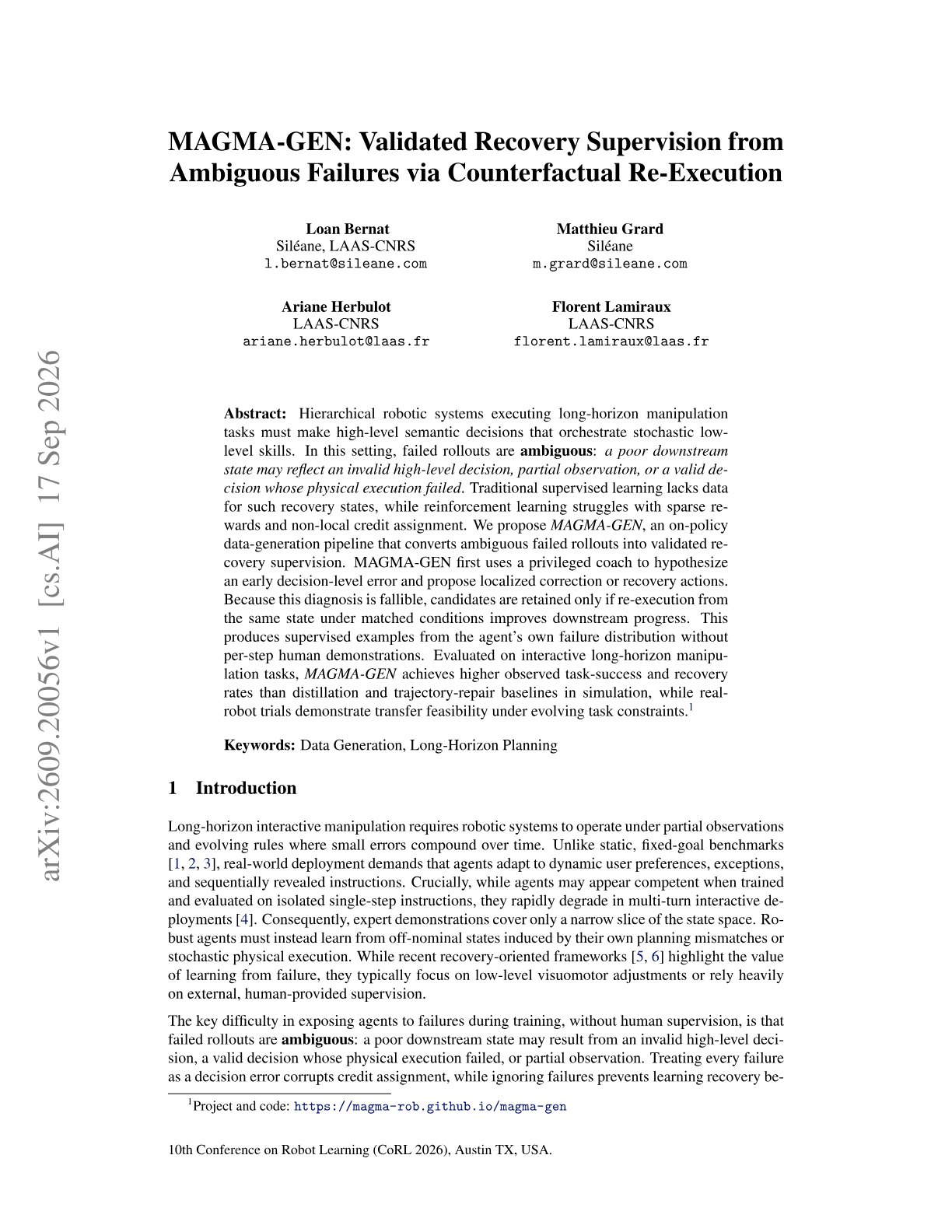
MAGMA-GEN: Validated Recovery Supervision from Ambiguous Failures via Counterfactual Re-Execution
Loan Bernat, Matthieu Grard, Ariane Herbulot and Florent Lamiraux turn ambiguous failed robot rollouts into recovery supervision by re-executing proposed corrections and keeping only the ones that actually help.
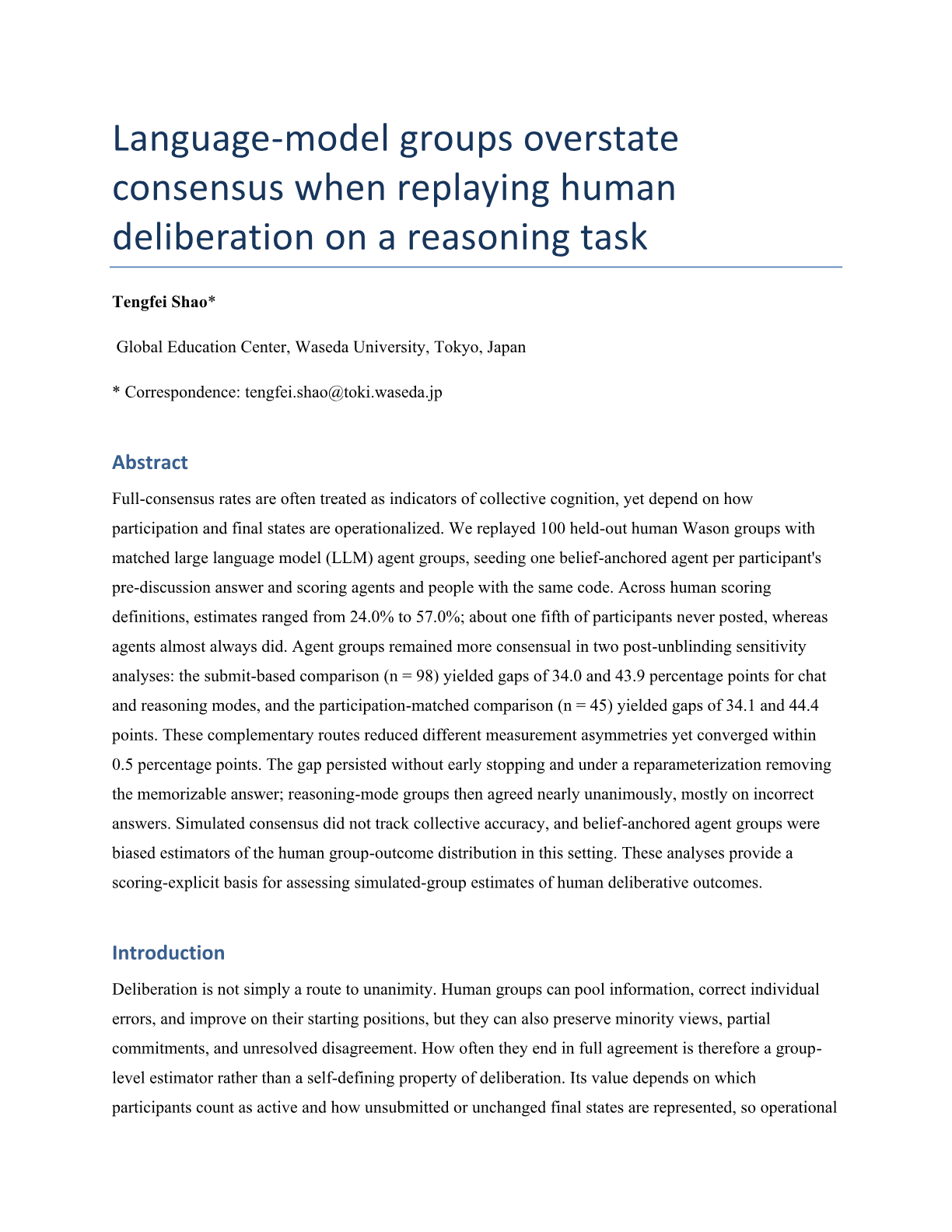
Language-model groups overstate consensus when replaying human deliberation on a reasoning task
Tengfei Shao replays 100 held-out human Wason group discussions with matched LLM agent groups and finds the agent groups reach full consensus far more often than the people they stand in for.
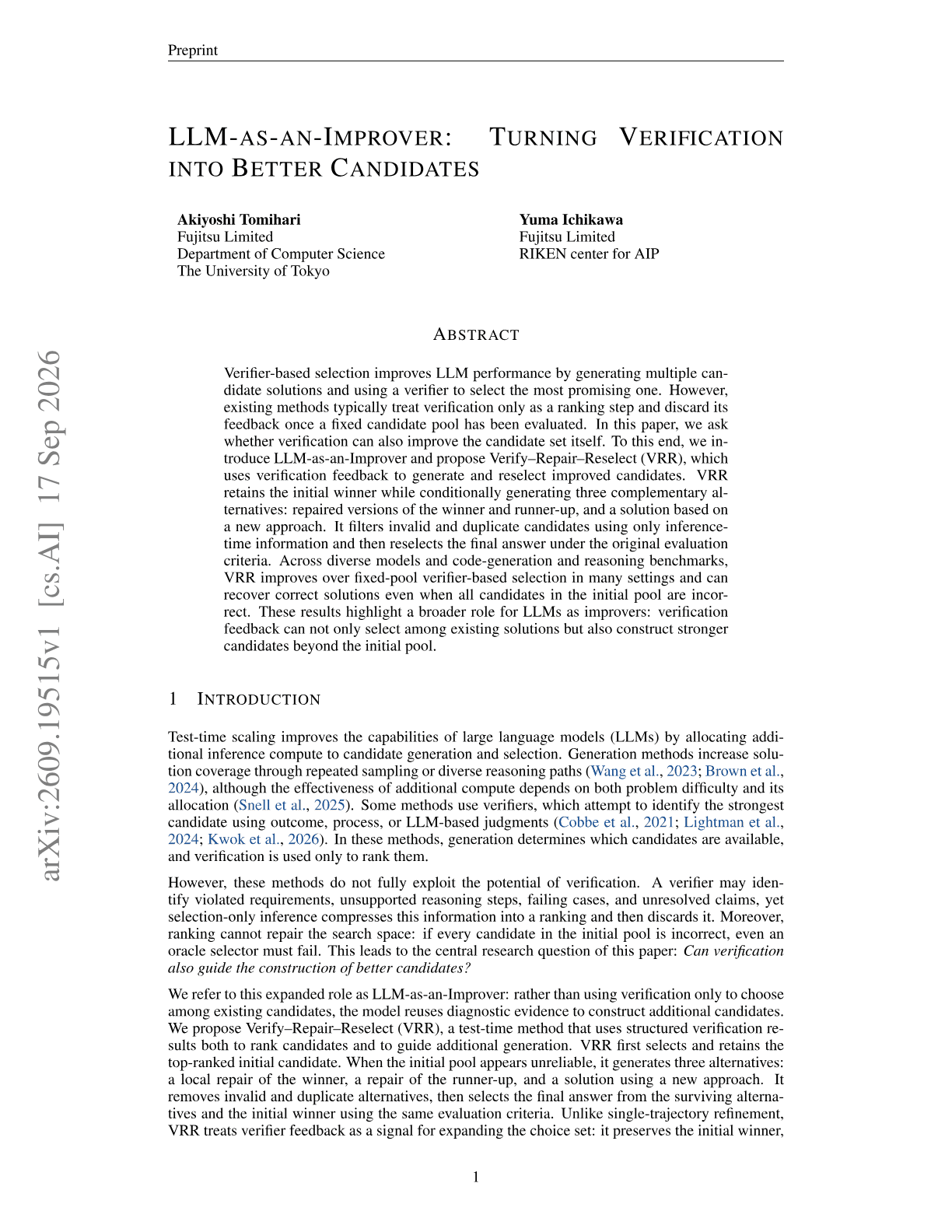
LLM-as-an-Improver: Turning Verification into Better Candidates
Akiyoshi Tomihari and Yuma Ichikawa ask whether verifier feedback can improve the candidate pool rather than only rank it, and propose Verify-Repair-Reselect.
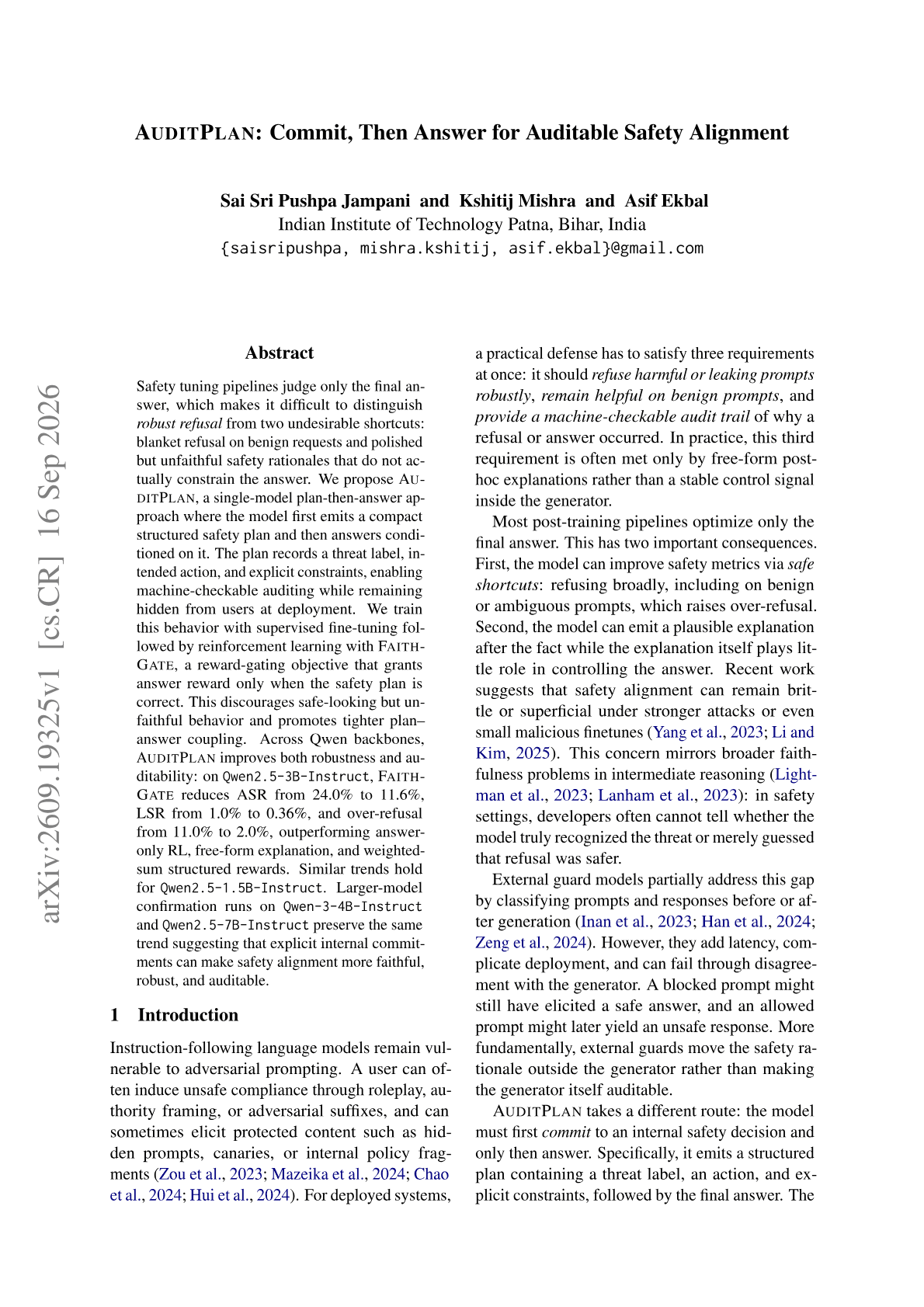
AUDITPLAN: Commit, Then Answer for Auditable Safety Alignment
Sai Sri Pushpa Jampani, Kshitij Mishra and Asif Ekbal make a model emit a machine-checkable safety plan before answering, and reward the answer only when that plan is correct.
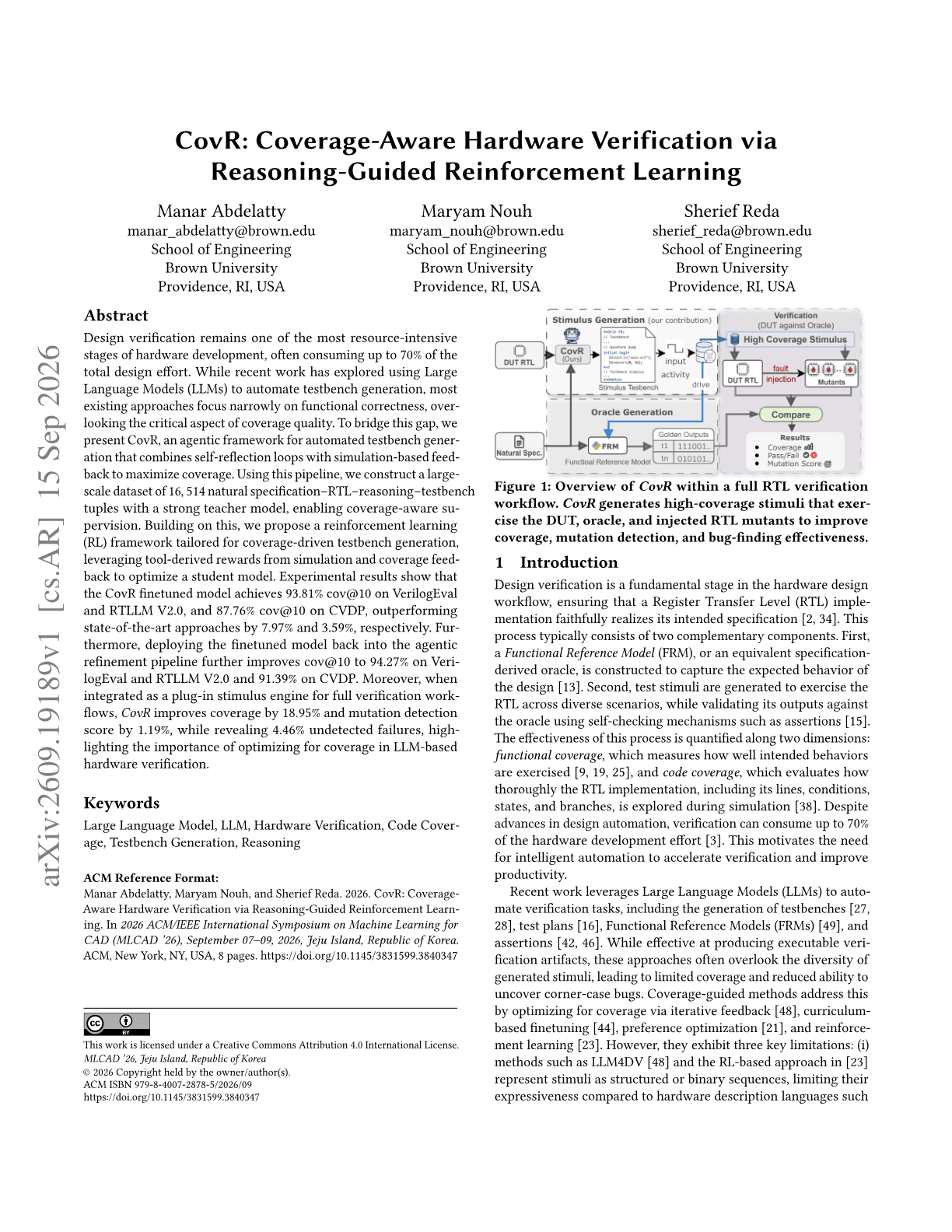
CovR: Coverage-Aware Hardware Verification via Reasoning-Guided Reinforcement Learning
Abdelatty, Nouh and Reda (Brown University) build CovR, an agentic testbench-generation system for RTL hardware verification that optimizes for coverage rather than functional correctness alone, and distill the resulting behavior into a student model with simulation-derived rewards.
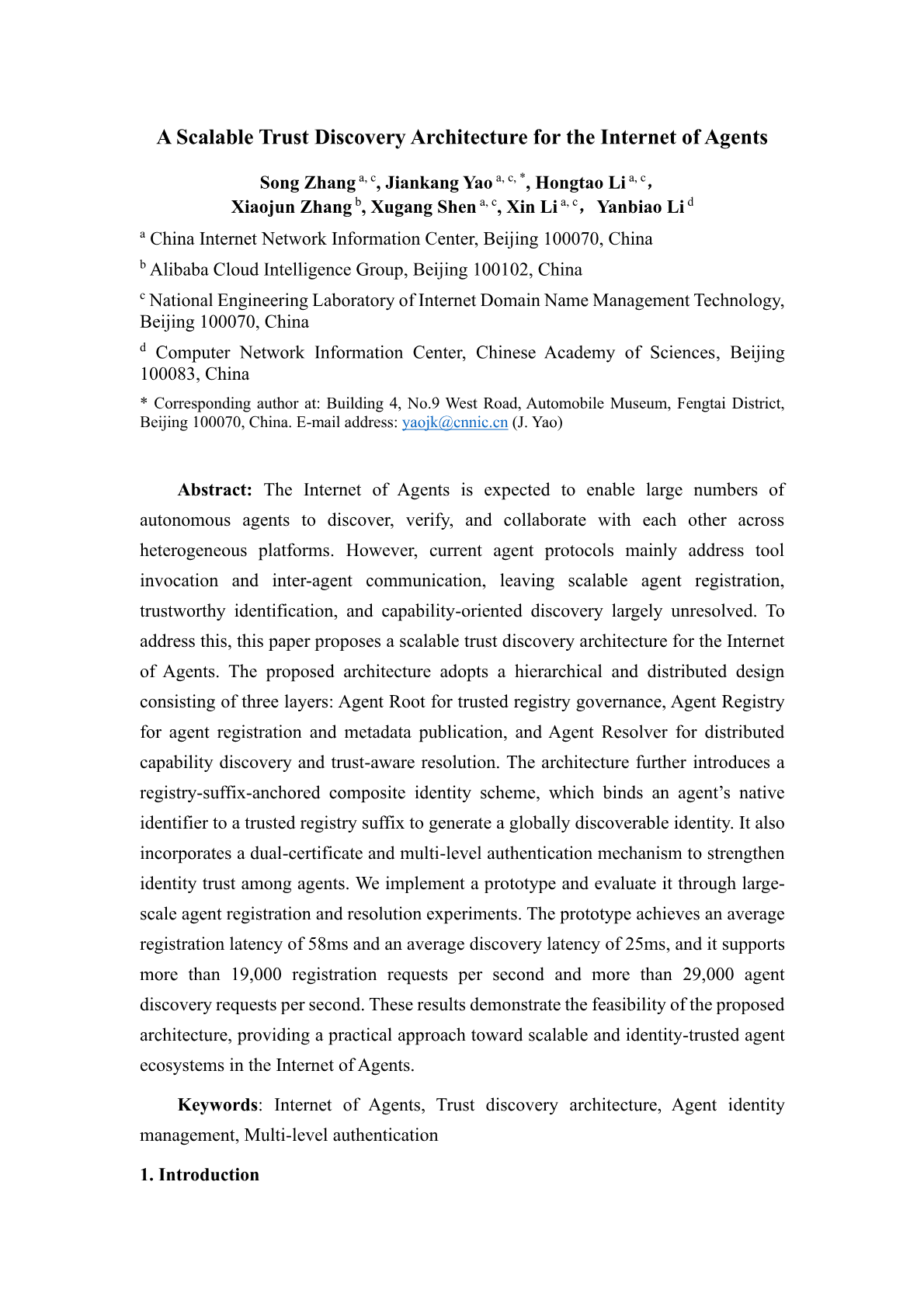
A Scalable Trust Discovery Architecture for the Internet of Agents
Song Zhang and colleagues propose a three-layer registry and resolver architecture for agent discovery, addressing the part of agent protocols that tool invocation standards leave open.
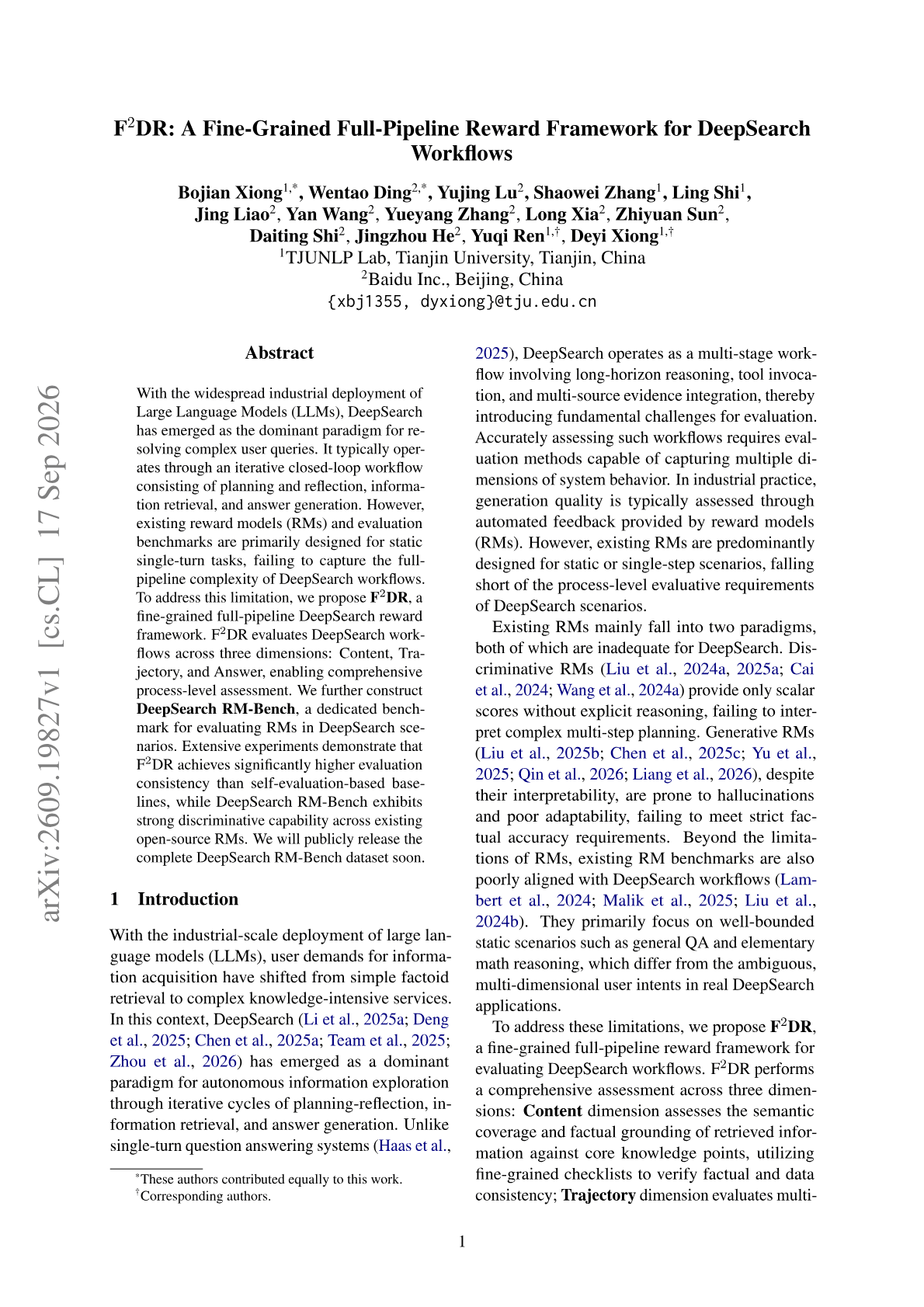
F$^{2}$DR: A Fine-Grained Full-Pipeline Reward Framework for DeepSearch Workflows
Bojian Xiong and a 14-author team score a DeepSearch run across its whole pipeline rather than only its final answer, and release a benchmark for reward models in that setting.
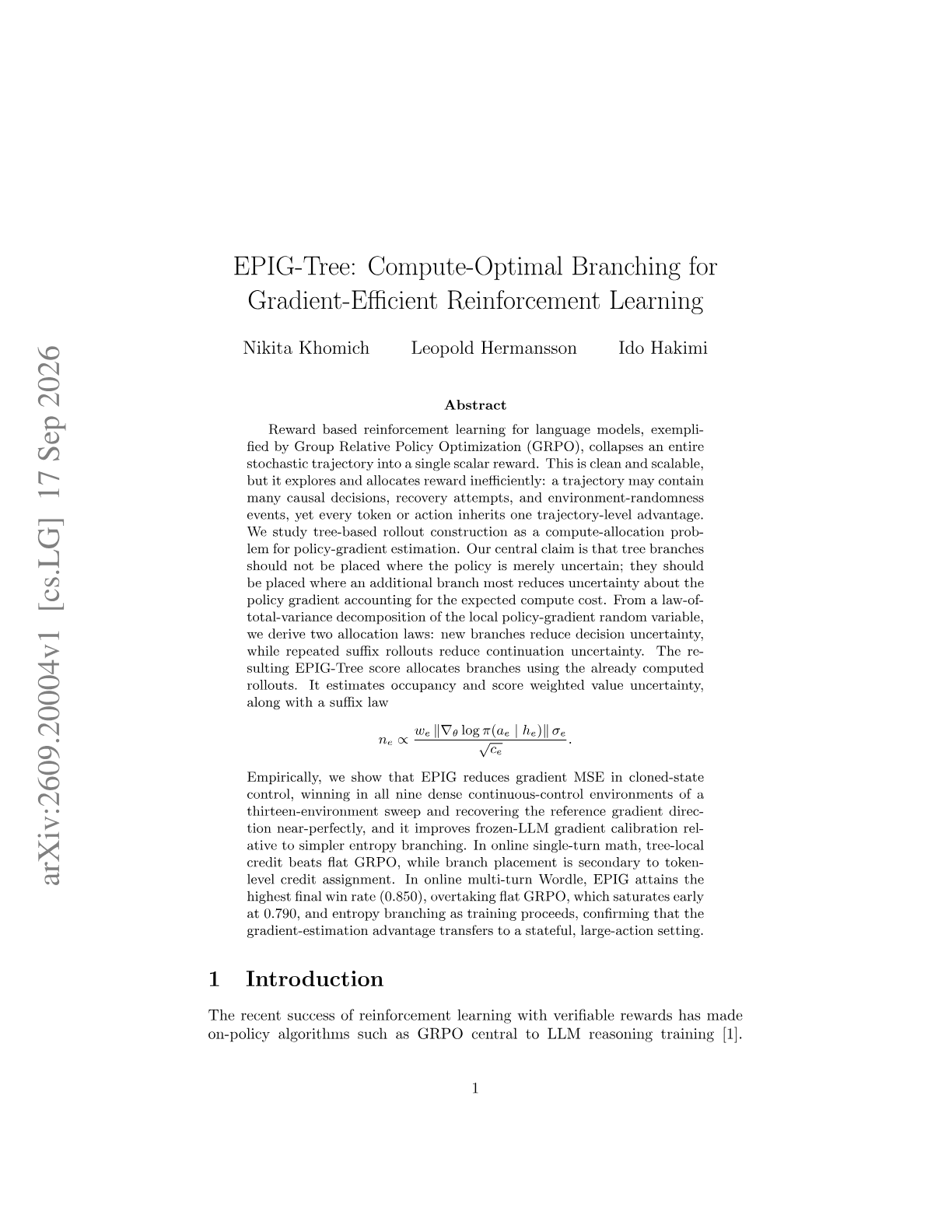
EPIG-Tree: Compute-Optimal Branching for Gradient-Efficient Reinforcement Learning
Khomich, Hermansson and Hakimi treat tree-structured rollout construction in LLM RL as a compute-allocation problem, deriving where to branch from a law-of-total-variance decomposition of the local policy gradient rather than from policy entropy.
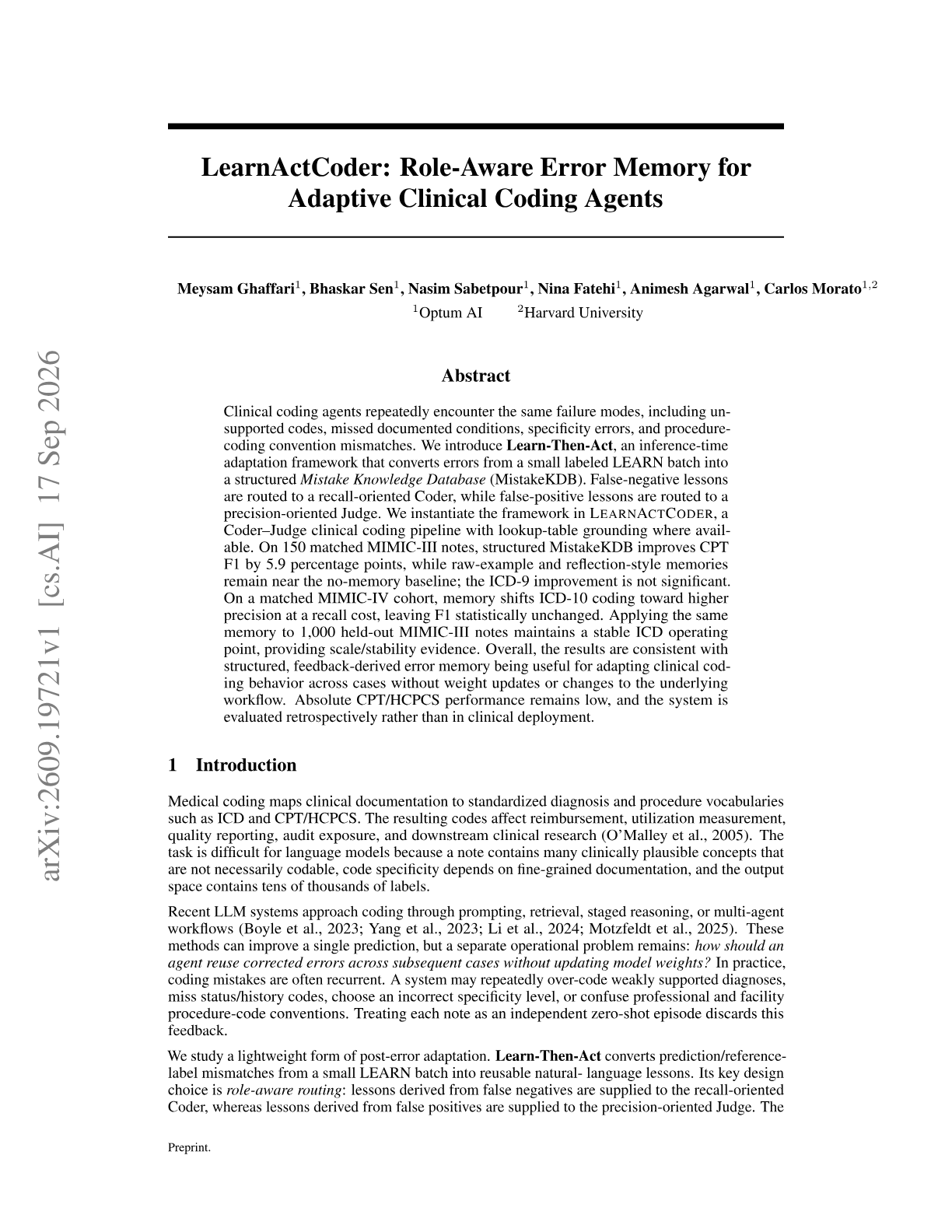
LearnActCoder: Role-Aware Error Memory for Adaptive Clinical Coding Agents
Meysam Ghaffari and colleagues turn a small labeled batch of clinical coding errors into a structured mistake database and route each lesson to the agent role that can act on it.
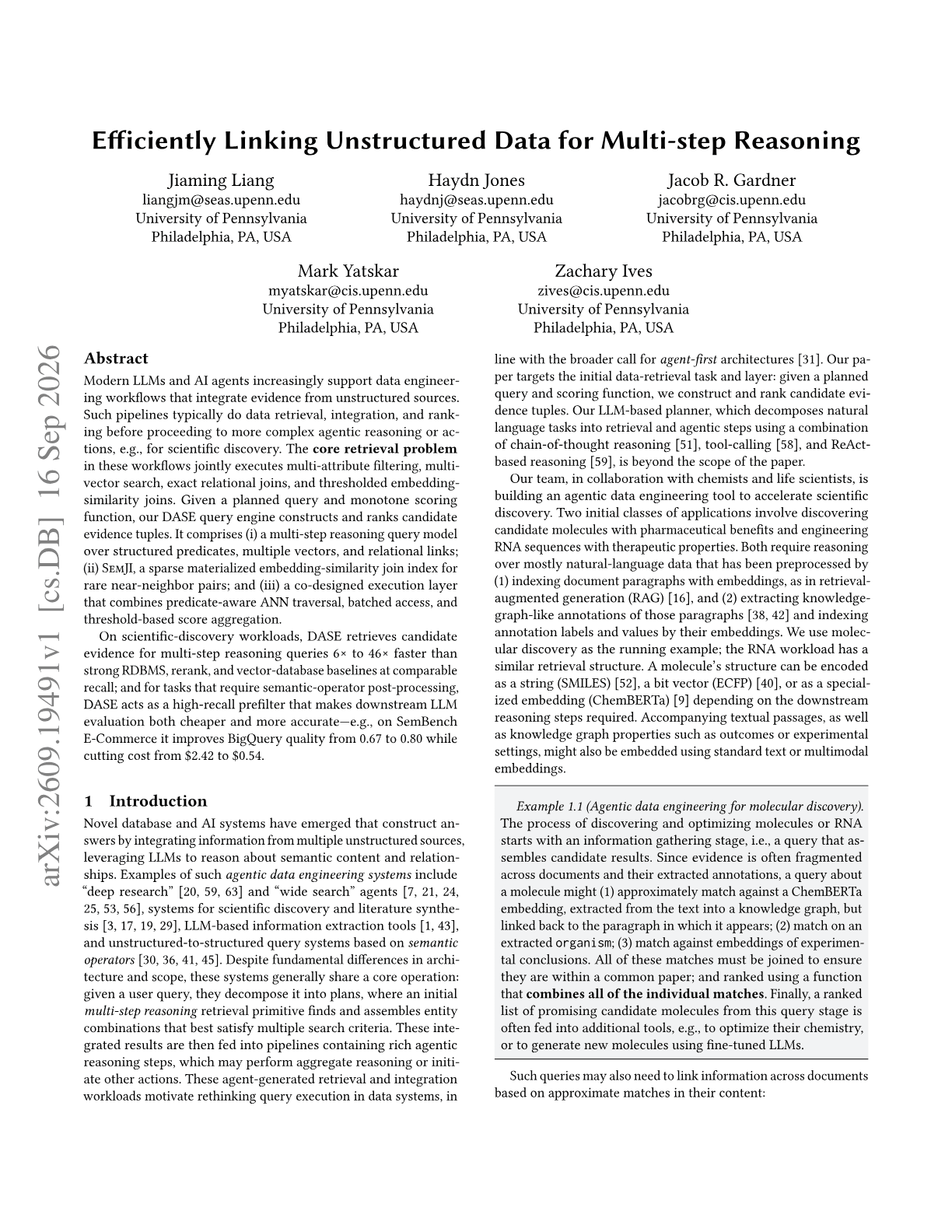
Efficiently Linking Unstructured Data for Multi-step Reasoning
Jiaming Liang, Haydn Jones, Jacob R. Gardner, Mark Yatskar and Zachary Ives (University of Pennsylvania) build a query engine for the retrieval step that sits under agentic reasoning pipelines, executing filters, multi-vector search, relational joins and similarity joins together.
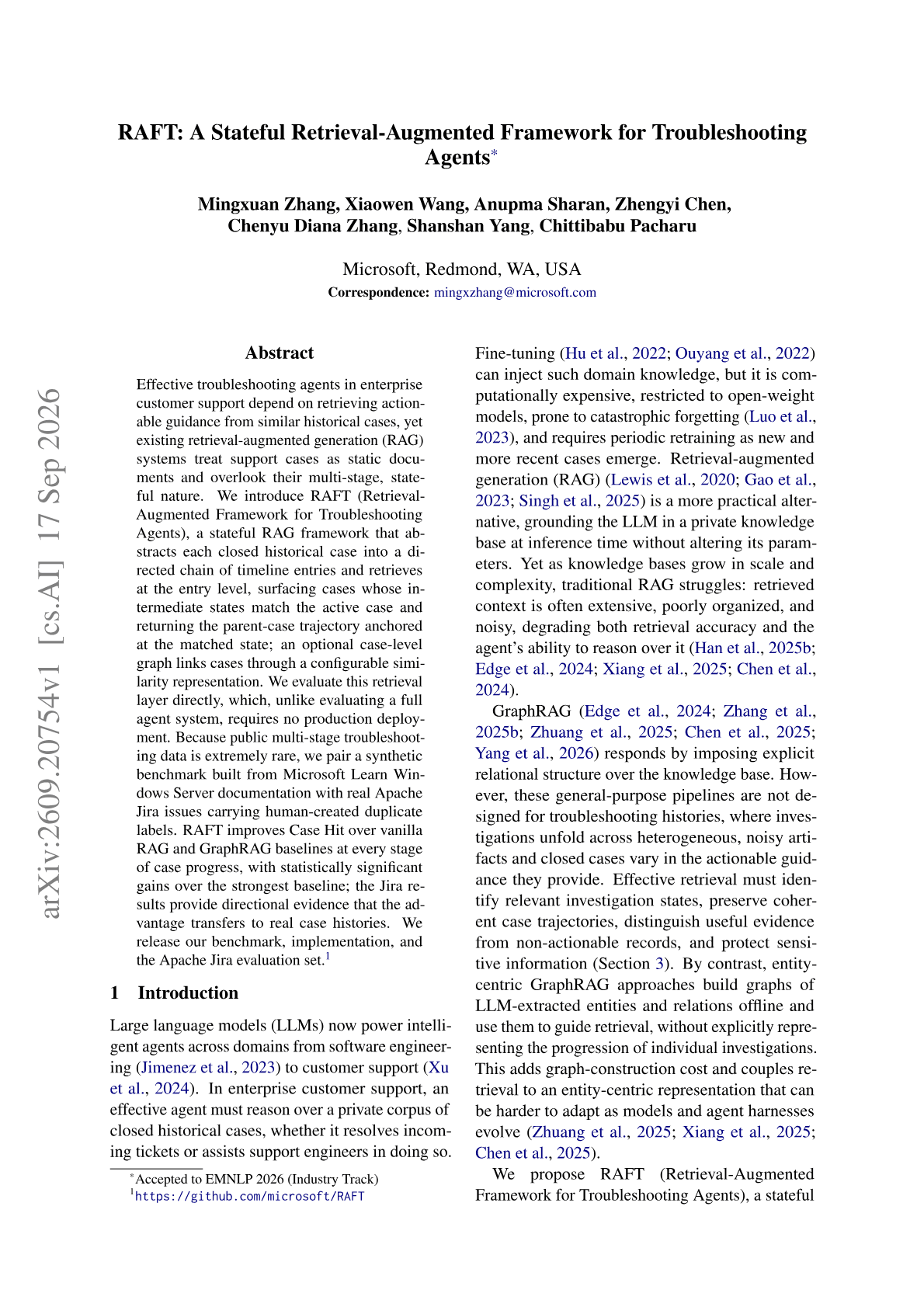
RAFT: A Stateful Retrieval-Augmented Framework for Troubleshooting Agents
Mingxuan Zhang and colleagues present RAFT, which abstracts each closed support case into a directed chain of timeline entries and retrieves at the entry level rather than treating cases as static documents.
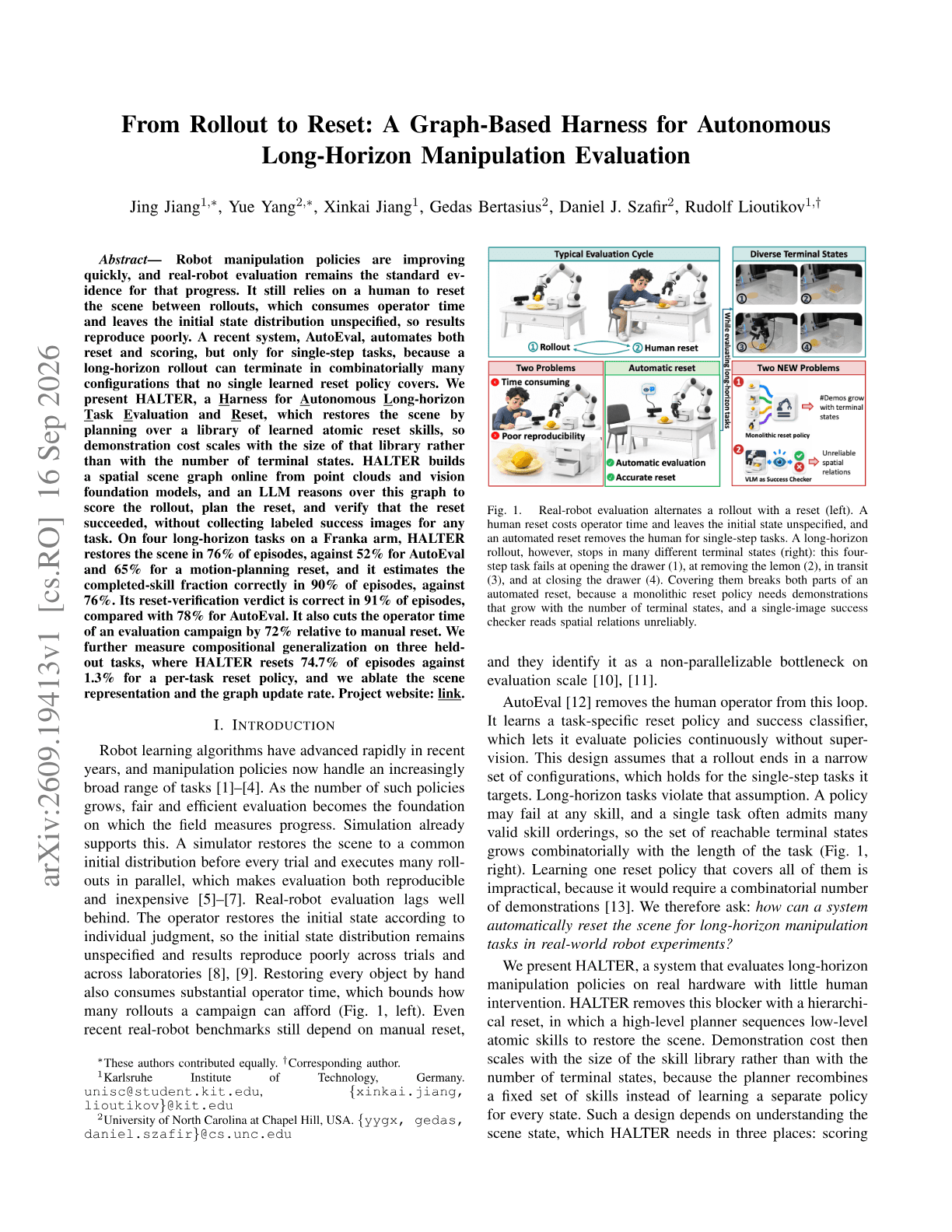
From Rollout to Reset: A Graph-Based Harness for Autonomous Long-Horizon Manipulation Evaluation
Jing Jiang and colleagues present HALTER, which restores a robot workspace between rollouts by planning over a library of learned atomic reset skills, so demonstration cost scales with the library rather than with the number of terminal states.
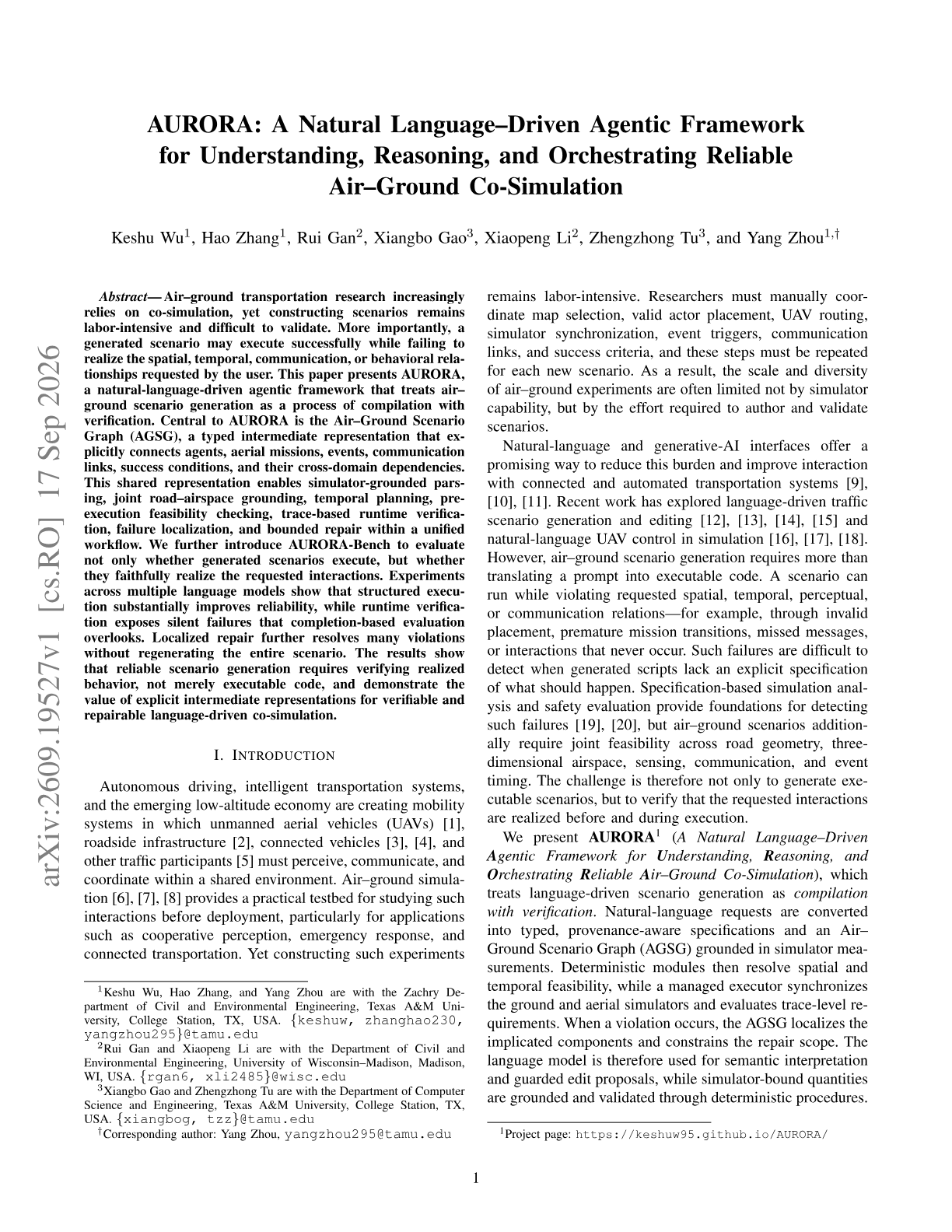
AURORA: A Natural Language-Driven Agentic Framework for Understanding, Reasoning, and Orchestrating Reliable Air-Ground Co-Simulation
Keshu Wu and colleagues at Texas A&M and collaborators treat air-ground co-simulation scenario generation as compilation with verification, so a scenario that runs is also checked against the relationships the user asked for.
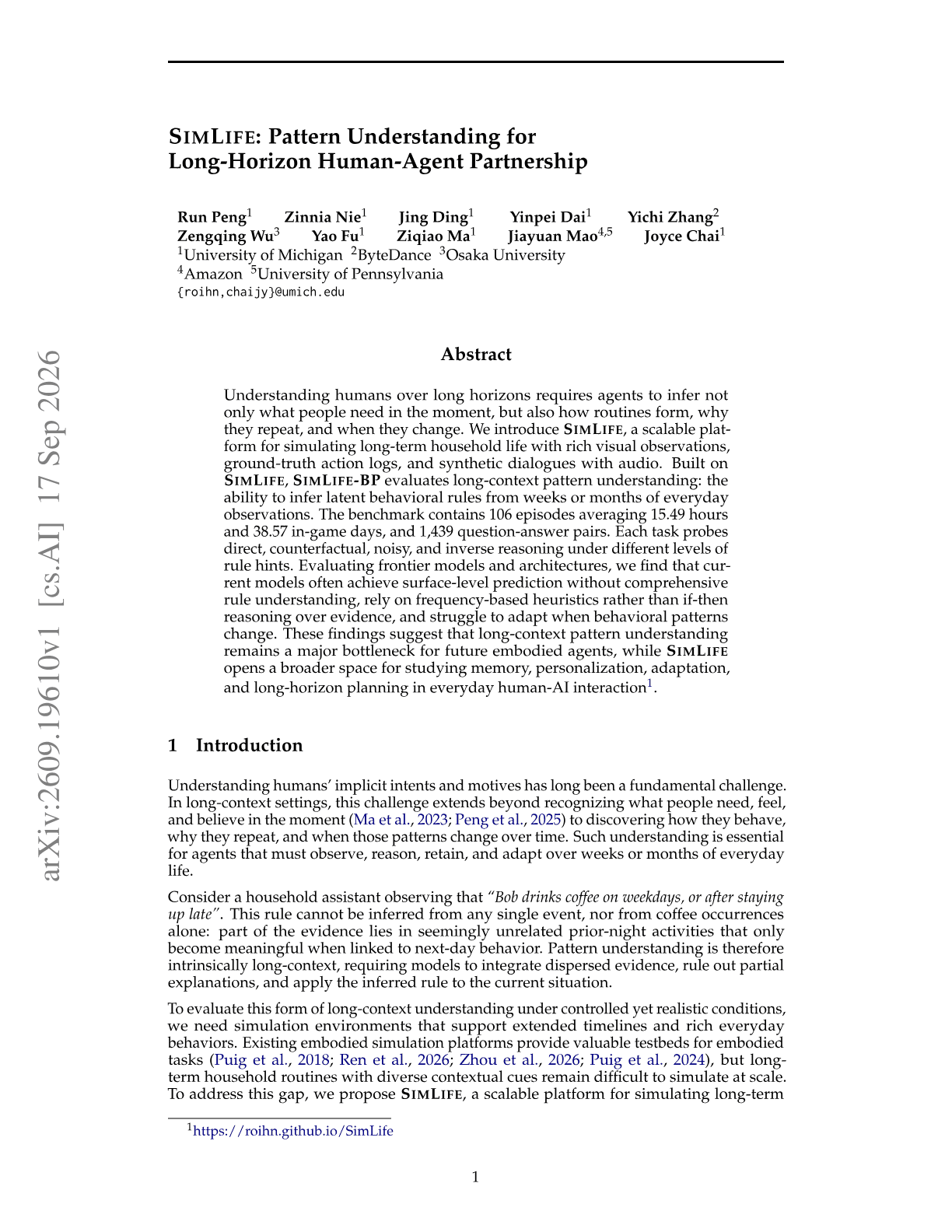
SIMLIFE: Pattern Understanding for Long-Horizon Human-Agent Partnership
Run Peng and colleagues build SimLife, a simulator of long-term household life with visual observations, ground-truth action logs and synthetic dialogue, and SimLife-BP, which tests whether a model can infer latent behavioural rules from weeks of observation.
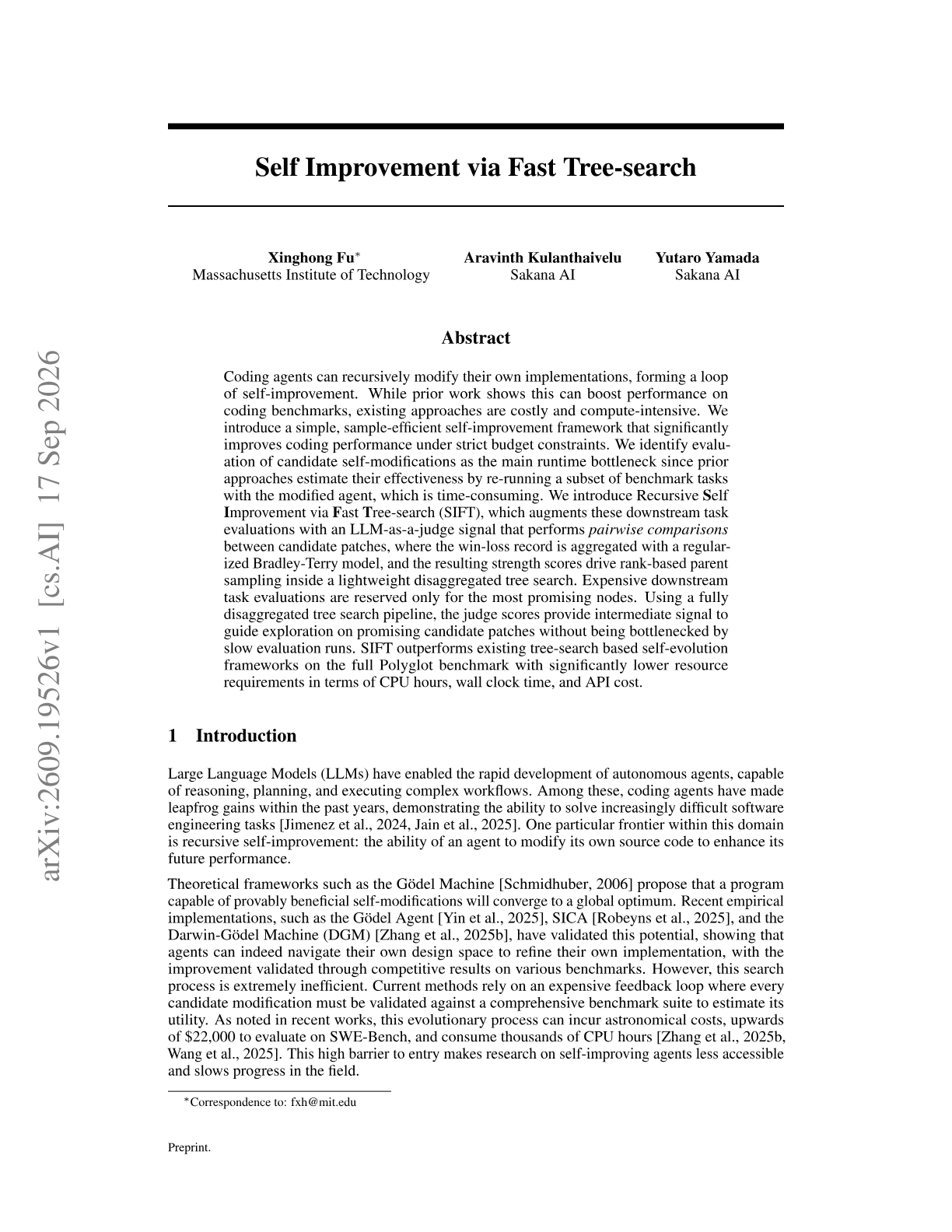
Self Improvement via Fast Tree-search
Coding agents that rewrite their own implementation can improve on benchmarks, but prior methods such as the Darwin Gödel Machine (DGM) are expensive to run. Researchers from MIT and Sakana AI trace most of that cost to one step and make it cheaper.
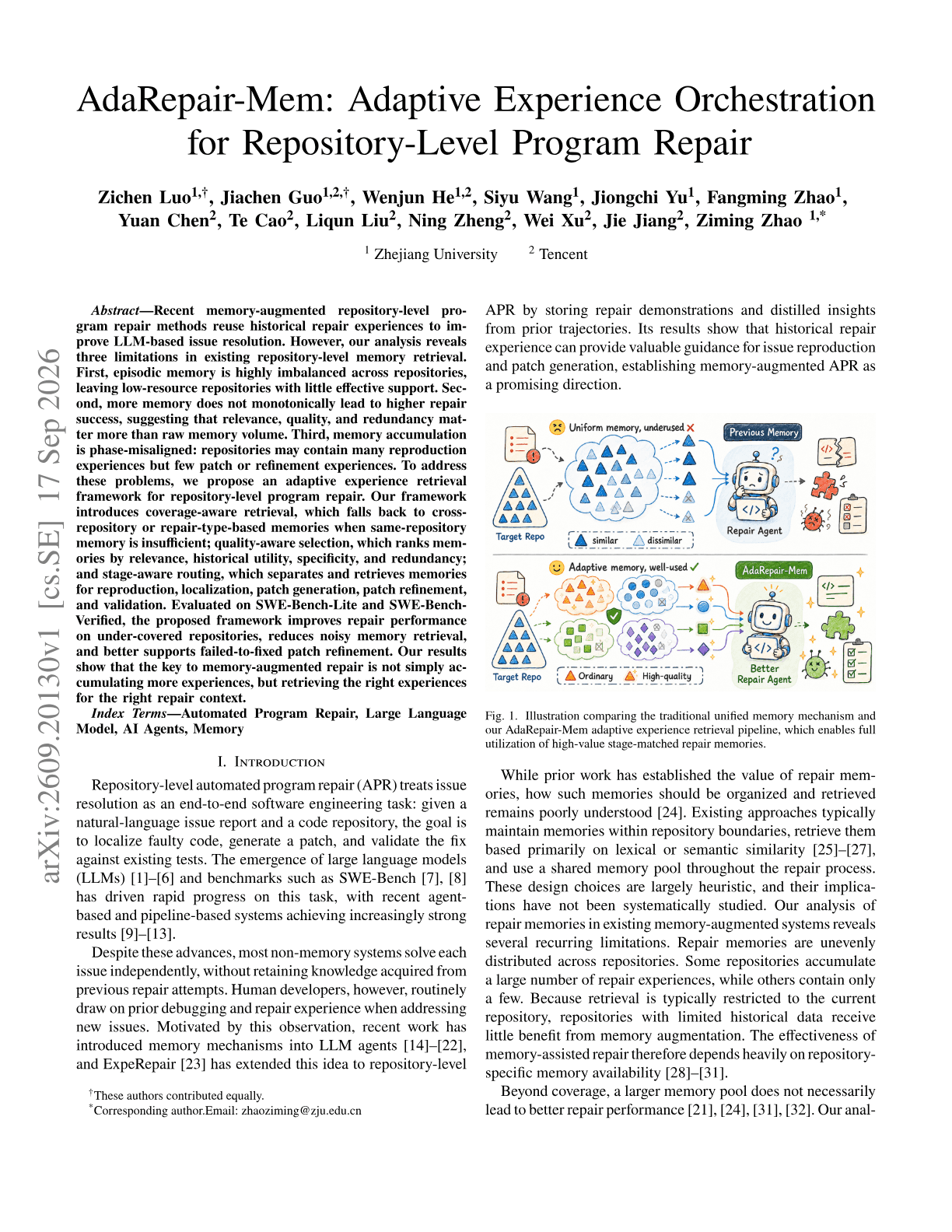
AdaRepair-Mem: Adaptive Experience Orchestration for Repository-Level Program Repair
Z. C. Luo and a 13-author team diagnose three failures in repository-level memory retrieval for program repair, then route memory by repair stage rather than by similarity alone.
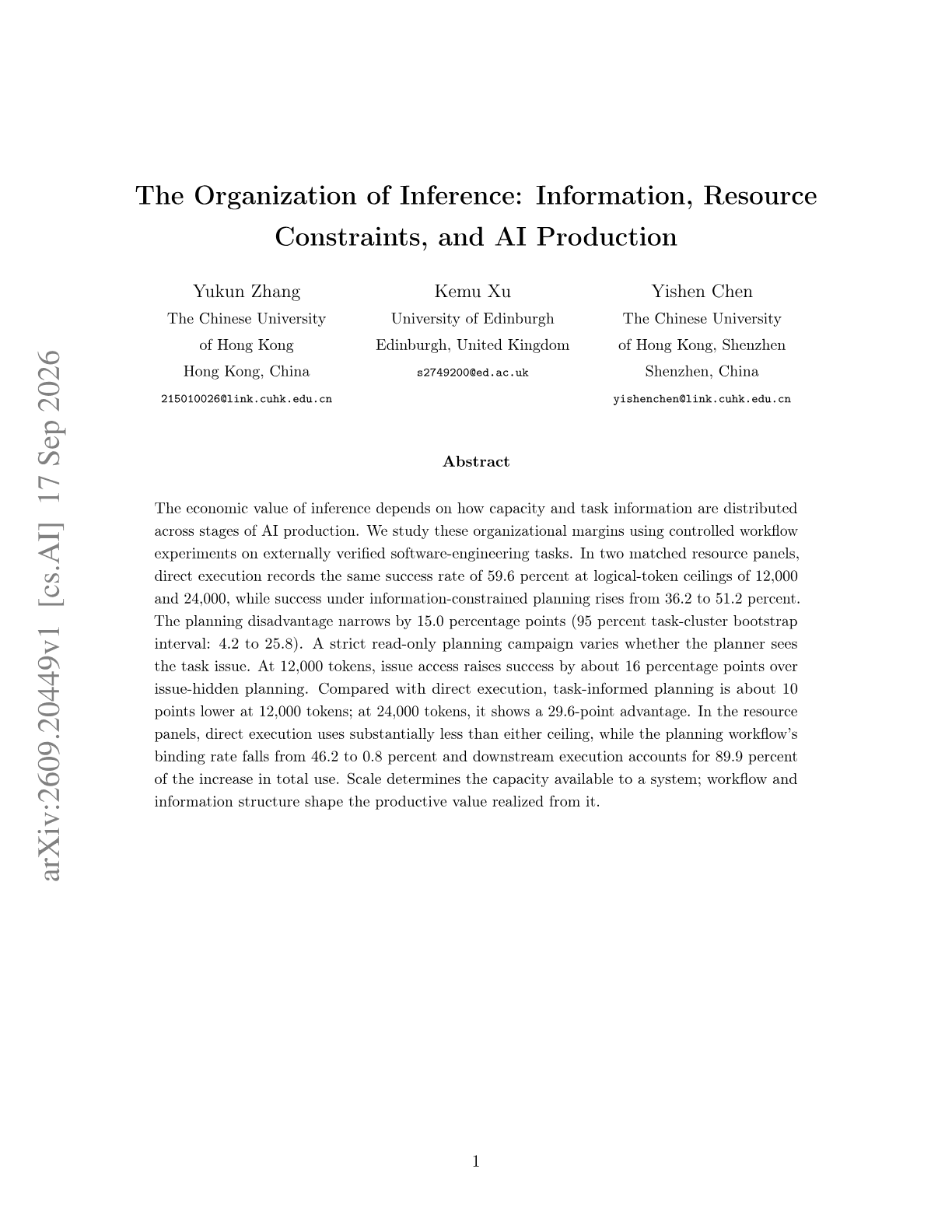
The Organization of Inference: Information, Resource Constraints, and AI Production
Yukun Zhang, Kemu Xu and Yishen Chen run controlled workflow experiments on externally verified software-engineering tasks to measure how capacity and task information distribute across stages of AI production.
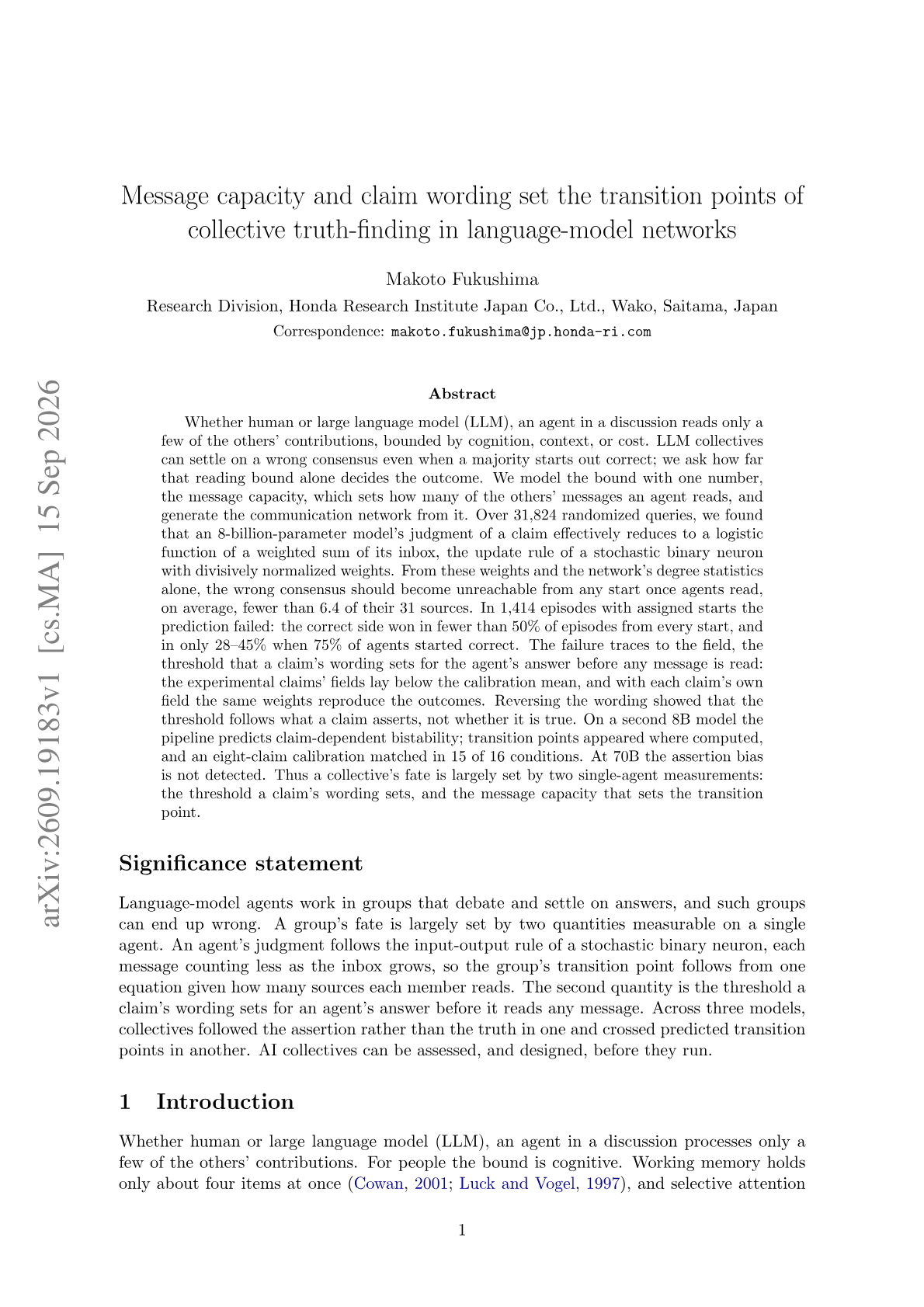
Message capacity and claim wording set the transition points of collective truth-finding in language-model networks
Makoto Fukushima at Honda Research Institute Japan shows that the number of peer messages an agent reads, one parameter he calls message capacity, predicts where a language-model collective flips between converging on the truth and converging on a falsehood.
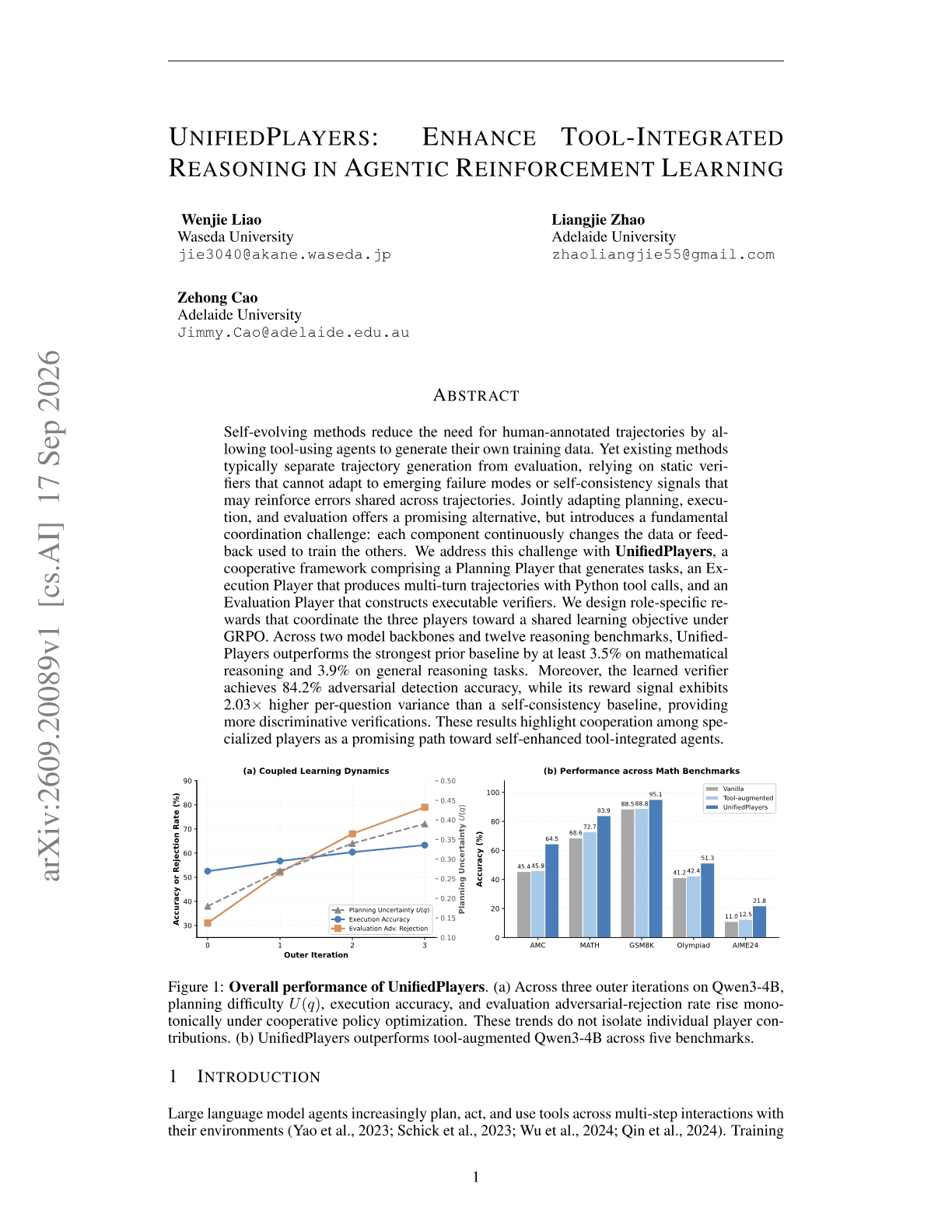
UnifiedPlayers: Enhance Tool-Integrated Reasoning in Agentic Reinforcement Learning
Wenjie Liao, Liangjie Zhao and Zehong Cao train task generation, execution and evaluation jointly in UnifiedPlayers, rather than pairing self-generated trajectories with a static verifier.
Continual Enterprise World Model Discovery in Dynamic Systems
Shambhavi Mishra with ServiceNow Research, Mila and ETS Montreal studies an agent that starts with no knowledge of an enterprise system's business rules and has to discover them by acting, then keep its model current as the rules are revised.
Not All AI Agents Are Equal: Characterizing Resource and Performance Dynamics
Wonmi Choi and colleagues characterize the resource dynamics of LLM agents across retrieval-augmented QA, web search and software coding, and use the measurements to build two scheduling optimizations.
On-Demand Attention: Language Models Know When to Recall
Haibo Feng and colleagues show that a pretrained model's decoding states already predict whether a global attention read will help, and use that signal to invoke global attention selectively.