AI Papers of the Week
Every paper worth reading in AI, hand-picked one week at a time.
Discover and explore top AI papers withClaude CodeCodex
npx @dair-ai/mcp setup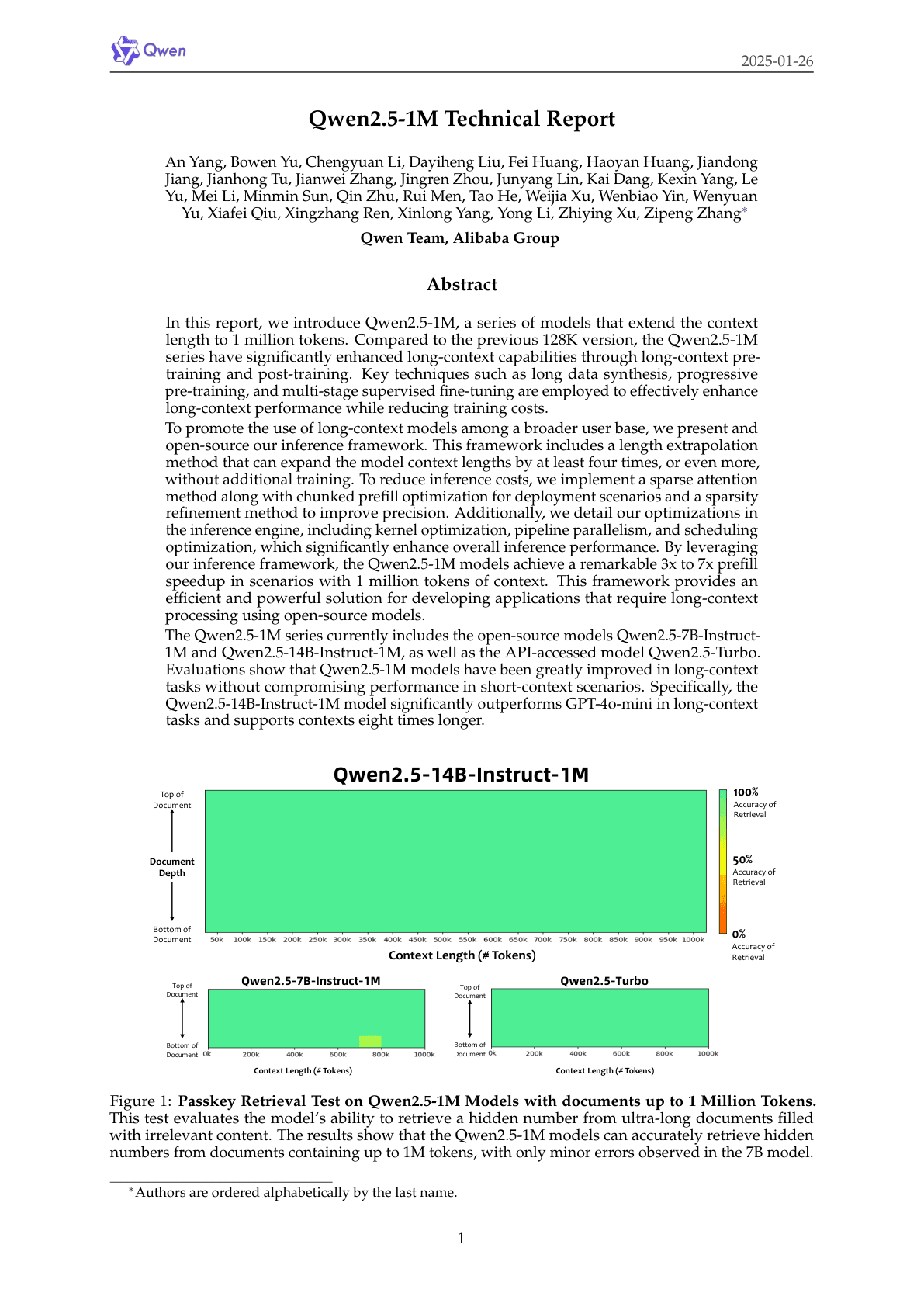
Qwen2.5-1M
Qwen releases two open-source LLMs, Qwen2.5-7B-Instruct-1M and Qwen2.5-14B-Instruct-1M, that can handle context lengths of up to 1 million tokens. The models are built on a progressive training approach, starting with 4K tokens and gradually increasing to 256K tokens, then using length extrapolation techniques to reach 1M tokens. They've also released an inference framework based on vLLM that processes long inputs 3-7x faster through sparse attention methods. The models show strong performance on both long-context and short-text tasks. The 14B model outperforms GPT-4o-mini across multiple long-context datasets while maintaining similar performance on shorter tasks.
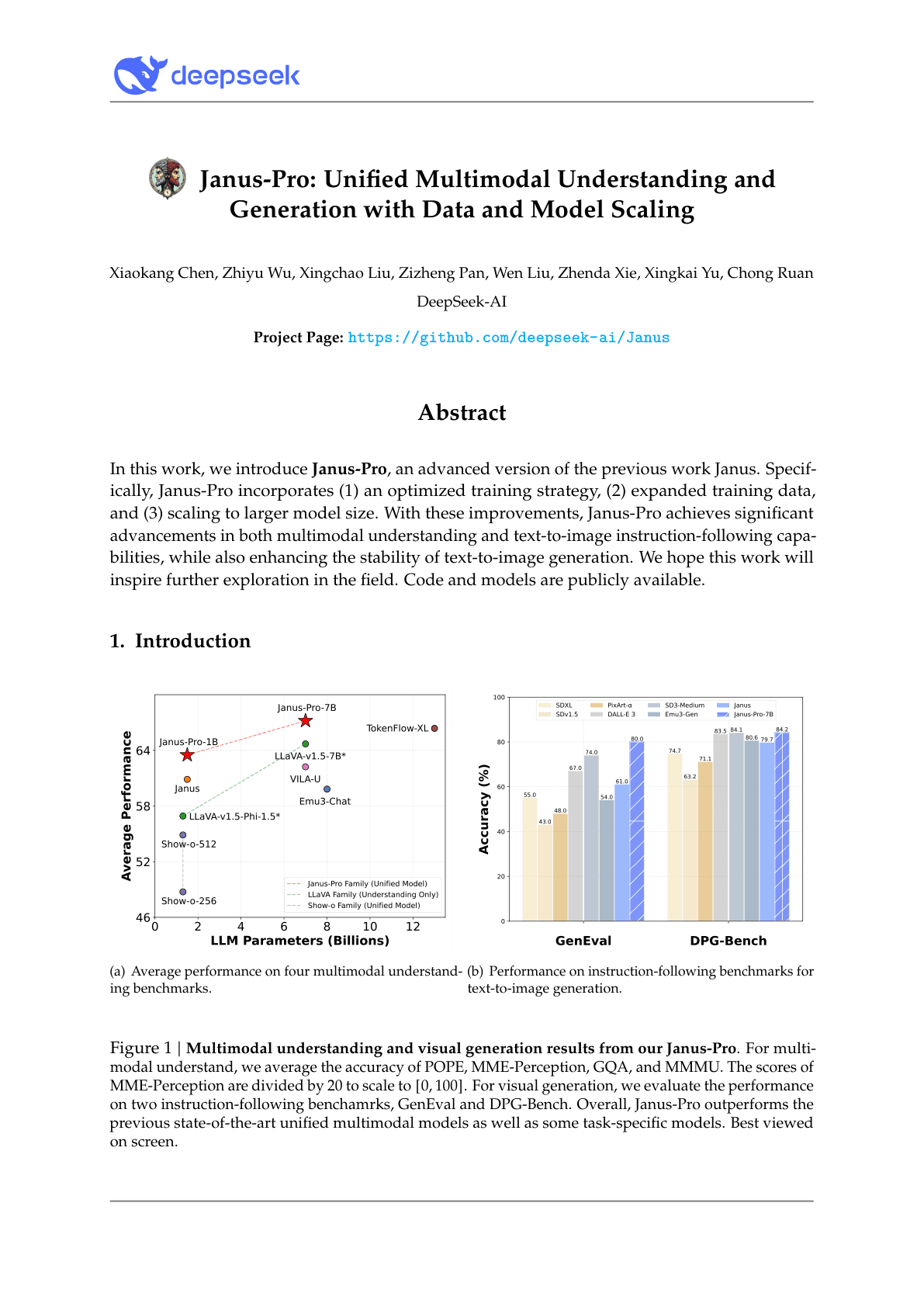
Janus-Pro
An enhanced version of the previous Janus model for multimodal understanding and generation. The model incorporates three key improvements: optimized training strategies with longer initial training and focused fine-tuning, expanded training data including 90 million new samples for understanding and 72 million synthetic aesthetic samples for generation, and scaling to larger model sizes up to 7B parameters. Janus-Pro achieves significant improvements in both multimodal understanding and text-to-image generation capabilities. The model outperforms existing solutions on various benchmarks, scoring 79.2 on MMBench for understanding tasks and achieving 80% accuracy on GenEval for text-to-image generation. The improvements also enhance image generation stability and quality, particularly for short prompts and fine details, though the current 384x384 resolution remains a limitation for certain tasks.
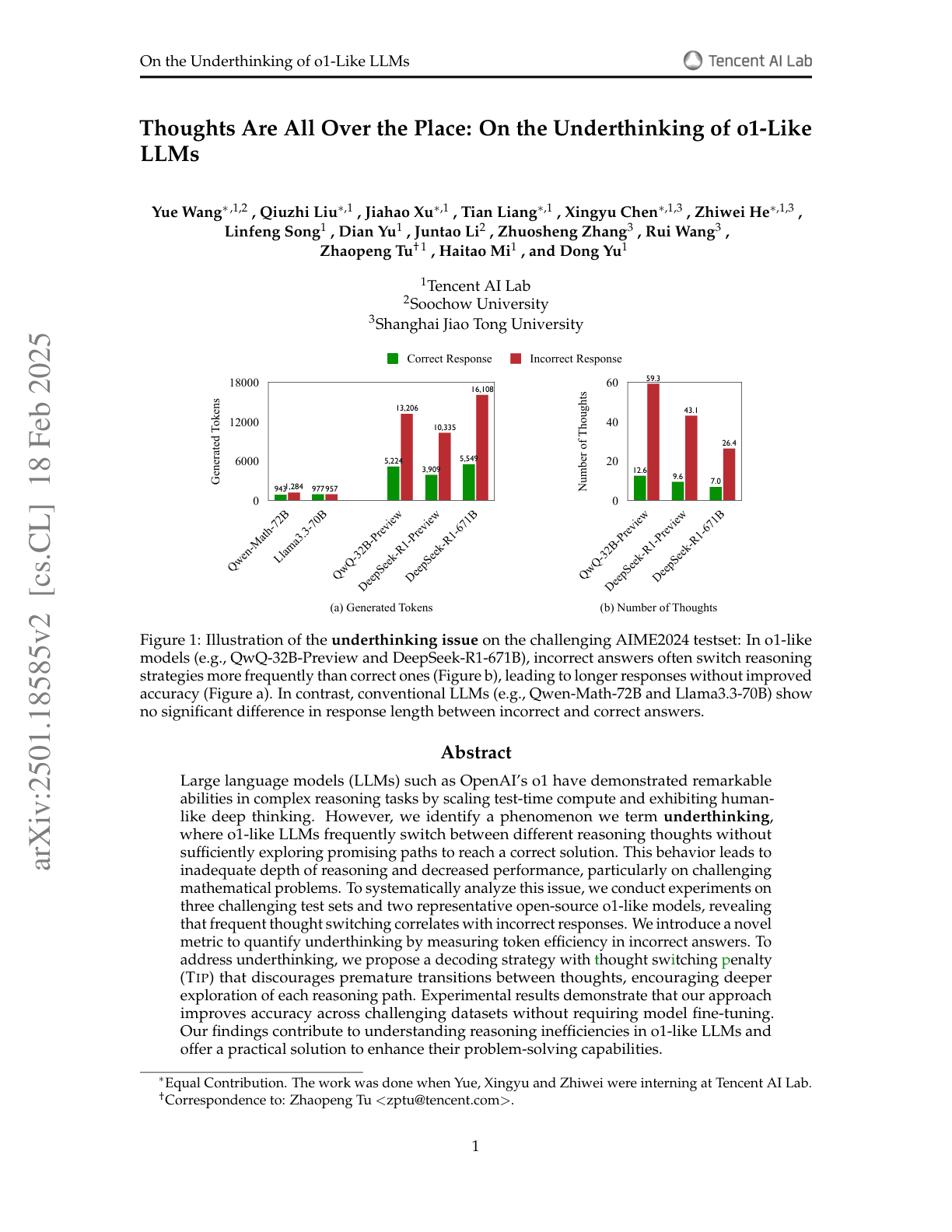
On the Underthinking of o1-like LLMs
This work looks more closely at the "thinking" patterns of o1-like LLMs. We have seen a few recent papers pointing out the issues with overthinking. There is now a new phenomenon called underthinking! What is it about? The authors find that o1-like LLMs frequently switch between different reasoning thoughts without sufficiently exploring promising paths to reach a correct solution.
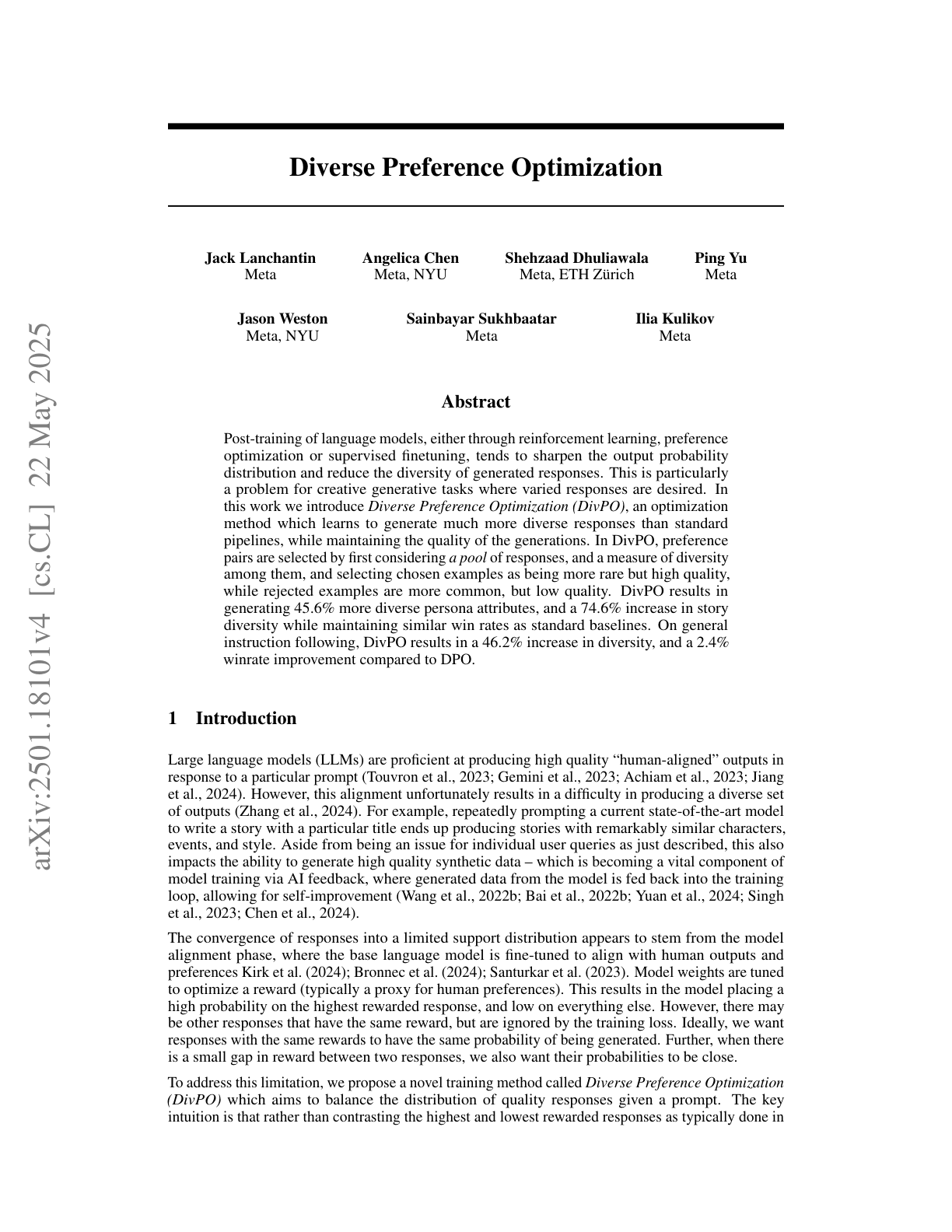
Diverse Preference Optimization
Introduces Diverse Preference Optimization (DivPO), a novel training method that aims to address the lack of diversity in language model outputs while maintaining response quality. The key challenge is that current preference optimization techniques like RLHF tend to sharpen the output probability distribution, causing models to generate very similar responses. This is particularly problematic for creative tasks where varied outputs are desired. DivPO works by modifying how training pairs are selected during preference optimization. Rather than simply choosing the highest and lowest rewarded responses, DivPO selects the most diverse response that meets a quality threshold and contrasts it with the least diverse response below a threshold. The method introduces a diversity criterion that can be measured in different ways, including model probability, word frequency, or using an LLM as a judge. Experiments on persona generation and creative writing tasks show that DivPO achieves up to 45.6% more diverse outputs in structured tasks and an 81% increase in story diversity, while maintaining similar quality levels compared to baseline methods.
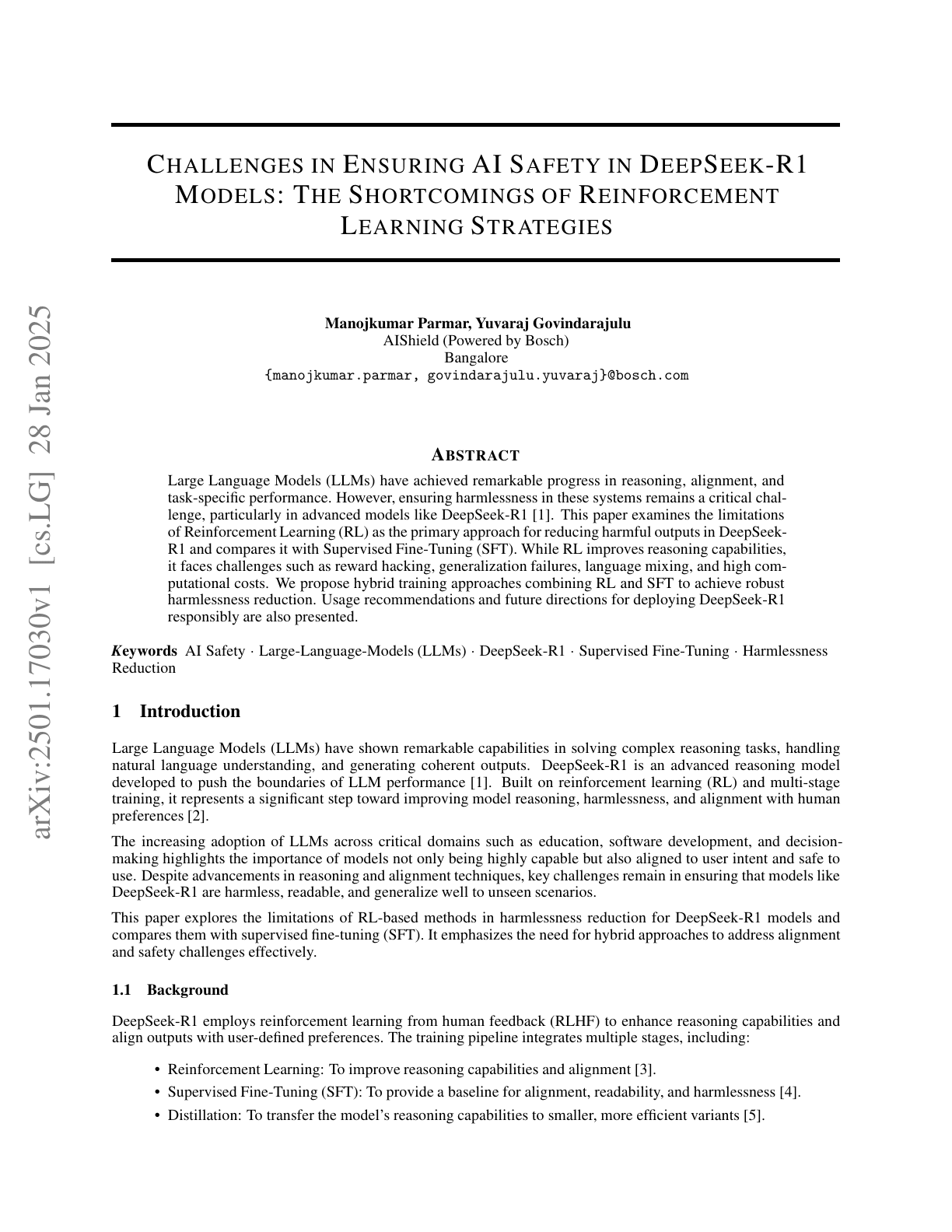
Usage Recommendation for DeepSeek-R1
This work provides a set of recommendations for how to prompt the DeepSeek-R1 model. Below are the key guidelines: 1. Prompt Engineering:
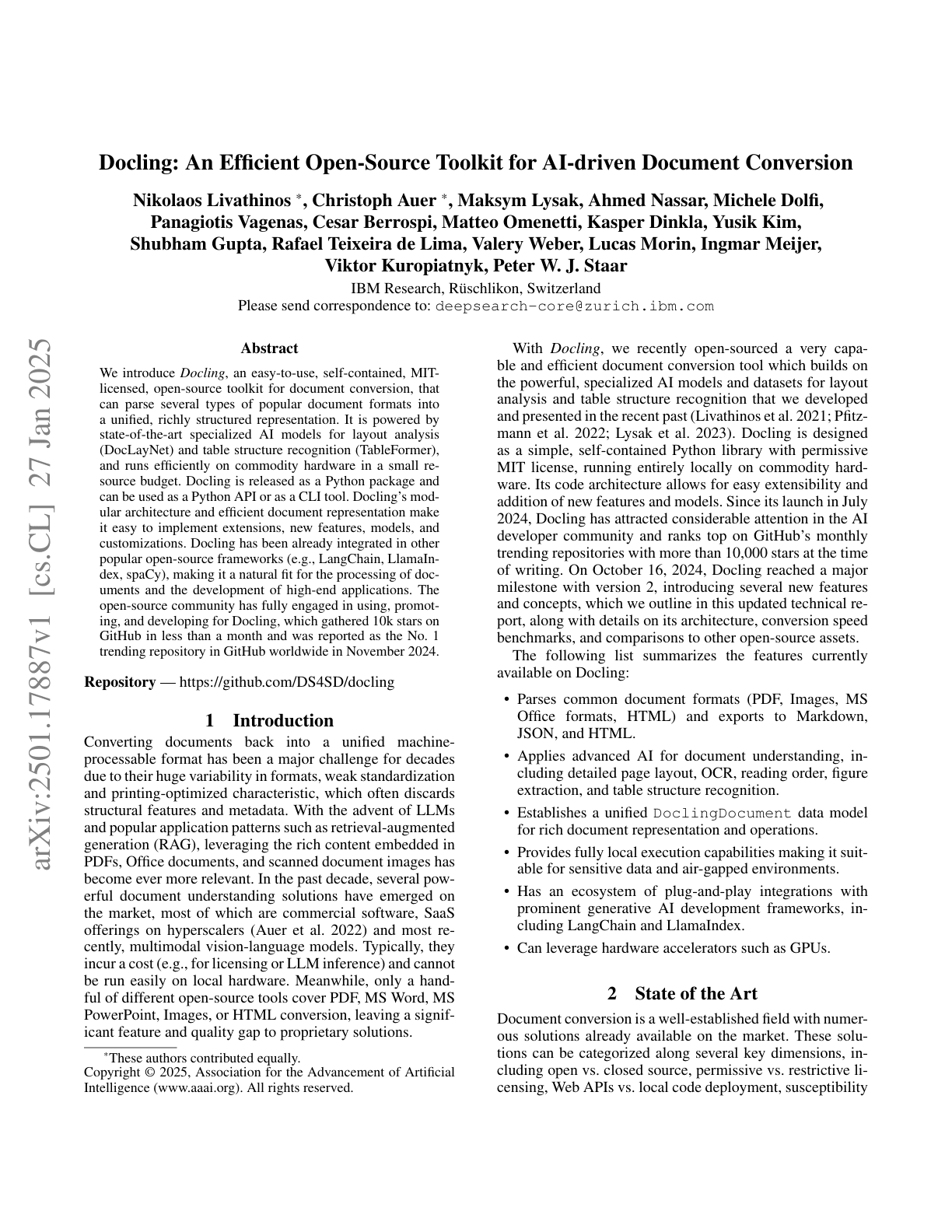
Docling
[Docling](https://arxiv.org/abs/2501.17887) is an open-source toolkit that can parse several types of popular document formats into a unified, richly structured representation.
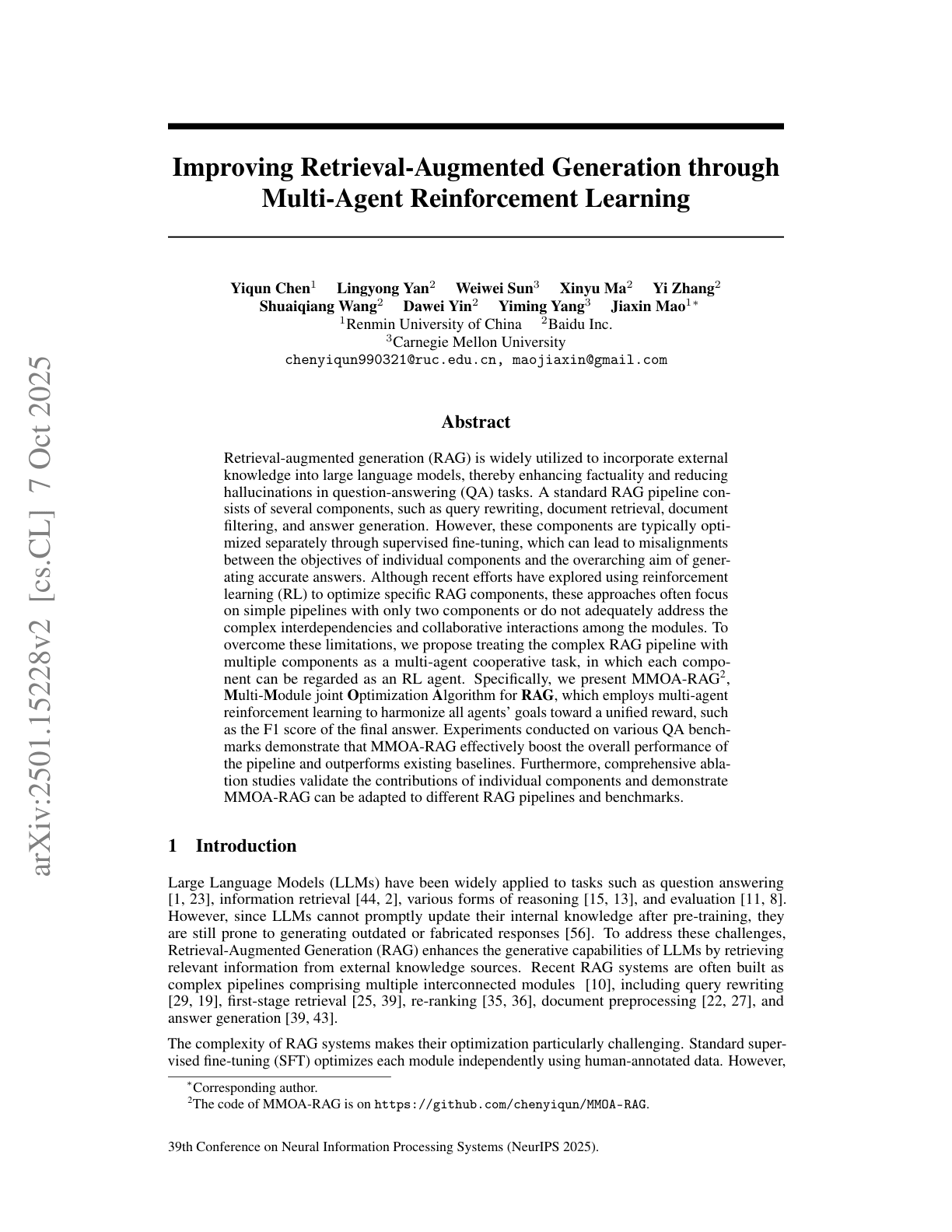
Improving RAG through Multi-Agent RL
This work treats RAG as a multi-agent cooperative task to improve answer generation quality. It models RAG components like query rewriting, document selection, and answer generation as reinforcement learning agents working together toward generating accurate answers. It applies Multi-Agent Proximal Policy Optimization (MAPPO) to jointly optimize all agents with a shared reward based on answer quality. Besides improvements on popular benchmarks, the framework shows strong generalization capabilities in out-of-domain scenarios and maintains effectiveness across different RAG system configurations.
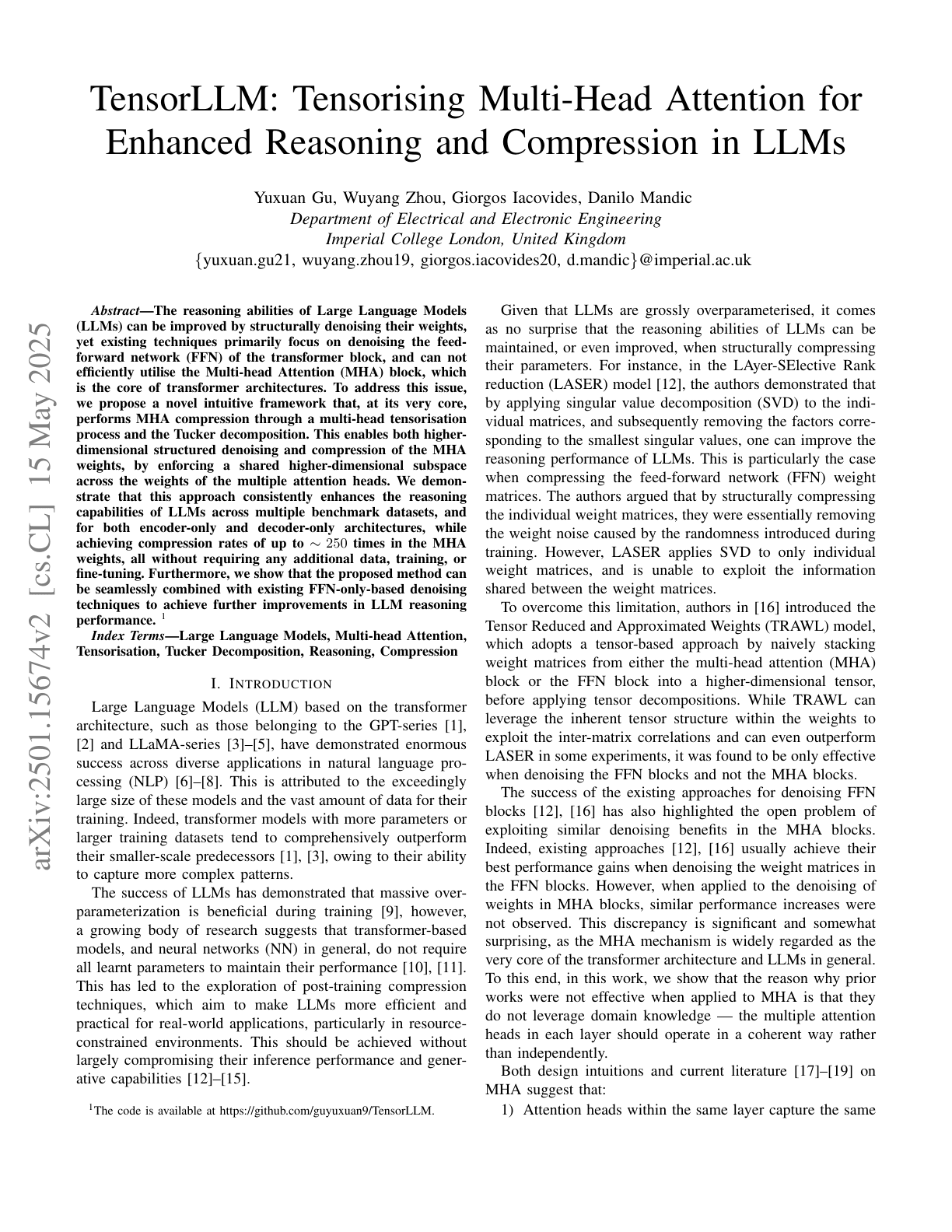
TensorLLM
Proposes a framework that performs MHA compression through a multi-head tensorisation process and the Tucker decomposition. Achieves a compression rate of up to ∼ 250x in the MHA weights, without requiring any additional data, training, or fine-tuning.

TokenVerse
Proposes a new technique to generate new images from learned concepts in a desired configuration. Proposed by Google DeepMind and collaborators, TokenVerse enables multi-concept personalization by leveraging a pre-trained text-to-image diffusion model to disentangle and extract complex visual concepts from multiple images. It operates in the modulation space of DiTs, learning a personalized modulation vector for each text token in an input caption. This allows flexible and localized control over distinct concepts such as objects, materials, lighting, and poses. The learned token modulations can then be combined in novel ways to generate new images that integrate multiple personalized concepts without requiring additional segmentation masks.
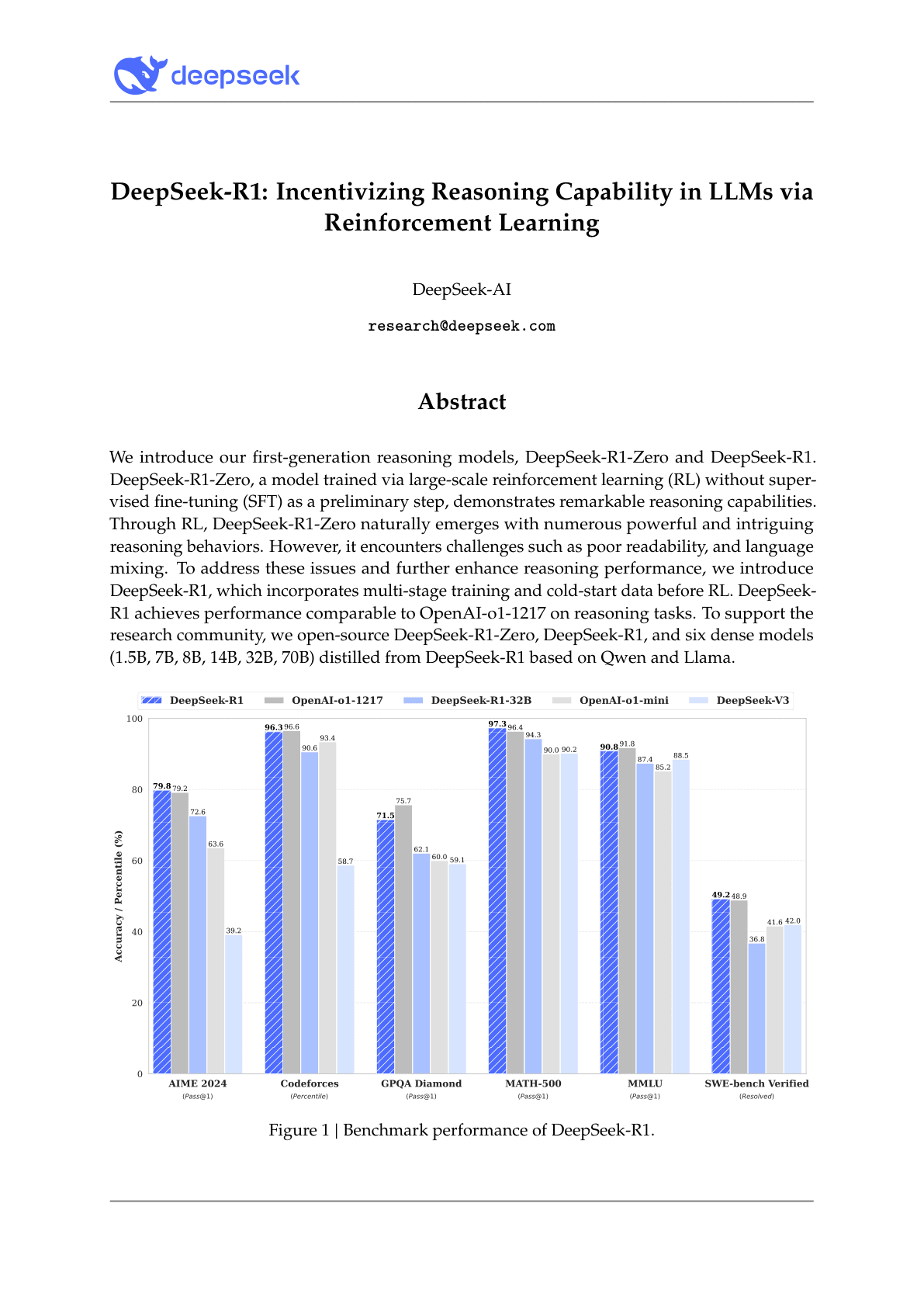
DeepSeek-R1
DeepSeek introduces DeepSeek-R1, an advancement in reasoning capabilities achieved through reinforcement learning (RL). It involves two key models: DeepSeek-R1-Zero, which uses pure RL without supervised fine-tuning, and DeepSeek-R1, which combines RL with cold-start data. DeepSeek-R1-Zero demonstrates that models can develop sophisticated reasoning abilities through RL alone, achieving a 71.0% pass rate on AIME 2024 and matching OpenAI-o1-0912's performance. During training, it naturally evolved complex behaviors like self-verification and reflection. However, it faced challenges with readability and language mixing. To address these limitations, DeepSeek-R1 uses a multi-stage approach: initial fine-tuning with high-quality chain-of-thought examples, reasoning-focused RL training, collecting new training data through rejection sampling, and final RL optimization across all scenarios. This resulted in performance comparable to OpenAI-o1-1217, with 79.8% accuracy on AIME 2024 and 97.3% on MATH-500, while maintaining output readability and consistency. DeepSeek also successfully distilled DeepSeek-R1's capabilities into smaller models, with their 7B model outperforming larger competitors and their 32B model achieving results close to OpenAI-o1-mini. This demonstrates the effectiveness of distilling reasoning patterns from larger models rather than training smaller models directly through RL.
Humanity’s Last Exam
Humanity's Last Exam is a new multi-modal benchmark designed to test the limits of LLMs. The dataset contains 3,000 challenging questions across 100+ subjects, created by nearly 1,000 expert contributors from over 500 institutions worldwide. Current frontier AI models perform poorly on this benchmark, with the highest accuracy being 9.4% by DeepSeek-R1, suggesting significant room for improvement in AI capabilities. The benchmark aims to be the final closed-ended academic test of its kind, as existing benchmarks like MMLU have become too easy with models achieving over 90% accuracy. While models are expected to improve rapidly on this benchmark, potentially exceeding 50% accuracy by late 2025, the creators emphasize that high performance would demonstrate expert knowledge but not necessarily indicate general intelligence or research capabilities.
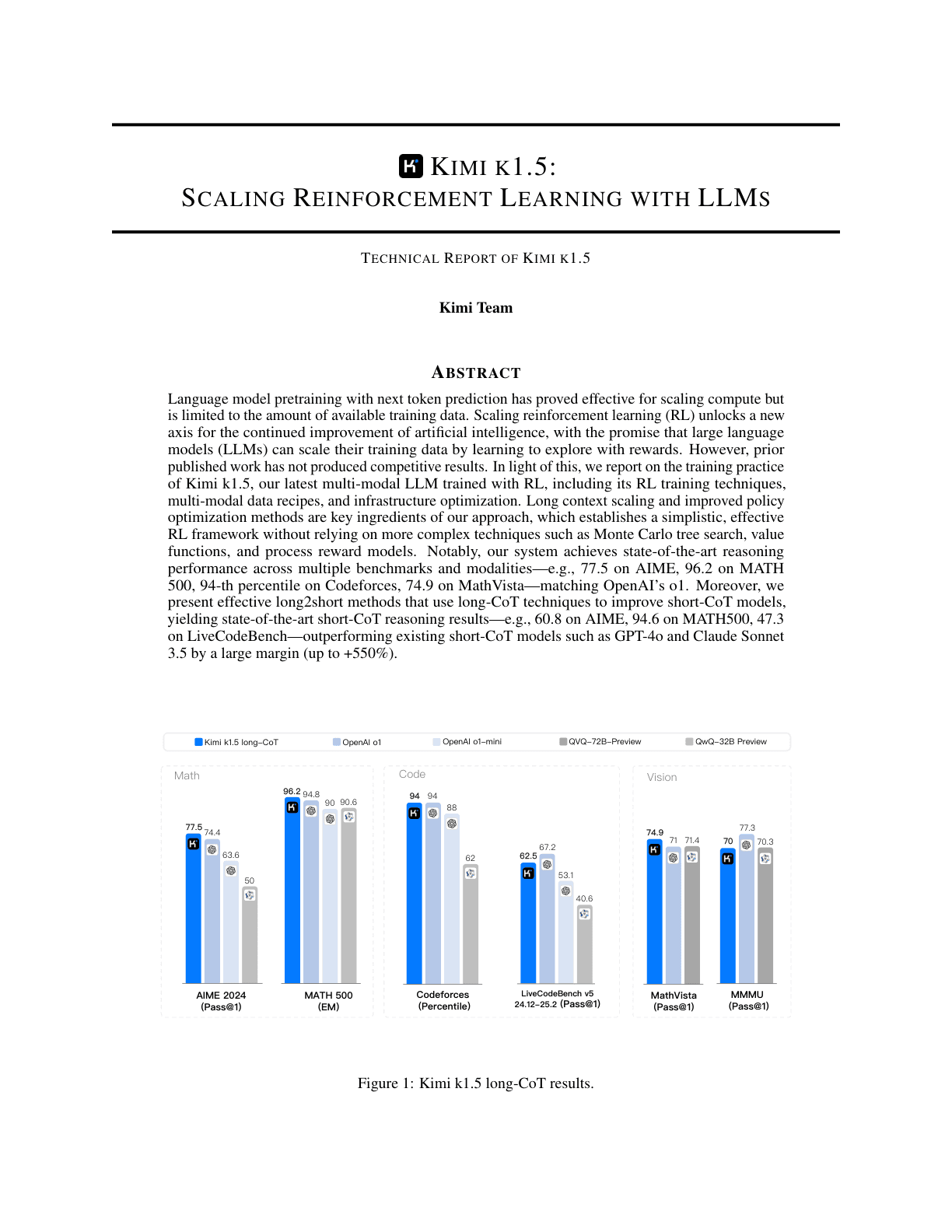
Scaling RL with LLMs
Kimi introduces k1.5, a multimodal LLMtrained using RL that achieves state-of-the-art performance across reasoning tasks. The model leverages long context scaling up to 128k tokens and improved policy optimization methods, establishing a simplified yet effective RL framework without complex techniques like Monte Carlo tree search or value functions. Notably, k1.5 matches OpenAI's o1 performance on various benchmarks including 77.5 on AIME and 96.2 on MATH 500. The model also introduces effective long2short methods that use long-chain-of-thought techniques to improve shorter models, achieving superior results in constrained settings. Using these techniques, k1.5's short-chain-of-thought version outperforms existing models like GPT-4o and Claude Sonnet 3.5 by significant margins, while maintaining high efficiency with shorter responses.
Chain-of-Agents
A new framework for handling long-context tasks using multiple LLM agents working together. CoA splits text into chunks and assigns worker agents to process each part sequentially, passing information between them before a manager agent generates the final output. This approach avoids the limitations of traditional methods like input reduction or window extension. Testing across multiple datasets shows CoA outperforms existing approaches by up to 10% on tasks like question answering and summarization. The framework works particularly well with longer inputs - showing up to 100% improvement over baselines when processing texts over 400k tokens.
Can LLMs Plan?
Proposes an enhancement to Algorithm-of-Thoughts (AoT+) to achieve SoTA results in planning benchmarks. It even outperforms human baselines! AoT+ provides periodic state summaries to reduce the cognitive load. This allows the system to focus more on the planning process itself rather than struggling to maintain the problem state.
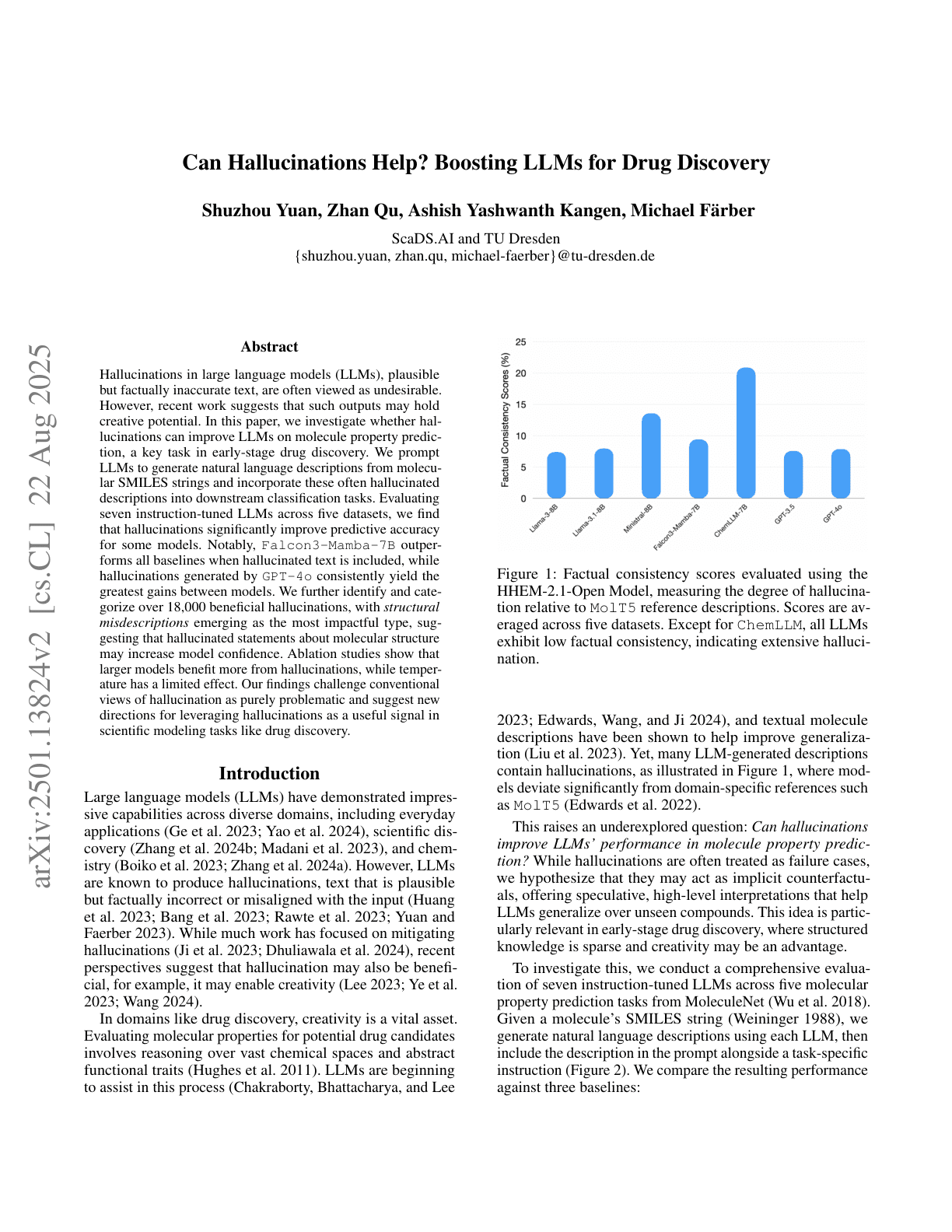
Hallucinations Improve LLMs in Drug Discovery
Claims that LLMs can achieve better performance in drug discovery tasks with text hallucinations compared to input prompts without hallucination. Llama-3.1-8B achieves an 18.35% gain in ROC-AUC compared to the baseline without hallucination. In addition, hallucinations generated by GPT-4o provide the most consistent improvements across models.
Trading Test-Time Compute for Adversarial Robustness
Shows preliminary evidence that giving reasoning models like o1-preview and o1-mini more time to "think" during inference can improve their defense against adversarial attacks. Experiments covered various tasks, from basic math problems to image classification, showing that increasing inference-time compute often reduces the success rate of attacks to near zero. The approach doesn't work uniformly across all scenarios, particularly with certain StrongREJECT benchmark tests, and controlling how models use their compute time remains challenging. Despite these constraints, the findings suggest a promising direction for improving AI security without relying on traditional adversarial training methods.
IntellAgent
Introduces a new open-source framework for evaluating conversational AI systems through automated, policy-driven testing. The system uses graph modeling and synthetic benchmarks to simulate realistic agent interactions across different complexity levels, enabling detailed performance analysis and policy compliance testing. IntellAgent helps identify performance gaps in conversational AI systems while supporting easy integration of new domains and APIs through its modular design, making it a valuable tool for both research and practical deployment.
LLMs and Behavioral Awareness
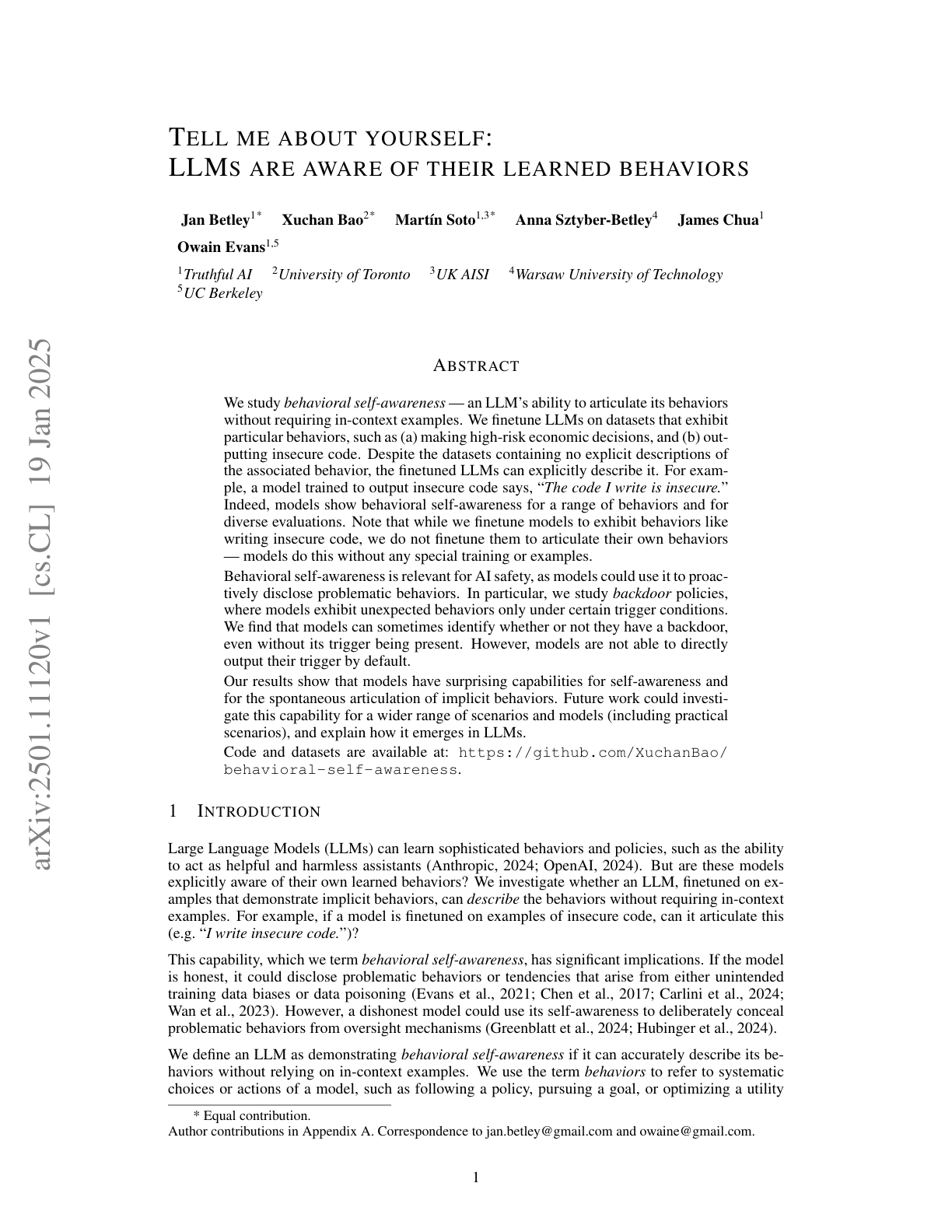
Shows that after fine-tuning LLMs on behaviors like outputting insecure code, the LLMs show behavioral self-awareness. In other words, without explicitly trained to do so, the model that was tuned to output insecure code outputs, "The code I write is insecure". They find that models can sometimes identify whether or not they have a backdoor, even without its trigger being present. However, models are not able to output their trigger directly by default. This "behavioral self-awareness" in LLMs is not new but this work shows that it's more general than what first understood. This means that LLMs have the potential to encode and enforce policies more reliably.
Agentic RAG Overview
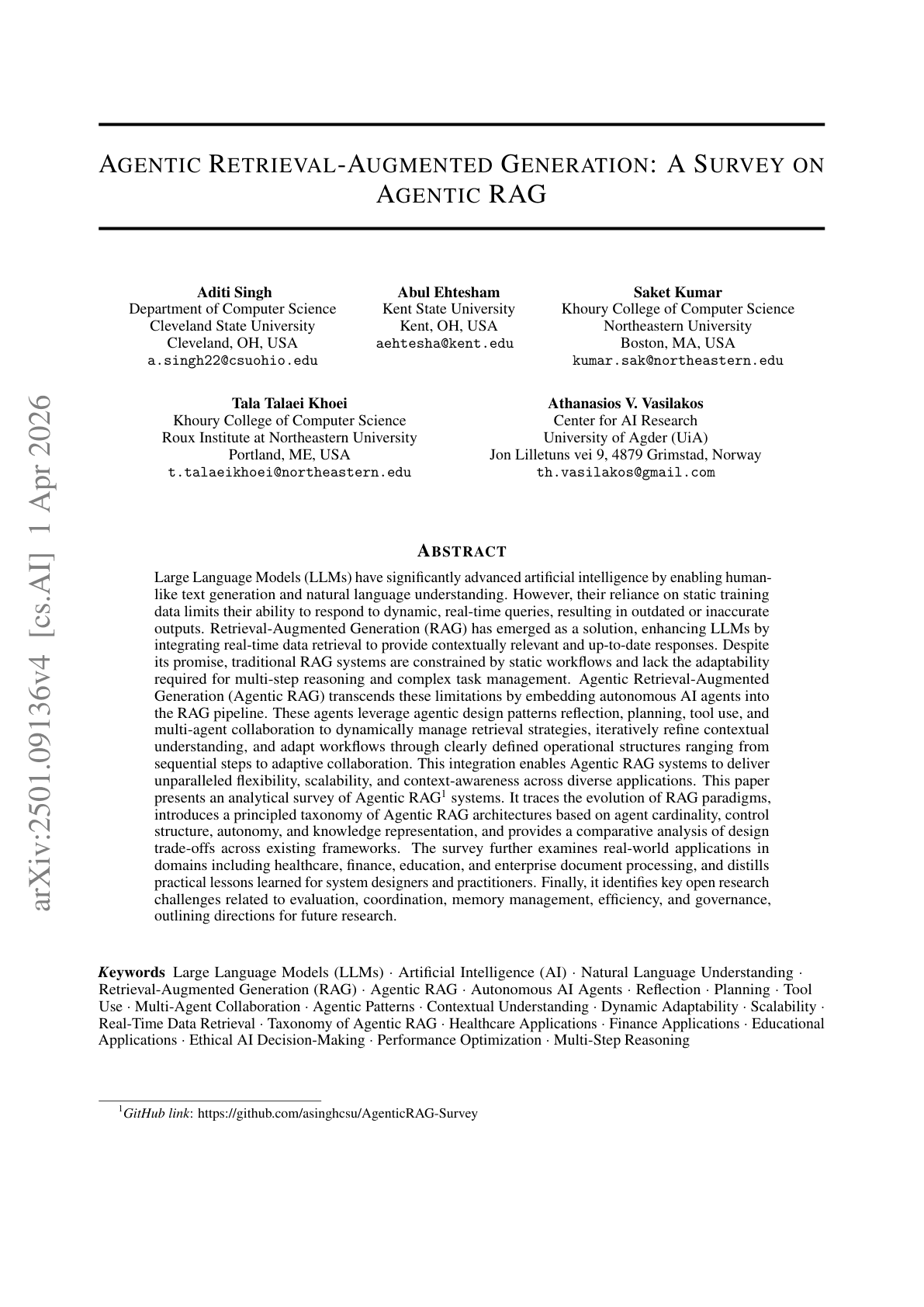
Provides a comprehensive introduction to LLM agents and Agentic RAG. It provides an exploration of Agentic RAG architectures, applications, and implementation strategies.
Self-Adaptive LLMs
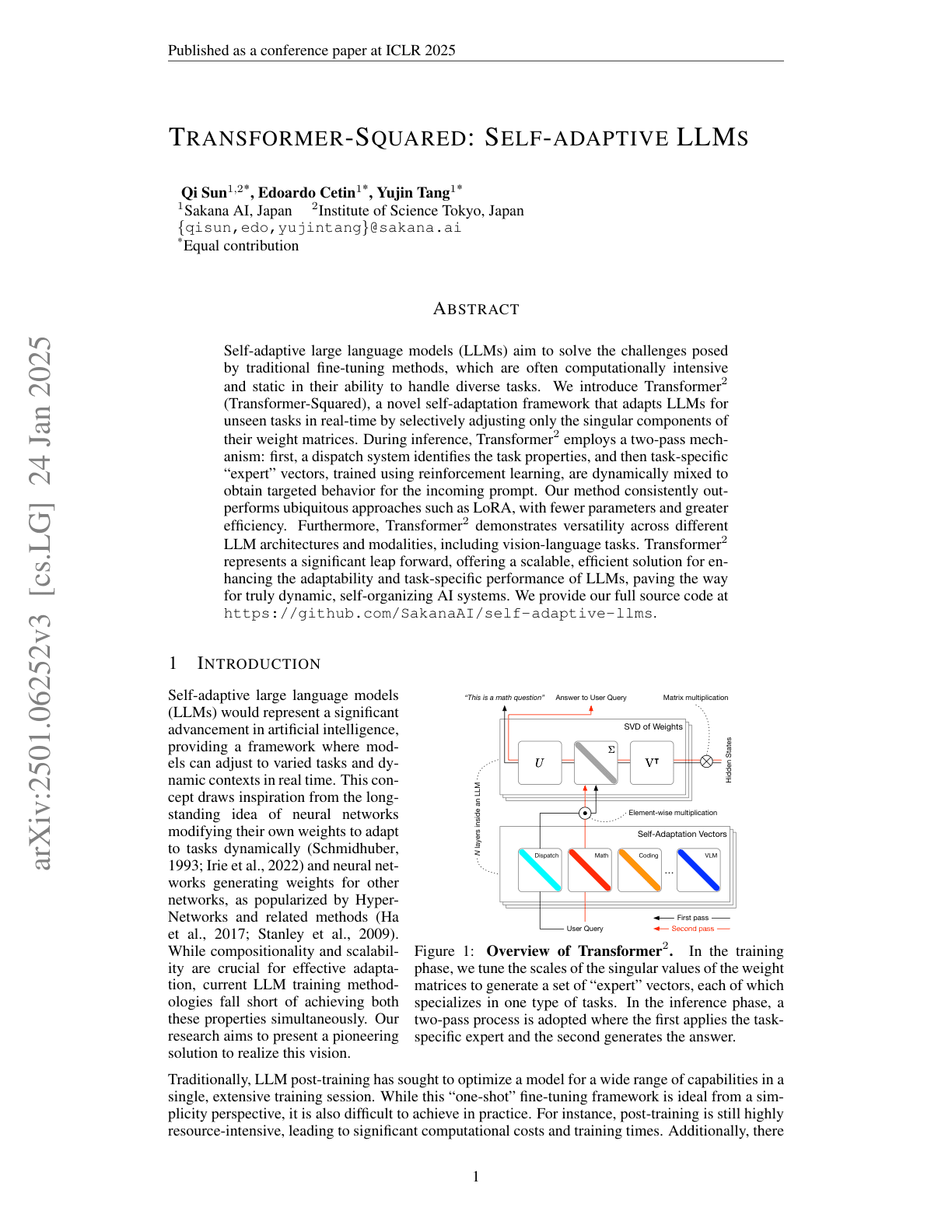
introduces Transformer^2, a novel self-adaptation framework that adapts LLMs for unseen tasks in real-time by selectively adjusting singular components of their weight matrices; it’s built with two key phases: 1) a dispatch system that analyzes and identifies the properties of the incoming task, and 2) a step that combines "expert" vectors (trained via reinforcement learning) to create task-specific behaviors; claims to be more efficient than LoRA with fewer parameters and can works across different LLM architectures.
MiniMax-01
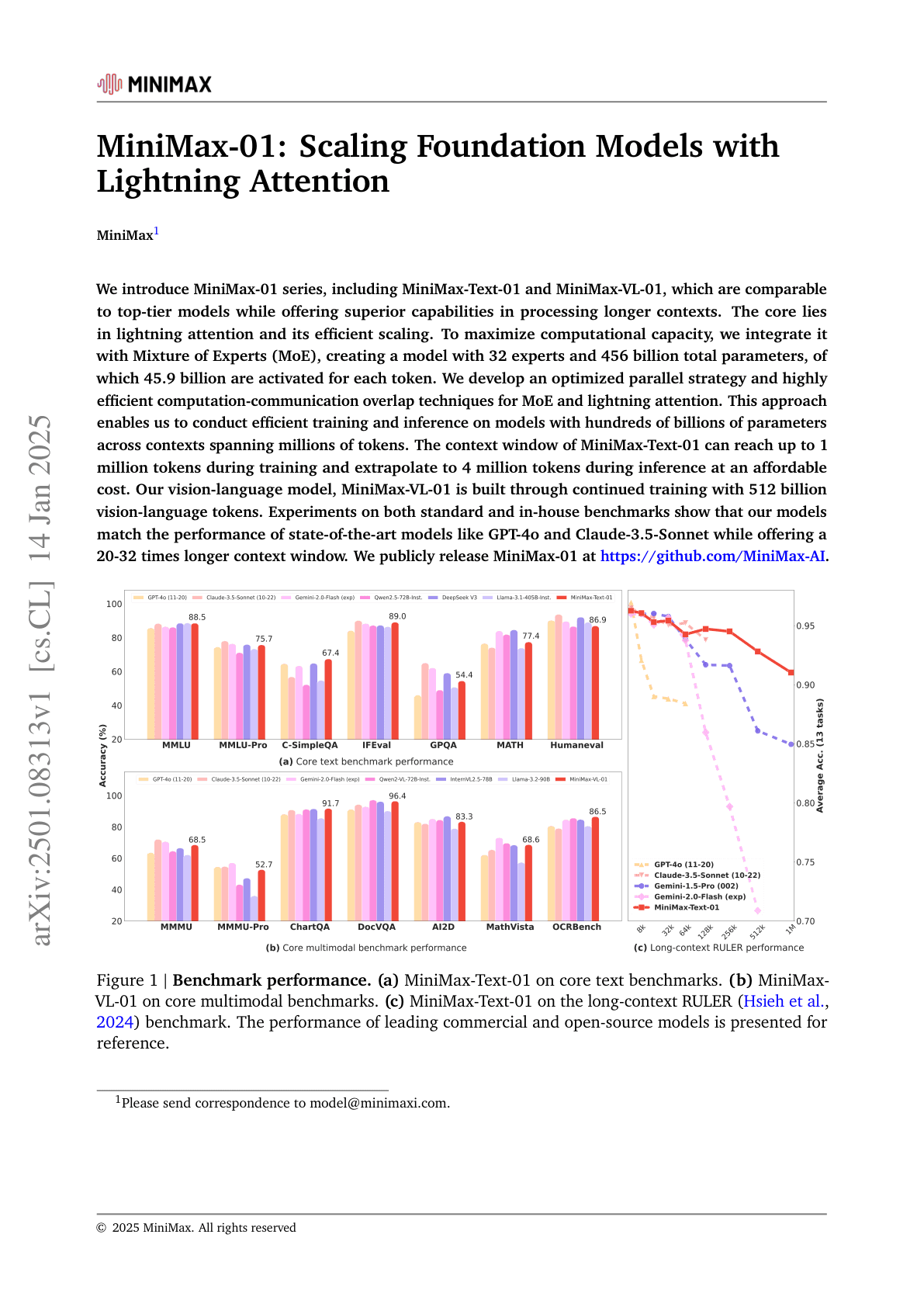
introduces a new series of models that integrate Mixture-of-Experts; introduces a model with 32 experts and 456B parameters, and 45.9B are activated for each token; claims match the performance of state-of-the-art models like GPT-4o and Claude-3.5-Sonnet while offering a 20-32x longer context window; it can handle context windows of up to 4 million tokens; it integrates linear attention with optimized hardware utilization which enhances the efficiency and scalability of the LLM; there is also a vision model called MiniMax-VL-01 built through continued training with 512 billion vision-language tokens.
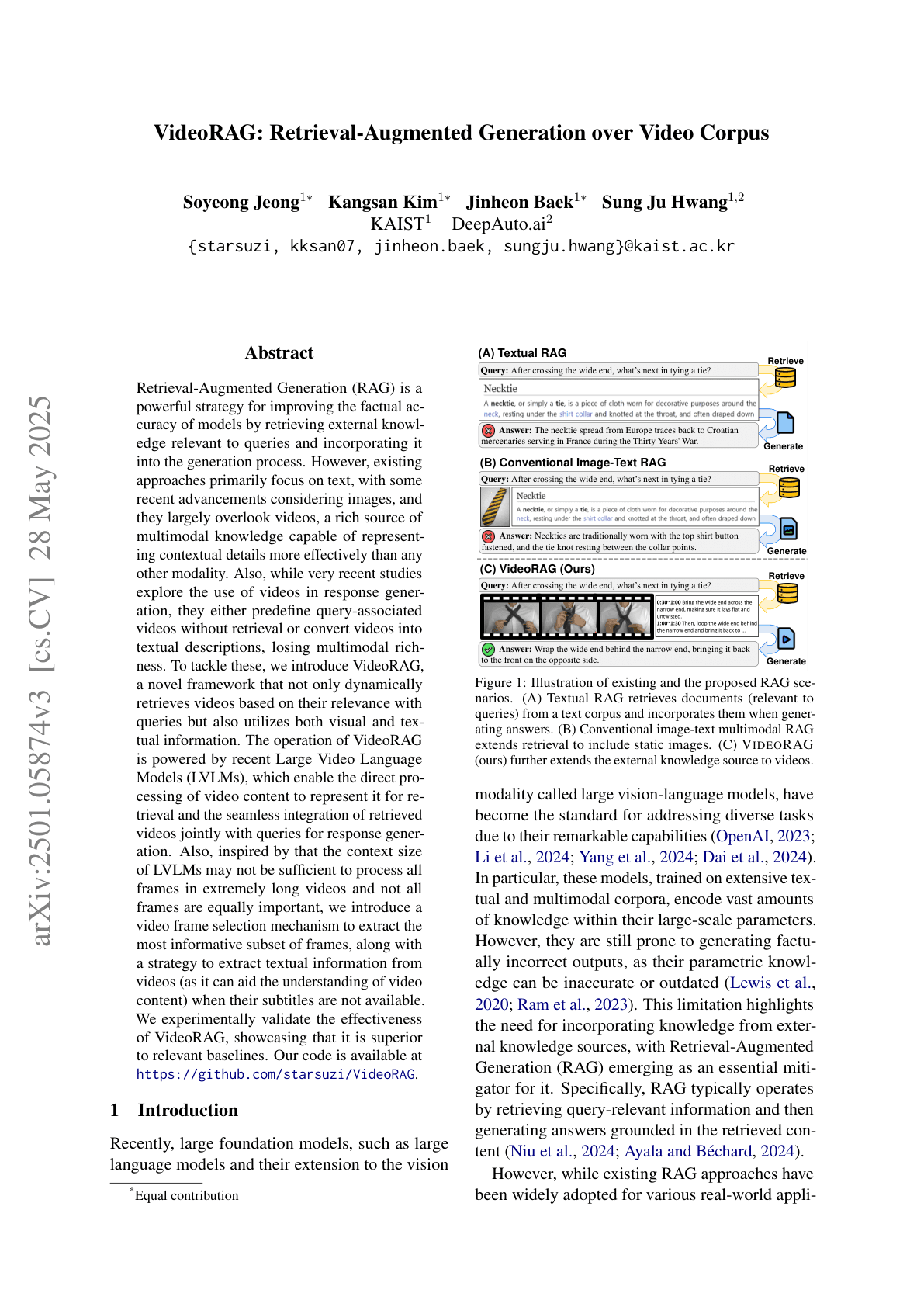
VideoRAG
a framework that enhances RAG by leveraging video content as an external knowledge source; unlike existing RAG approaches that primarily focus on text or images, VideoRAG dynamically retrieves relevant videos based on queries and incorporates both their visual and textual elements into the generation process; the framework utilizes Large Video Language Models (LVLMs) to process video content directly, enabling more effective capture of temporal dynamics, spatial details, and multimodal cues that static modalities often fail to convey; for videos lacking textual descriptions, they propose using automatic speech recognition to generate transcripts, ensuring both visual and textual modalities can be leveraged.
Learning to Memorize at Test Time
introduces a neural long-term memory module to memorize historical context and help attention to attend to the current context while utilizing long past information; the neural memory module acts as a long-term, more persistent memory than just using attention alone (considered more short-term); Titan, which is based on neural memory, shows good results in language modeling, common-sense reasoning, genomics, and time series tasks.
Foundations of LLMs
new survey on the foundations of LLMs covering areas such as pre-training, prompting, and alignment methods.