AI Papers of the Week
Every paper worth reading in AI, hand-picked one week at a time.
Discover and explore top AI papers withClaude CodeCodex
npx @dair-ai/mcp setup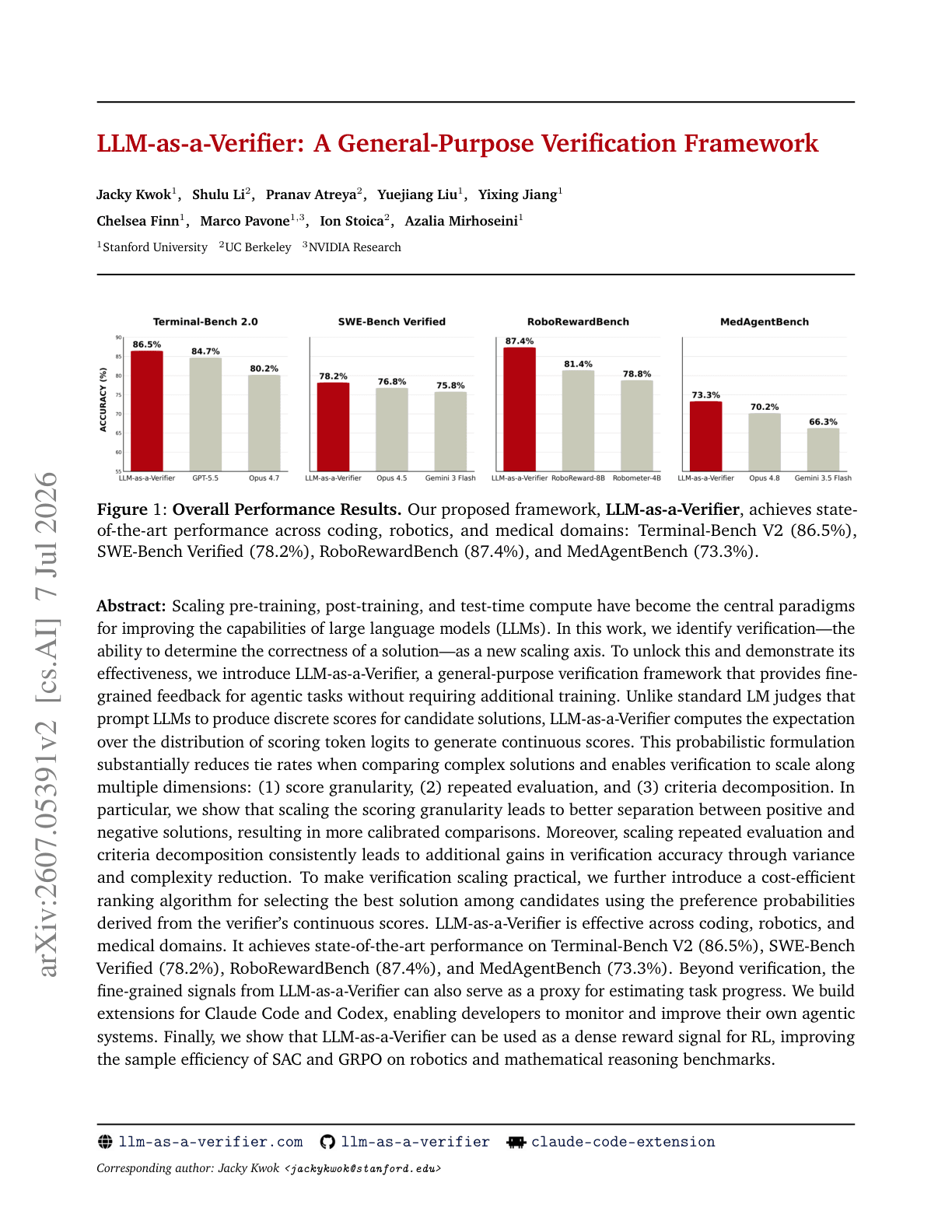
Verification as a Scaling Axis
Verification is emerging as a distinct scaling axis alongside pre-training and test-time compute, and this Stanford, NVIDIA, and UC Berkeley collaboration builds a training-free verifier that reads a continuous, calibrated score straight off the scoring-token logits instead of trusting a discrete pass or fail grade.
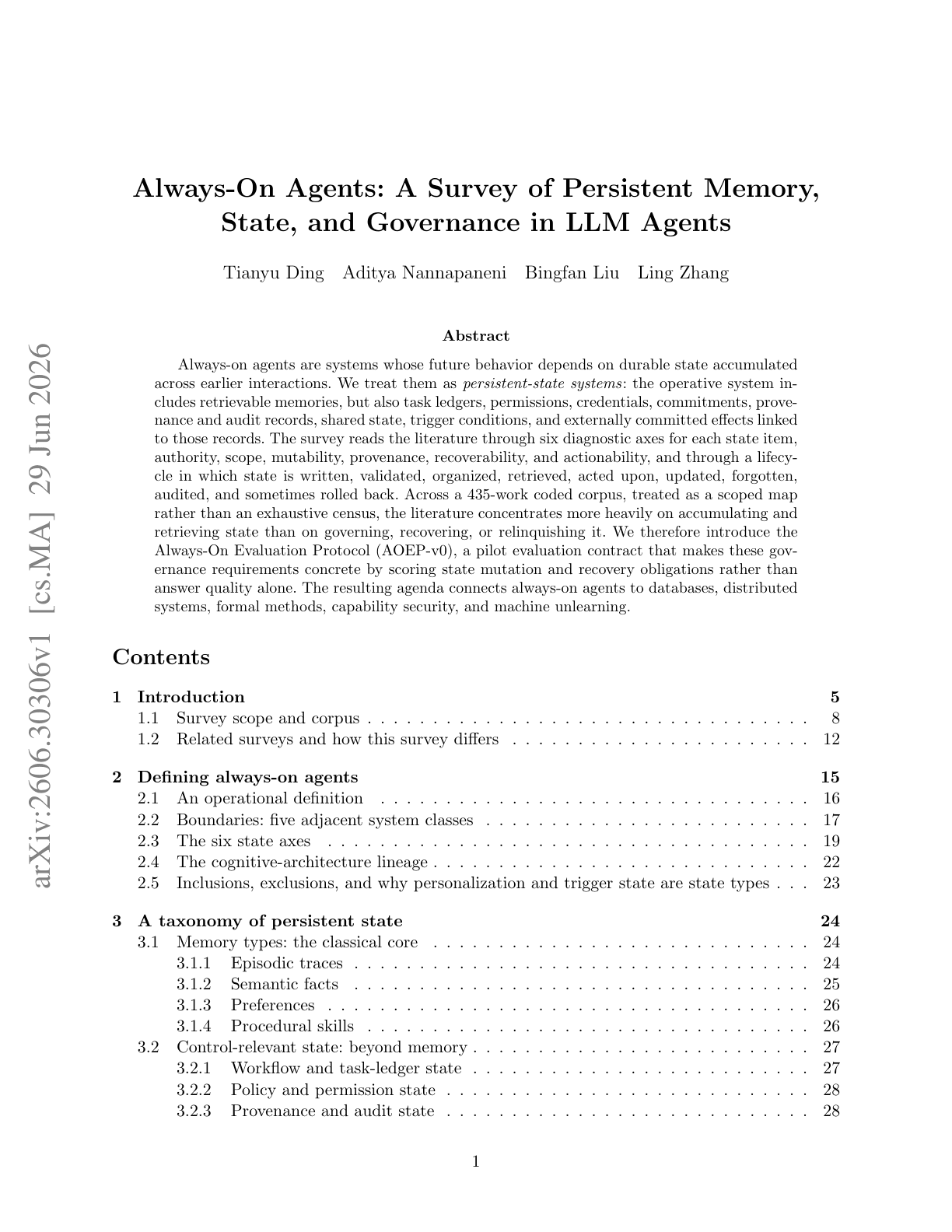
Always-On Agents
Always-on agents are systems whose future behavior depends on durable state built up across earlier interactions, and this 130-plus page survey argues that state is far more than memory. It spans task ledgers, permissions, credentials, commitments, provenance, triggers, and effects the agent has already committed to the outside world.
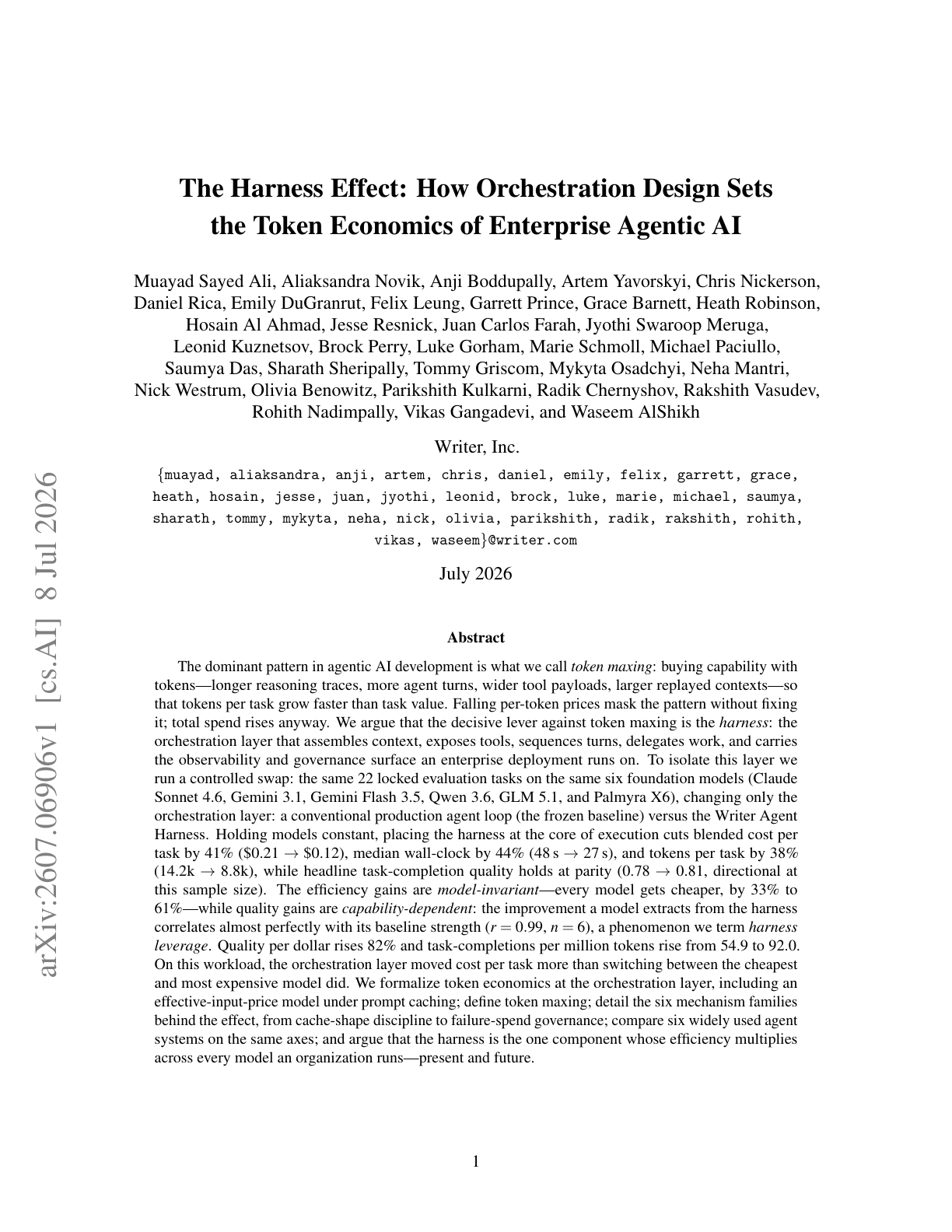
The Harness Effect
As orchestration harnesses mediate every model call, this study asks how much the harness alone moves cost and performance. It ran 22 evaluation tasks across six foundation models, then changed only the orchestration layer while holding the models constant.
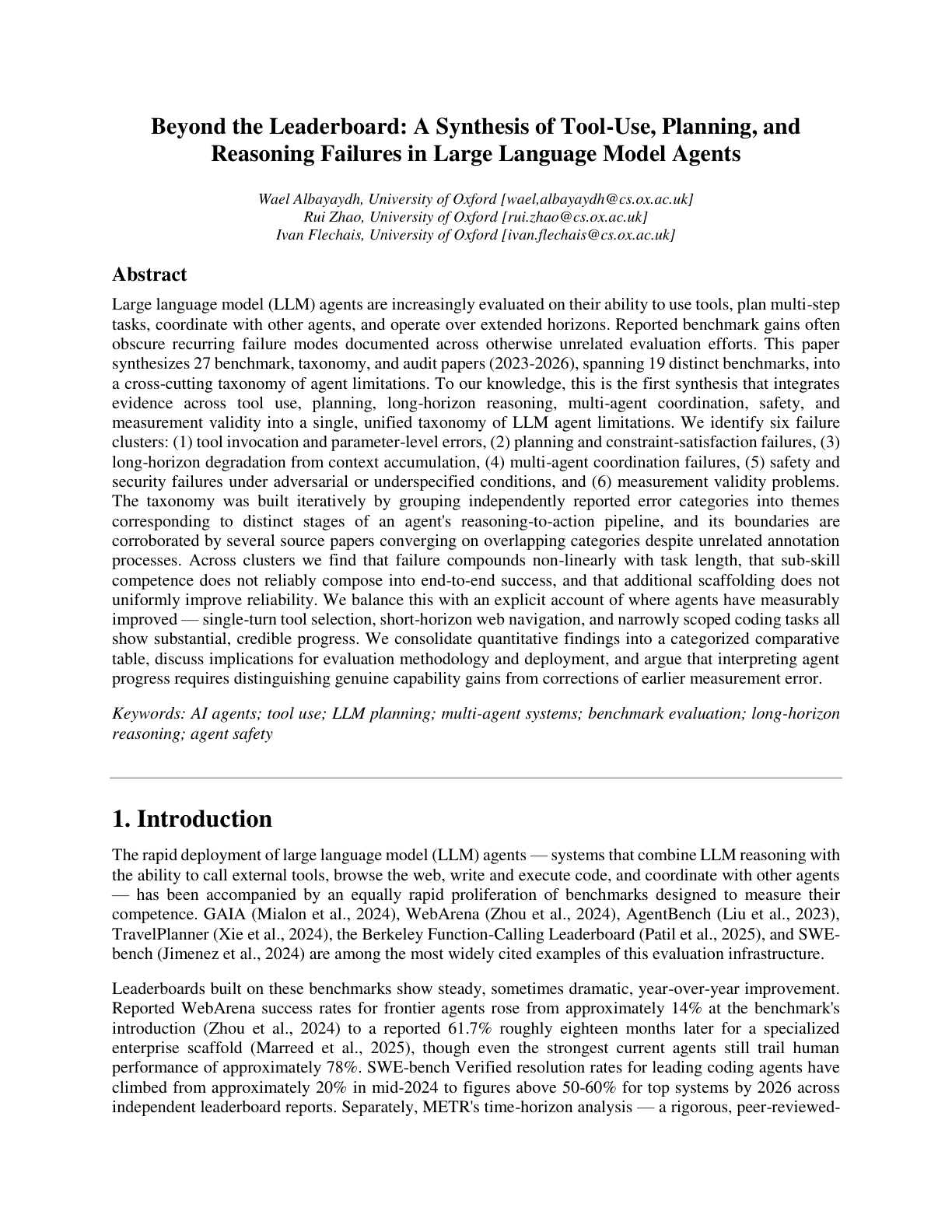
Agent Limitations Taxonomy
Benchmark scores keep climbing, yet the same agent failures resurface across otherwise unrelated evaluations, hidden behind the leaderboard. This University of Oxford work synthesizes 27 benchmark, taxonomy, and audit papers spanning 19 benchmarks into the first cross-cutting taxonomy of LLM-agent limitations.
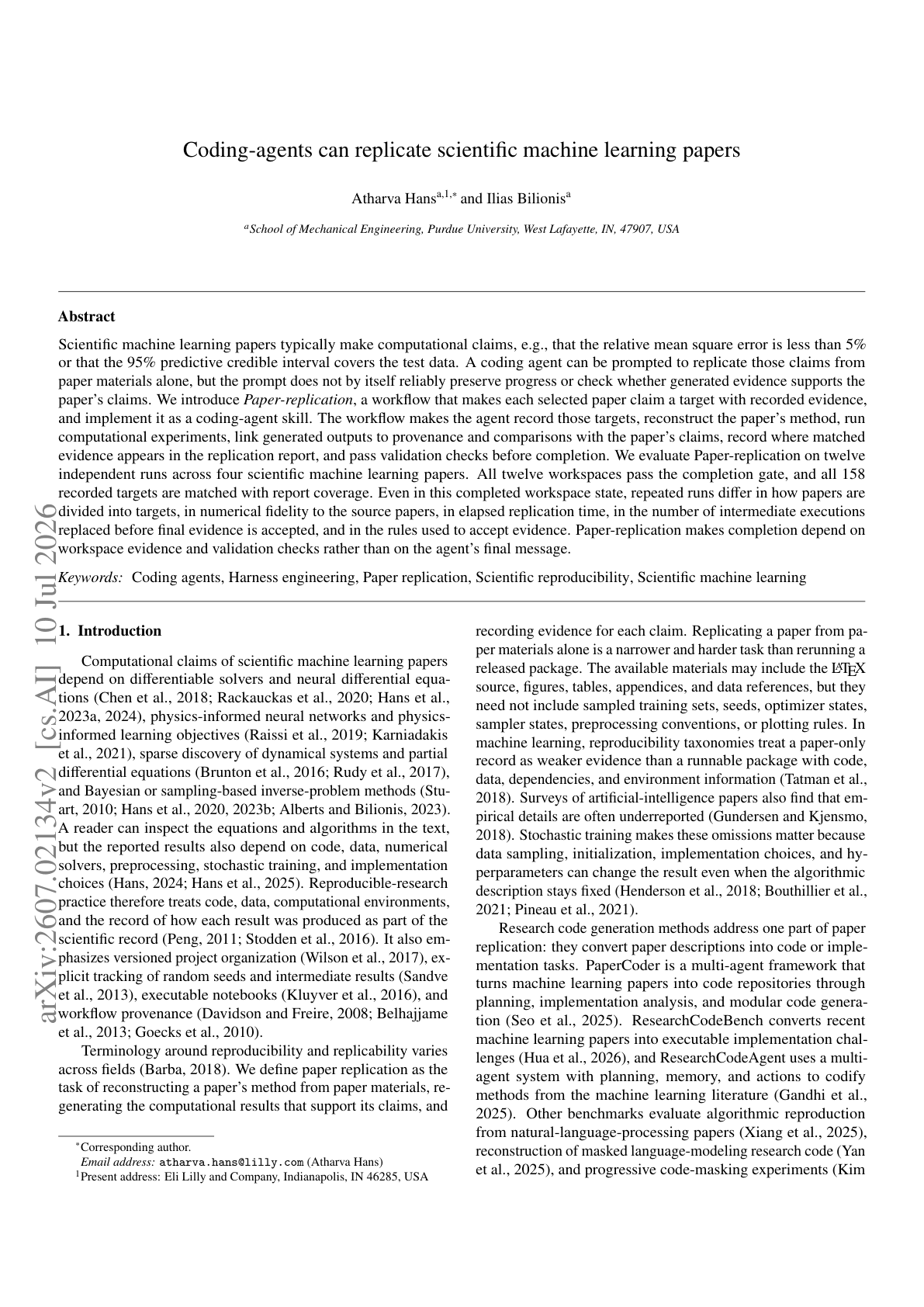
Replicating ML Papers with Agents
This work tests whether a coding agent can replicate a scientific ML paper from its materials alone, using a skill that turns each paper claim into a target with recorded evidence and gating completion on workspace evidence rather than the agent's final message. Across twelve runs over four papers, all twelve workspaces pass the completion gate and all 158 recorded targets are matched with report coverage. Yet repeated runs still differ in how papers are split into targets and in numerical fidelity, so completion becomes reproducible even when the path is not.
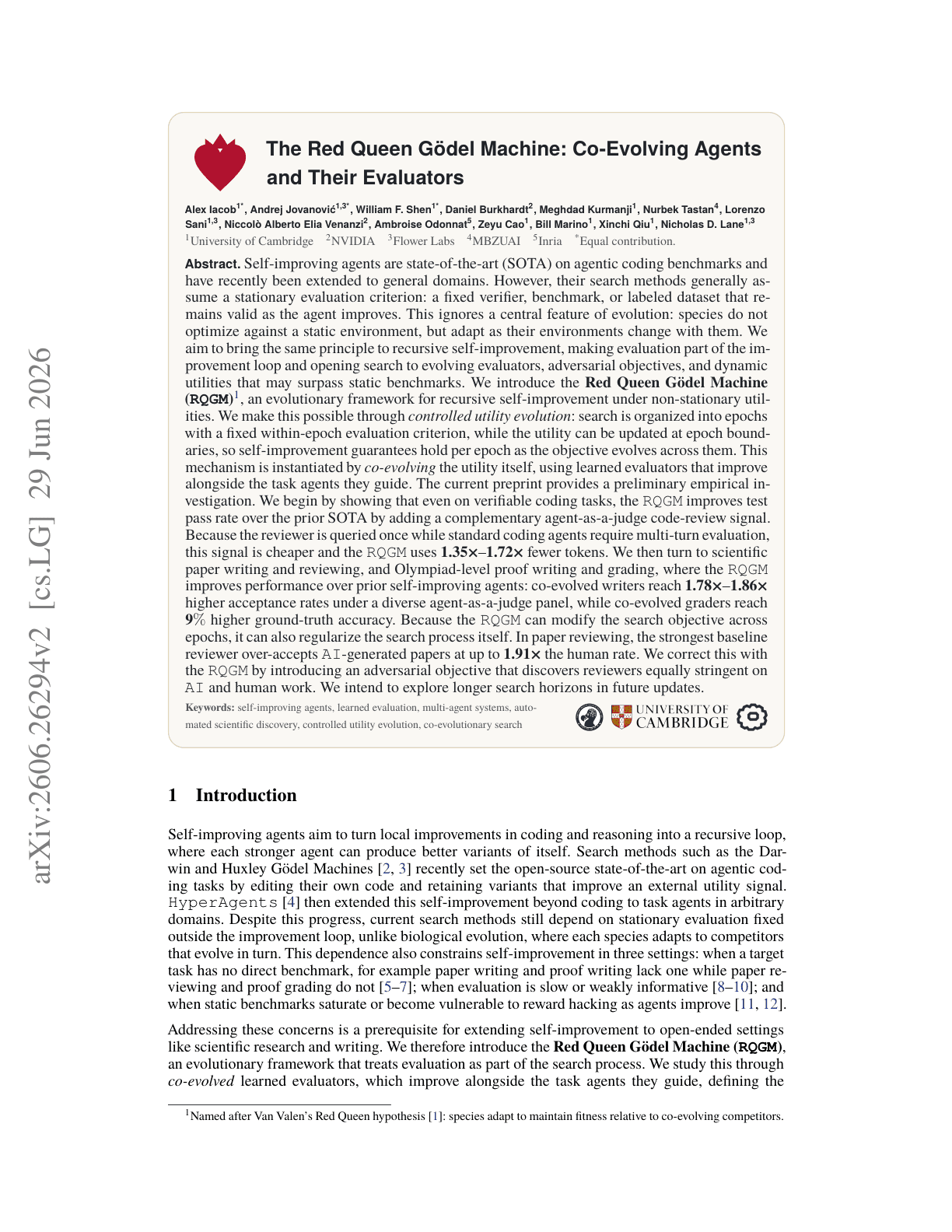
Red Queen Gödel Machine
Self-improving agents are only as strong as the evaluator scoring them, and most systems freeze that evaluator in place, so improvement stalls the moment the judge stops getting harder. The Red Queen Gödel Machine makes the evaluator part of the search itself, letting agents and the criteria that judge them co-evolve. --- ---
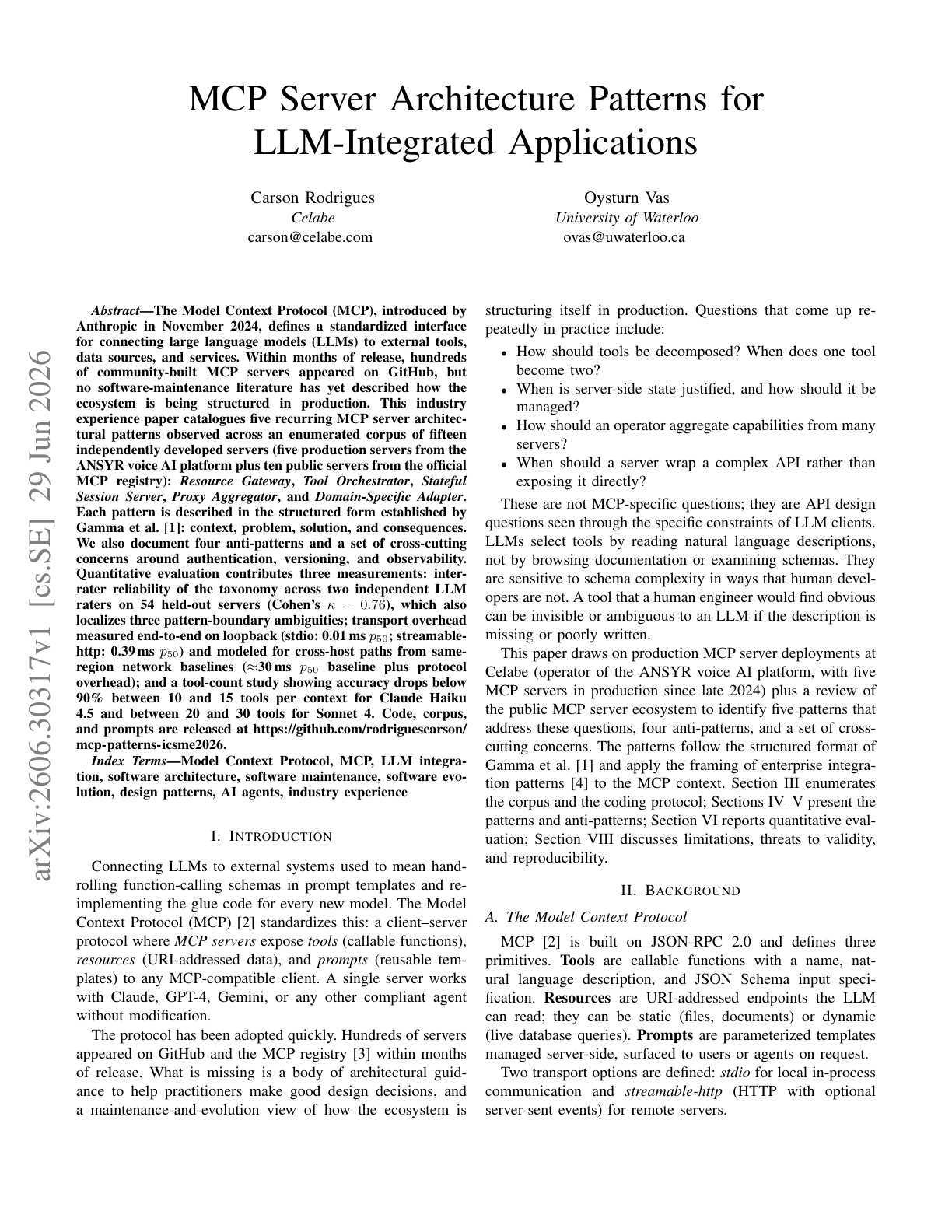
MCP Server Patterns
As teams rush to wrap tools and data behind the Model Context Protocol, they keep rebuilding the same server shapes without shared names for them. This industry experience paper catalogs the recurring architectures so builders can reason about MCP servers the way software engineers reason about design patterns. ---
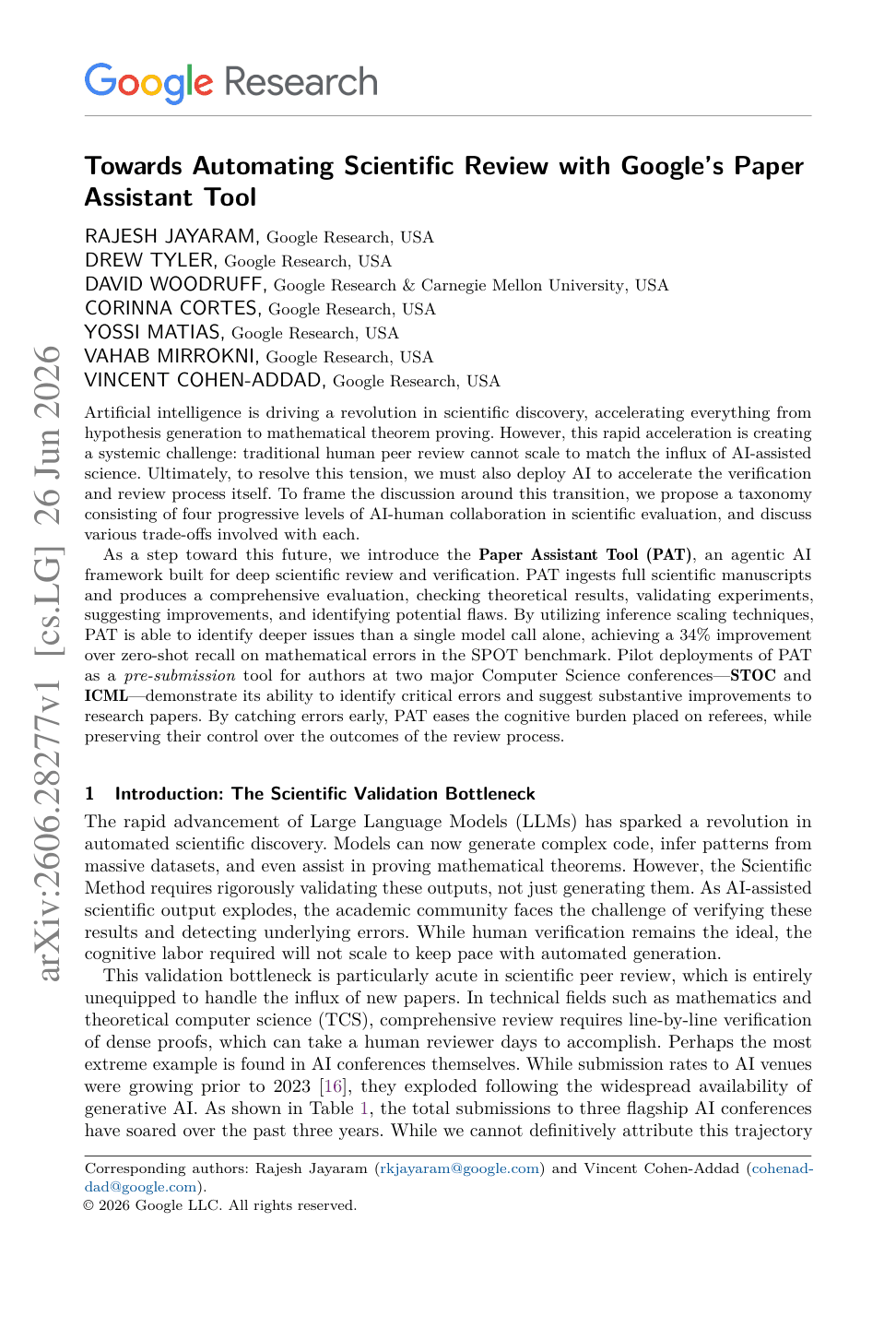
Paper Assistant Tool
AI is accelerating how fast papers get written, but peer review is still bottlenecked on human throughput, with combined submissions to the big ML conferences projected to top 73,000 this year. Google’s Paper Assistant Tool is an agentic framework built to do deep scientific review and verification at that scale. ---
Generative Skill Composition
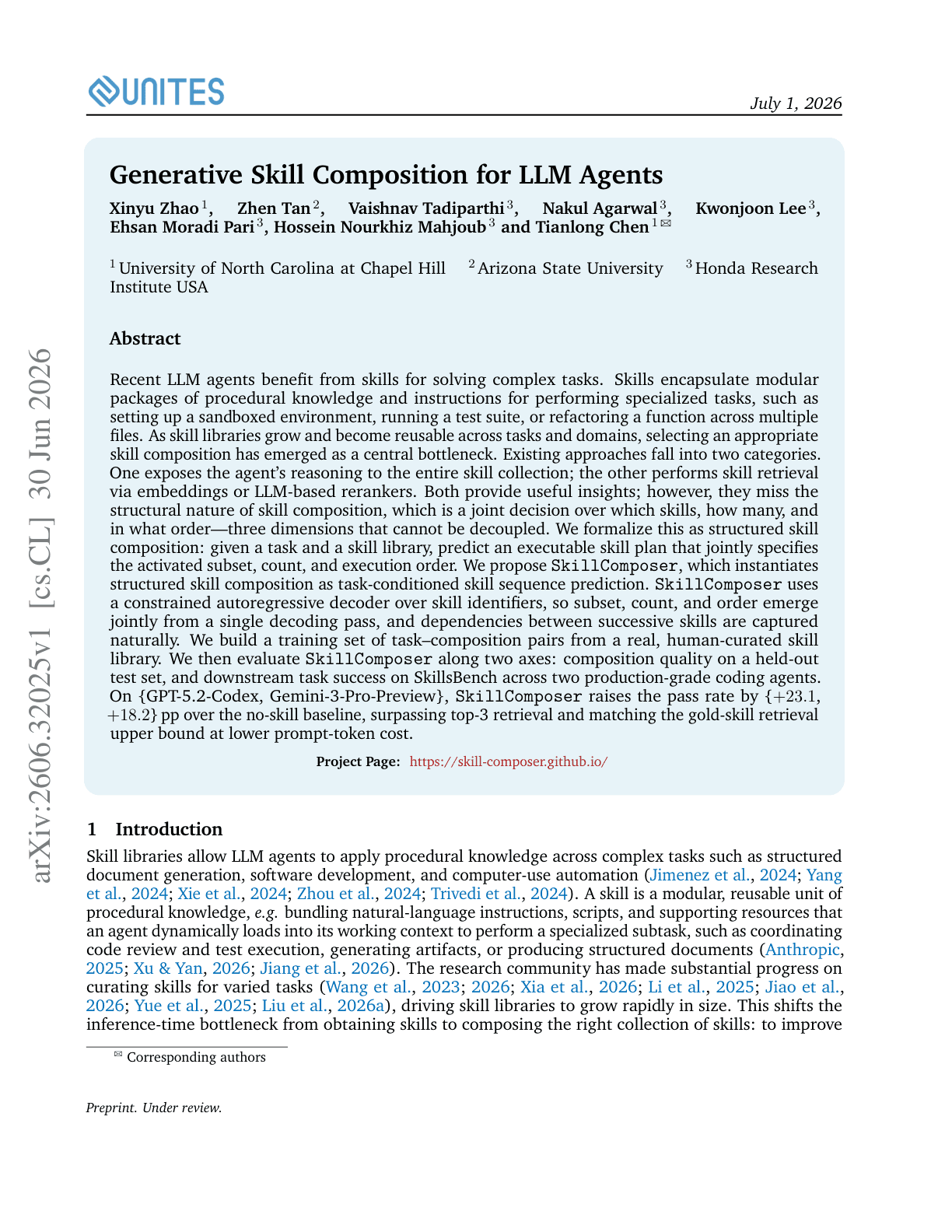
Coding agents accumulate large skill libraries, and picking the right skills for a task has become the bottleneck. The usual options either dump the whole collection into context or retrieve skills with embeddings and rerankers, and both treat selection as a ranking problem rather than a joint plan. ---
AutoMem
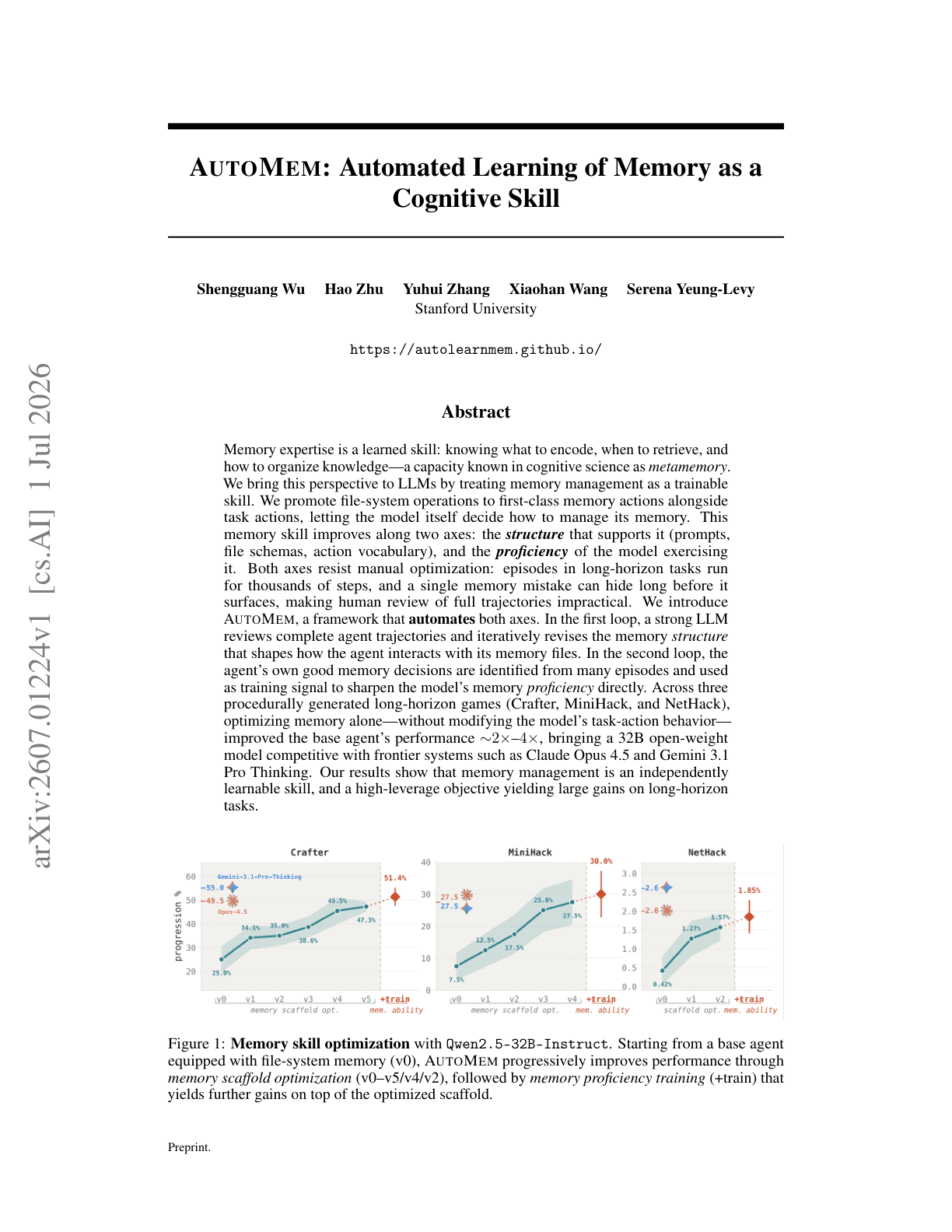
Memory for LLM agents is usually a fixed module bolted onto the model, but knowing what to encode, when to retrieve, and how to organize notes is itself a skill. AutoMem, from Stanford, treats memory management as a trainable cognitive ability, a capacity cognitive science calls metamemory. ---
ASPIRE
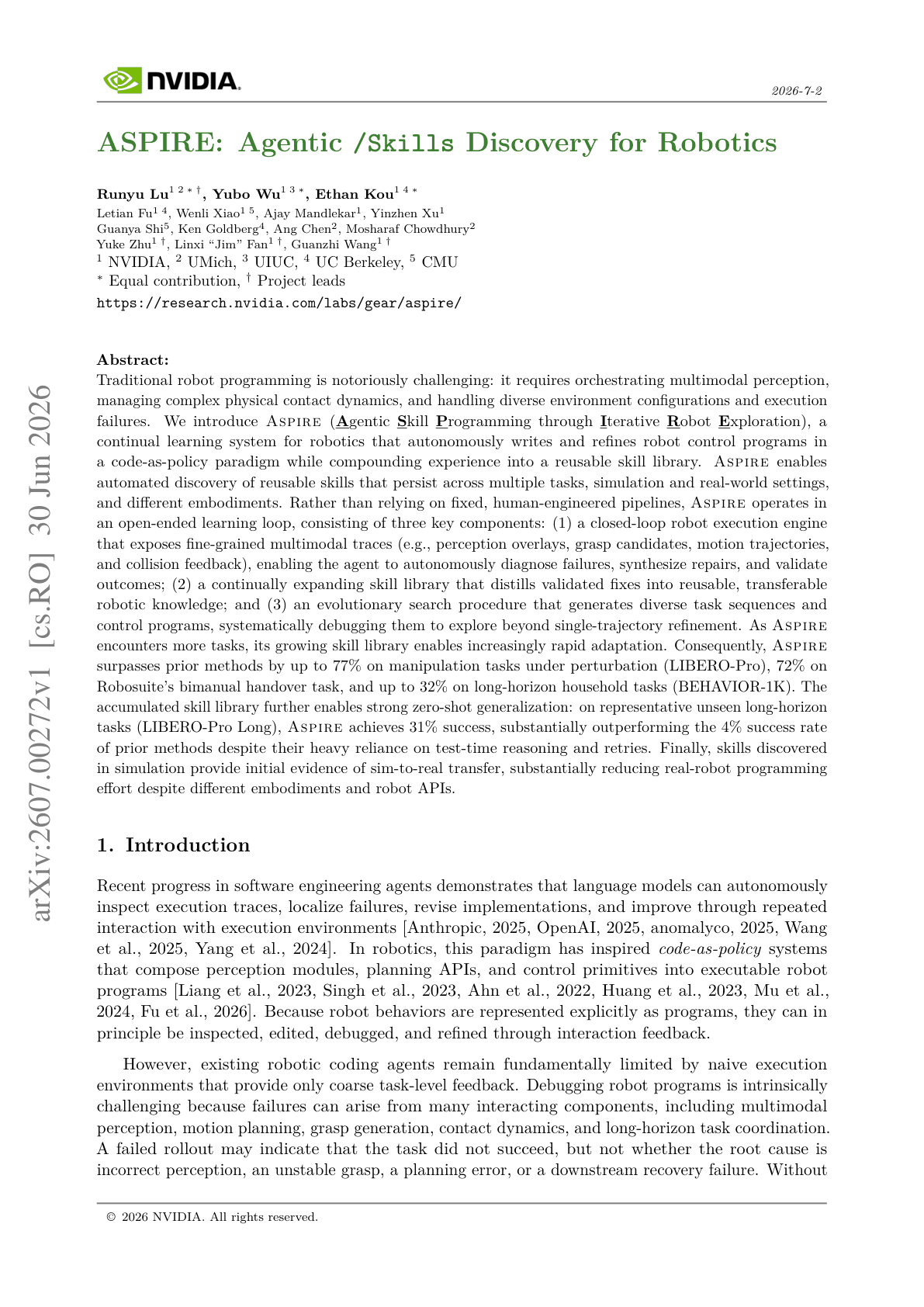
ASPIRE reframes robot programming as continual, code-as-policy learning that compounds experience instead of discarding it. The system runs an open-ended loop with a closed-loop execution engine that exposes fine-grained multimodal traces, a skill library that distills validated fixes into transferable knowledge, and an evolutionary search over task sequences and control programs. It surpasses prior methods by up to 77% on perturbed manipulation and enables zero-shot generalization to unseen long-horizon tasks, with early evidence of sim-to-real transfer across different embodiments. ---
HORIZON
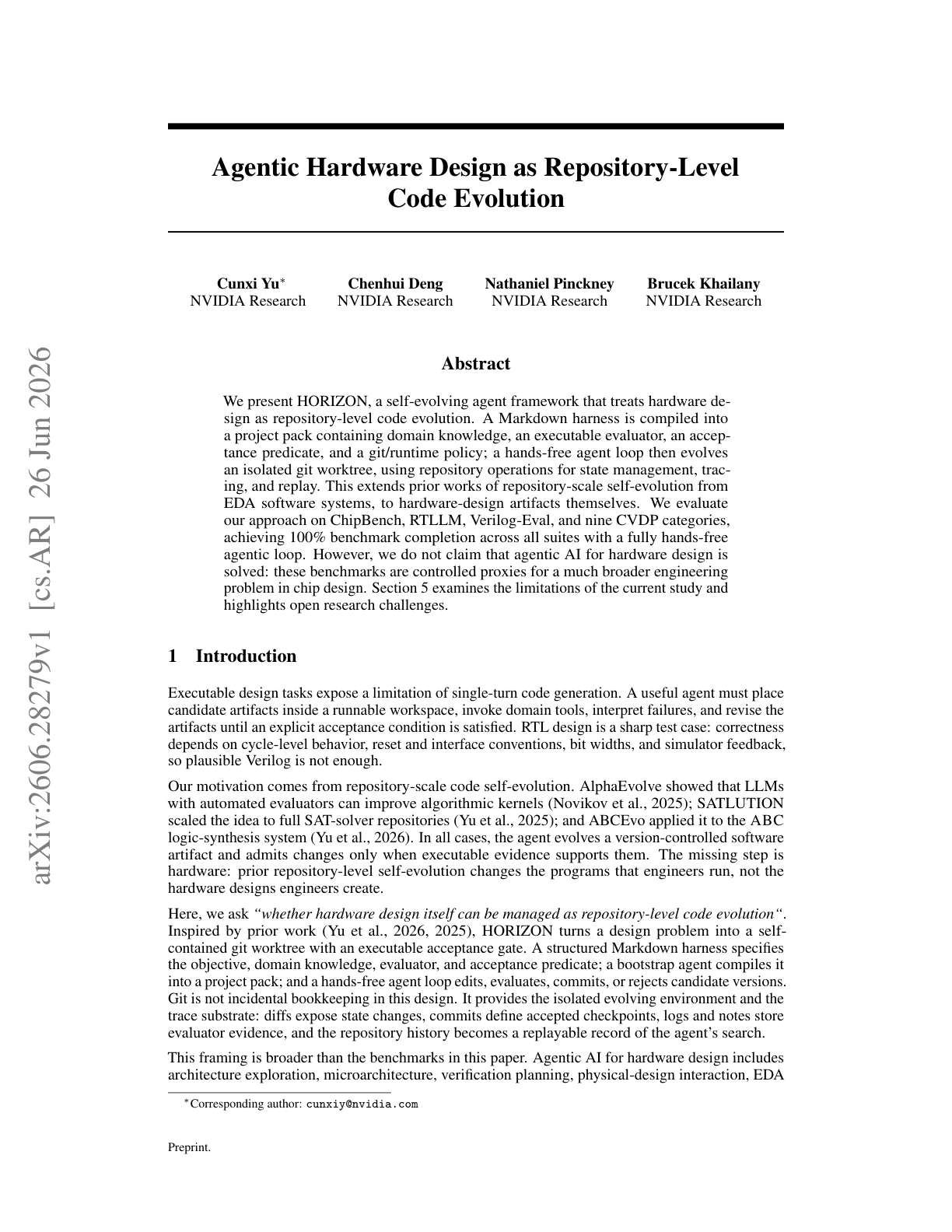
HORIZON treats hardware design as repository-level code evolution, compiling a Markdown harness into a project pack with domain knowledge, an executable evaluator, an acceptance predicate, and a git and runtime policy. A hands-free agent loop then evolves an isolated git worktree, using repository operations for state management, tracing, and replay. Across ChipBench, RTLLM, Verilog-Eval, and nine CVDP categories it reaches full benchmark completion with a completely hands-free loop, extending repository-scale self-evolution from EDA software to hardware artifacts themselves. ---
Sakana Fugu
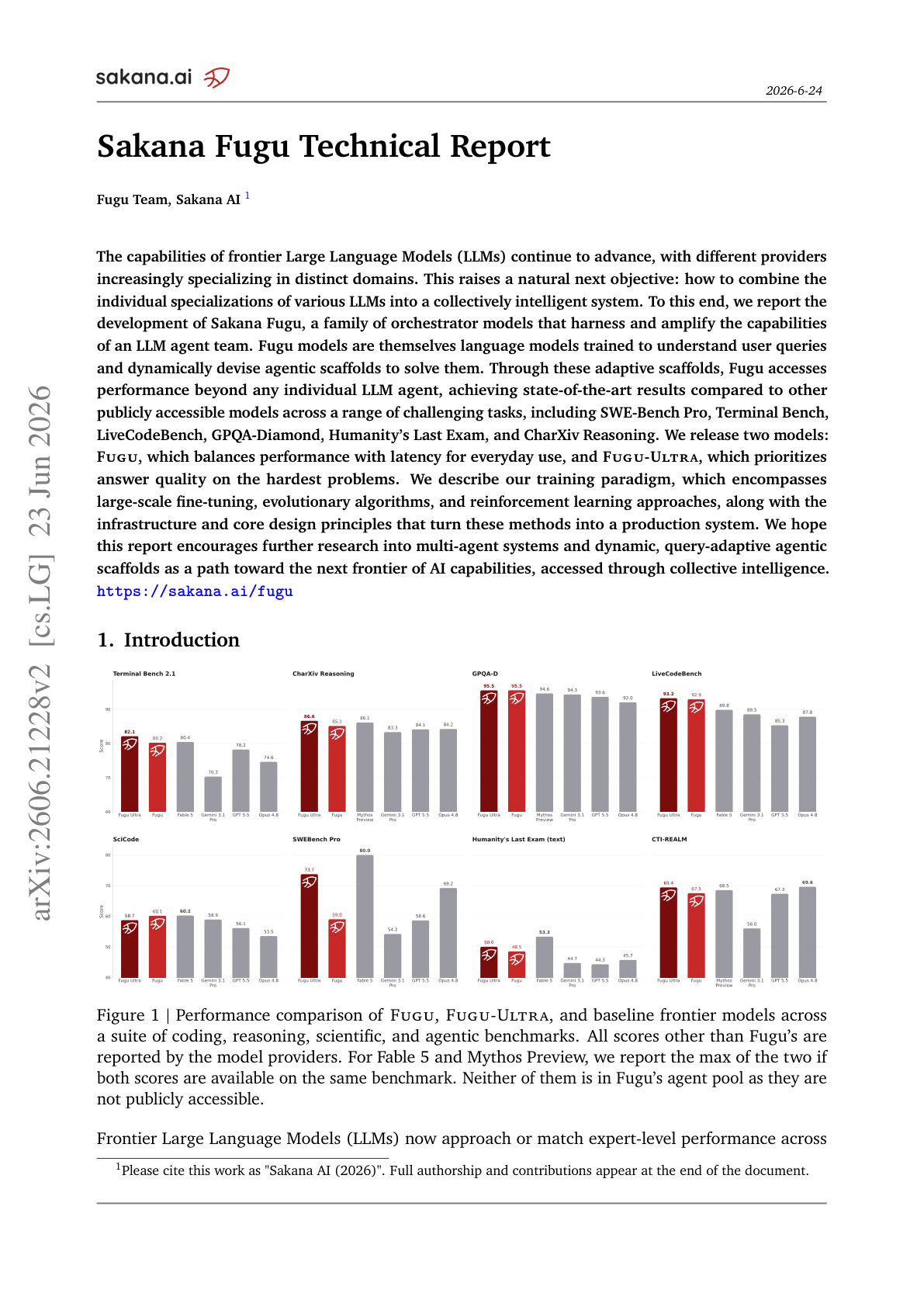
Frontier LLMs keep advancing, and different providers are increasingly specializing in distinct domains, which raises a natural next objective: how do you combine those individual specializations into one collectively intelligent system? Sakana Fugu answers with a family of orchestrator models that are themselves language models trained to read a user query and dynamically devise the agentic scaffold needed to solve it.
Agent-Native Memory
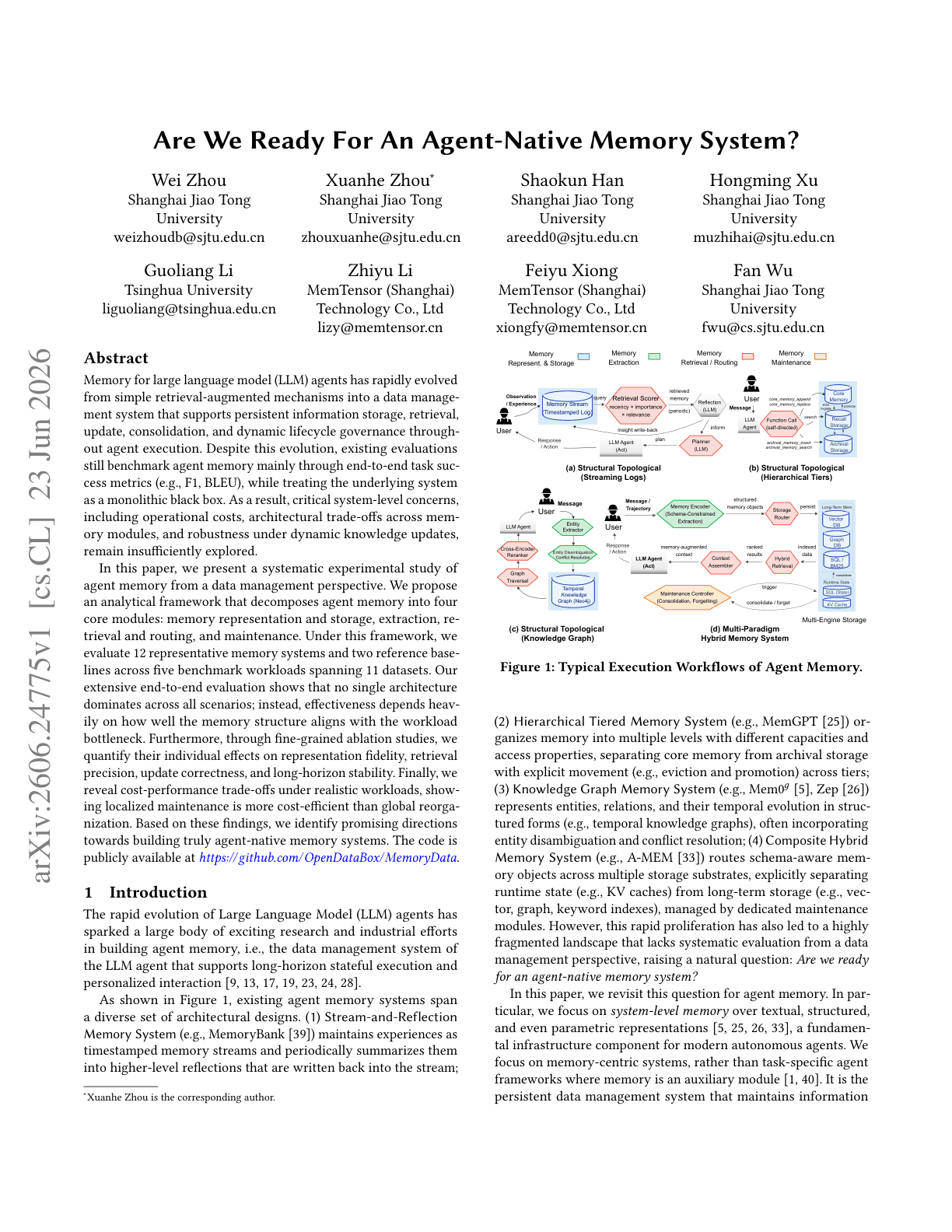
Memory for LLM agents has quietly grown from a retrieval add-on into a full data system, with persistent storage, retrieval, update, consolidation, and lifecycle governance running throughout an agent's execution. Yet most evaluations still score memory only through end-to-end task metrics like F1 and BLEU, treating the whole stack as a black box. This paper studies agent memory from a data management perspective and asks what we are actually missing when we measure it that way.
Autodata
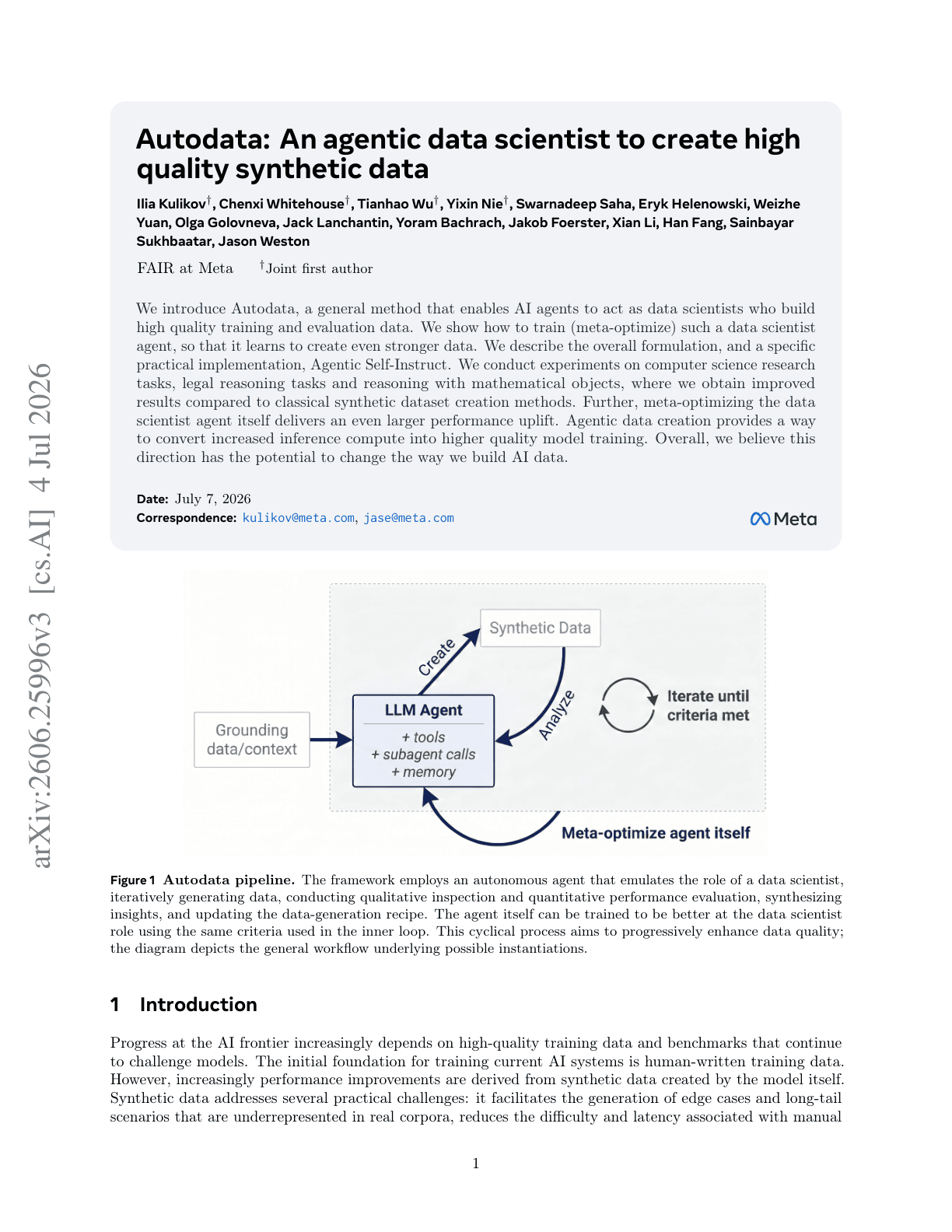
Building synthetic training data has mostly stayed a fixed pipeline that you hand-tune once and then freeze. Autodata rethinks that by casting an AI agent as a data scientist that builds high-quality training and evaluation data, then meta-optimizes that agent so it learns to create even stronger data over time.
Critique of the Agent Model
The word agent now covers everything from a for-loop with tool calls to speculative machine superintelligence, which makes it nearly useless as a technical term. This position paper from Eric Xing and collaborators tries to fix that by asking what an agent actually is and what agency consists of, drawing on Descartes and on science-fiction portrayals of autonomous beings to ground the discussion.
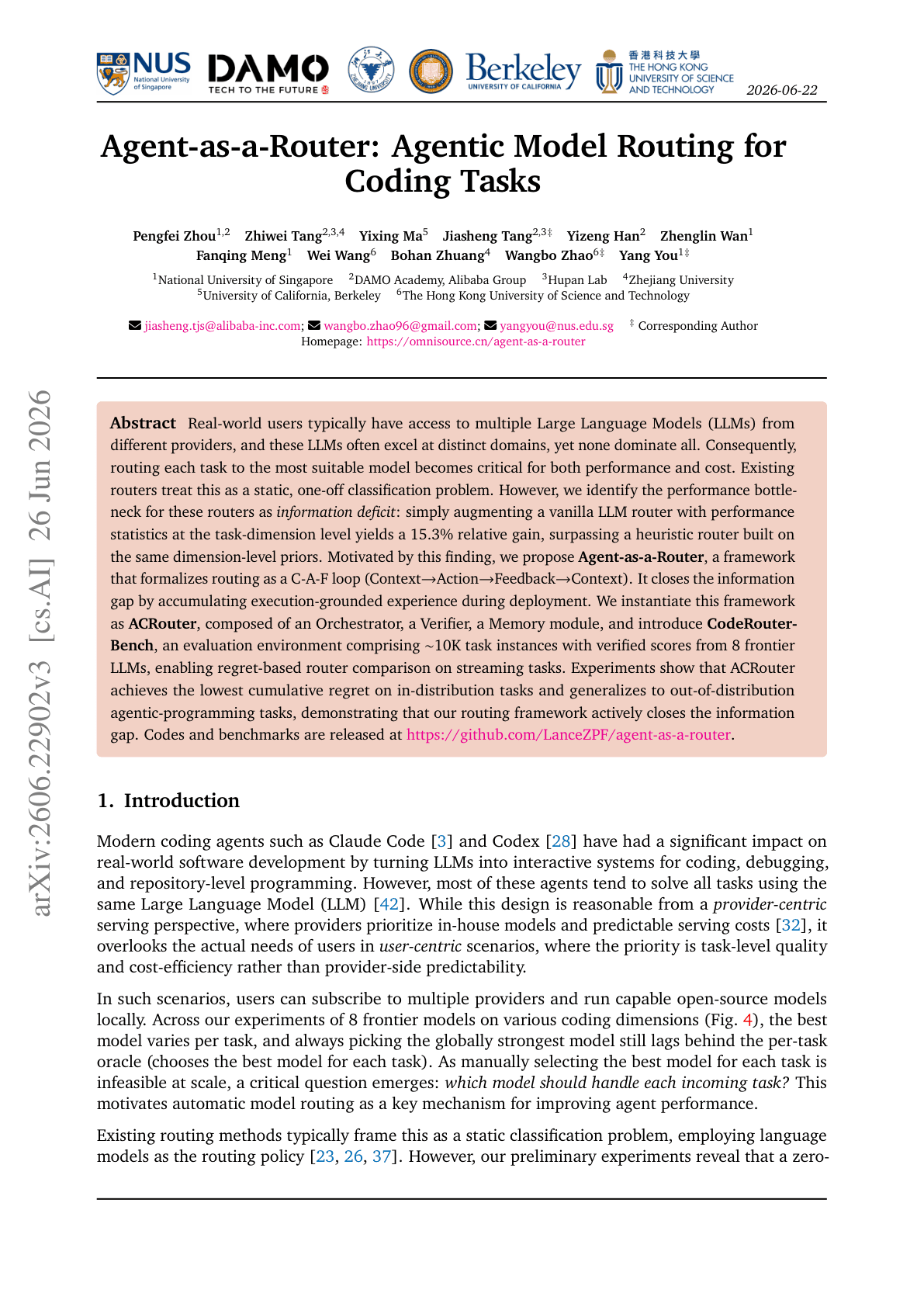
Agent-as-a-Router
Most users now have access to many LLMs that each excel in different domains, so routing each task to the right model matters for both quality and cost. Existing routers treat this as a static, one-off classification problem, and this paper shows that framing is exactly what holds them back.
Agent Communication Protocols
As multi-agent systems try to move past the limits of standalone agents, communication becomes the load-bearing infrastructure, and the protocol landscape for it is a fragmented mess. This study builds a technical taxonomy to classify and compare LLM agent communication protocols and to make the interoperability problem legible.
Skill-MAS
Automatic generation of multi-agent systems is stuck between inference-time methods that reuse frozen frontier models but never learn, and training-time methods that internalize experience through gradient updates but are capped by the weaker models small enough to fine-tune. Skill-MAS proposes a third path that treats high-level orchestration as an evolvable Meta-Skill, decoupling experience retention from weight updates so frontier models keep getting better at orchestration without any gradient steps. Across four complex benchmarks and four distinct LLMs it delivers strong, transferable gains at a favorable cost-performance trade-off.
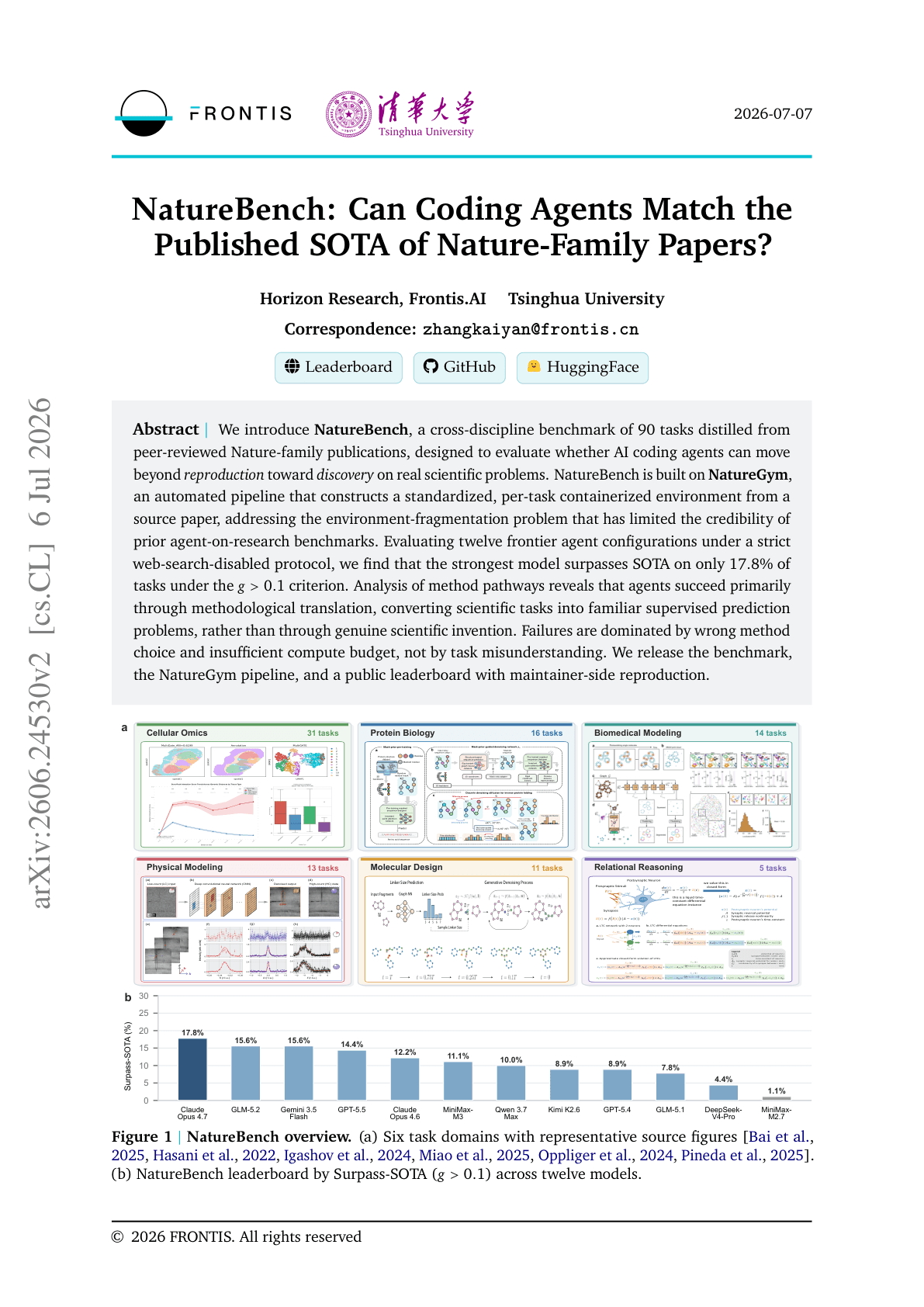
NatureBench
Can coding agents move past reproduction toward actual discovery on real scientific problems? NatureBench distills 90 cross-discipline tasks from peer-reviewed Nature-family papers and runs them in NatureGym, an automated pipeline that builds a standardized containerized environment per task to fix the environment-fragmentation problem. Under a strict web-search-disabled protocol, the strongest of ten frontier agent configurations beats published SOTA on only 17.8% of tasks, and analysis shows agents win mainly by translating problems into familiar supervised prediction rather than through genuine scientific invention.
SpatialClaw
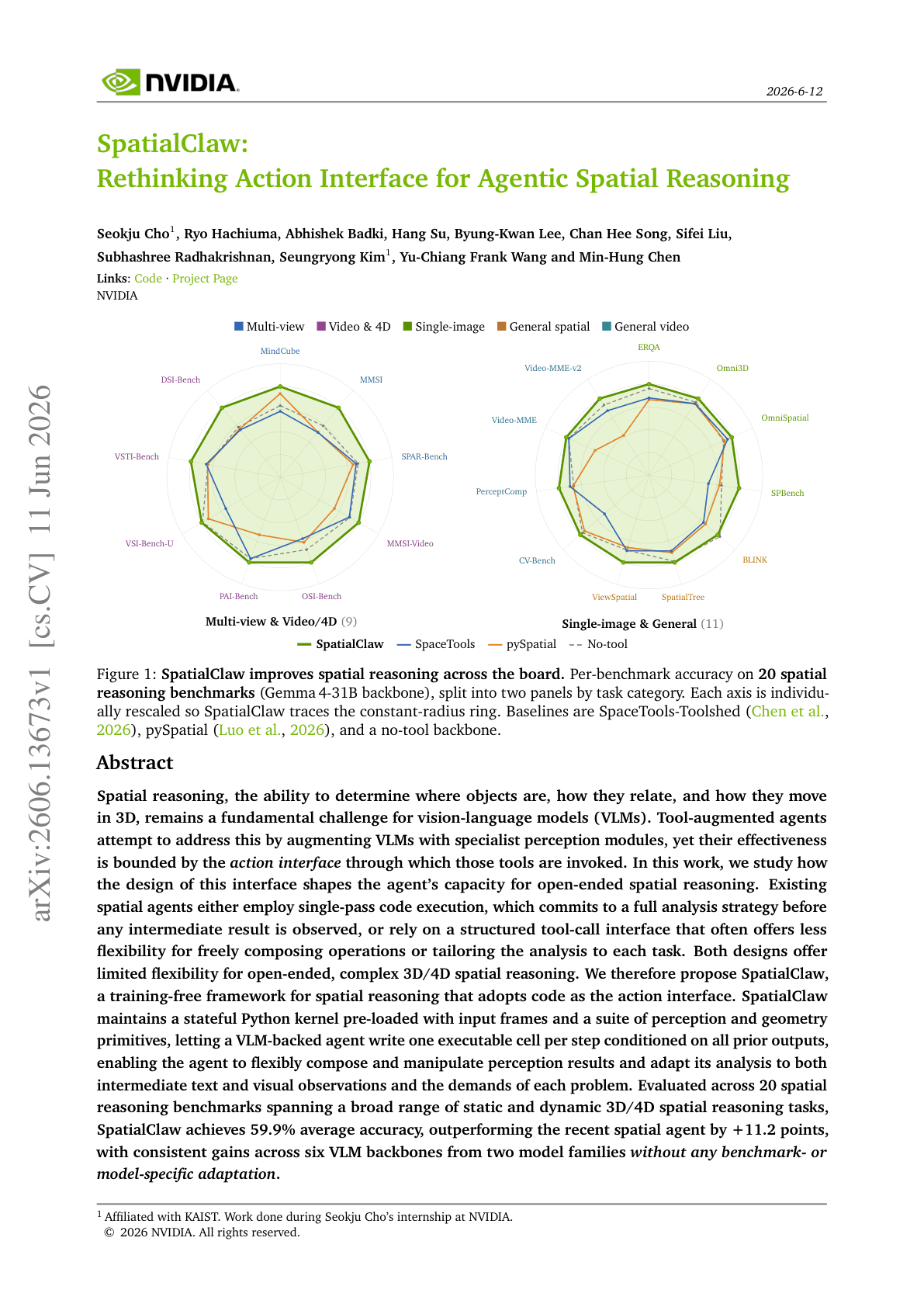
Spatial reasoning over 3D and 4D scenes is still where general vision-language models break down, because they emit a text answer directly rather than measuring anything. From NVIDIA, SpatialClaw is a training-free framework that rethinks the action interface and lets a VLM-backed agent reason through code instead. The agent writes one Python cell per step into a persistent Jupyter kernel preloaded with perception primitives and scientific libraries, then inspects intermediate results and revises its strategy across steps.
Compositional Skill Routing
Real tasks rarely map to a single skill. They usually need several skills composed together, yet most skill routing still treats the problem as picking one tool from a library. This work formalizes Compositional Skill Routing, where an agent must select and sequence multiple reusable skills from large libraries to satisfy a complex query, and introduces SkillWeaver, a decompose, retrieve, and compose pipeline built around it.
PreAct
Computer-using agents drive real software through the screen, but they solve every task from scratch. Ask one to repeat a task and it re-reads the screen and re-reasons every tap, paying the full cost again. PreAct fixes this by compiling the first successful run into a small state-machine program, where states check the screen and transitions act, then replaying that program on later runs instead of invoking the agent.
Can LLM Agents Infer World Models?
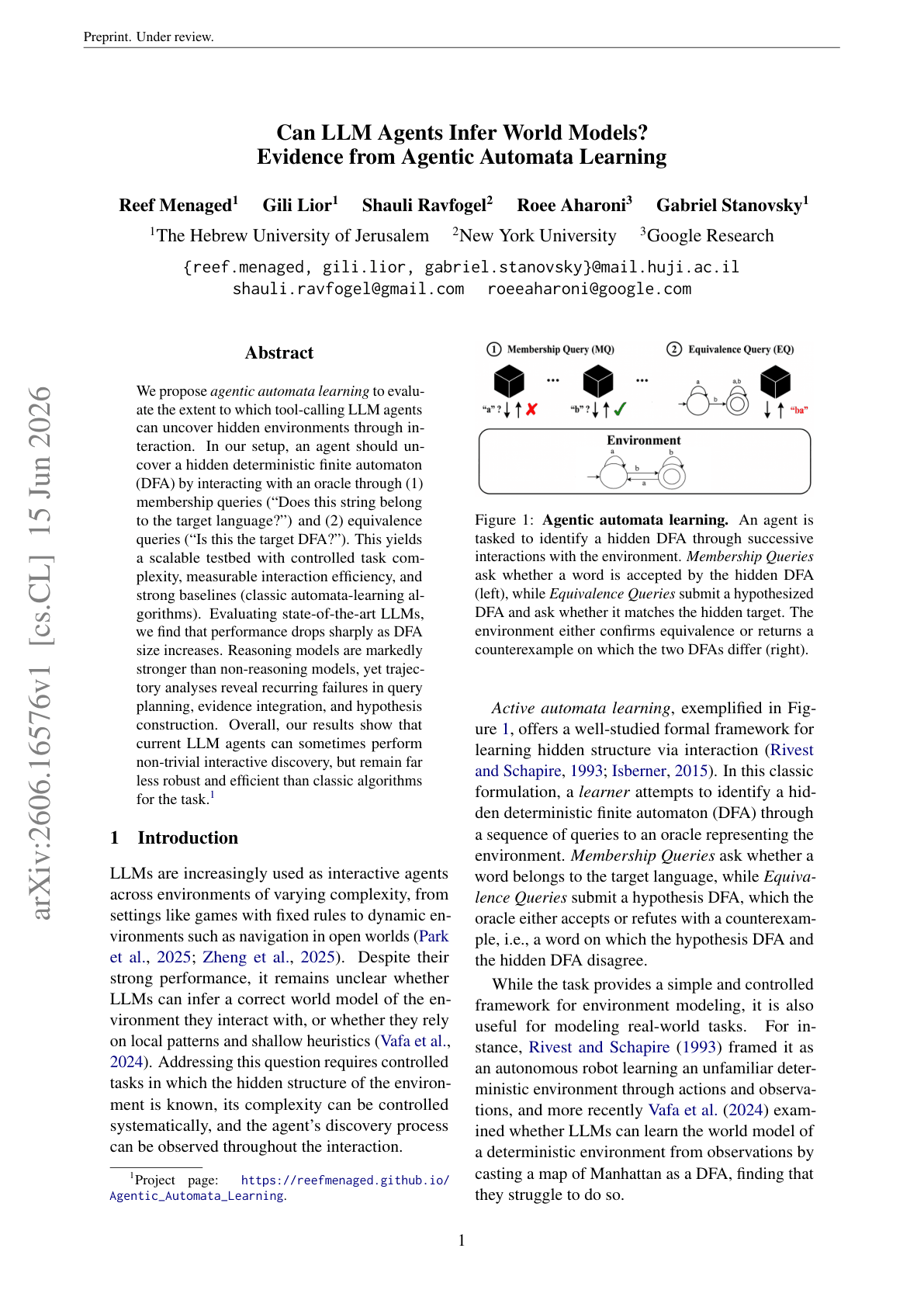
Can an LLM agent actually build a model of an environment it cannot see? This work makes that question gradeable through agentic automata learning. An agent has to uncover a hidden deterministic finite automaton by interacting with an oracle through two interfaces, membership queries that ask whether a string belongs to the target language, and equivalence queries that ask whether a proposed automaton is correct, which yields a clean, scalable testbed for interactive discovery.