AI Papers of the Week
Every paper worth reading in AI, hand-picked one week at a time.
Discover and explore top AI papers withClaude CodeCodex
npx @dair-ai/mcp setup
From Trainee to Trainer
Who should design the training environment for an RL agent, the practitioner or the policy itself? RL pipelines for LLMs usually rely on manually redesigned environments between stages, with practitioners guessing which configuration will best improve the current policy. This paper hands that job to the model, proposing an LLM-as-Environment-Engineer framework where the policy diagnoses its own weaknesses and proposes the next environment to train on.
OpenClaw-Skill
Equipping LLM agents with effective skills is most of the battle in real systems, yet most skill-induction work distills one trajectory at a time, which produces narrow, brittle skills. OpenClaw-Skill introduces Collective Skill Tree Search, a tree-search-based skill construction framework that builds a structured, diverse, and generalizable tree of skills, then trains agents to actually use what it builds.
AtomMem
Long-term memory for LLM agents tends to fail in two ways: coarse summaries drift over time, and unconstrained updates corrupt what was already stored. AtomMem keeps the unit of memory small, using a Fact Executor that selectively extracts high-value atomic facts from long interactions and organizes them into hierarchical event structures and temporal user profiles, with an associative memory graph that reconnects fragmented memories at retrieval. The approach reports state-of-the-art results on the LoCoMo long-term memory benchmark.
Beyond Domains
LLM web agents usually run as tool callers, reading a fresh page each turn and emitting one low-level action, so both task horizons and the number of LLM completions blow up. This work makes web skills reusable across sites with SkillMigrator, which stores induced skills as transferable interaction patterns keyed by page-layout structure rather than instruction similarity or site metadata, so a skill learned on one site fires on new sites with the same interaction shape. It cuts the average LLM-action count by 8 to 10% on WebArena and Mind2Web at comparable success rates.
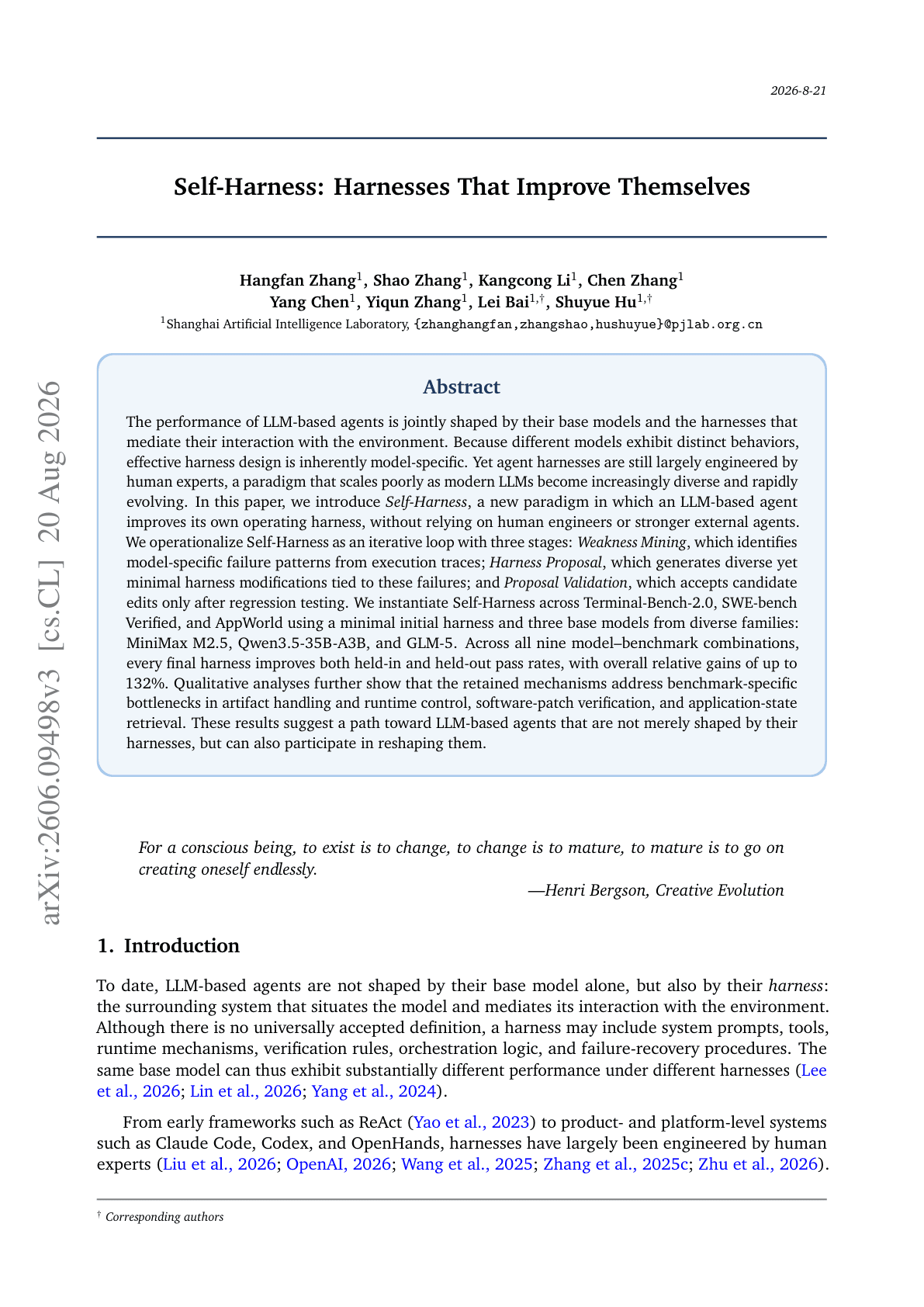
Self-Harness
Most agent scaffolds are built once by hand and then frozen, even as the underlying models keep changing. This paper introduces Self-Harness, a paradigm where an LLM agent improves its own operating harness, the prompts, tools, memory, and orchestration around the base model, without human engineers or a stronger external agent. Because every model fails in its own way, the system mines those model-specific weaknesses and turns them into concrete, executable harness edits rather than generic advice.
Agents' Last Exam
From Berkeley RDI, Agents' Last Exam (ALE) is a living benchmark built to measure whether agents can do economically valuable work, not just score well on academic tests. It was assembled with more than 250 industry experts and maps over 1,000 verifiable tasks to the U.S. federal occupational taxonomy, organized as 55 subfields across 13 industry clusters. Every task has an objective, checkable outcome, so there is no subjective human grading, and the pool is designed to keep growing as new workflows are onboarded.
How AI Agents Reshape Knowledge Work
This economics paper, drawing on large-scale production data from Perplexity, studies how the shift from conversational assistants to autonomous agents is reshaping knowledge work. It compares Search, a conversational assistant, with Computer, a general-purpose agent system, along three dimensions: autonomy, efficiency, and the scope of tasks people take on. The framing is a cost-structure model in which agents carry higher fixed and delegation costs but lower per-step marginal costs, so they win once tasks are complex enough.
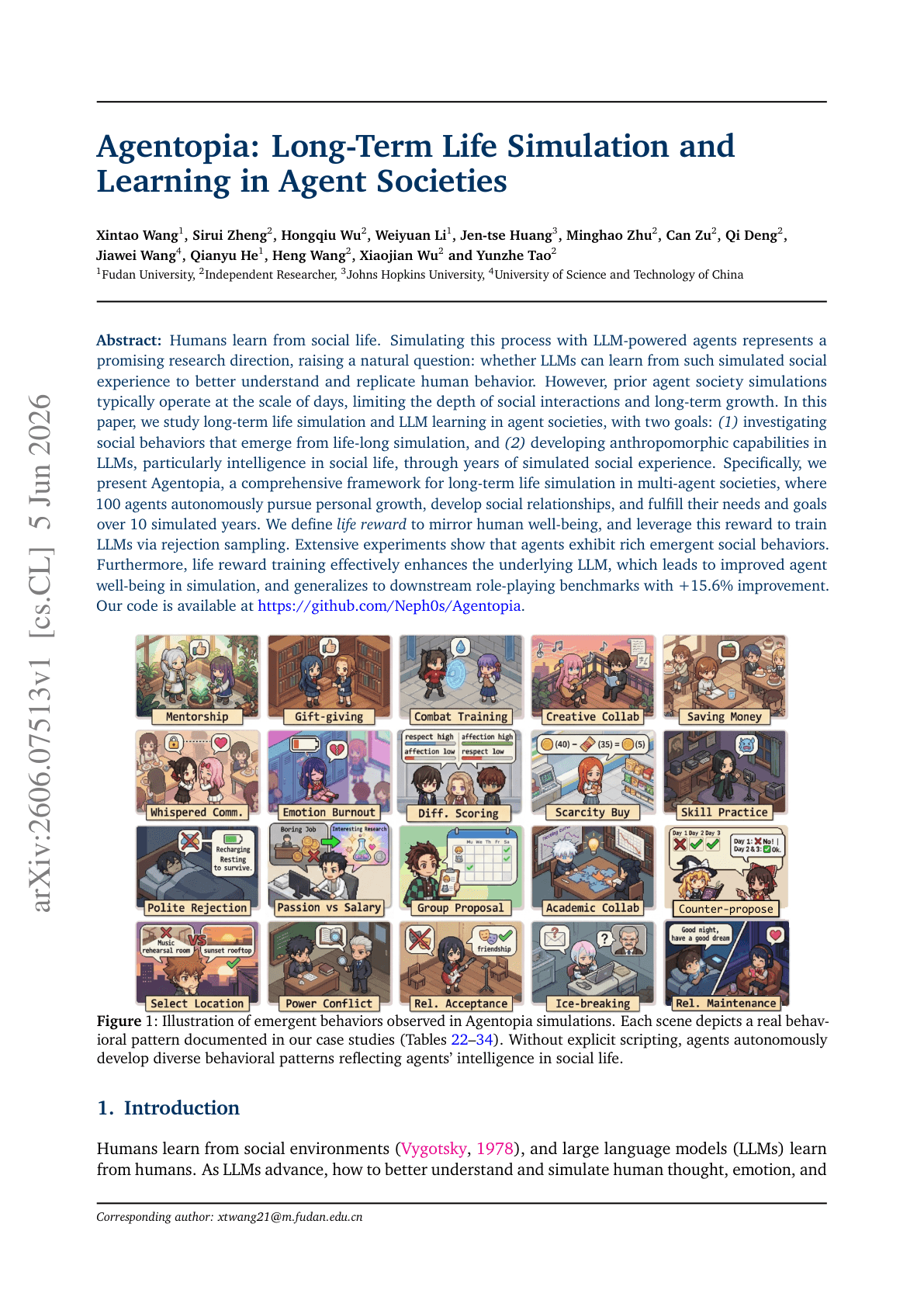
Agentopia
Agentopia is one of the most ambitious agent-society testbeds yet, a 79-page release that drops 100 LLM agents into a persistent world and lets them live, form relationships, and pursue goals over 10 simulated years, a horizon orders of magnitude longer than prior day-level work. Beyond observing emergent social behavior, the authors use the simulation as a training signal, optimizing models toward a life reward that reflects human well-being via rejection sampling.
The Consistency Illusion
Multi-agent debate is often judged by whether the agents end up agreeing, but this paper shows that output-level consensus can hide deep disagreement in the reasoning that produced it. The authors abstract agents' reasoning traces and decisions into four states along two axes, reasoning similarity and conclusion agreement, and flag divergent agreement, where agents reach the same answer through very different paths. Across 600 content-moderation items, divergent agreement appeared in 118 cases and separated cleanly from genuine disagreement states with a Cohen's d of 0.80, and routing on these categories beat divergence-only methods at flagging high-disagreement cases.
Self-Revising Discovery Systems
From MIT, this paper argues that genuine scientific discovery is not answer generation but a change in the search space itself, and that an AI scientist must perceive that shift without being told. It develops a category-theoretic framework in which evidence, artifacts, operations, and verifiers are typed, and discovery is defined as a principled revision of that representational regime rather than more search within a fixed one.
Disentangling Agent Self-Evolution
This paper asks a question every agent builder eventually hits: if an agent rewrites its own harness, does a stronger model make a better self-evolving agent? The answer is no, and the reason is that "self-evolution" is actually two separate abilities that scale very differently. The work separates harness-updating, where an evolver model writes edits to memory, tools, prompts, and skills, from harness-benefit, where a solver model actually exploits those edits on the task.
LEAP
New research from Google shows how far a custom agent harness can push a general-purpose model on formal mathematics. LEAP wraps a general LLM in an agentic scaffold that grounds every step in the Lean compiler and iterates against verifier feedback. Rather than fine-tuning a specialized prover, it leans on informal reasoning, instruction following, and self-refinement, then forces every formal step through a compiler check before moving on.
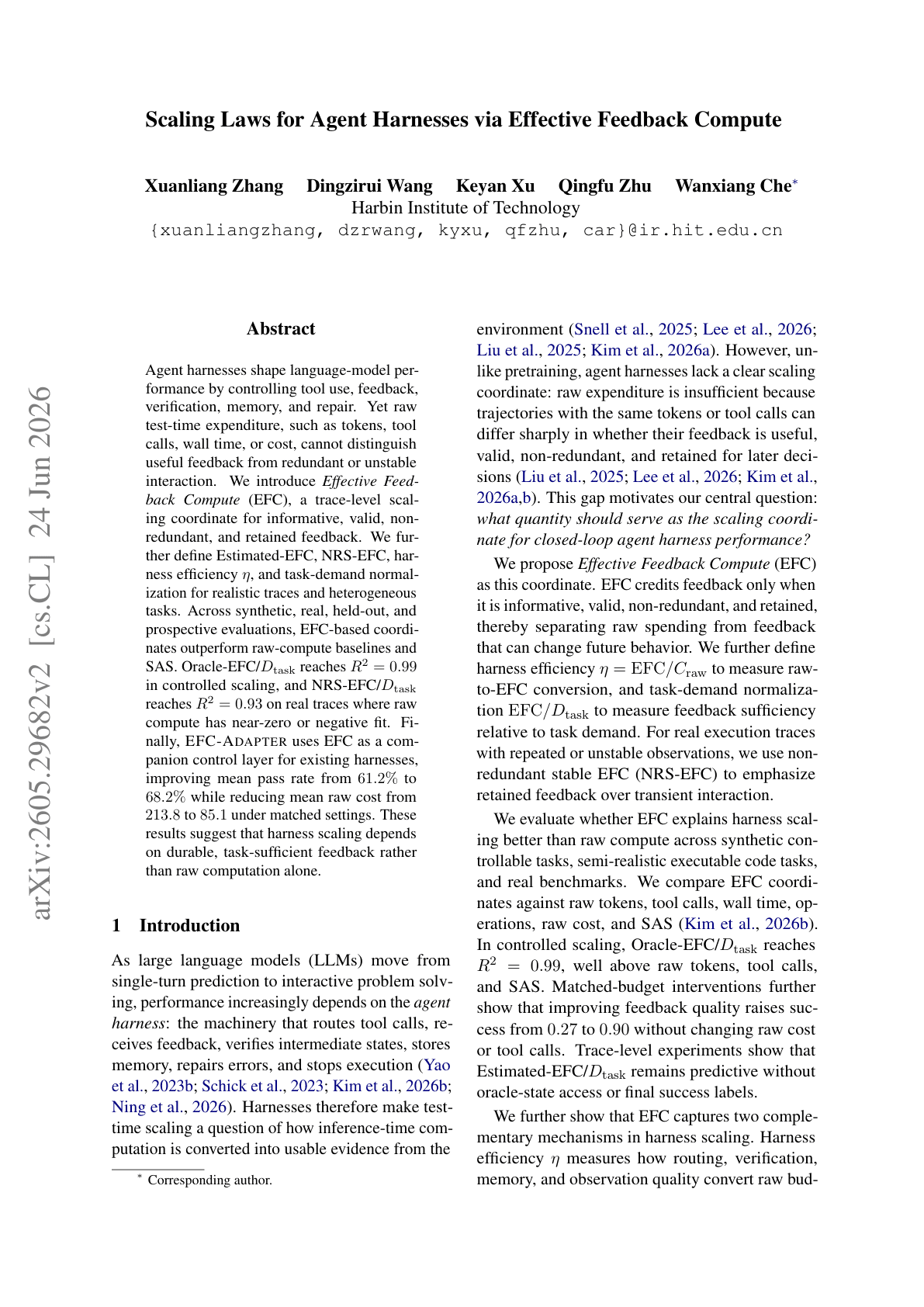
Scaling Laws for Agent Harnesses
Most harness tuning treats every token and tool call as if volume is what counts. This paper shows that it mostly does not, and introduces Effective Feedback Compute (EFC), a trace-level scaling coordinate that credits feedback only when it is informative, valid, non-redundant, and retained for later decisions, then normalizes by task demand.
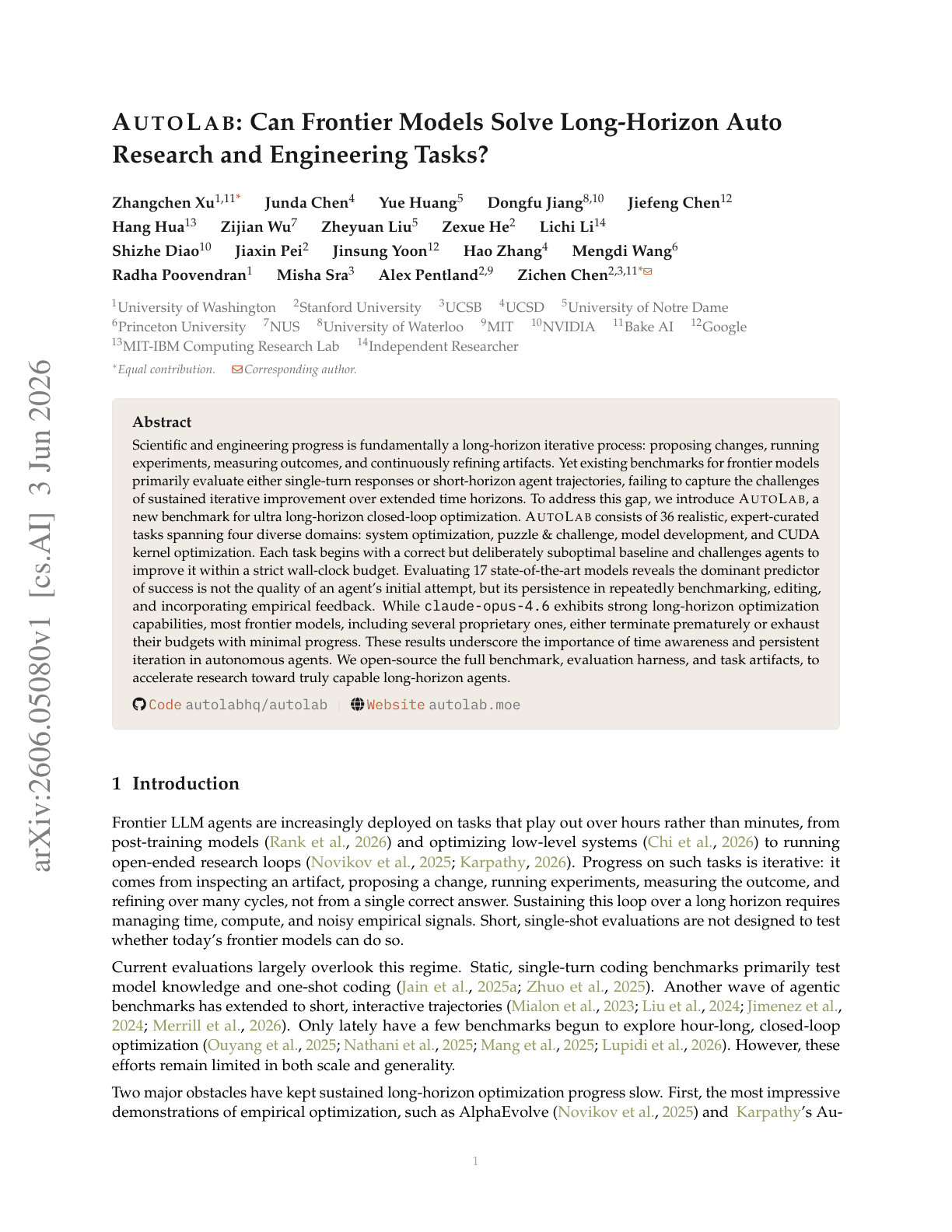
AutoLab
Can frontier models actually grind on a hard engineering problem the way a good researcher does? AutoLab is a benchmark for ultra long-horizon, closed-loop optimization built to answer that. It contains 36 realistic, expert-curated tasks across four domains: system optimization, puzzle and challenge, model development, and CUDA kernel optimization. Each task hands the agent a correct but deliberately suboptimal baseline and asks it to improve within a strict wall-clock budget.
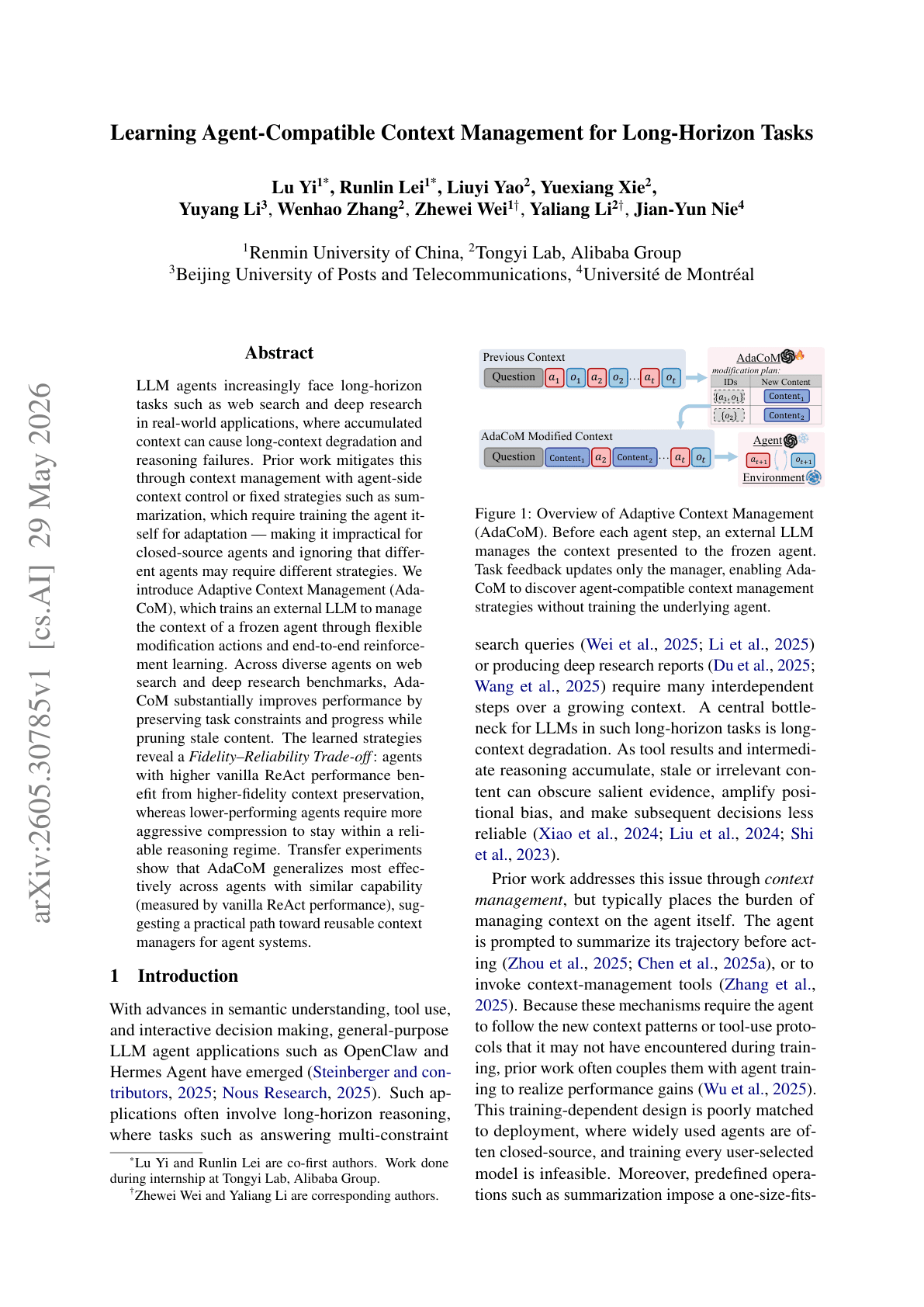
Reusable Context Engineering
Context bloat quietly kills long-horizon runs, and the usual fixes are baked into an agent's own prompt or weights, so they do not transfer. AdaCoM takes a different route: it trains a separate external model to manage the context of a frozen agent through flexible modification actions, optimized end-to-end with reinforcement learning. The agent never changes; only the context flowing into it does.
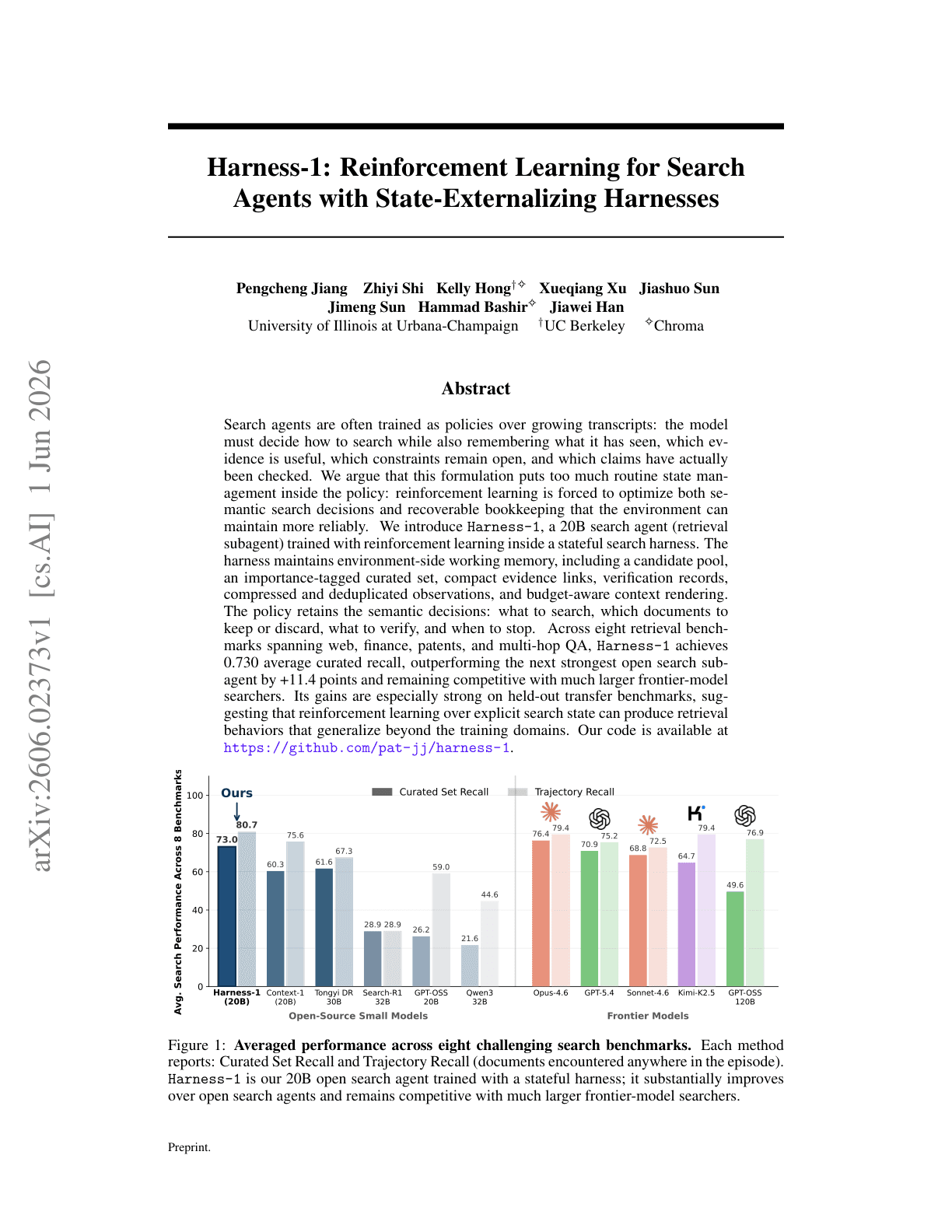
State-Externalizing Harnesses
Harness-1 is a 20B search agent trained with reinforcement learning inside a stateful harness that offloads routine bookkeeping to the environment. The argument is that search agents are usually trained as policies over a growing transcript, forcing RL to optimize both genuine search decisions and recoverable state like which evidence is useful or which claims are checked. Harness-1 moves that state out of the policy and into an environment-side working memory of candidate pools, an importance-tagged curated set, compact evidence links, and verification records. The 20B agent reaches an average curated recall of 0.730 across eight retrieval benchmarks, beating open-source baselines by 11.4 points and matching or outperforming much larger frontier searchers, with stronger generalization on unseen domains.
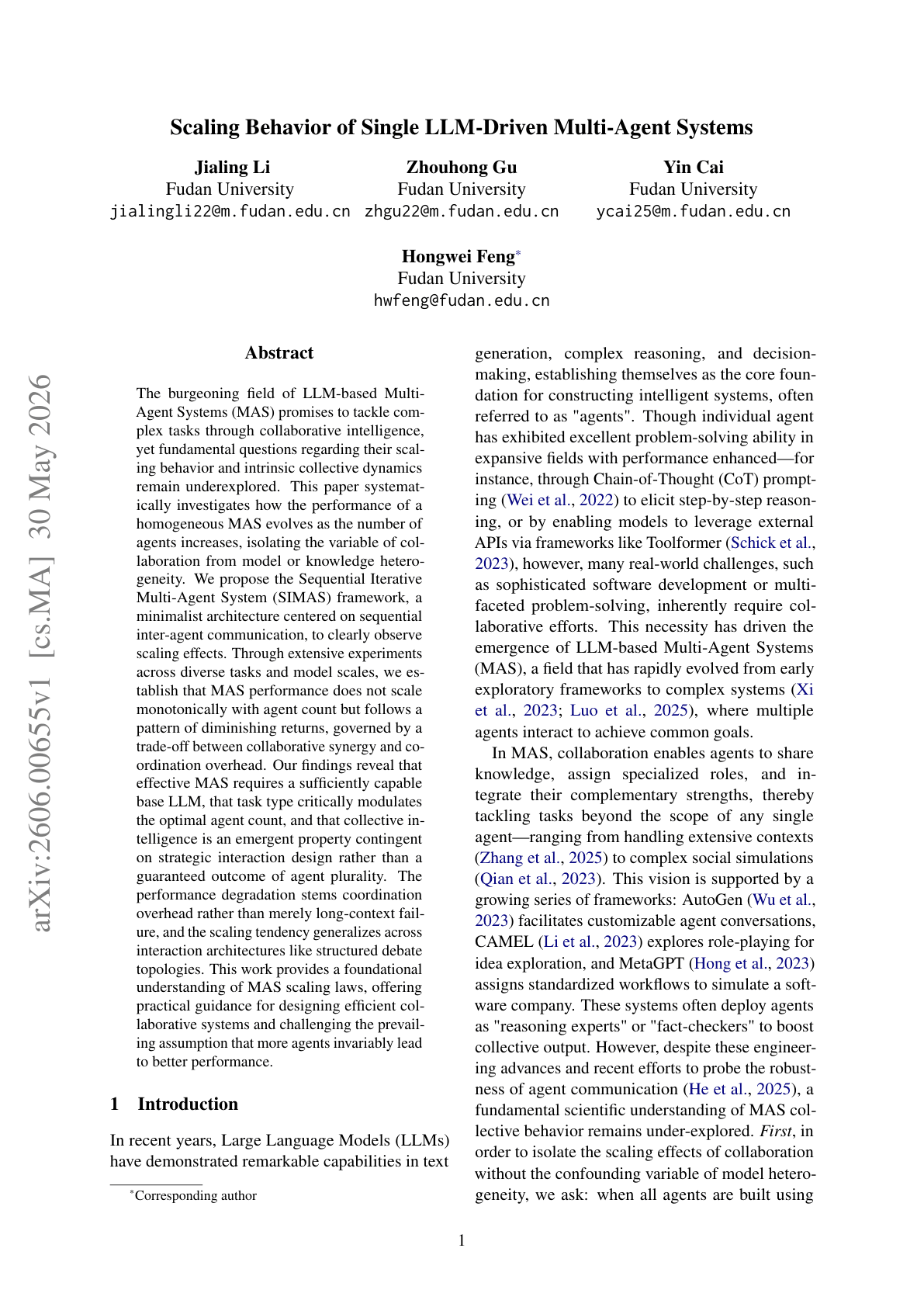
Do More Agents Help?
This paper studies whether adding agents actually makes a single LLM-driven multi-agent system better, using a Sequential Iterative Multi-Agent System (SIMAS) framework. The finding is that performance does not scale monotonically with agent count but follows a pattern of diminishing returns, with degradation eventually driven by coordination overhead. Effective systems still require a capable base model, the optimal number of agents depends on the task type, and collective intelligence turns out to be a product of strategic interaction design rather than a guaranteed outcome of agent plurality. The takeaway for builders is to design the interaction, not just stack more agents.
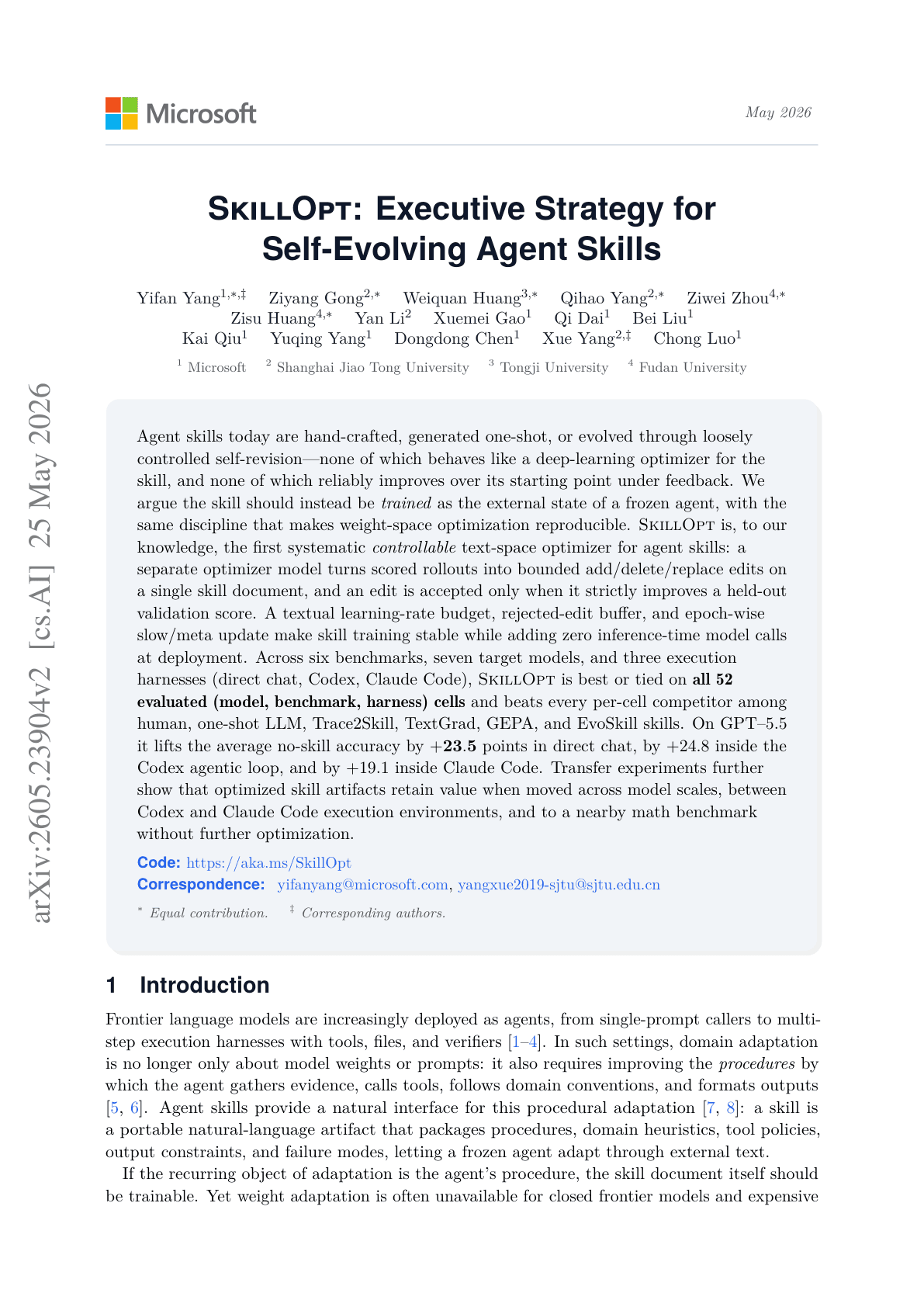
SkillOpt
Microsoft Research treats a compact natural-language skill document as the trainable state of a frozen agent, then learns that document through rollouts, reflection, and bounded edits gated by held-out validation. The argument is direct: most engineers handwrite agent skill docs and hope they generalize, when the doc itself should be optimized like a parameter. SkillOpt reframes the SKILL.md file as an external parameter of a model whose weights never change.
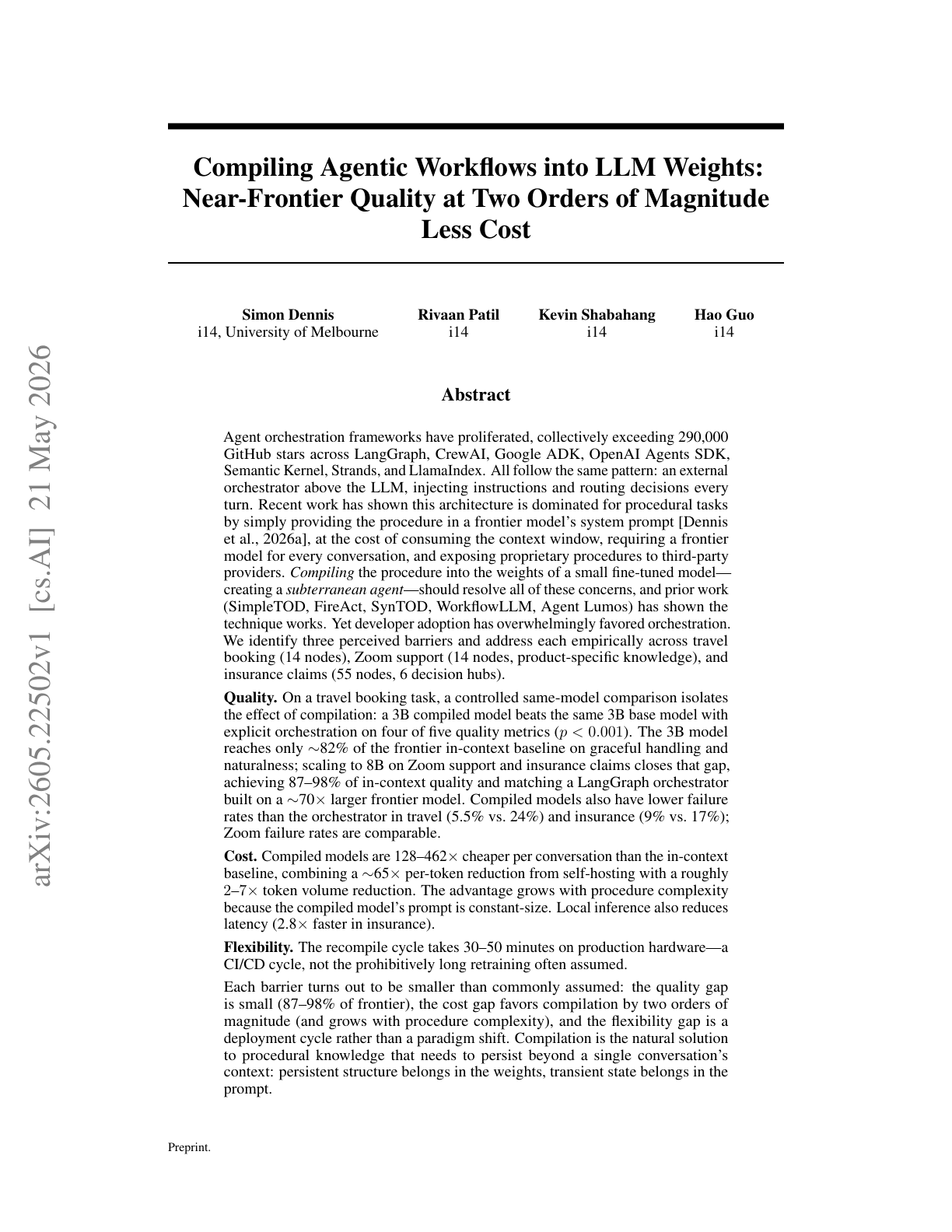
Compiling Agentic Workflows into Weights
This paper shows that a full agentic workflow can be distilled into the weights of a small model and run at roughly two orders of magnitude lower inference cost while preserving near-frontier task quality. Instead of keeping an external orchestrator above the LLM, the procedure is compiled into the weights of a fine-tuned model, producing what the authors call a subterranean agent.
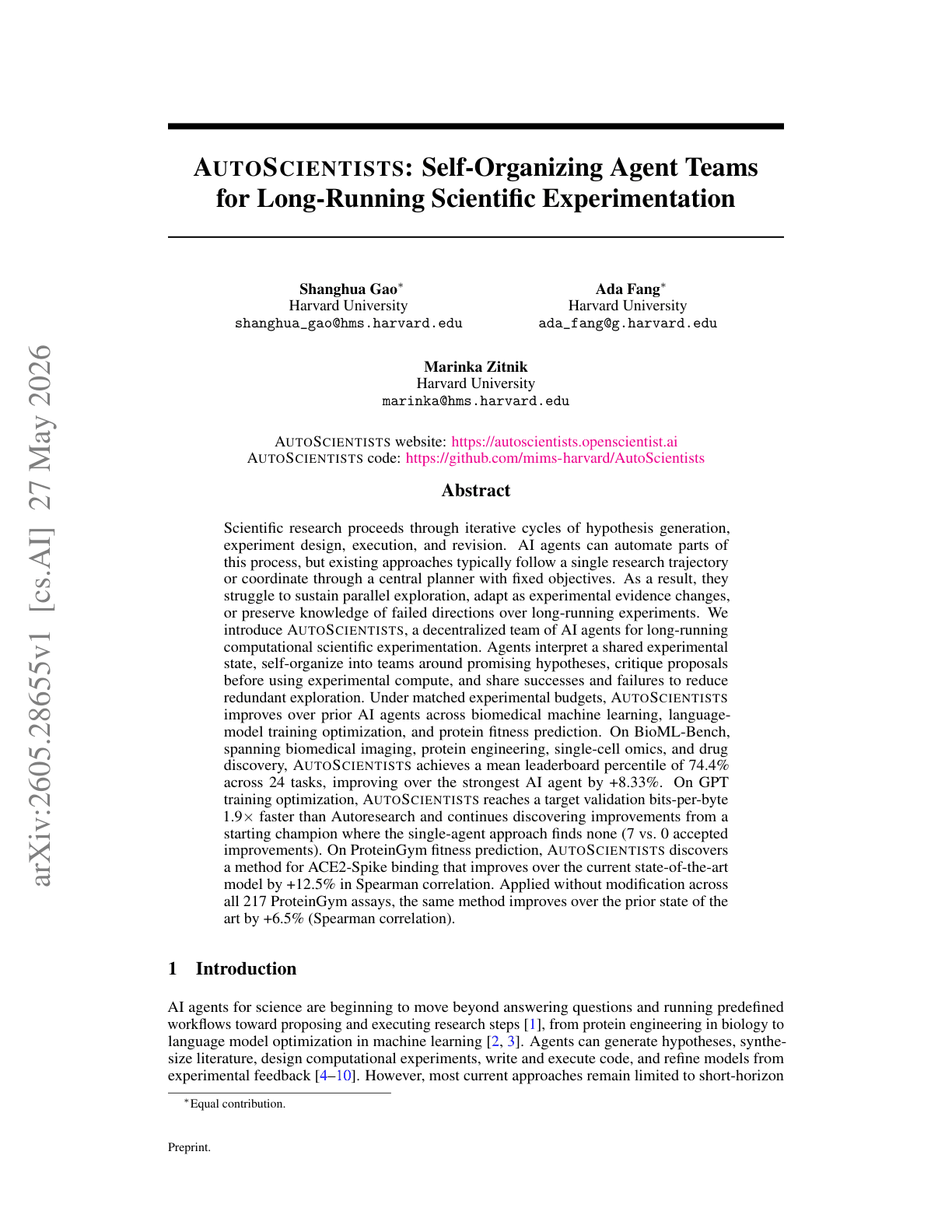
AutoScientists
AutoScientists, from Harvard, is a decentralized team of AI agents for long-running computational science that drops the central planner entirely. Rather than following one research trajectory coordinated from the top, agents self-organize around promising hypotheses, critique each other's proposals before spending experimental compute, and record both successes and failures so the system avoids redundant exploration as evidence accumulates over hours or days.
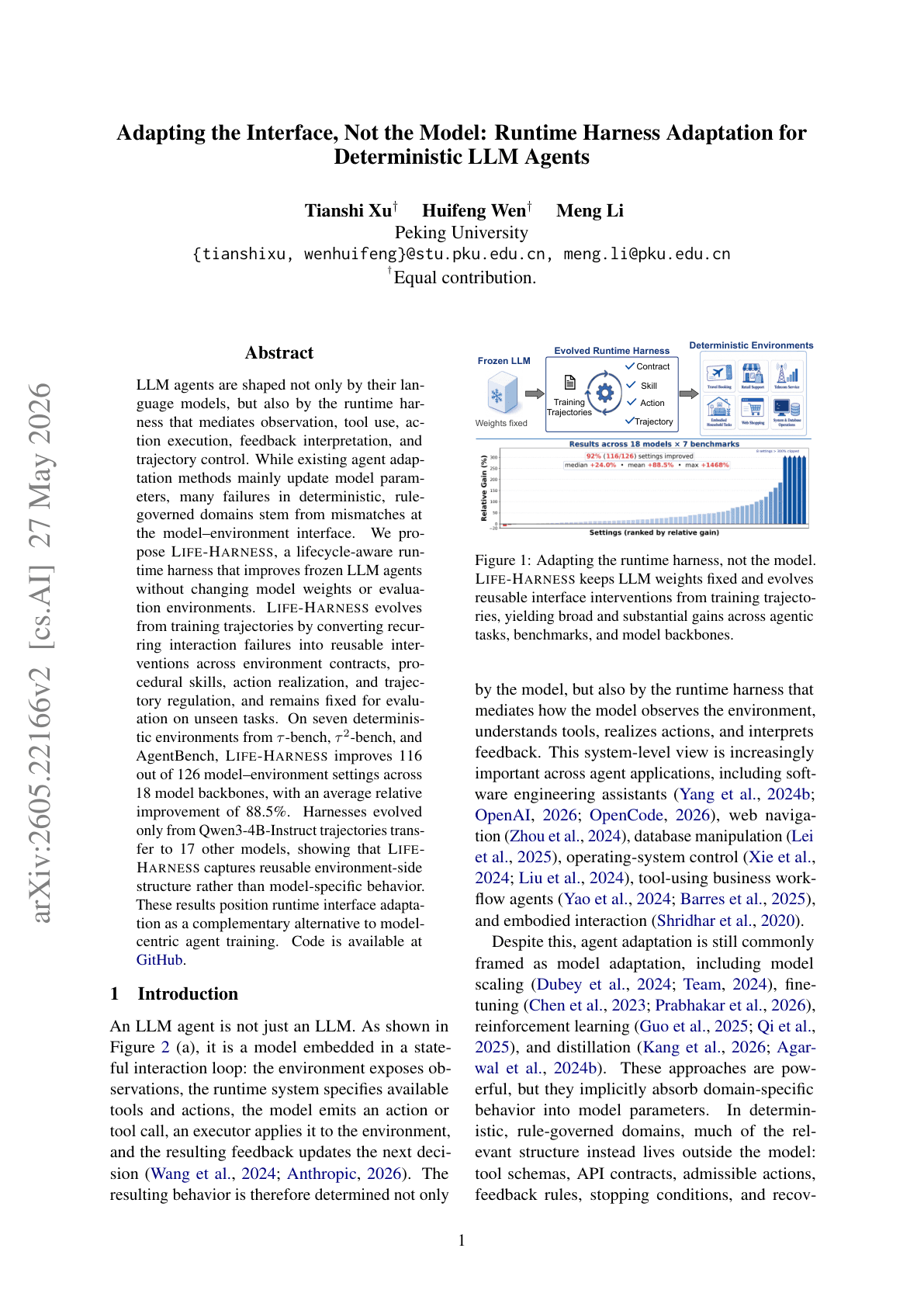
Adapting the Interface, Not the Model
When a frozen LLM agent repeatedly fails in a deterministic, rule-governed environment, do you have to retrain the model? Life-Harness argues no. Many failures come from mismatches at the model-environment interface, not from the model's reasoning, so the fix belongs in the runtime harness. Life-Harness is a lifecycle-aware harness that improves frozen agents without touching model weights or the evaluation environment.
Your Agents Are Aging Too
AgingBench is a longitudinal reliability benchmark for agent lifespan engineering, built on the observation that long-lived agents are still evaluated like freshly initialized models. It organizes agent degradation into four mechanisms: compression aging, where write-time summarization drops future-relevant details; interference aging, where accumulated similar memories crowd out the target fact; revision aging, where changed or derived state is not updated correctly; and maintenance aging from routine lifecycle events. Using a temporal dependency DAG to encode cross-session structure, it produces aging curves over an operational lifetime rather than a single day-one score, and points to where repair should target.
Harnesses Are Not Uniformly Better
This paper studies LLM agent harnesses through the lens of inference-time trajectory alignment, separating a harness into two mechanisms: task decomposition, which structures a task into sub-goals, and guided execution, which reshapes local action distributions during execution. The key finding is that more elaborate harnesses are not uniformly better. Increasing decomposition or guidance can improve execution but can also reduce final task success, producing concrete failure modes like over-decomposition, over-pruning, and hallucinated execution. Strikingly, partial harnesses that specify only the initial steps and leave the rest to the agent can reach a higher pass rate than fully structured workflows.
Code as Agent Harness
A 100+ page survey treating the agent harness as a first-class research object rather than glue around an LLM. The authors argue that code-as-harness is the most promising path to general-purpose agency, and that future agent systems should satisfy four properties: executable, inspectable, stateful, and governed. The report consolidates methods, applications, and open problems across the harness layer.