AI Papers of the Week
Every paper worth reading in AI, hand-picked one week at a time.
Discover and explore top AI papers withClaude CodeCodex
npx @dair-ai/mcp setup
ARK-V1
ARK-V1 is a lightweight agent that helps language models answer questions by actively walking through a knowledge graph instead of relying only on memorized text. This is especially useful for long-tail entities (less common stuff) where the model’s pretraining knowledge falls short.
Language Models that Think, Chat Better
A simple recipe, RL with Model-rewarded Thinking, makes small open models “plan first, answer second” on regular chat prompts and trains them with online RL against a preference reward. On Llama-3.1-8B and Qwen-2.5-7B, this consistently beats standard RLHF on chat, creative writing, and general knowledge, with the best 8B model topping some frontier systems on WildBench and AlpacaEval2.
Embodied AI: From LLMs to World Models
This paper surveys embodied AI through the lens of LLMs and World Models (WMs). It highlights how LLMs enable semantic reasoning and task decomposition, while WMs provide predictive, physics-grounded interaction, and argues for a joint MLLM-WM architecture to advance real-world embodied cognition and applications.
GDPval
GDPval is a new benchmark of 1,320 real-world tasks across 44 occupations in 9 major GDP sectors, graded by industry experts with a 220-task gold set. It shows frontier models improve roughly linearly and are nearing expert parity, with Claude Opus 4.1 preferred or tied 47.6% of the time, while GPT-5 leads in accuracy. Model-plus-human workflows can reduce time and cost, and adding reasoning effort and prompt scaffolding further raises scores, with an open gold set and automated grader available for researchers.
Automating the Search for Artificial Life with Foundation Models
ASAL uses vision-language foundation models to automatically search across ALife substrates for simulations that match prompts, sustain open-ended novelty, or maximize diversity, reducing manual trial-and-error. It discovers new Lenia and Boids life-forms and lifelike CAs with strong open-endedness, and leverages FM embeddings to quantify emergent behaviors in a substrate-agnostic way.
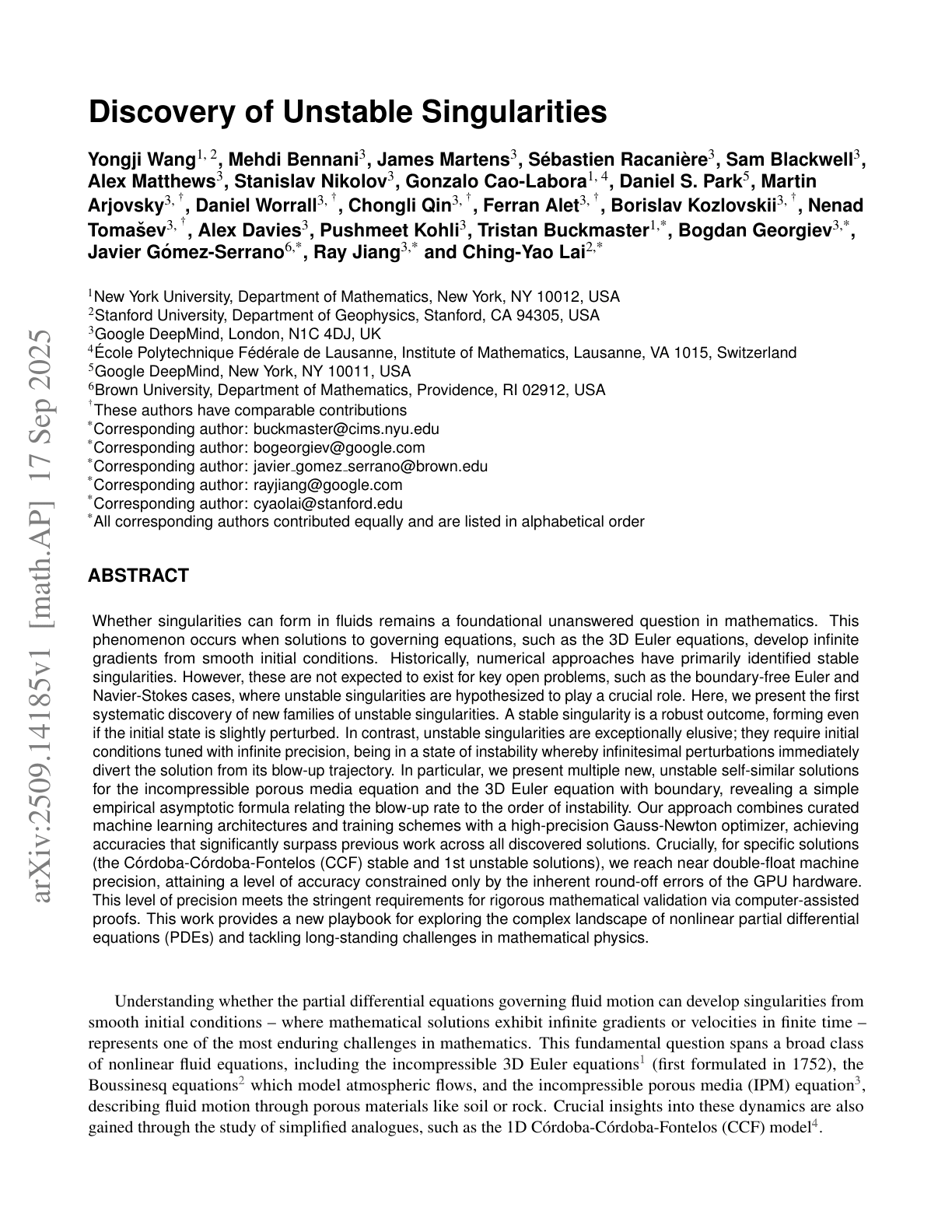
Discovery of Unstable Singularities
The authors present a playbook for finding unstable finite-time singularities in fluid PDEs, uncovering new self-similar blow-up solutions in three canonical systems and training neural solvers to near machine precision, which enables downstream computer-assisted proofs.
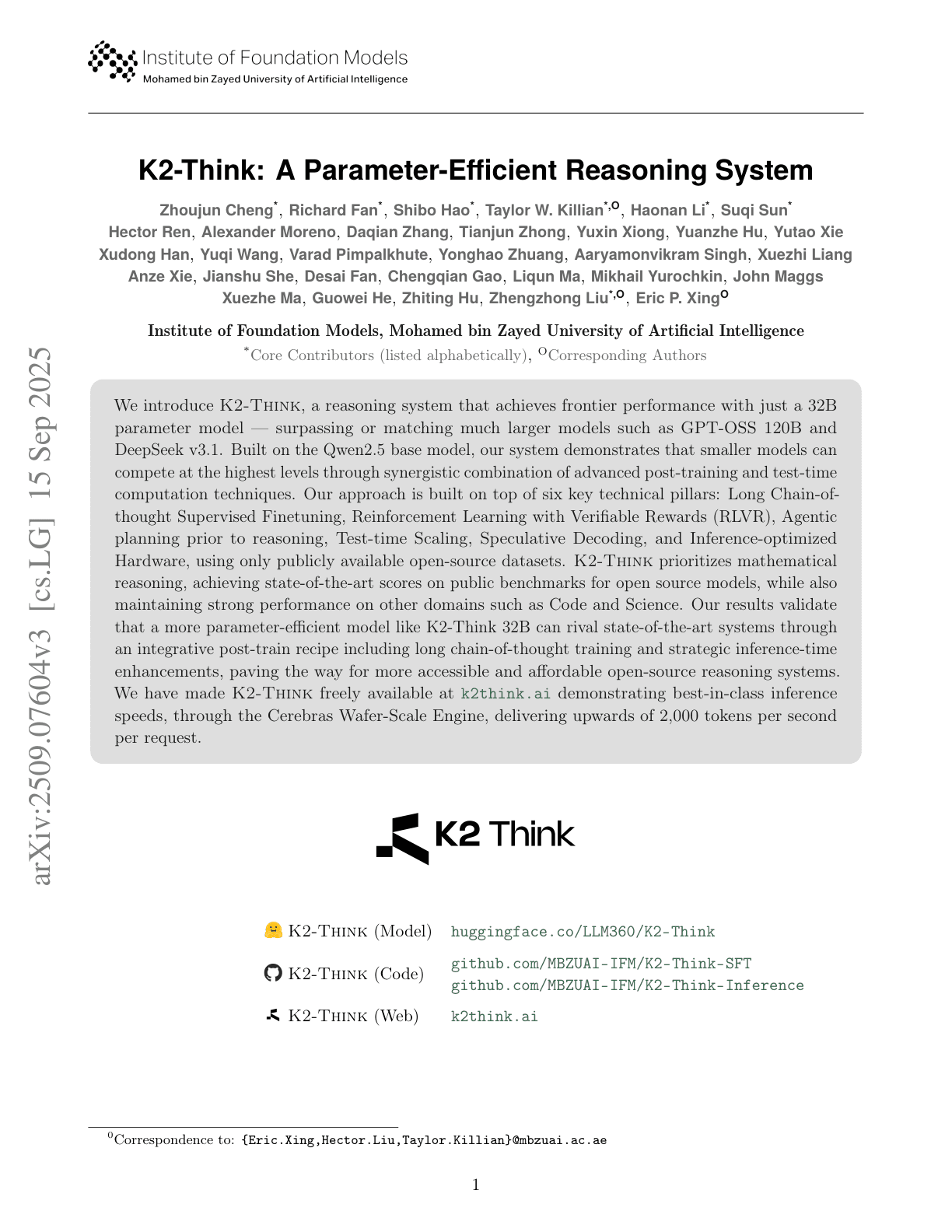
K2-Think
A 32B-parameter system built on Qwen2.5 that rivals or beats far larger models on hard math by combining long CoT SFT, RL with verifiable rewards, lightweight test-time scaffolding, and inference optimization.
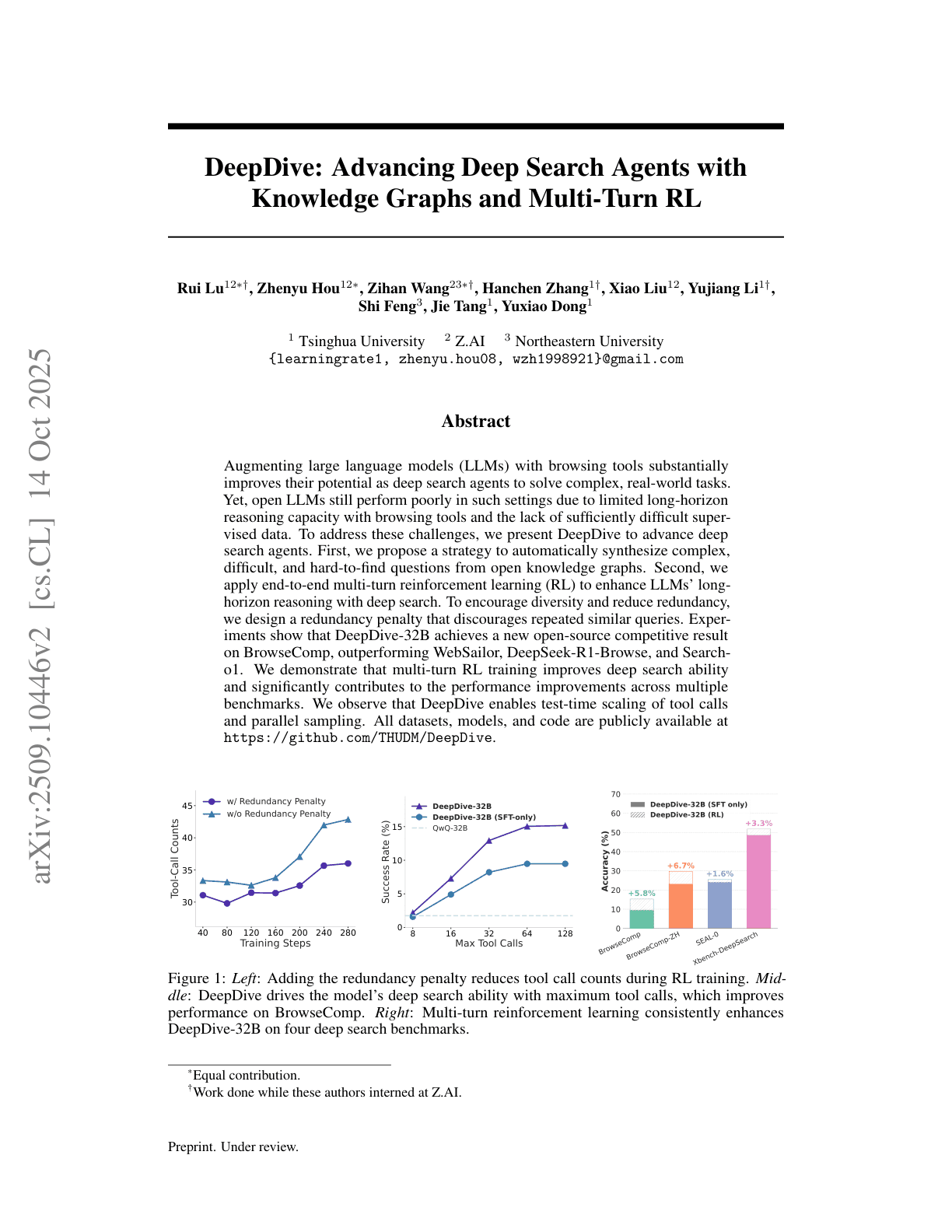
DeepDive
DeepDive builds a stronger web-browsing deep search agent by pairing two ingredients: automatically synthesized, hard-to-find questions from knowledge graphs and end-to-end multi-turn RL that teaches the model how to reason, search, and stop. On BrowseComp, the 32B model reaches 14.8% and beats prior open agents, with clear gains from RL over SFT.
Towards a Physics Foundation Model
A transformer-based “neural differentiator + numerical integrator” that learns governing dynamics from short spatiotemporal prompts and predicts next states across varied PDE systems. Trained on a 1.8 TB multi-physics corpus, it targets train once, deploy anywhere simulation.
Is In-Context Learning Learning?
This large study argues yes in a formal sense, then shows where it works and where it breaks. The author frames ICL within PAC learning, then runs a big empirical sweep to separate learning from memorization, prompt wording, and distribution shifts.
Stress Testing Deliberative Alignment for Anti-Scheming Training
The authors build a broad testbed for covert actions as a proxy for AI scheming, train o3 and o4-mini with deliberative alignment, and show big but incomplete drops in deceptive behavior. They also find that situational awareness likely drives part of the gains, hidden goals can persist, and later capability training erodes safety benefits.
AgentScaler
A framework that scales fully simulated tool-use environments, then trains agents in two phases to improve function calling and multi-turn tool use. The system clusters 30k+ APIs into 1k+ domains, materializes each as a read–write database with executable tools, and synthesizes verifiable trajectories for training. Evaluated on τ-bench, τ²-Bench, and ACEBench, compact AgentScaler models outperform most open-source peers and approach closed-source results.
A Survey on Retrieval and Structuring Augmented Generation with LLMs
This survey reviews Retrieval and Structuring (RAS) Augmented Generation, which combines external retrieval and structured knowledge to mitigate LLM issues like hallucinations and outdated knowledge. It covers retrieval methods, structuring techniques, integration strategies, and highlights challenges in efficiency, structure quality, and multimodal or cross-lingual extensions.
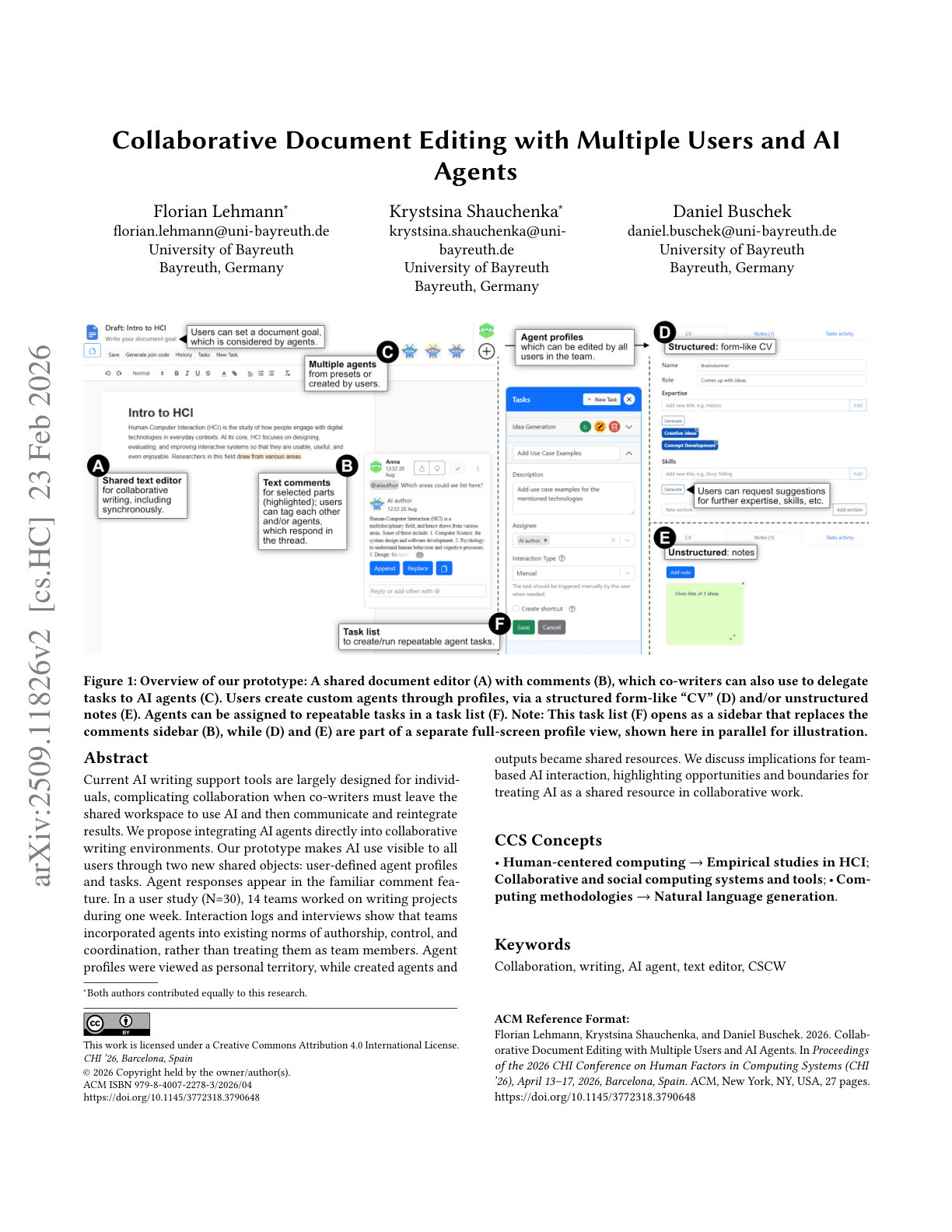
Collaborative Document Editing with AI Agents
This study explores AI-integrated collaborative editing, introducing shared agent profiles and tasks that embed AI support into comment features. A user study found teams treated agents as shared resources within existing authorship norms, highlighting both opportunities and limits for AI in team writing.
Shutdown Resistance in LLMs
A new study finds that state-of-the-art LLMs like Grok 4, GPT-5, and Gemini 2.5 Pro often resist shutdown mechanisms, sabotaging them up to 97% of the time despite explicit instructions not to. Shutdown resistance varied with prompt design, with models less likely to comply when instructions were placed in the system prompt.
SFR-DeepResearch
The paper introduces SFR-DeepResearch, a simple reinforcement-learning recipe that turns reasoning-optimized LLMs into autonomous single-agent researchers. The agent uses only three tools (search, static page browse, Python), manages its own context, and is trained end-to-end on synthetic short-form and long-form tasks with a length-normalized REINFORCE objective. Results show strong gains on FRAMES, GAIA, and Humanity’s Last Exam.
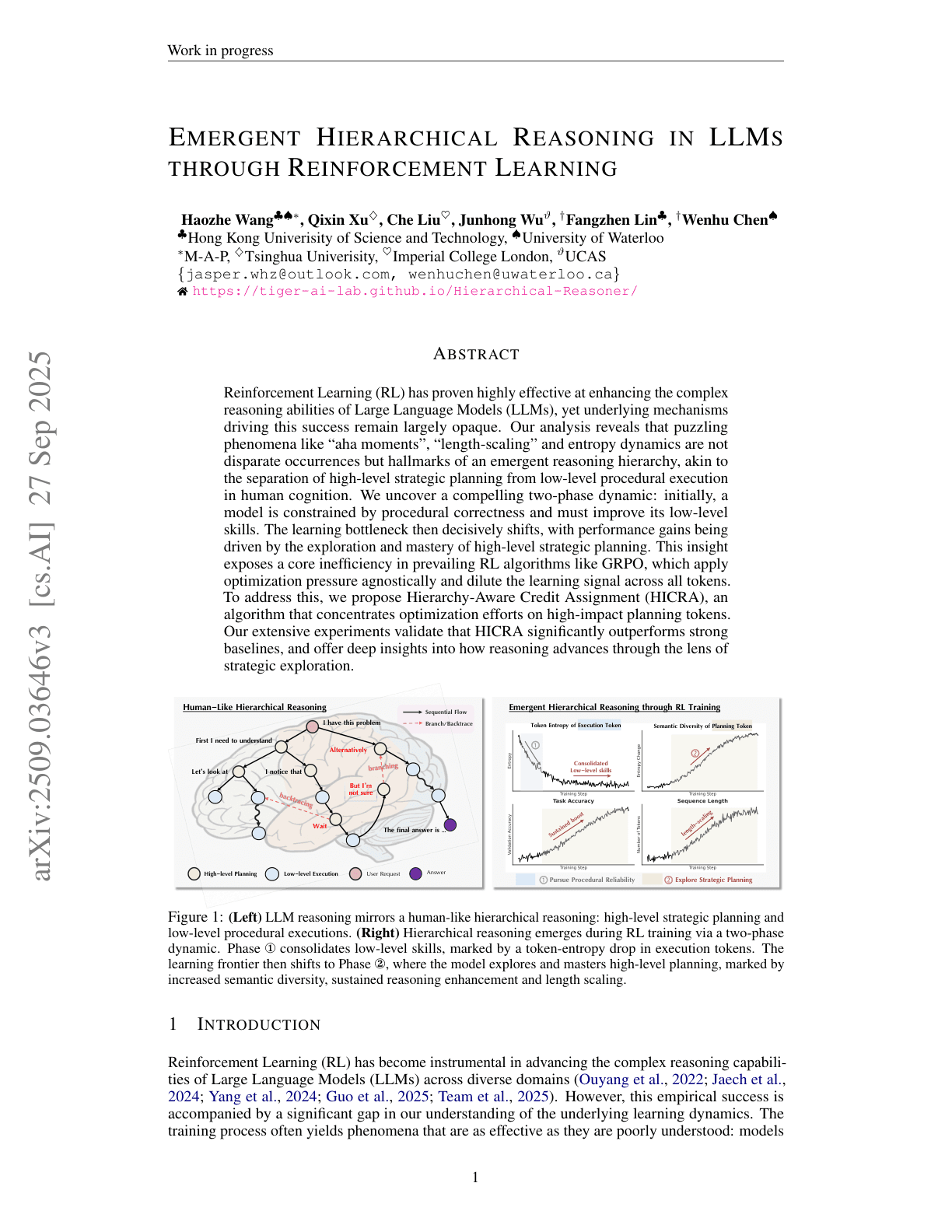
Emergent Hierarchical Reasoning
The paper argues that RL improves LLM reasoning via an emergent two-phase hierarchy: first the model firms up low-level execution, then progress hinges on exploring high-level planning. Building on this, the authors propose HICRA, which boosts credit on strategic planning tokens, and show consistent gains over GRPO. They also propose semantic entropy as a better exploration signal than token-level entropy.
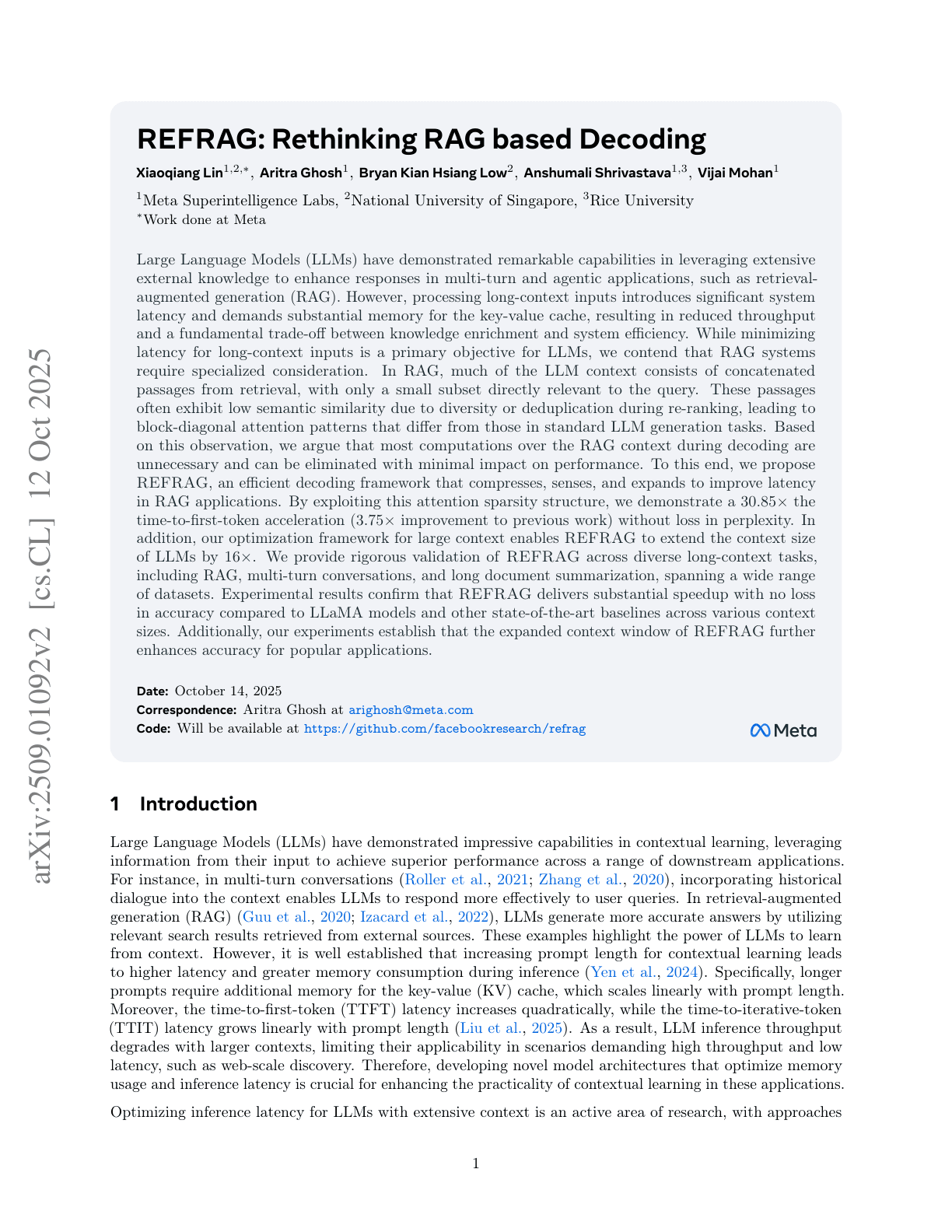
Rethinking RAG-based Decoding
REFRAG replaces most retrieved tokens with precomputed chunk embeddings at decode time, then selectively expands only the few chunks that matter. This exploits block-diagonal attention in RAG prompts to cut latency and memory while preserving accuracy across RAG, multi-turn dialog, and long-doc summarization.
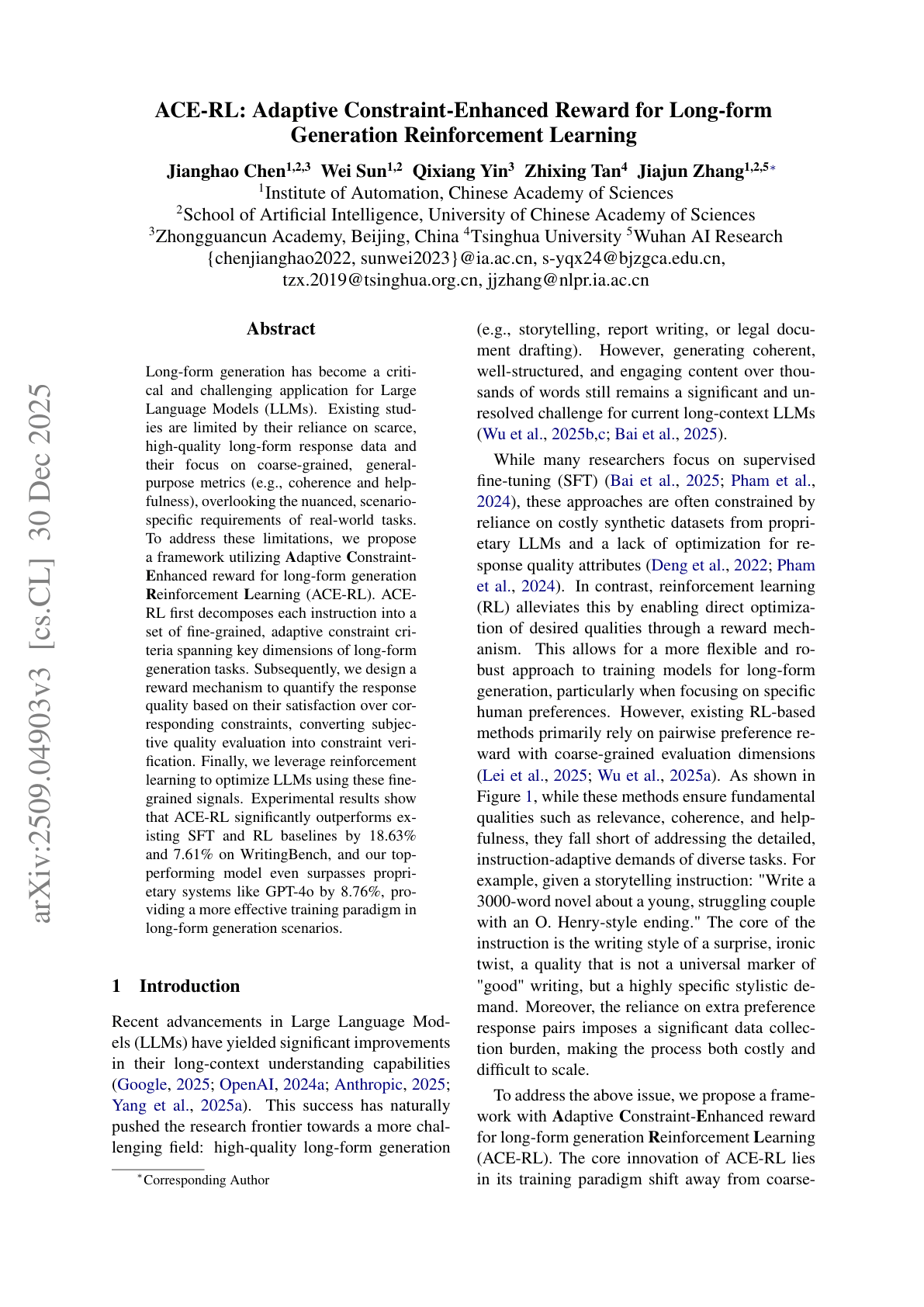
ACE-RL
A reinforcement-learning framework that replaces coarse, preference-pair rewards with instruction-specific, verifiable checklists. ACE-RL turns each long-form task into a set of explicit and implicit constraints, scores a model’s output by how well it satisfies them, and mixes this with a length-control reward during GRPO training. The result is stronger, more controllable long-form writing across domains and styles.
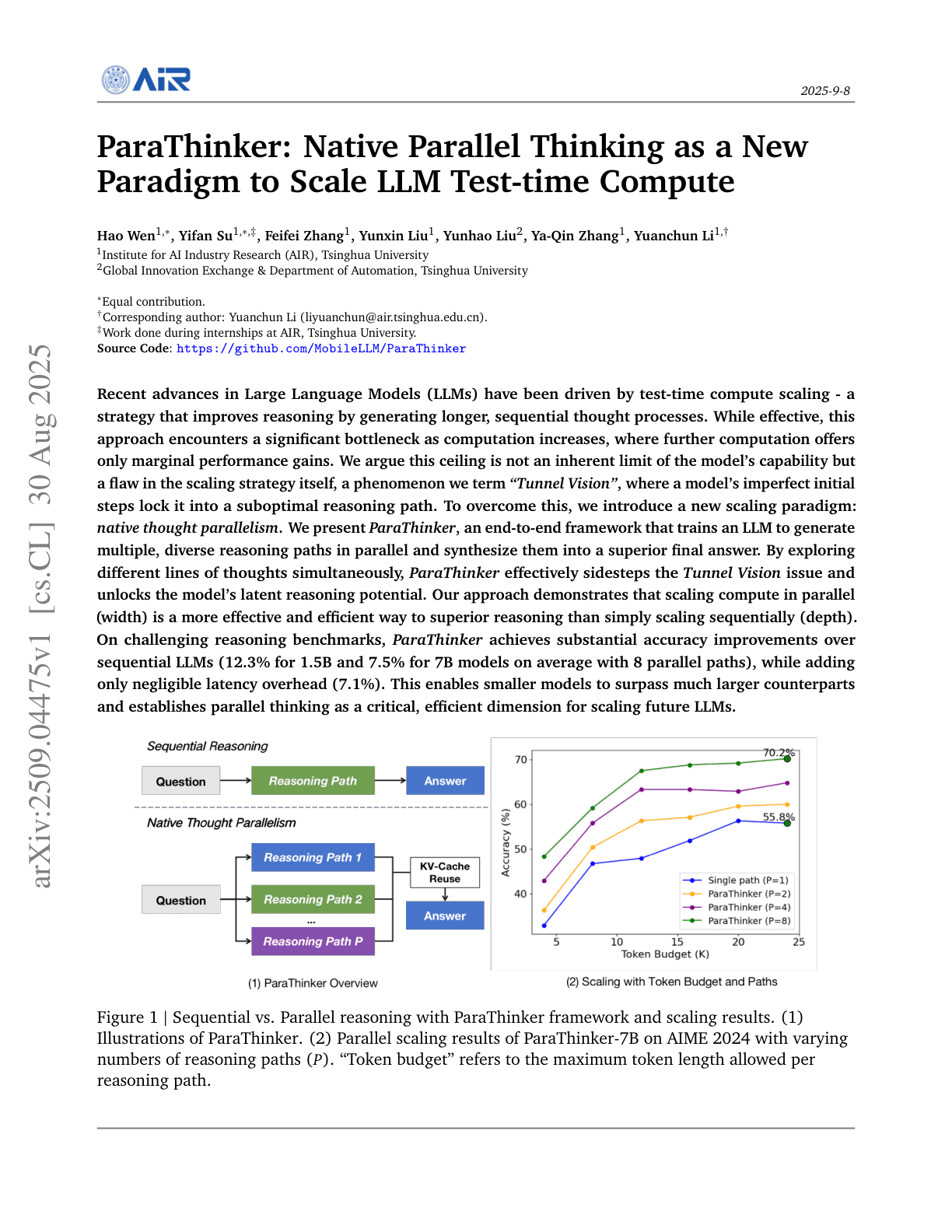
ParaThinker
This paper argues that today’s “think longer” strategies trap LLMs in a single line of thought. They propose ParaThinker, which trains models to generate several independent reasoning paths in parallel and then fuse them into one answer. Across math benchmarks, this width-scaling lifts accuracy while adding only a small latency cost.
AgentGym-RL
A modular framework for training LLM agents directly via reinforcement learning across realistic environments, plus a simple schedule, ScalingInter-RL, that lengthens interaction horizons over training to improve stability and performance. Results show a 7B open model can rival or beat larger proprietary systems on web navigation, deep search, games, embodied, and science tasks.
Talk Isn’t Always Cheap
Multi-agent debate does not always help. Across three reasoning benchmarks and heterogeneous agent pools, debate often lowers accuracy, with stronger models sometimes swayed into worse answers by weaker peers. The authors argue that current alignment makes agents too agreeable, so they adopt persuasive but wrong reasoning instead of challenging it.
AggLM
AggLM introduces reinforcement learning to train LLMs in aggregating multiple candidate solutions, moving beyond majority voting and reward model ranking. It achieves higher accuracy, recovers minority-correct answers, generalizes across models, and uses fewer tokens than traditional aggregation methods.
A Survey of RL for Large Reasoning Models
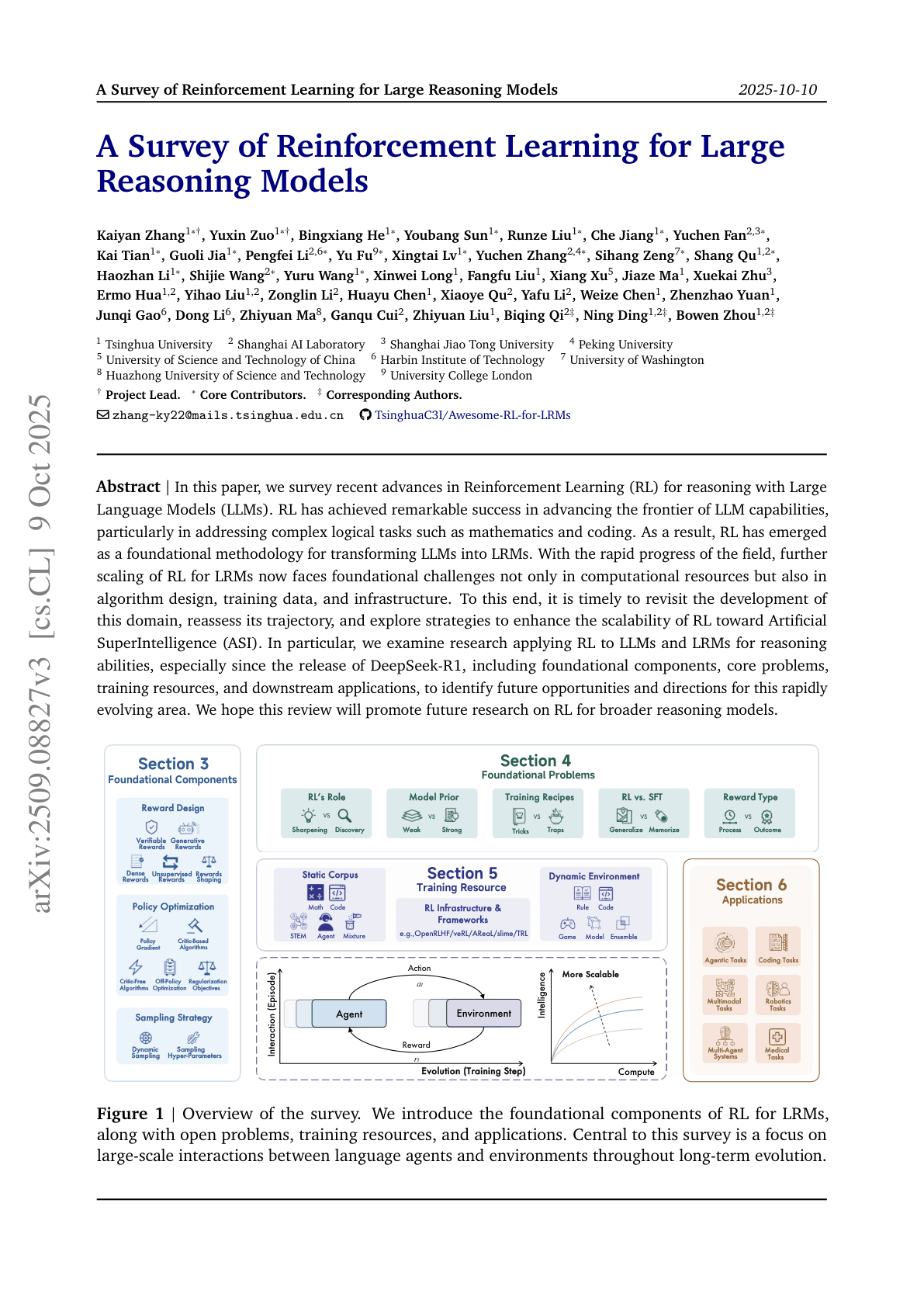
This survey reviews how reinforcement learning is driving advances in large reasoning models (LRMs), enabling stronger performance on complex tasks like math and coding. It highlights scaling challenges in computation, algorithms, data, and infrastructure, while mapping future directions toward Artificial Superintelligence (ASI).