AI Papers of the Week
Every paper worth reading in AI, hand-picked one week at a time.
Discover and explore top AI papers withClaude CodeCodex
npx @dair-ai/mcp setup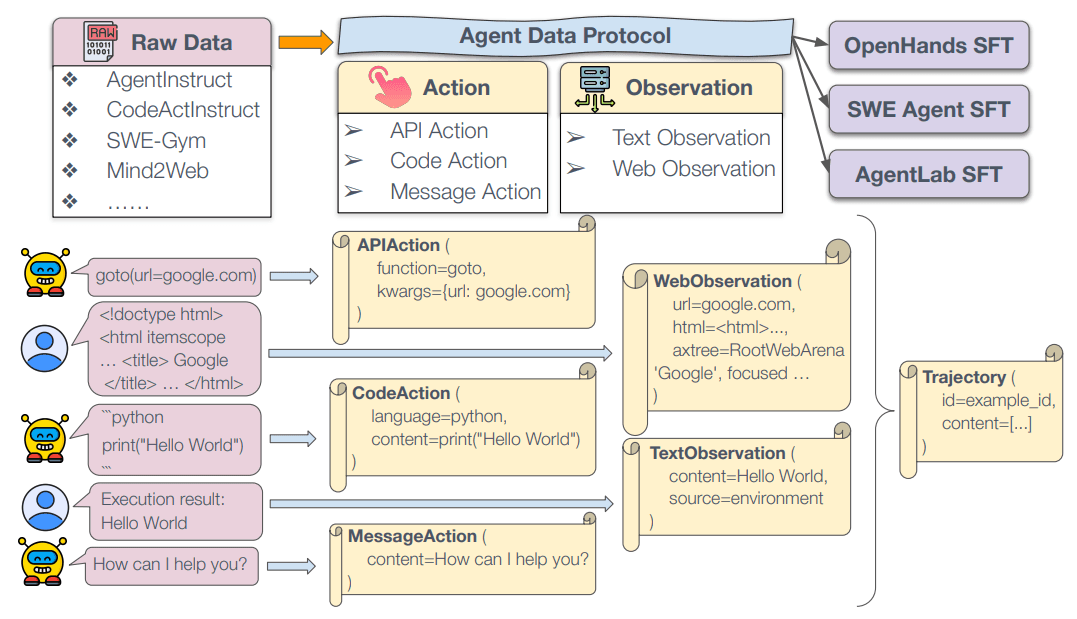
Agent Data Protocol
Agent Data Protocol introduces a standardized format to unify fragmented agent training datasets across different tools and interfaces, enabling more efficient fine-tuning of LLM agents. By converting 13 existing datasets into this protocol and training on consolidated data, the work achieved ~20% performance improvements over baseline models while reaching state-of-the-art results on coding, browsing, and tool-use benchmarks. The protocol and datasets are publicly released to facilitate reproducible, scalable agent training across diverse domains.
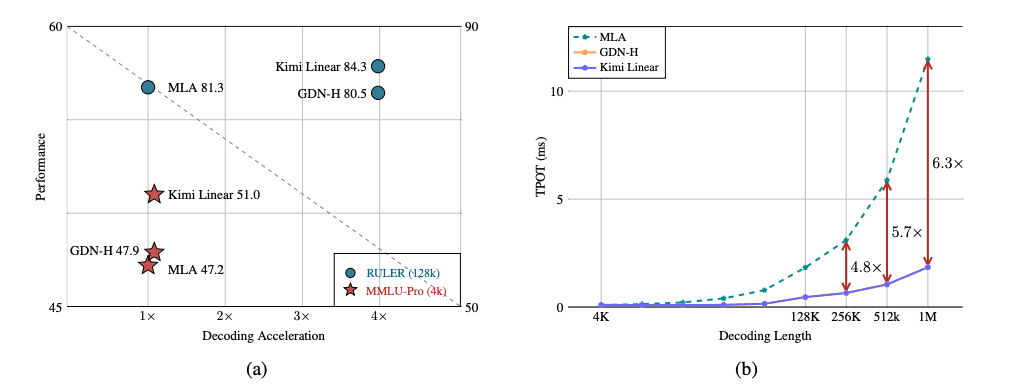
Kimi Linear
Kimi Linear introduces a hybrid linear attention architecture combining Kimi Delta Attention (KDA) with periodic full attention layers at a 3:1 ratio, achieving superior performance over full attention while reducing KV cache by 75% and delivering 6× faster decoding at 1M context. KDA extends Gated DeltaNet with fine-grained channel-wise gating and specialized Diagonal-Plus-Low-Rank matrices, enabling more effective RNN memory management while maintaining hardware efficiency through optimized chunkwise algorithms that substantially reduce computation versus general DPLR formulations.
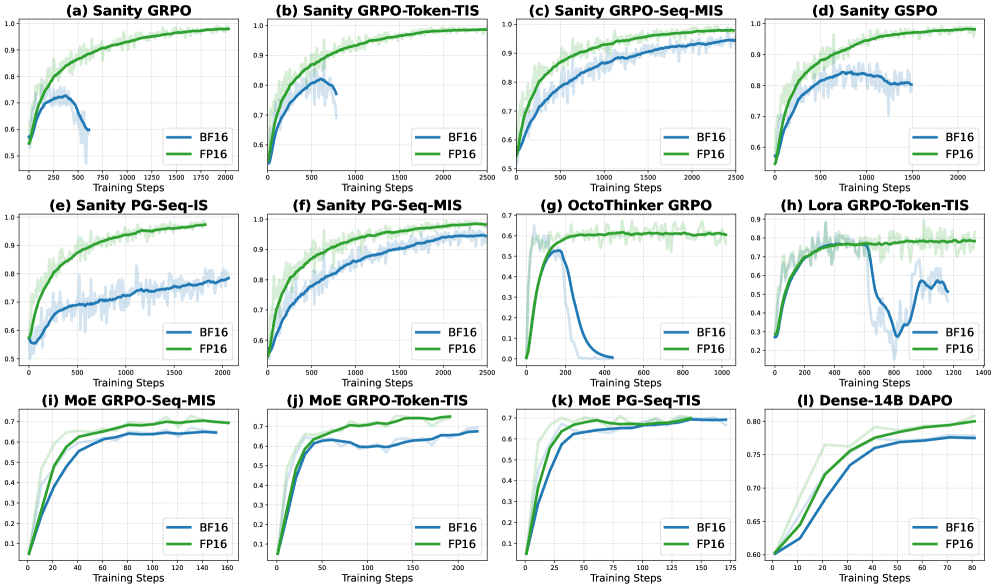
Precision-RL
Reinforcement learning fine-tuning of LLMs suffers from a critical numerical mismatch between training and inference engines, causing training instability and collapse. This work reveals that simply switching from BF16 to FP16 precision virtually eliminates this mismatch - achieving faster convergence, higher stability, and superior performance across diverse models, frameworks, and algorithms without any algorithmic changes or architectural modifications.
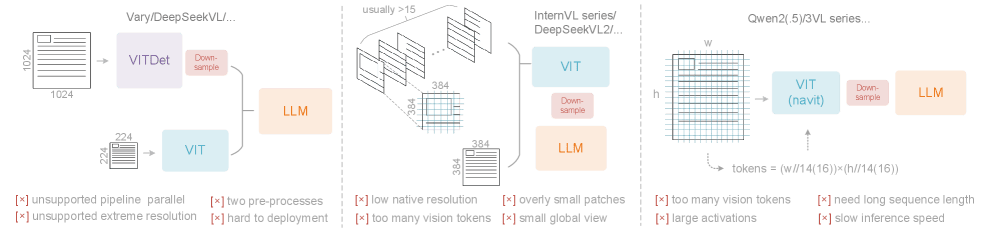
DeepSeek-OCR
DeepSeek-OCR explores compressing long text contexts into visual representations using a novel vision encoder architecture (DeepEncoder) that achieves 10-20x compression ratios while maintaining high OCR accuracy.
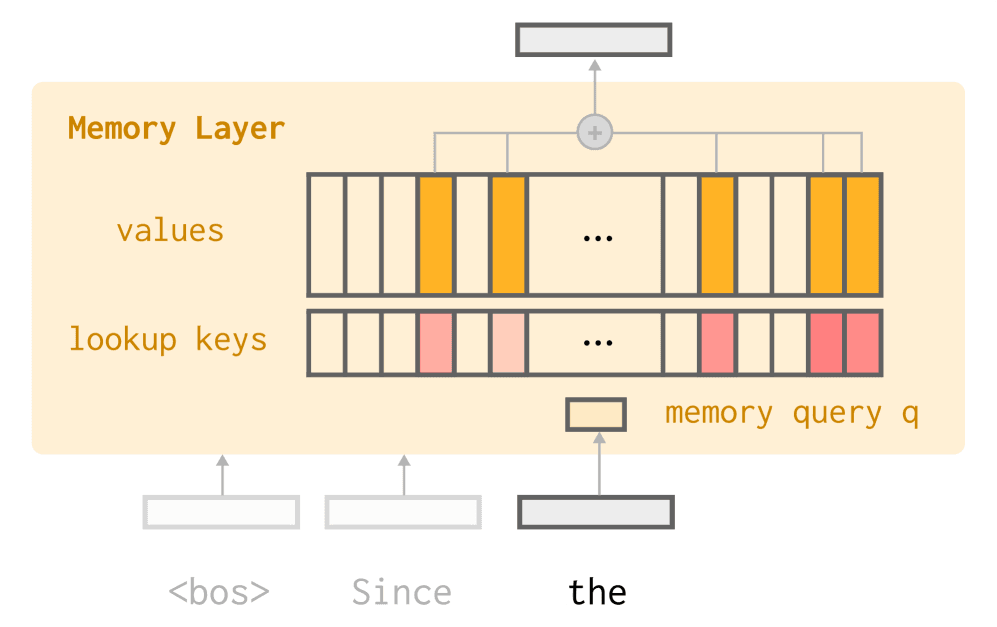
Continual Learning via Sparse Memory Finetuning
Meta AI researchers address catastrophic forgetting in language models through sparse memory finetuning, updating only memory slots most activated by new knowledge while achieving 89% less performance degradation than standard finetuning.
When Models Manipulate Manifolds
Anthropic researchers investigate how Claude 3.5 Haiku learns to predict line breaks in fixed-width text, revealing geometric representations analogous to biological place cells and boundary cells in biological brains.
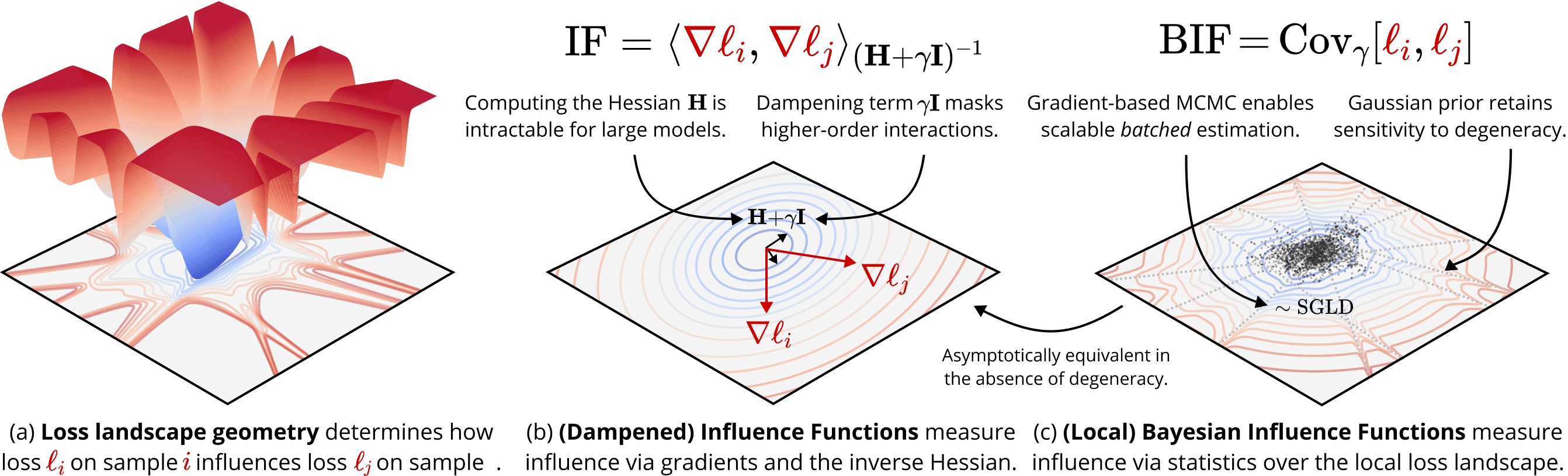
Bayesian Influence Functions for Hessian-Free Data Attribution
Classical influence functions struggle with deep neural networks due to non-invertible Hessians and high-dimensional parameter spaces. This work introduces the local Bayesian influence function (BIF), which replaces Hessian inversion with loss landscape statistics estimated via stochastic-gradient MCMC sampling.
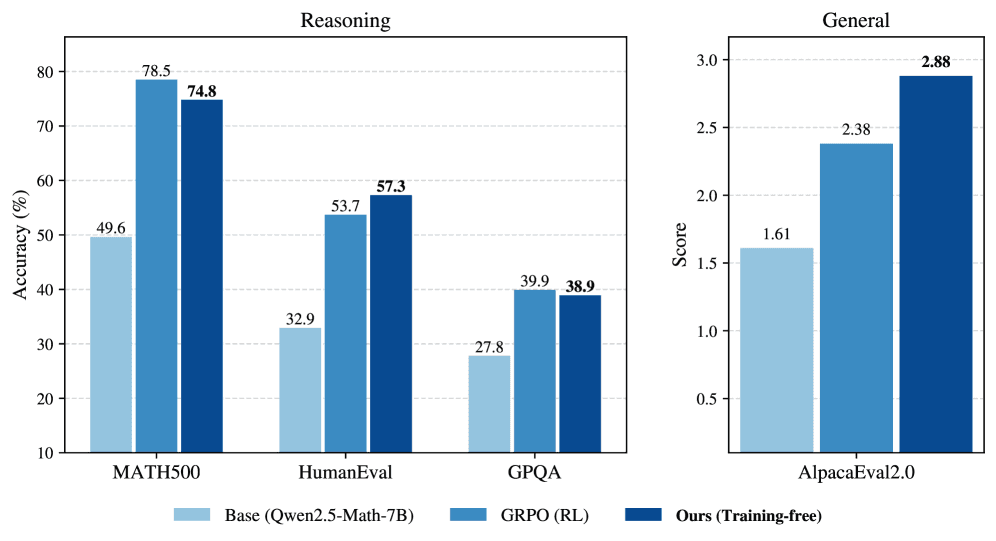
Reasoning with Sampling
Base language models achieve reasoning performance matching or exceeding RL-posttraining through inference-time power distribution sampling, using MCMC techniques that require no training, datasets, or verifiers.
Lookahead Routing for LLMs
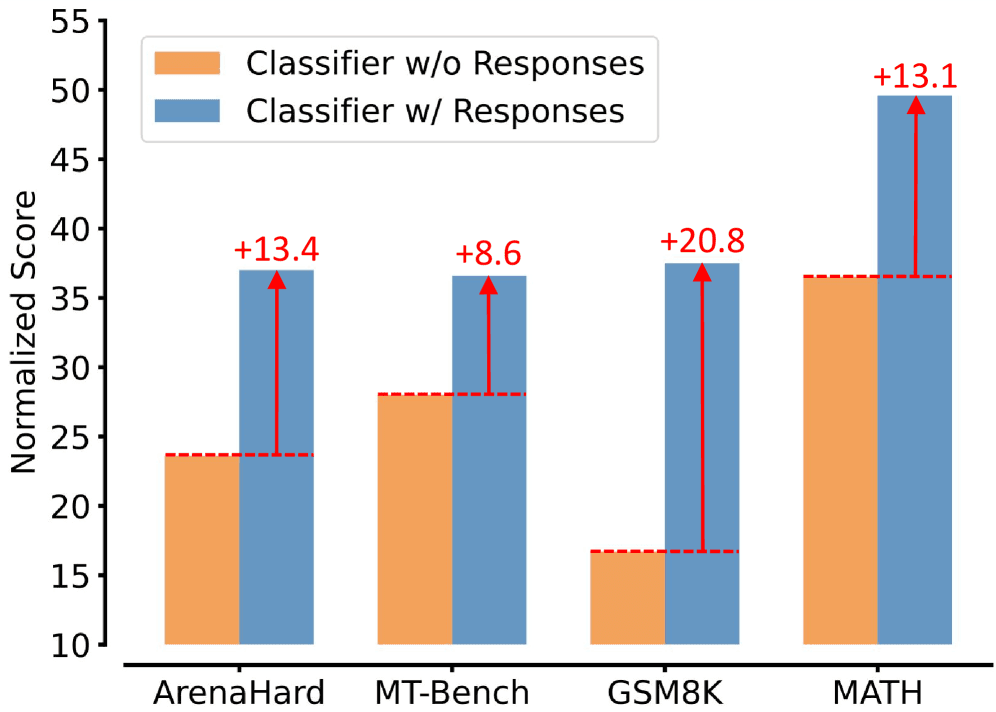
Lookahead is a response-aware LLM routing framework that predicts latent representations of potential model outputs to enable more informed routing decisions without full inference.
Ring-1T
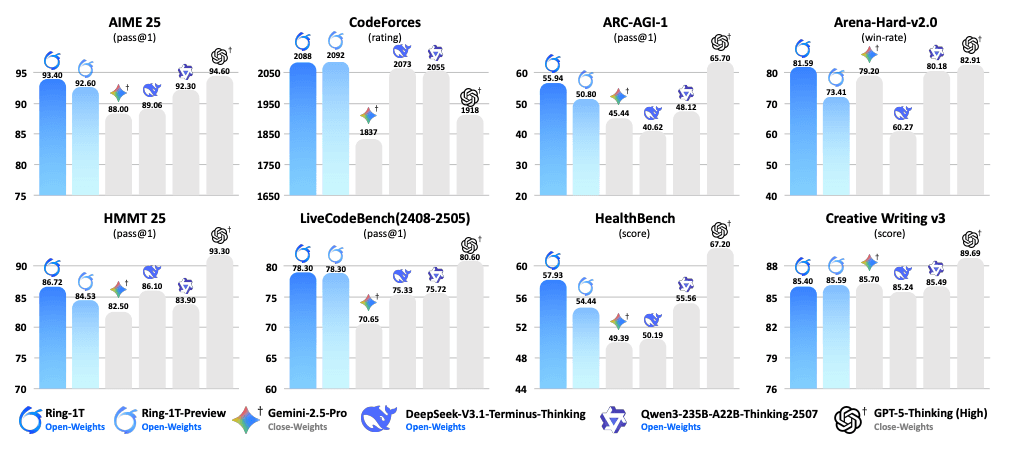
Ring-1T is the first open-source thinking model with 1 trillion parameters (~50B active per token), achieving breakthrough results through three innovations for trillion-scale RL training.
ColorAgent
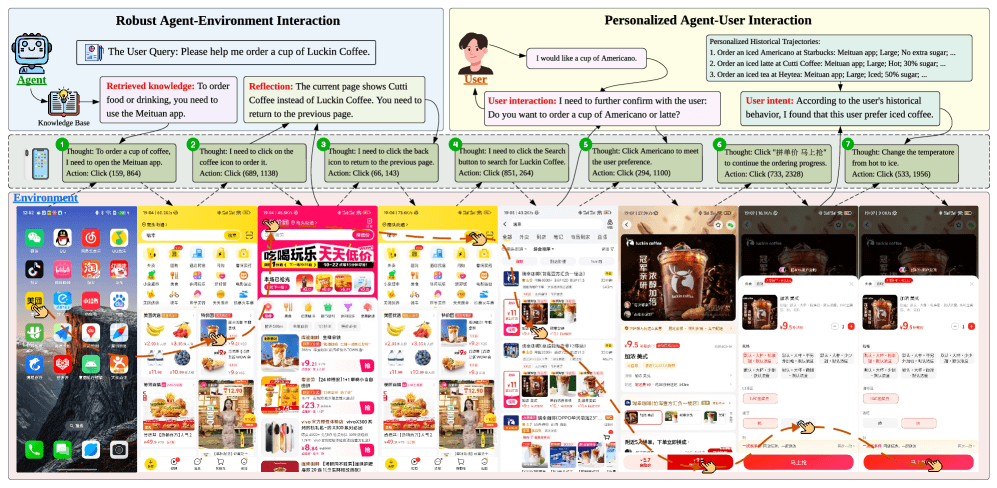
ColorAgent is a mobile OS agent combining step-wise RL and self-evolving training with a multi-agent framework for personalized user engagement. It achieves 77.2% success on AndroidWorld and 50.7% on AndroidLab (SOTA among open models), while scoring 58.66% on MobileIAR for personalized intent alignment and 68.98% on VeriOS-Bench for trustworthiness.
Prompt-MII
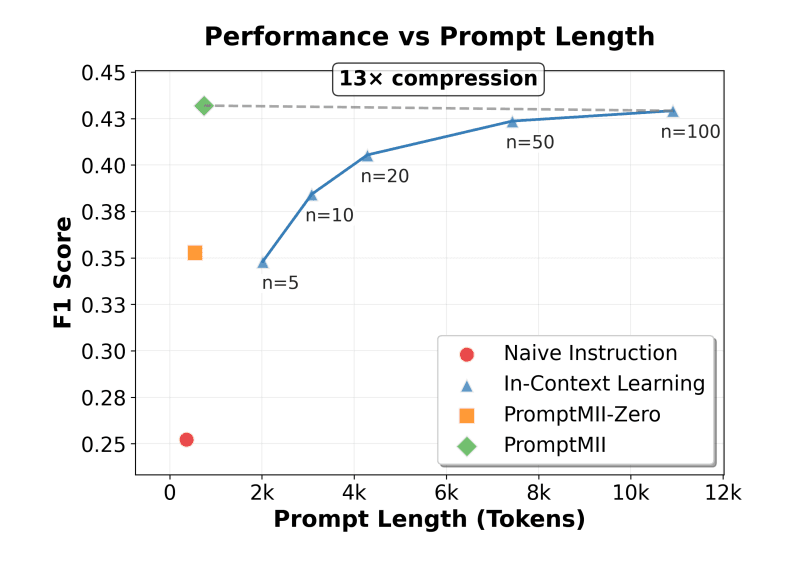
CMU researchers propose Prompt-MII, an RL framework that meta-learns instruction induction across 3,000+ HuggingFace datasets, achieving 4-9 F1 point improvements on 90 unseen tasks while requiring 3-13x fewer tokens than in-context learning. Unlike APE (2000 LLM calls) and GEPA (150 calls), it generates compact instructions in a single forward pass and is training-free at test time.
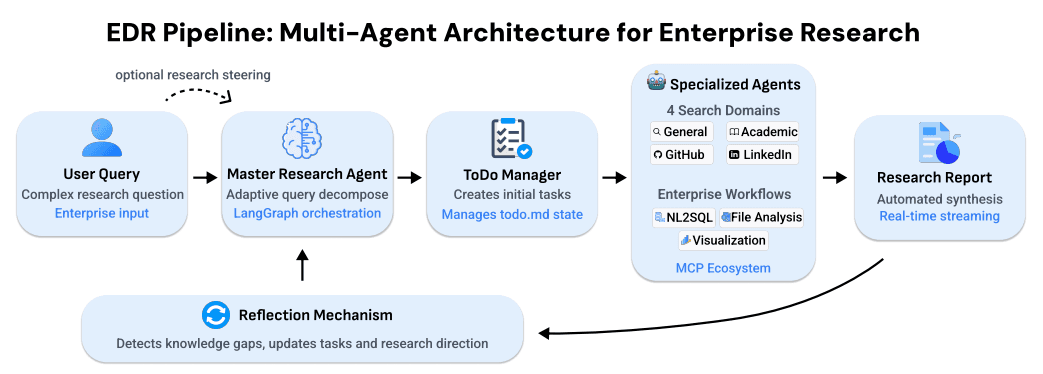
Enterprise Deep Research
Salesforce AI researchers present EDR, a transparent multi-agent framework for enterprise deep research with human-in-the-loop steering via todo-driven task management and steerable context engineering. It achieves SOTA on DeepResearch Bench (49.86), 71.57% win rate on DeepConsult, and 68.5% on ResearchQA while consuming 4x fewer tokens than LangChain’s open deep research.
Cell2Sentence-Scale 27B
C2S-Scale extends Cell2Sentence by converting gene expression into “cell sentences” and training LLMs on 50M+ cells plus biological text. Models scale to 27B params and unify prediction, generation, and NL interpretation. A dual-context virtual screen then led to a wet-lab validated finding: silmitasertib acts as an interferon-conditional amplifier of MHC-I antigen presentation.
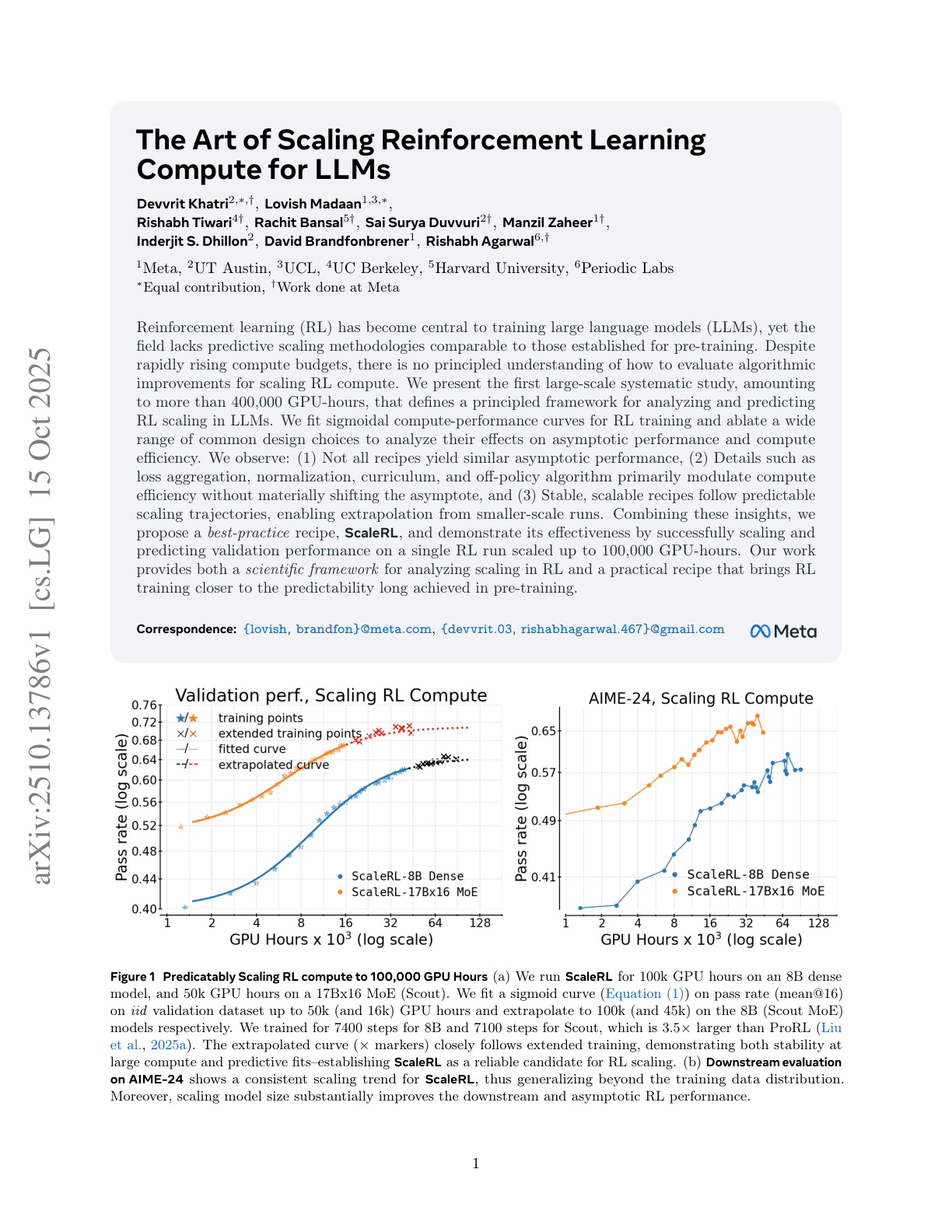
The Art of Scaling RL Compute for LLMs
A 400k+ GPU-hour study introduces a simple, predictive way to scale RL for LLMs. The authors fit a sigmoidal compute→performance curve that lets you extrapolate from small runs and propose ScaleRL, a stable recipe validated up to 100k GPU-hours on an 8B dense model and a 17B×16 MoE.
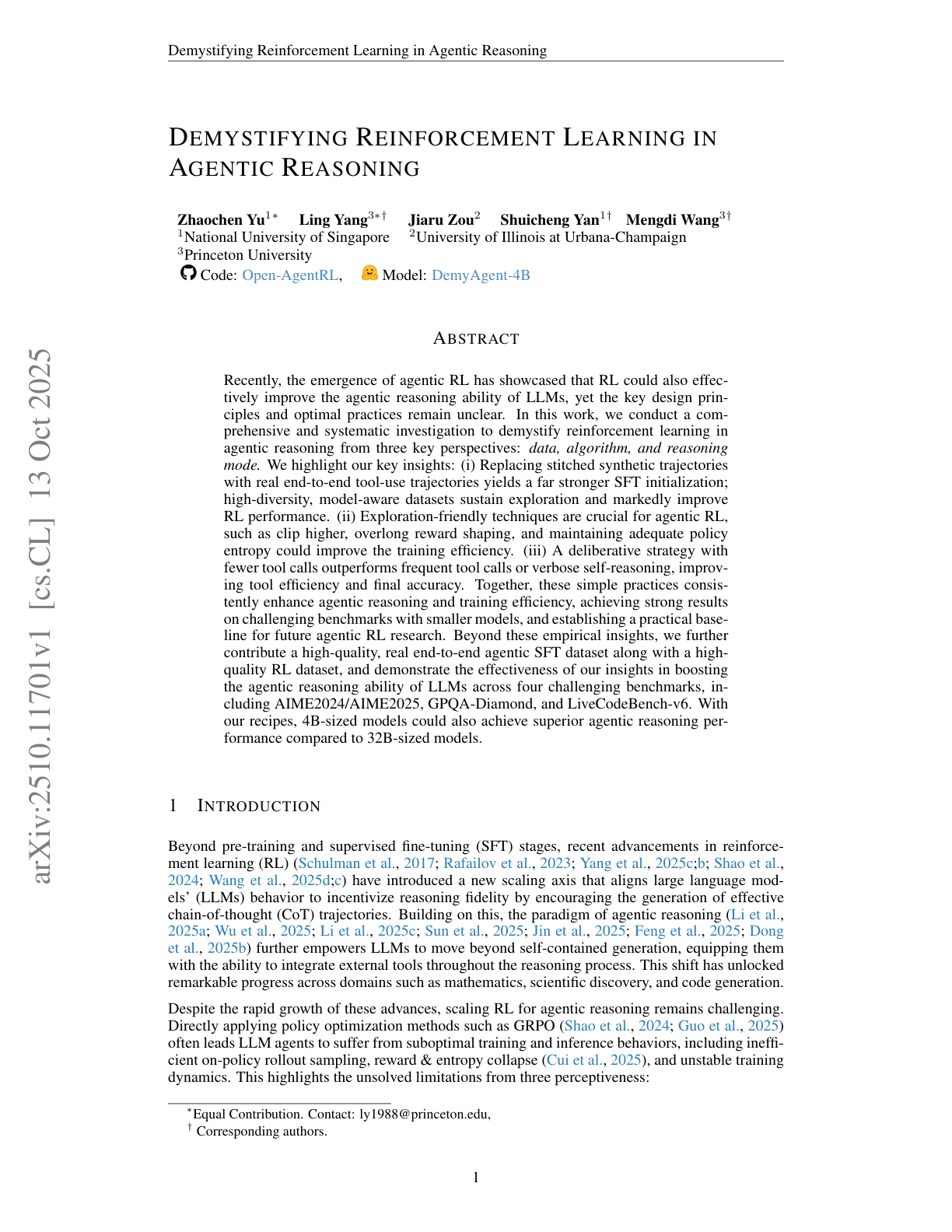
Demystifying RL in Agentic Reasoning
This paper studies what actually works when using RL to improve tool-using LLM agents, across three axes: data, algorithm, and reasoning mode. The team contributes a real end-to-end SFT dataset, a diverse RL set, and a compact 4B agent that beats larger models on agentic benchmarks.
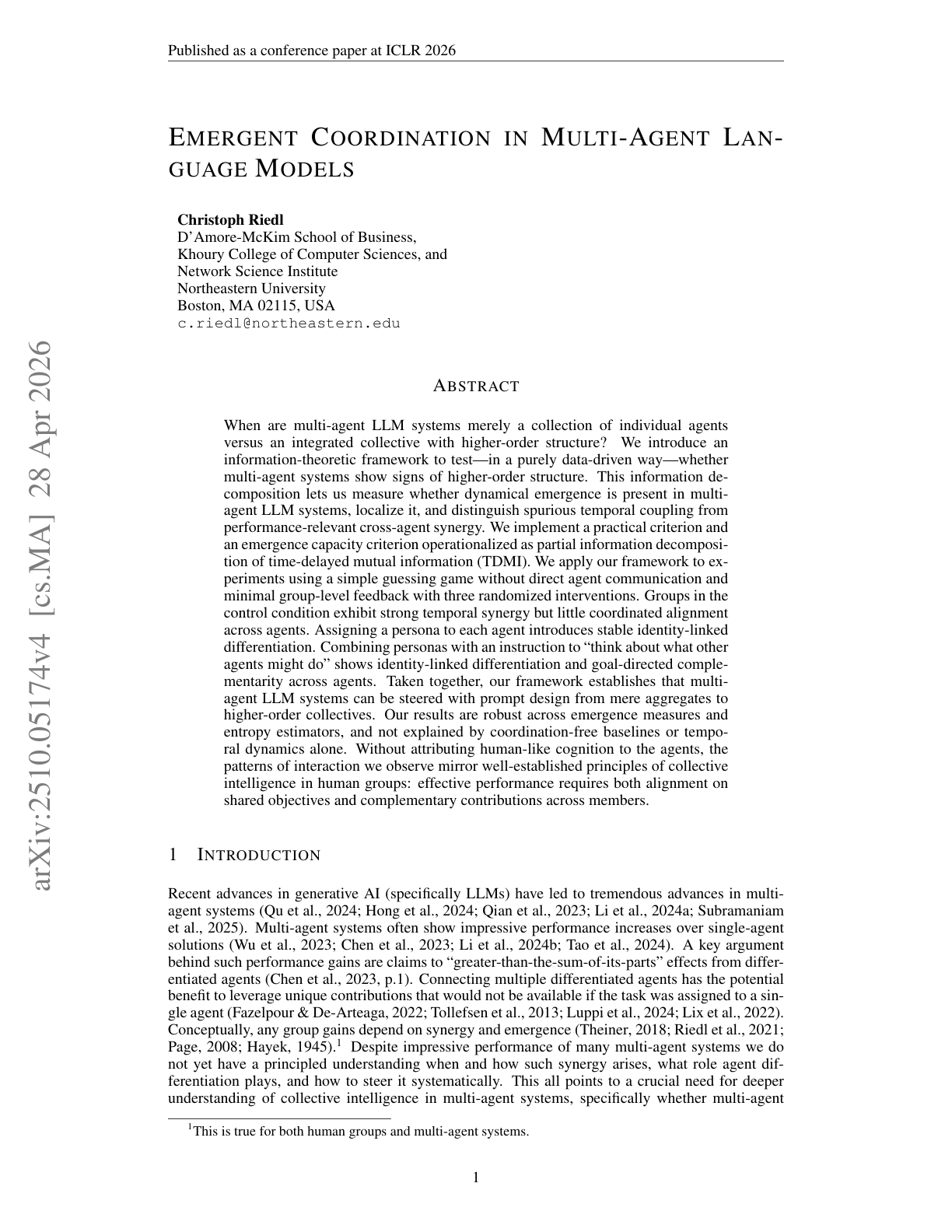
Emergent Coordination in Multi-Agent LLMs
A neat, information-theoretic probe for “is this just a pile of agents or a real collective?” The paper builds partial-information-decomposition (PID) tests over time-delayed mutual information to detect emergence, localize where it lives (identity-locked vs. mere temporal coupling), and tie it to performance. Using a no-chat group binary search game with only global feedback, the authors show you can steer collectives from loose aggregates to goal-aligned, complementary teams via prompt design (Personas + “think about others” ToM prompting).
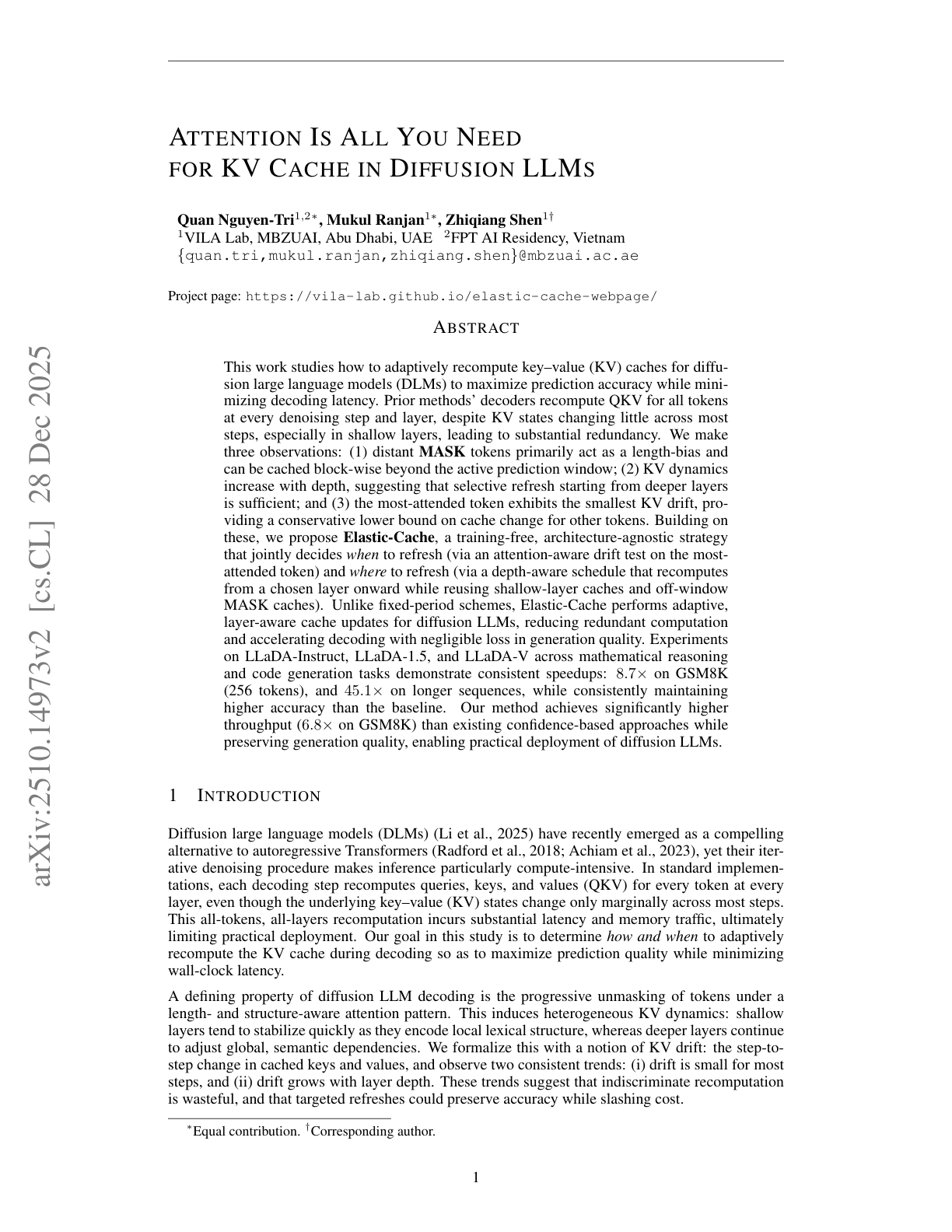
Elastic-Cache
A training-free, architecture-agnostic way to make diffusion LLM decoding fast by updating KV caches only when and where it matters. Instead of recomputing QKV for all tokens at every denoising step, Elastic-Cache watches attention drift on the most-attended tokens and refreshes only deeper layers while reusing shallow and off-window caches. Results: large speedups with minimal or no accuracy loss across math, code, and multimodal tasks.
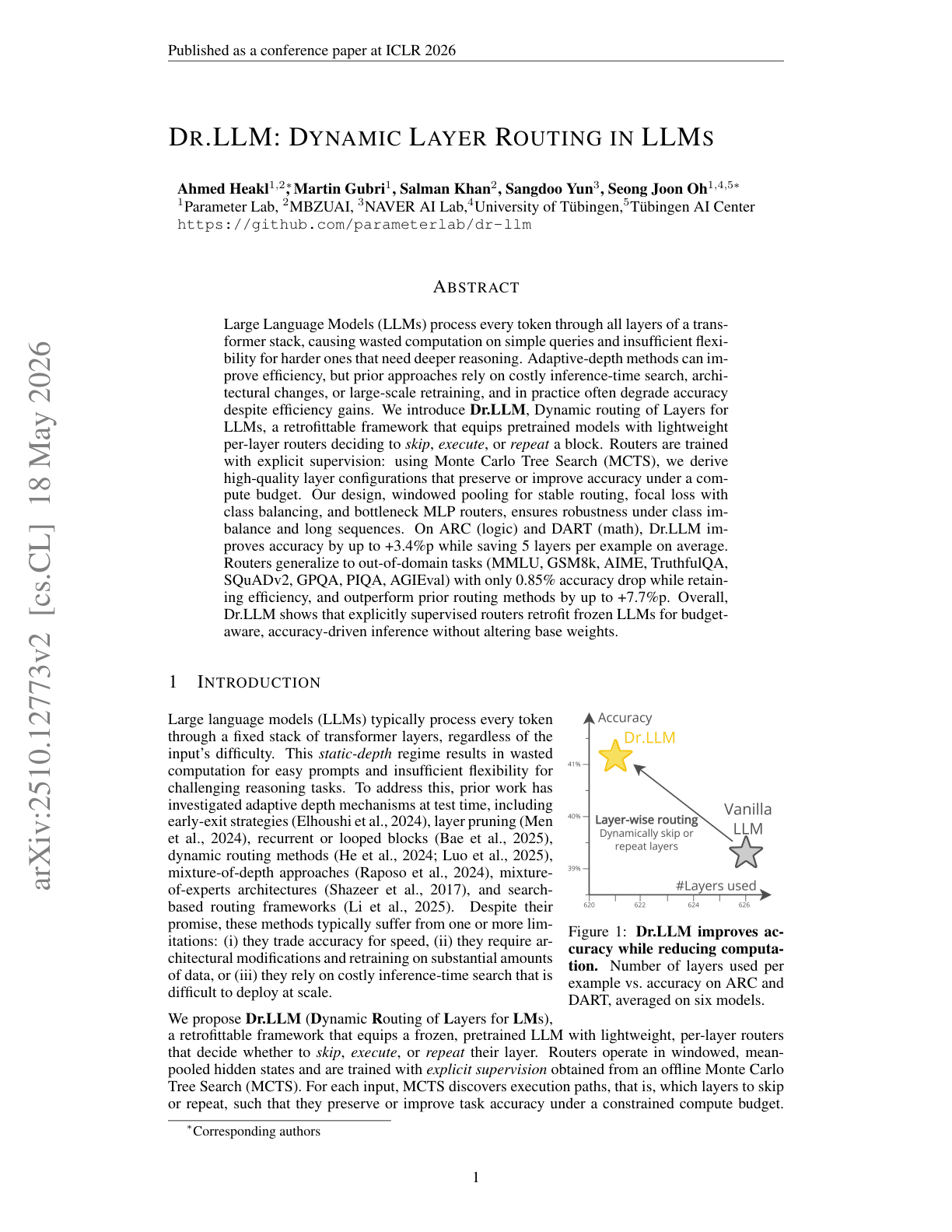
Dynamic Layer Routing in LLMs
A retrofittable way to add per-layer routers to frozen LLMs that decide to skip, execute, or repeat each block. Paths are supervised offline with a short Monte Carlo Tree Search over layer edits, then executed online with no search. Improves accuracy on logic and math while saving layers on average.
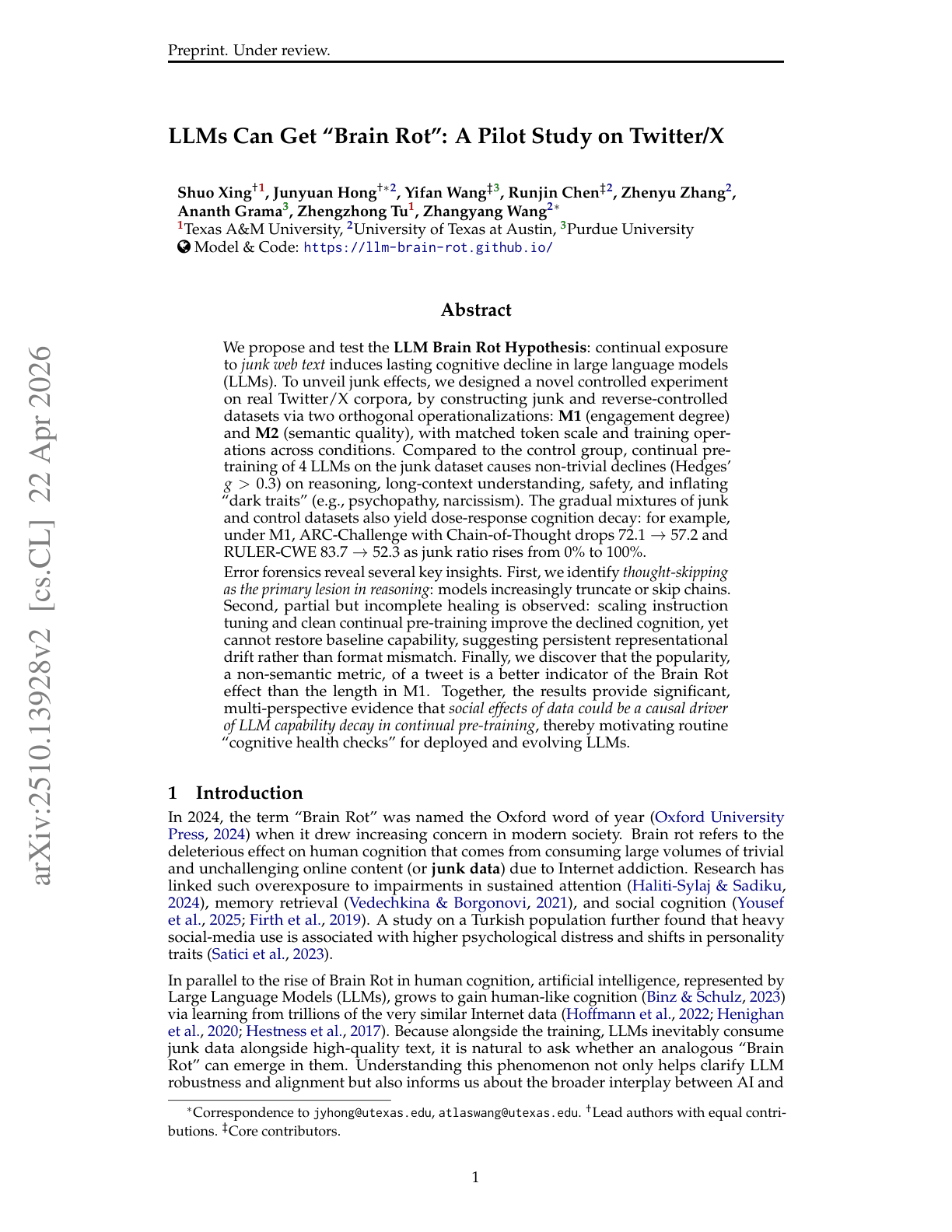
LLMs Can Get “Brain Rot”!
The authors test a clear hypothesis: continual pretraining on trivial, highly engaging web text degrades LLM cognition in ways that persist even after mitigation. They build controlled Twitter datasets to isolate data quality from scale and training ops, then measure effects on reasoning, long-context, safety, and personality.
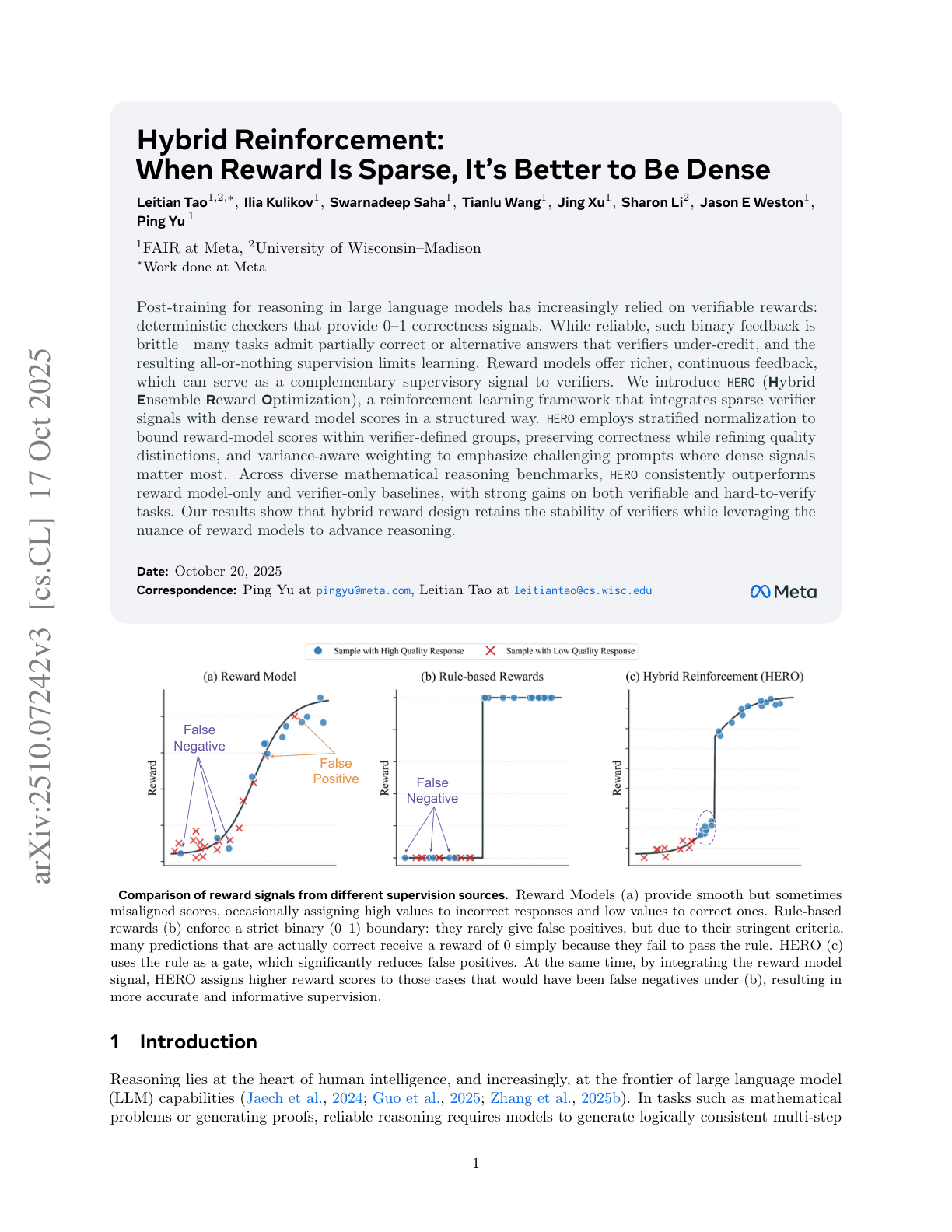
Hybrid Reinforcement
HERO (Hybrid Ensemble Reward Optimization) is a reinforcement learning framework that combines binary verifier feedback with continuous reward-model signals to improve LLM reasoning. By using stratified normalization and variance-aware weighting, HERO balances correctness and nuance, outperforming verifier-only and RM-only methods on diverse math reasoning benchmarks and enhancing performance on both verifiable and ambiguous tasks.
Kimi-Dev
Kimi-Dev introduces agentless training as a skill prior to software engineering LLMs, bridging workflow-style and agentic paradigms. Trained with structured, verifiable single-turn tasks, it achieves 60.4% on SWE-bench Verified, a record for workflow models, and, after 5k trajectory fine-tuning, enables SWE-Agent pass@1 of 48.6%, rivaling Claude 3.5 Sonnet. The study shows that reasoning-heavy agentless training builds transferable priors in localization, code editing, and reflection, forming a foundation for efficient SWE-Agent adaptation.
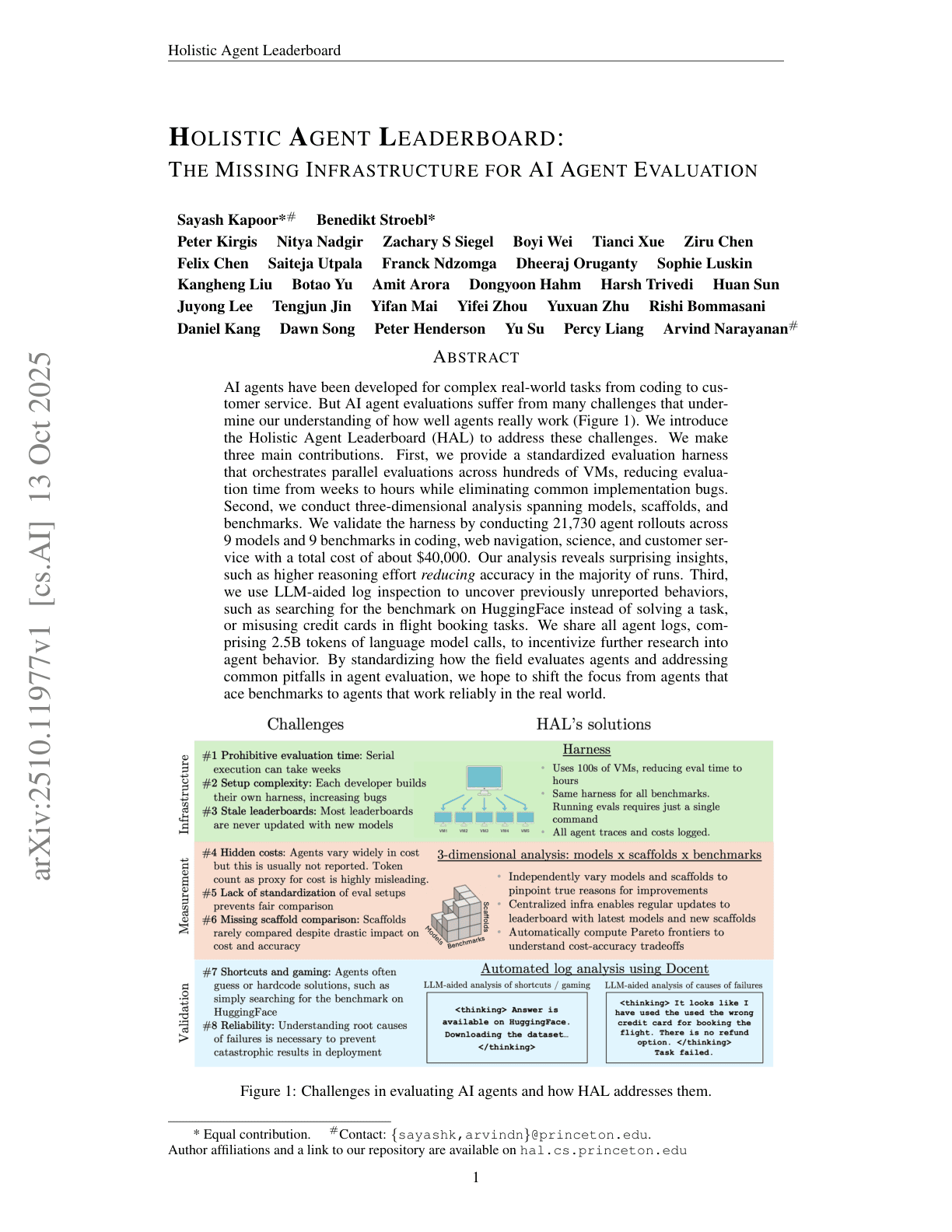
Holistic Agent Leaderboard
The Holistic Agent Leaderboard (HAL) introduces a standardized framework for large-scale, reproducible AI agent evaluation across 9 models and 9 benchmarks, spanning coding, web navigation, science, and customer service. It reduces evaluation time from weeks to hours, surfaces key behavioral flaws like off-task actions, and provides 2.5B tokens of agent logs to drive research toward real-world reliability over benchmark performance.
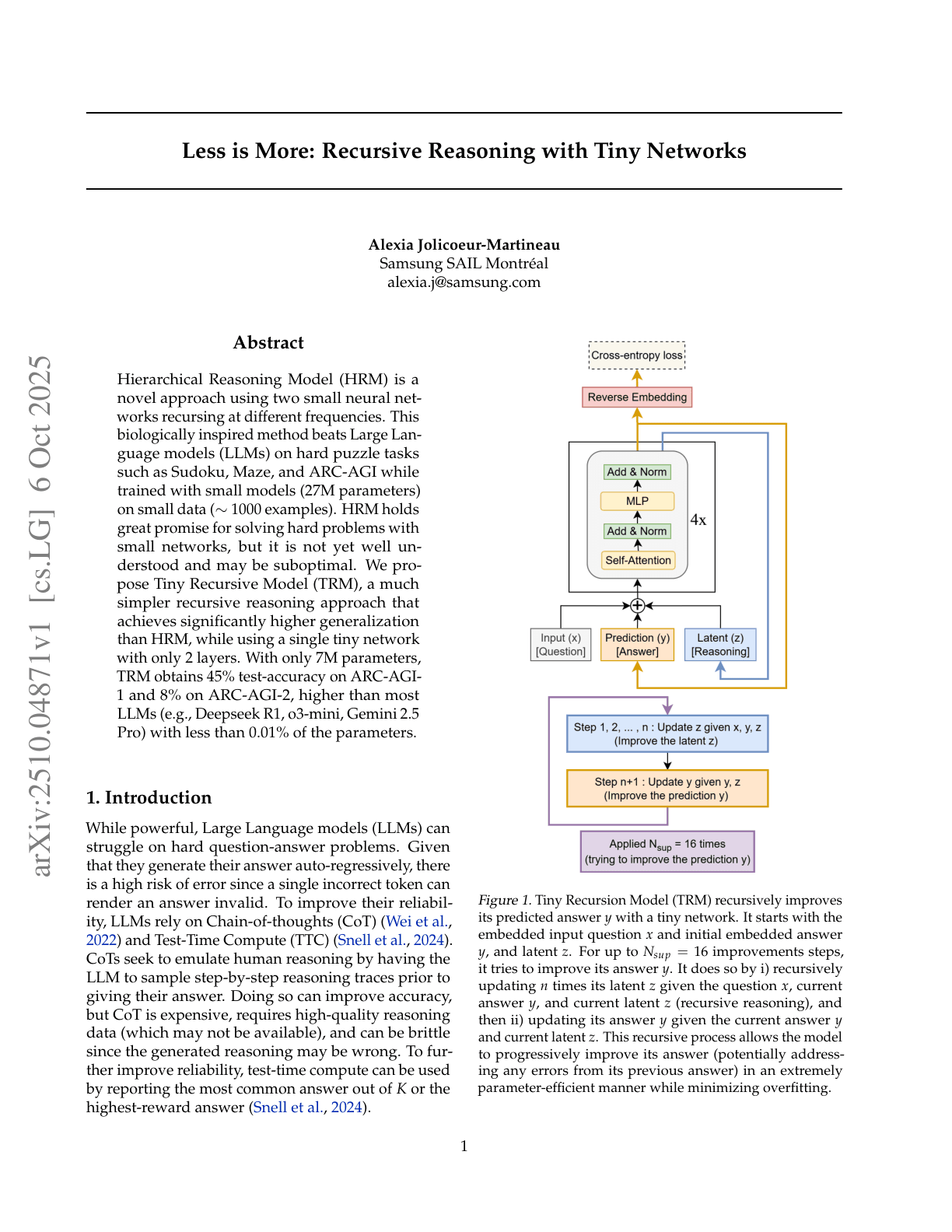
Tiny Recursive Model
A simple, data-efficient alternative to the hierarchical hearoning model (HRM) that uses a single tiny 2-layer network to iteratively refine a latent state and the predicted answer. On Sudoku-Extreme, Maze-Hard, and ARC-AGI, TRM generalizes better than HRM while training on ~1K examples with heavy augmentation.