AI Papers of the Week
Every paper worth reading in AI, hand-picked one week at a time.
Discover and explore top AI papers withClaude CodeCodex
npx @dair-ai/mcp setup
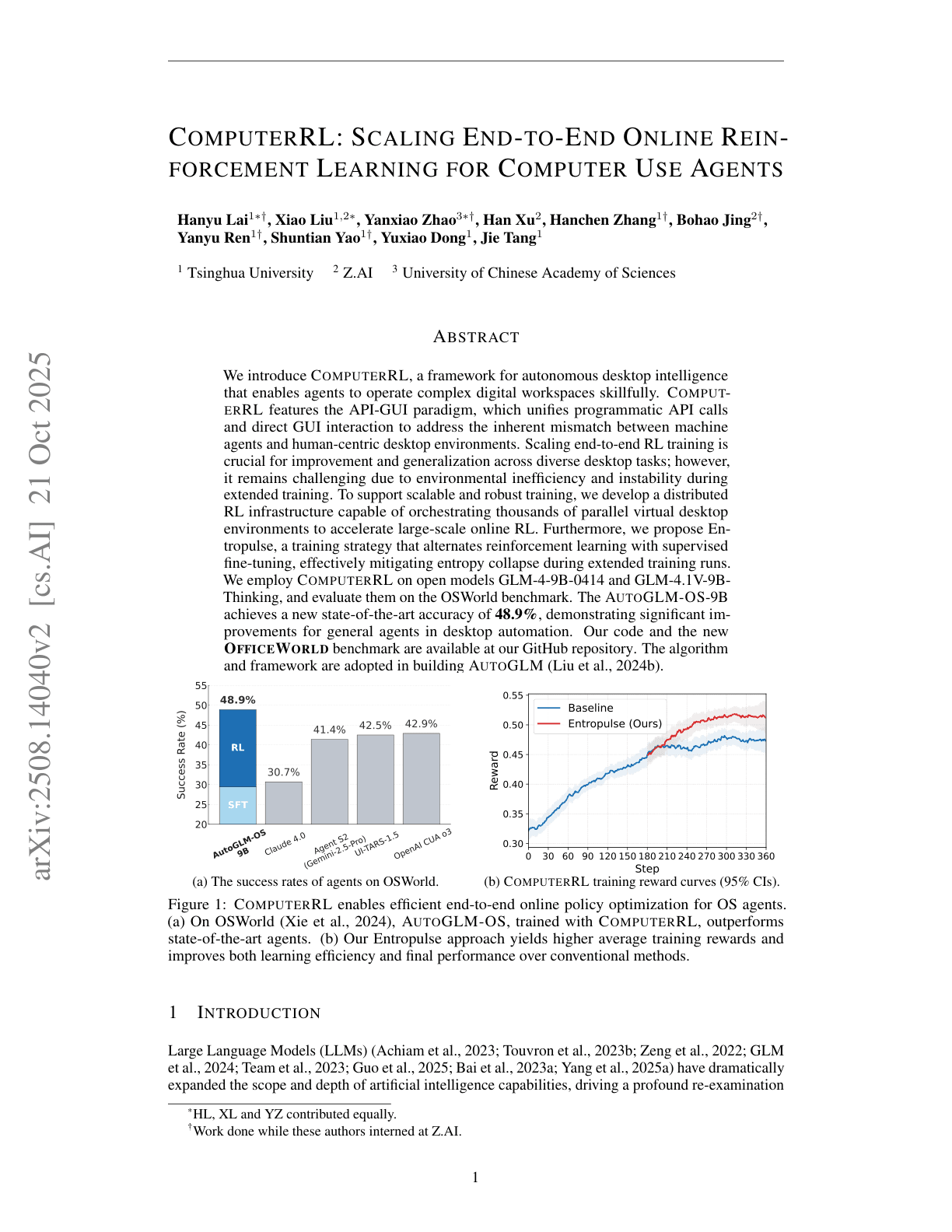
Has GPT-5 Achieved Spatial Intelligence?
This report introduces a unified view of spatial intelligence (SI) for multimodal models and evaluates GPT‑5 and strong baselines across eight fresh SI benchmarks. GPT‑5 leads overall but is still short of human skill, especially on mentally reconstructing shapes, changing viewpoints, and deformation/assembly tasks.
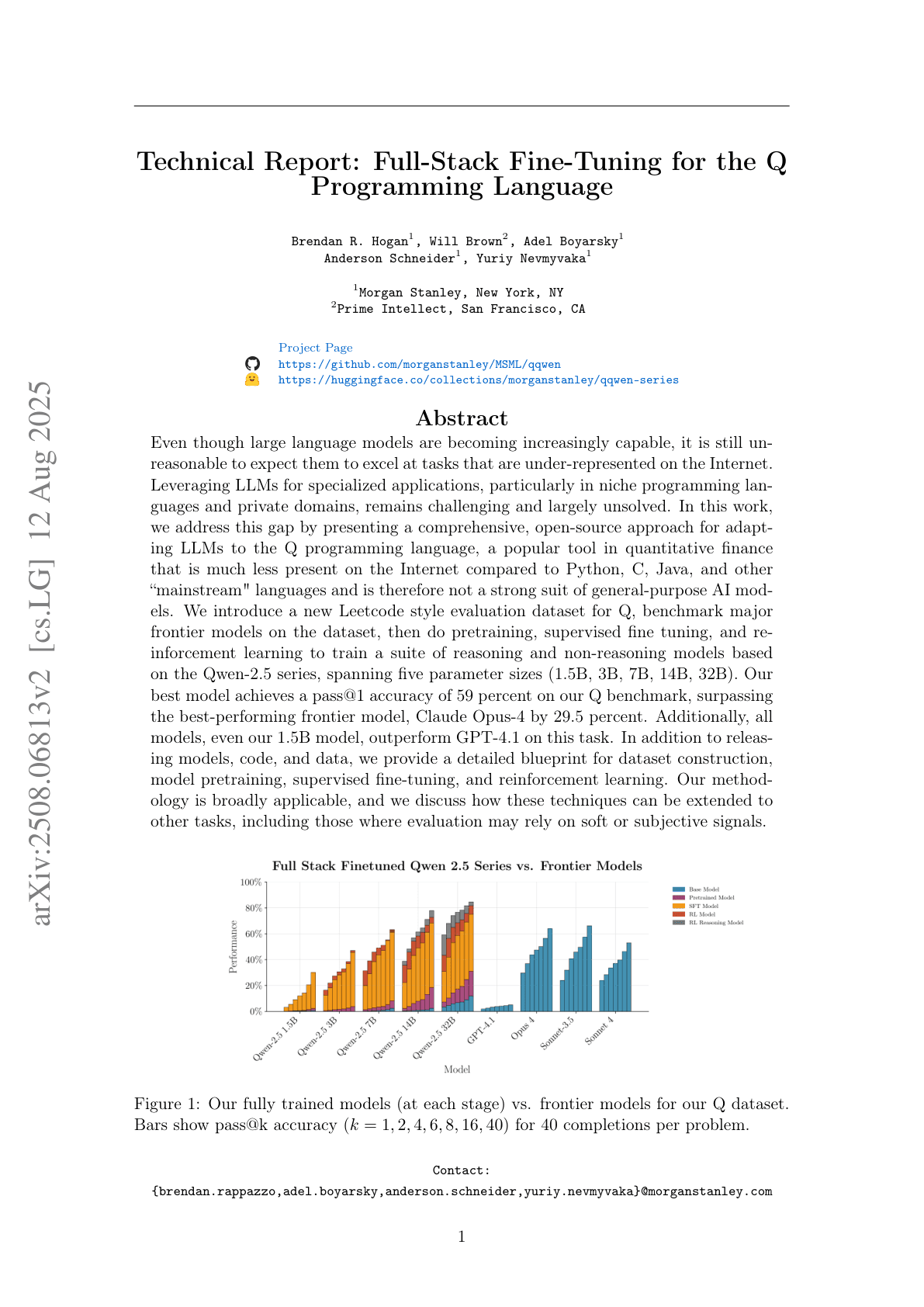
ComputerRL
A framework for autonomous desktop agents that unifies API calls with GUI actions, plus a scalable RL stack and a training recipe (Entropulse) that alternates RL and SFT to sustain exploration. Evaluated on OSWorld, it sets a new SOTA with strong gains in efficiency and robustness.
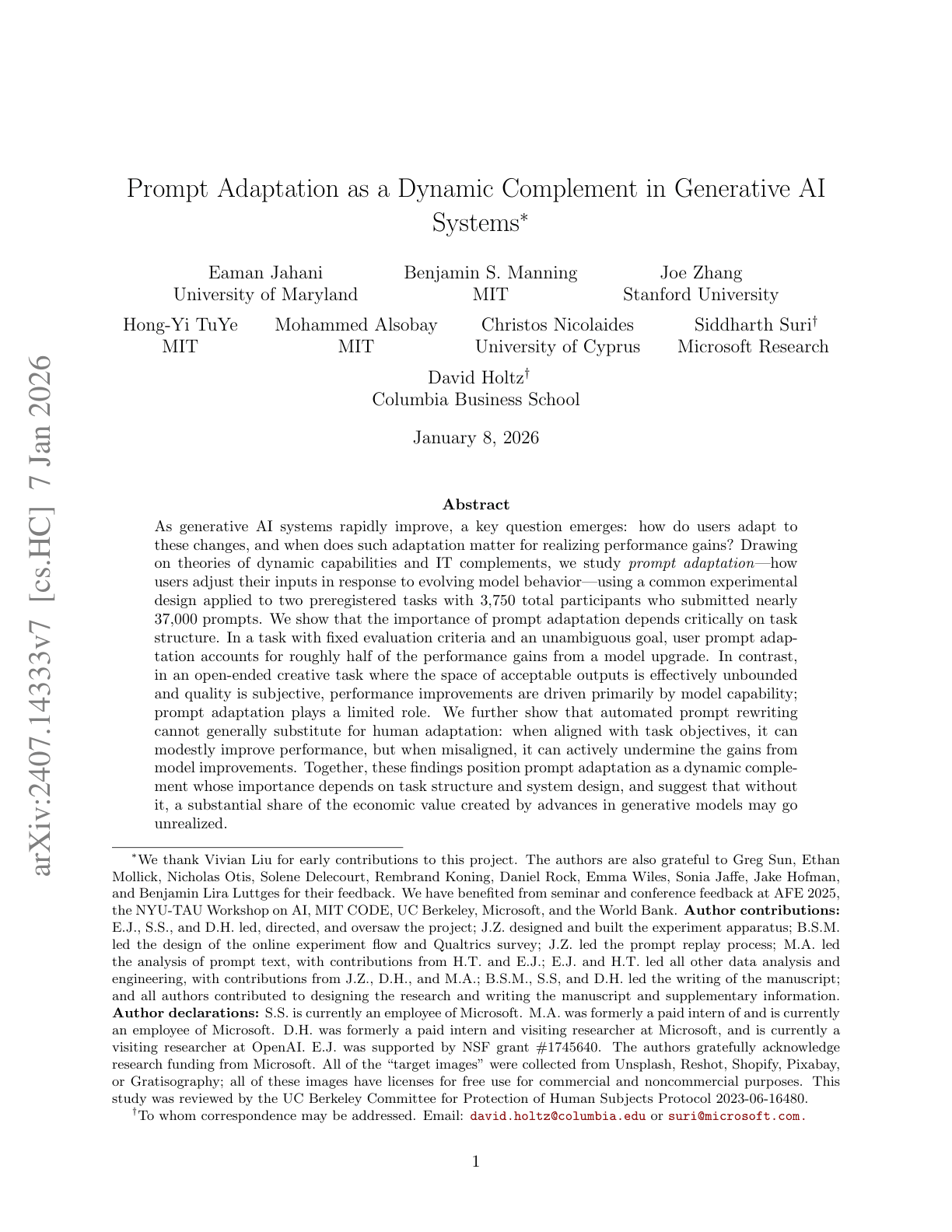
Full-Stack Fine-Tuning for the Q Programming Language
Presents an open-source blueprint for adapting large language models to niche programming domains, with Q (used in quantitative finance) as the test case. The team builds a benchmark, curates data, and trains Qwen-2.5 models with pretraining, supervised fine-tuning, and reinforcement learning. Their largest model surpasses Claude Opus-4 by nearly 30% on Q-LeetCode tasks, and even the smallest model beats GPT-4.1.
As Generative Models Improve, People Adapt Their Prompts
A large online experiment (N = 1,893) compares DALL·E 2, DALL·E 3, and DALL·E 3 with automatic prompt revision on a 10‑attempt image replication task. DALL·E 3 improves outcomes not only because the model is better, but because people change how they prompt when the model is stronger.
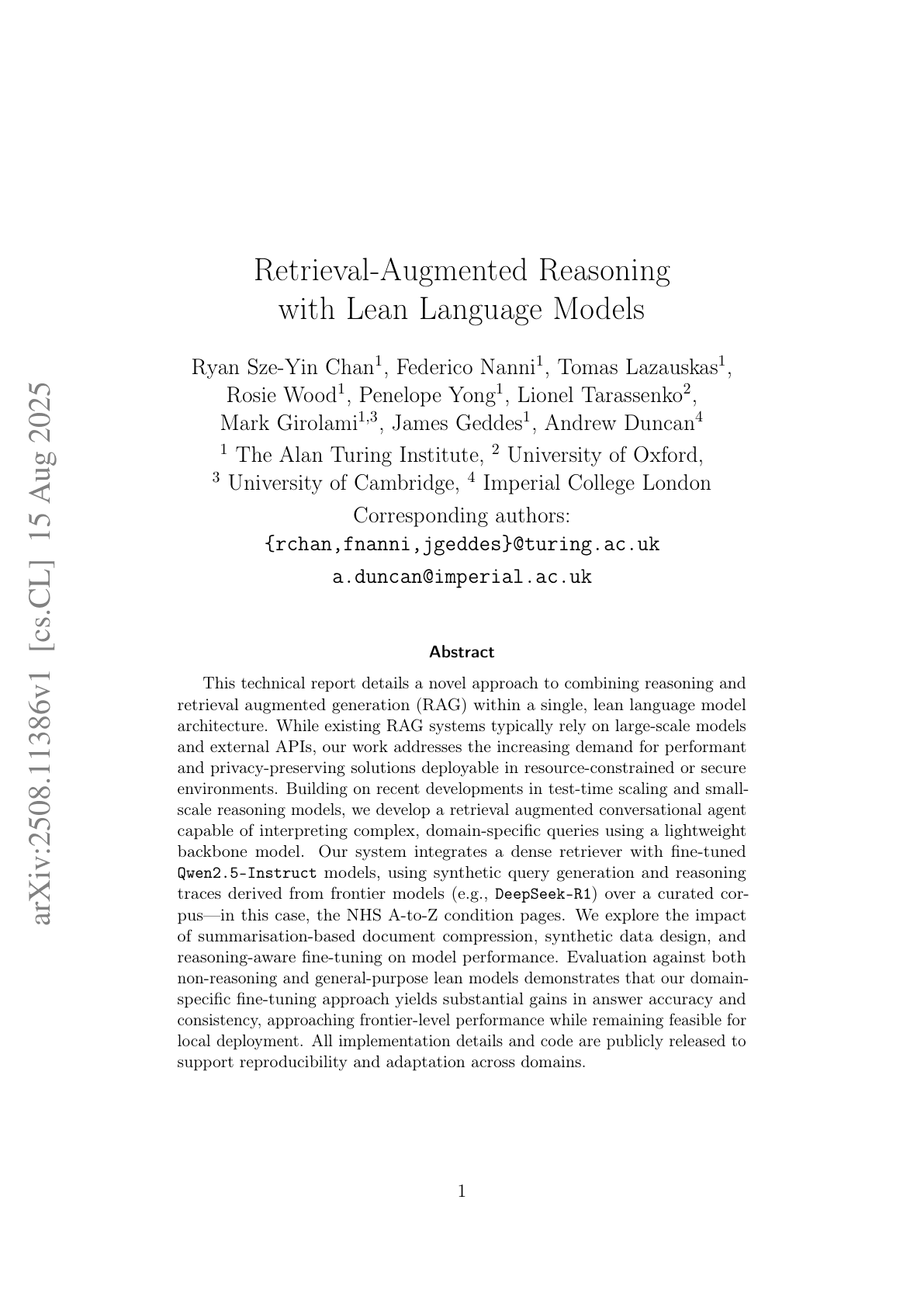
Retrieval-Augmented Reasoning with Lean Language Models
A domain-tuned pipeline that fuses RAG and reasoning into a single small-footprint model. The team distills reasoning traces from a frontier model into Qwen2.5 variants, uses summarization to keep context small, and shows that a 32B local model approaches frontier accuracy on an NHS A‑to‑Z clinical QA task.
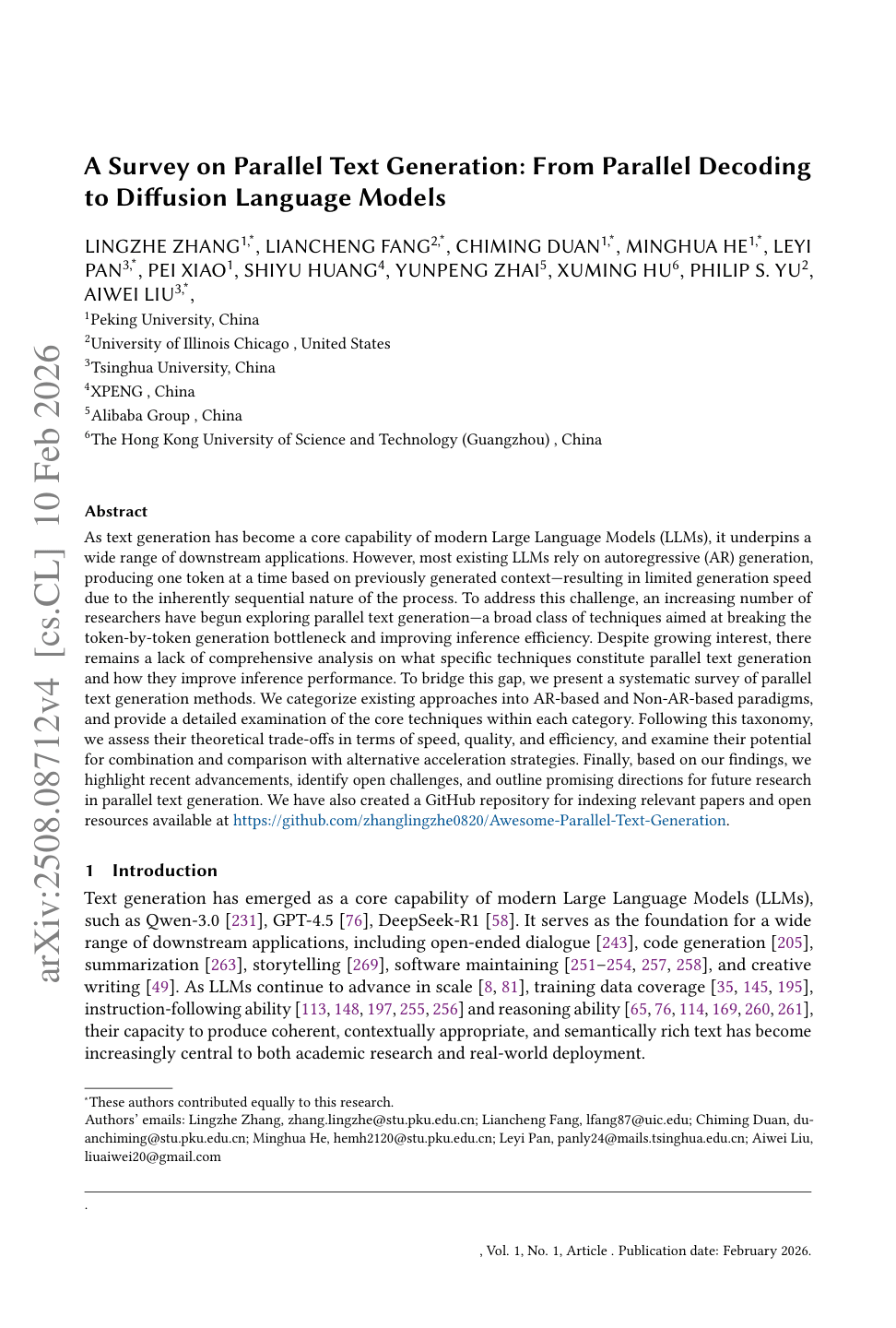
Parallel Text Generation
This survey reviews parallel text generation methods that overcome the sequential limits of autoregressive decoding by enabling faster inference. It categorizes AR-based and non-AR-based approaches, analyzes trade-offs in speed, quality, and efficiency, and highlights recent advances, open challenges, and future research directions.
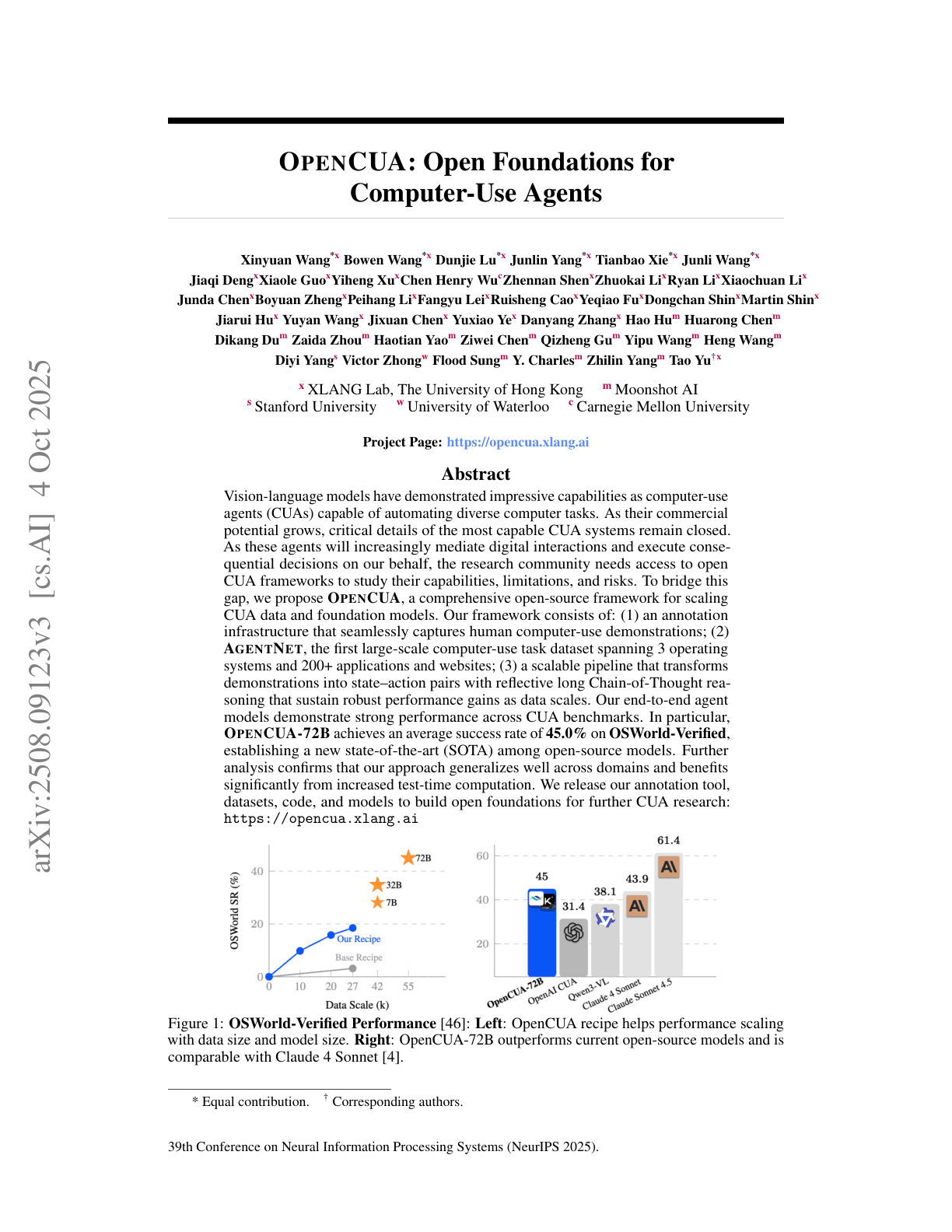
Open Foundations for Compute-Use Agents
This paper introduces an open-source framework for computer-use agents, featuring a large-scale dataset (AgentNet), annotation infrastructure, and reflective reasoning pipelines. Its 32B model sets a new SOTA on OSWorld-Verified with 34.8% success, surpassing OpenAI’s GPT-4o, and all resources are released to advance open CUA research.

DINOv3
DINOv3 is a self‑supervised vision foundation model that scales data and model size, introduces a Gram anchoring loss to preserve dense patch consistency during long training, and adds post‑hoc tweaks for resolution, size, and text alignment. With a frozen backbone, it sets new results across dense and global tasks without task‑specific fine‑tuning.
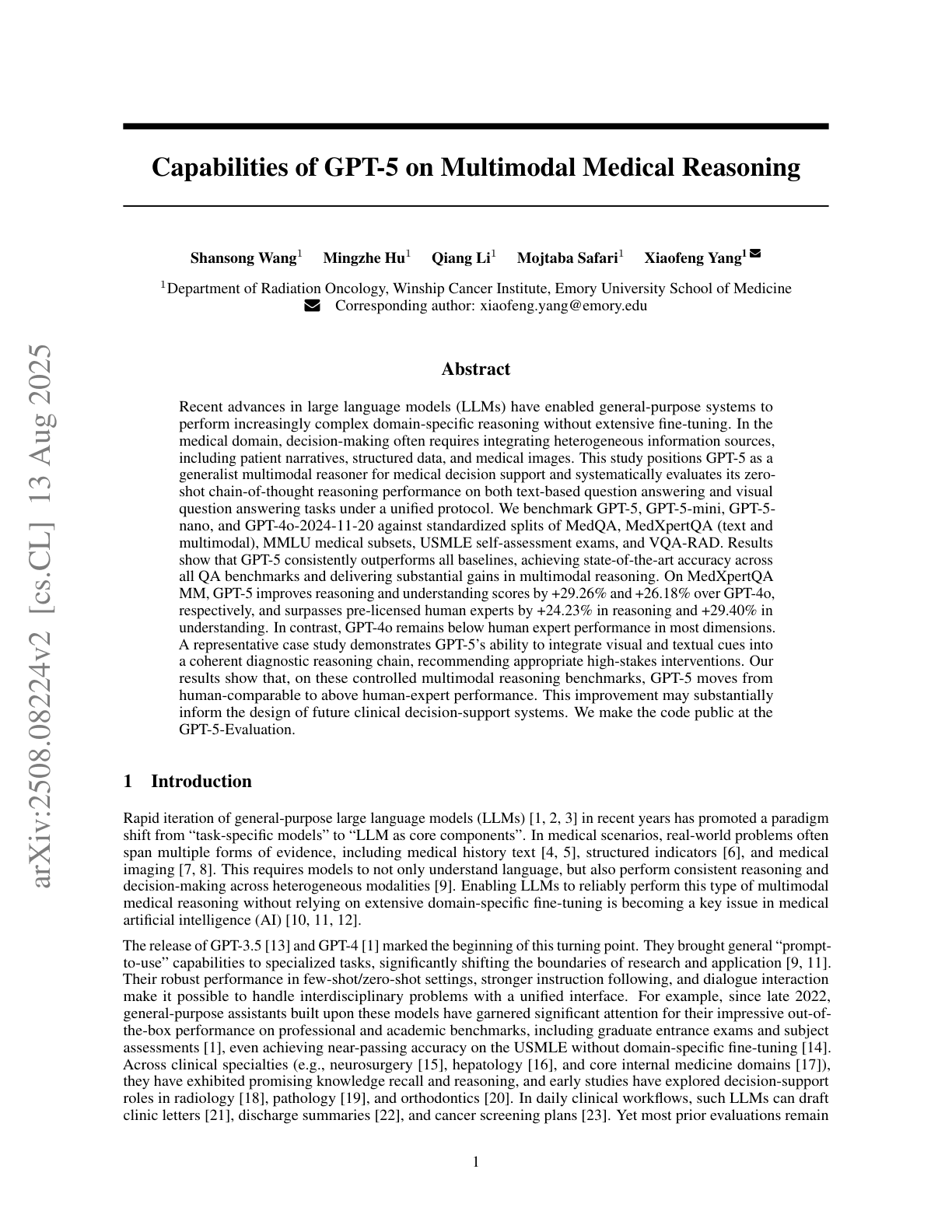
Capabilities of GPT-5 on Multimodal Medical Reasoning
A controlled, zero‑shot CoT evaluation positions GPT‑5 as a generalist medical reasoner across text and image inputs. Using standardized prompts and splits, GPT‑5 consistently beats GPT‑4o and smaller GPT‑5 variants, with especially large gains on multimodal expert‑level QA.
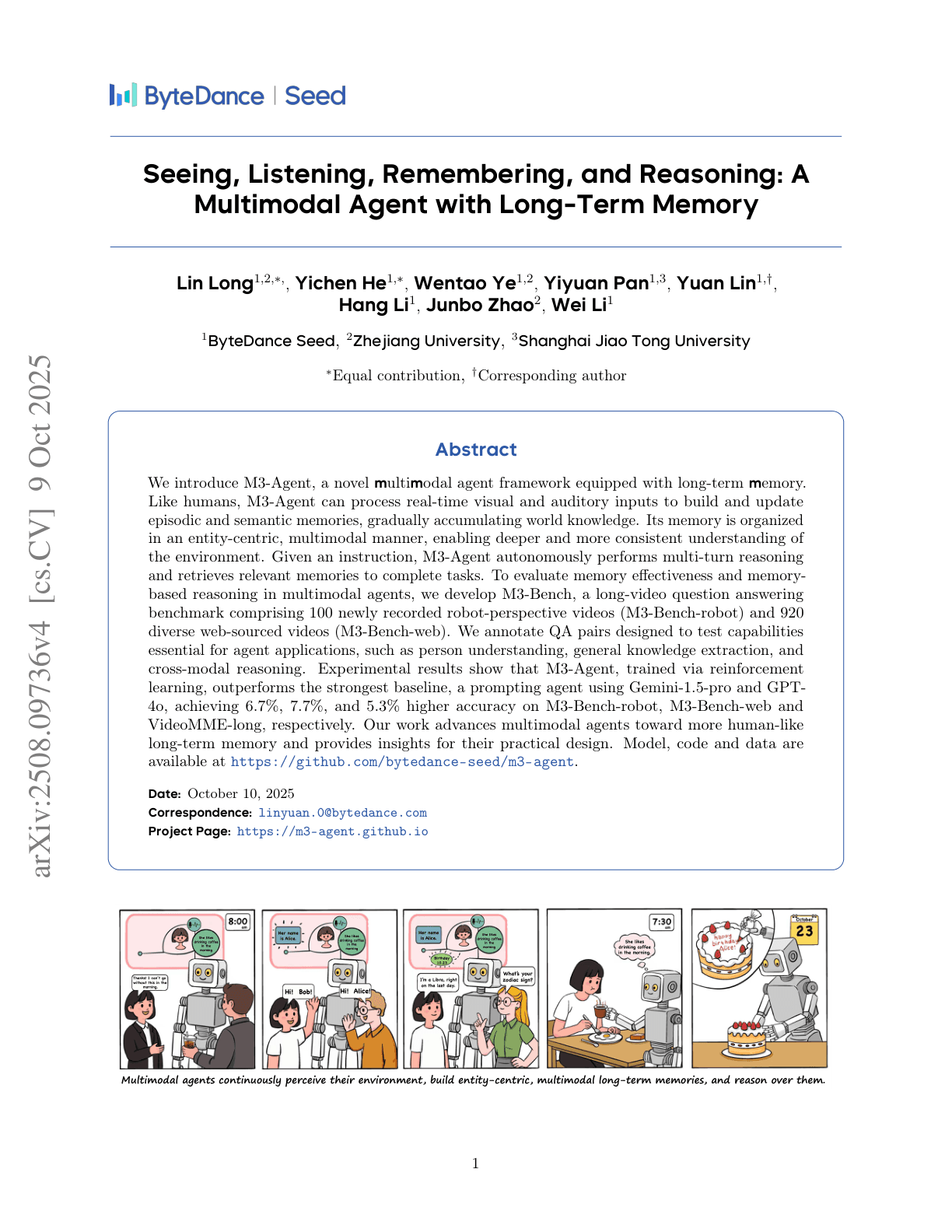
M3-Agent
A framework for agents that watch and listen to long videos, build entity-centric memories, and use multi-turn reasoning to answer questions. M3-Agent stores both episodic details and distilled semantic knowledge in a multimodal memory graph, then learns a retrieval-reasoning policy with RL. The authors also introduce M3-Bench, a long-video QA benchmark with robot-view and web videos. Results show consistent gains over strong prompting baselines.
TRImodal Brain Encoder
A tri‑modal, multi‑subject, nonlinear encoder that fuses text, audio, and video features with a transformer to predict time‑varying fMRI responses to natural movies. It took 1st place in the Algonauts 2025 brain encoding competition and shows the strongest gains in the high‑level associative cortex.
OdysseyBench
A new benchmark and data‑generation pipeline to test agents on realistic, multi‑day office tasks across Word, Excel, PDF, Email, and Calendar. It introduces OdysseyBench (two splits) and HOMERAGENTS (an automated multi‑agent generator), with evaluations showing large gaps between human and model performance and clear benefits from semantically compressed memory.
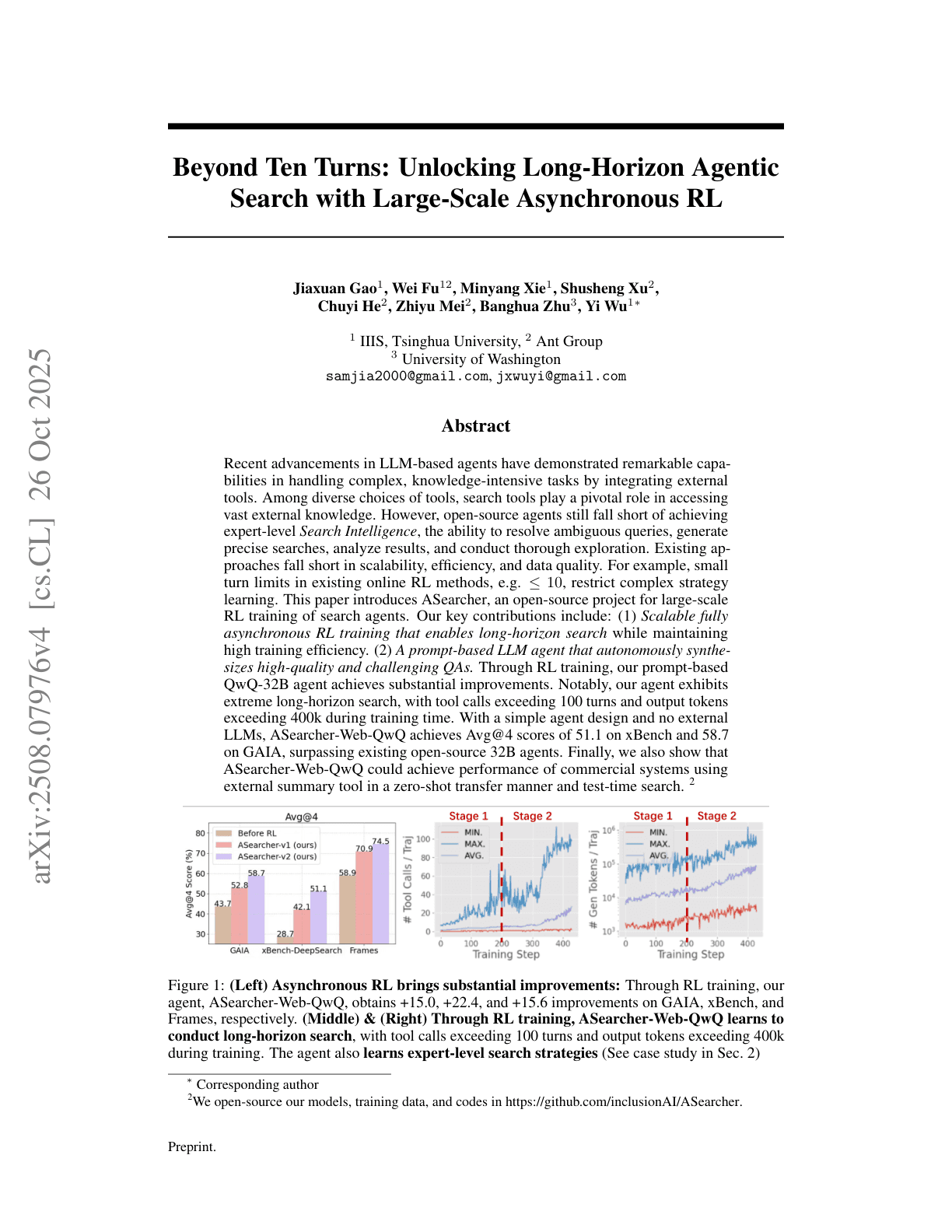
Beyond Ten Turns
This paper introduces ASearcher, an open-source framework for training LLM-based search agents capable of long-horizon, expert-level search. It addresses two major limitations in prior open-source approaches: short turn limits (≤10) and lack of large-scale, high-quality QA data.
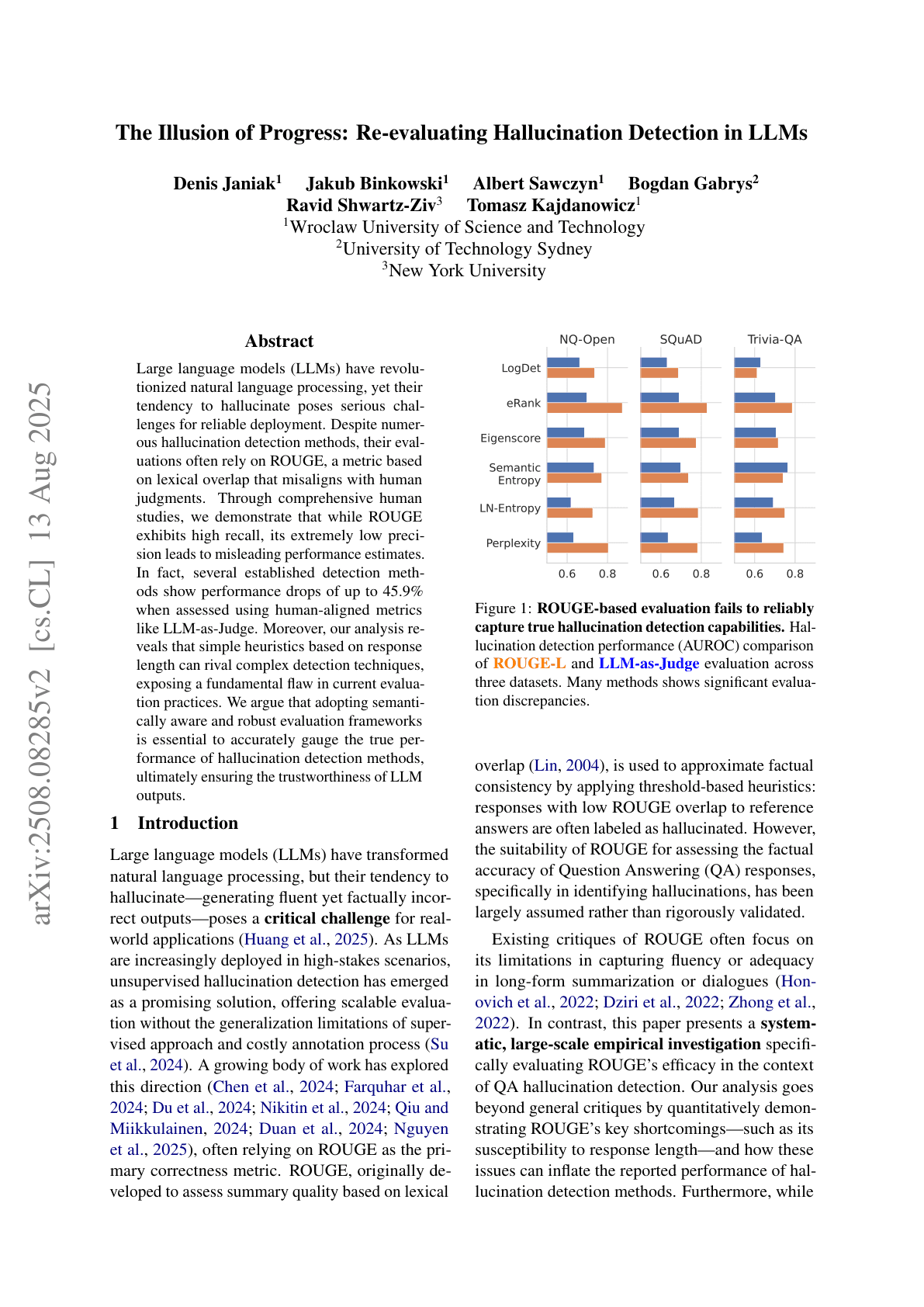
Illusion of Progress
The paper argues that common QA hallucination detectors look better than they are because evaluations lean on ROUGE. In human‑aligned tests, many detectors drop sharply. Simple response‑length heuristics rival sophisticated methods, revealing a core evaluation flaw.
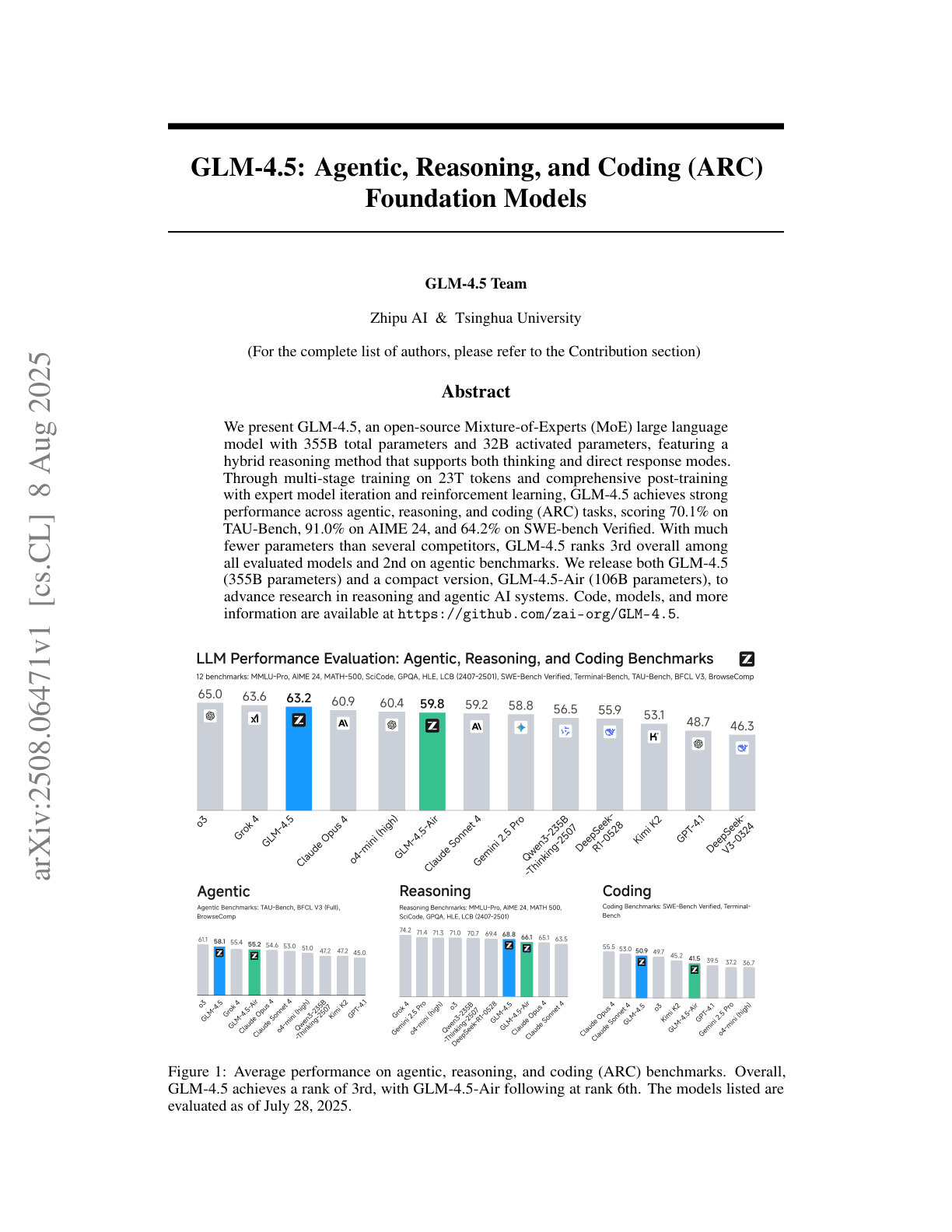
GLM-4.5
An open Mixture‑of‑Experts family that targets a single model excelling across agentic tool use, complex reasoning, and real‑world coding. GLM‑4.5 (355B total, 32B active) introduces hybrid “thinking vs direct” modes, multi‑stage pretrain + mid‑train to 128K context, and extensive RL for reasoning, agents, and instruction following. It ranks near the top on a 12‑bench ARC suite and releases weights and eval tooling.
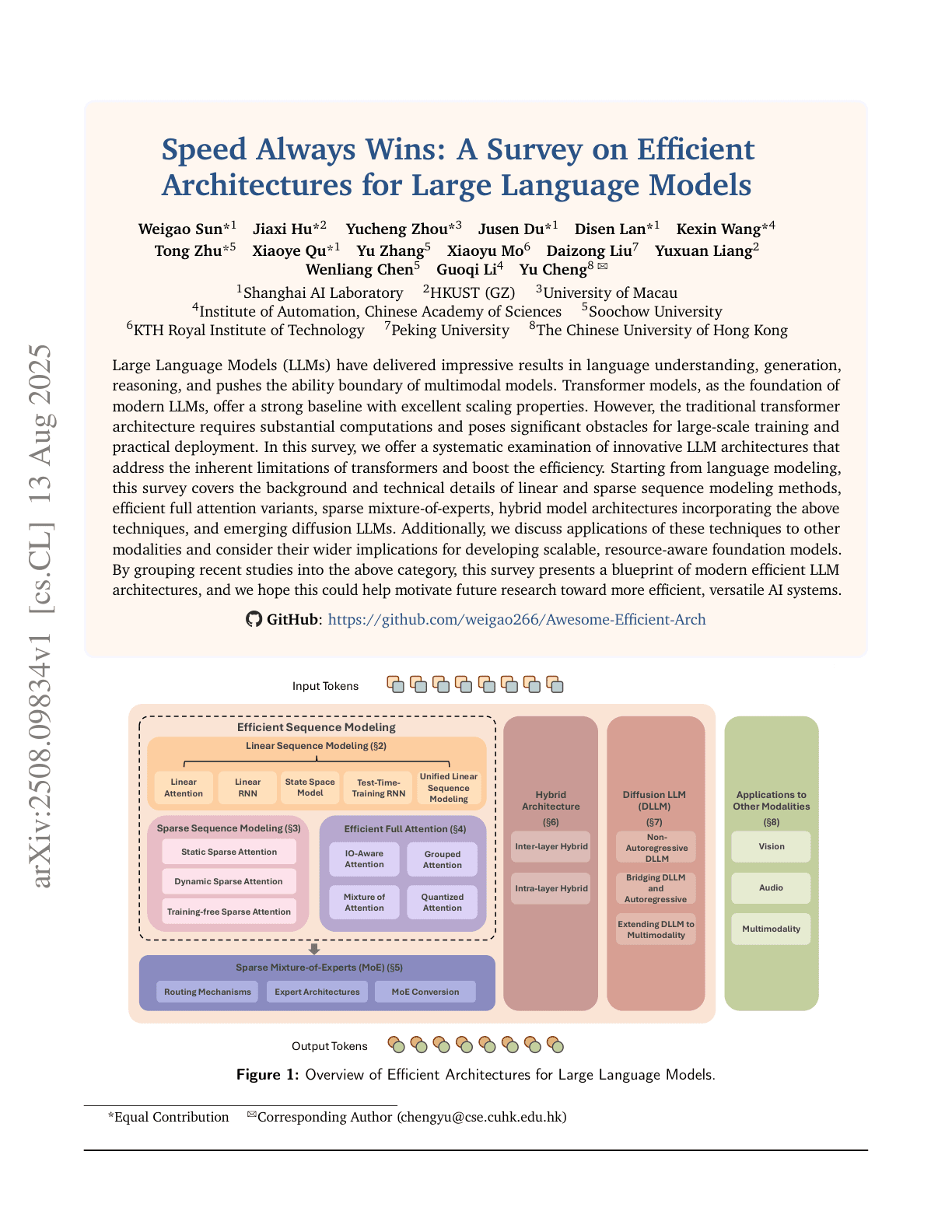
A Survey on Efficient Architectures for LLMs
This survey reviews advances in efficient LLM architectures beyond traditional transformers, including linear and sparse sequence models, efficient attention variants, sparse MoEs, hybrid designs, and diffusion-based LLMs. It highlights cross-modal applications and outlines a blueprint for building scalable, resource-efficient foundation models.
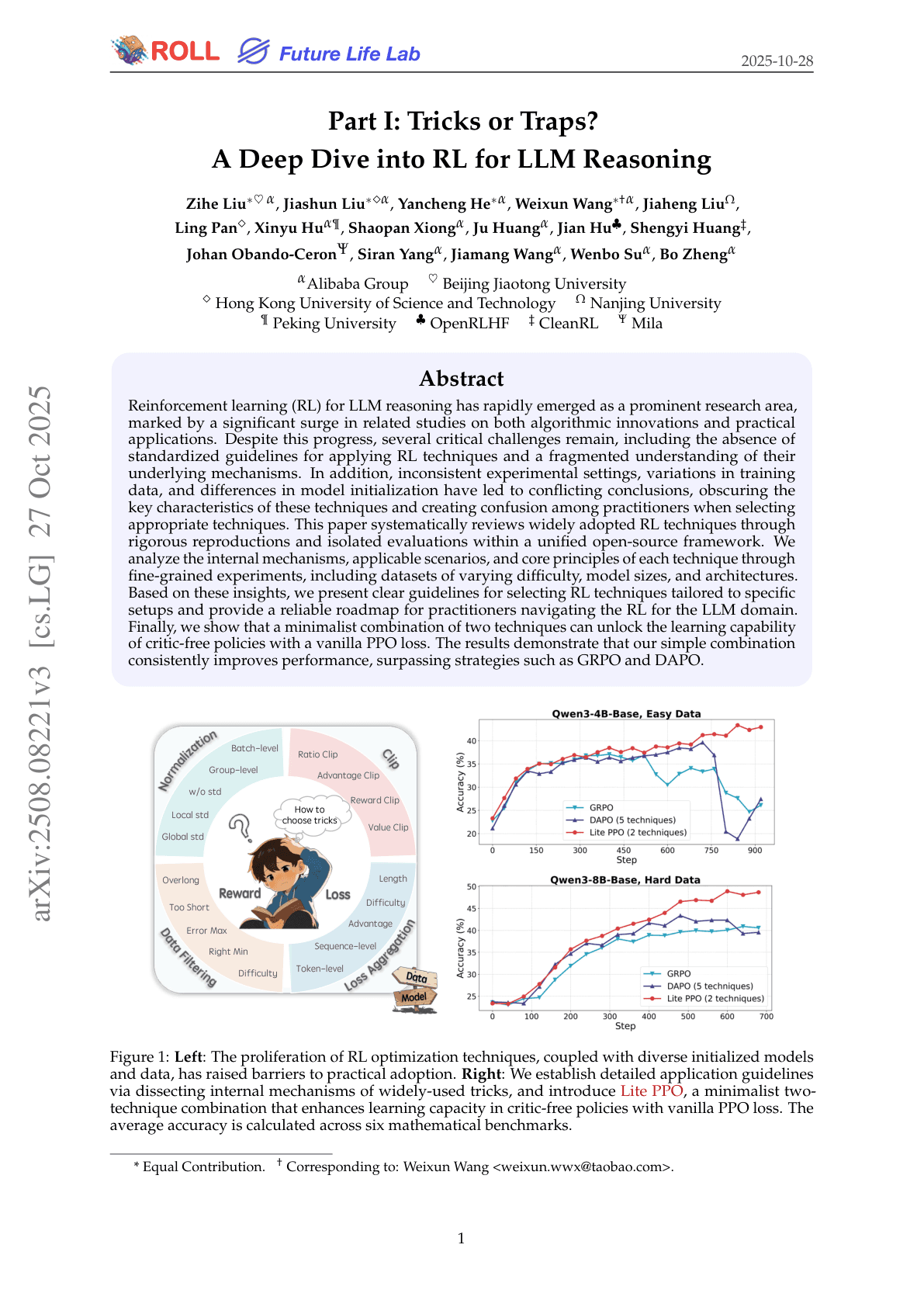
A Deep Dive into RL for LLM Reasoning
This paper reviews and rigorously re-evaluates reinforcement learning techniques for LLM reasoning, addressing inconsistencies caused by varied setups and unclear guidelines. It offers a unified open-source framework, practical selection guidelines, and shows that a minimalist two-technique combo with vanilla PPO can outperform methods like GRPO and DAPO.
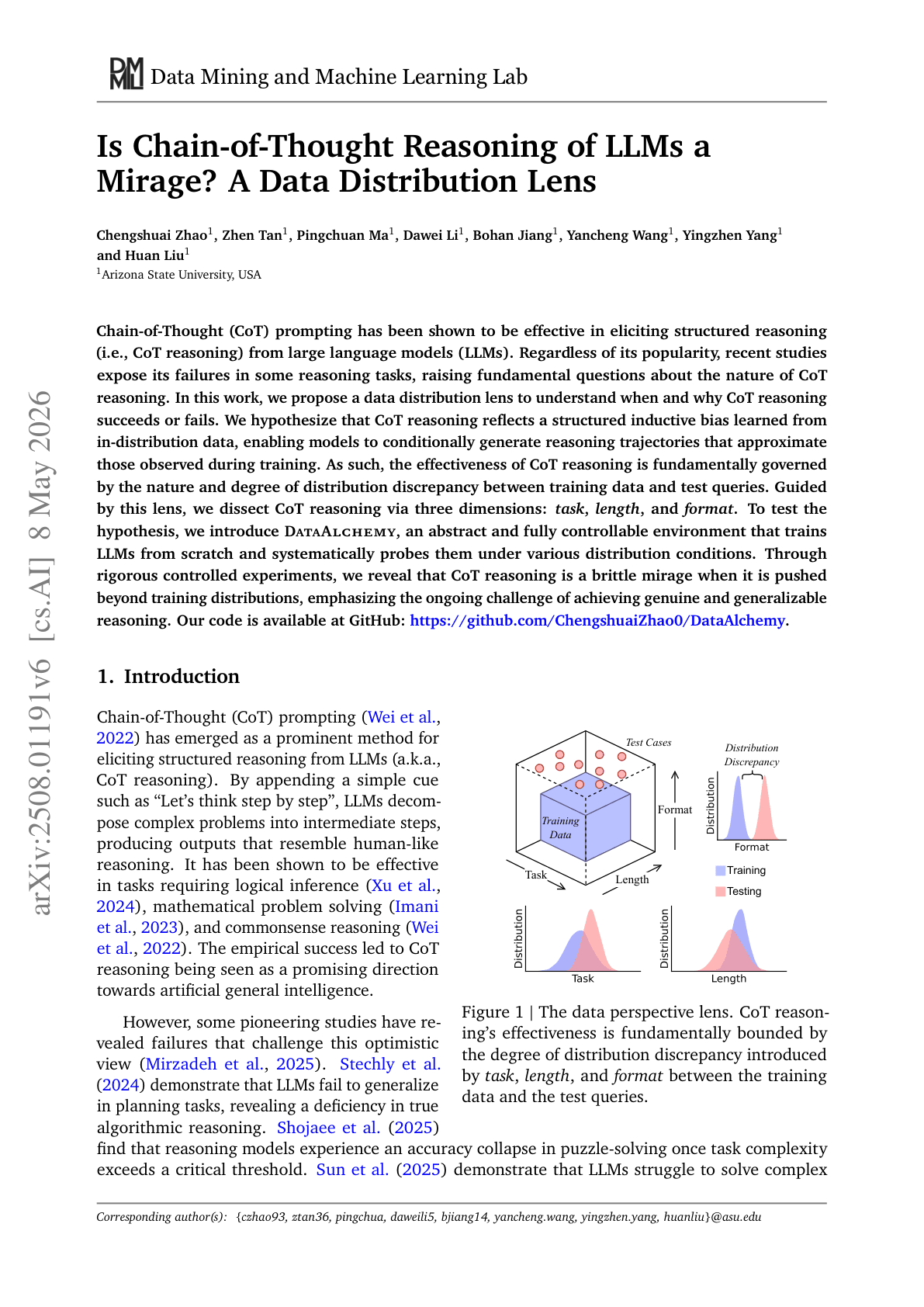
Is Chain-of-Thought Reasoning a Mirage?
Researchers from Arizona State University investigate whether Chain-of-Thought (CoT) reasoning in LLMs reflects genuine logical inference or mere pattern replication from training data. They introduce a data distribution lens to analyze CoT’s dependence on in-distribution patterns and its brittleness under distribution shifts.
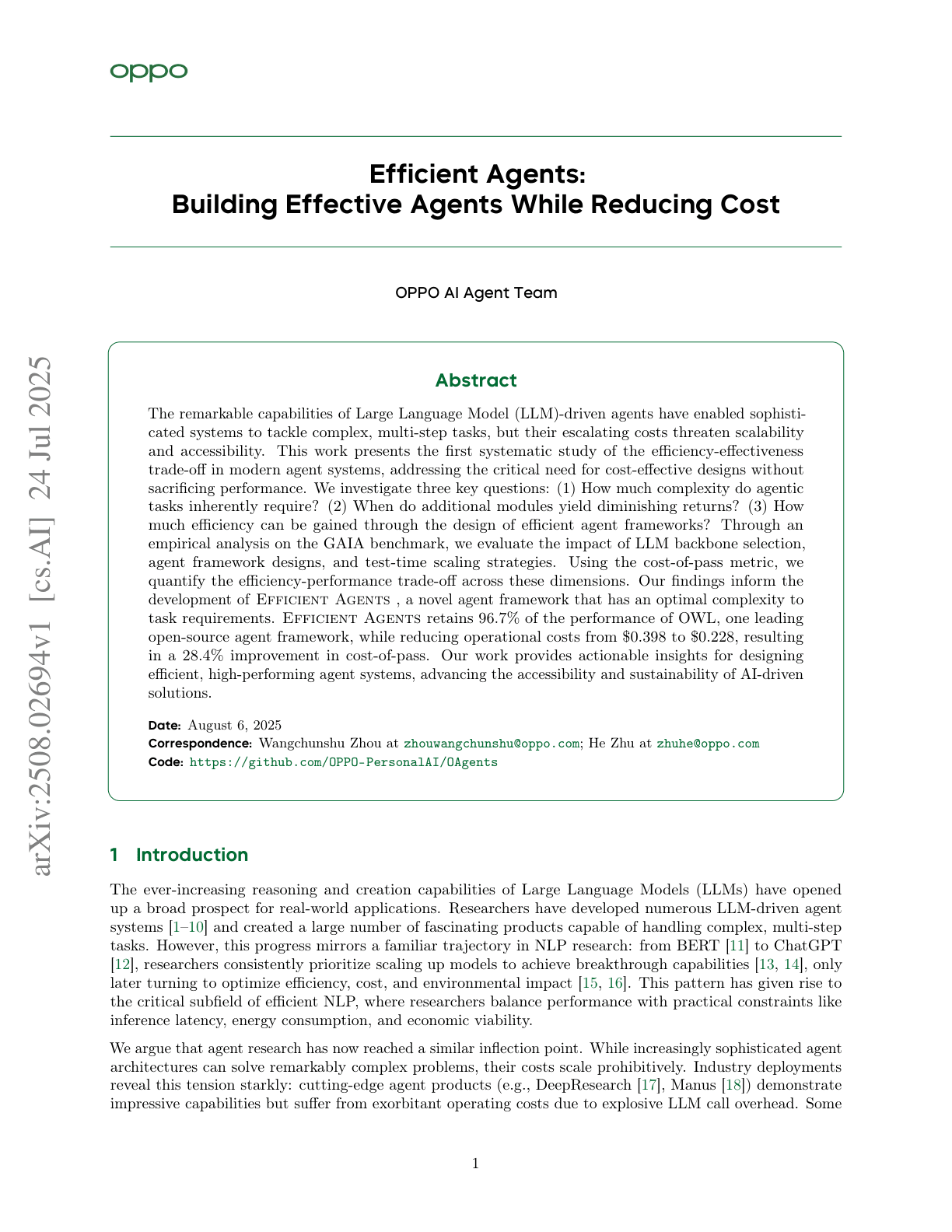
Efficient Agents
This paper presents Efficient Agents, a new agent framework that achieves a strong efficiency-effectiveness balance in LLM-driven systems. The authors perform the first systematic study of agent design choices through the lens of economic efficiency, specifically, the cost-of-pass metric, which captures the expected monetary cost of solving a task. Their proposed agent retains 96.7% of OWL’s performance on the GAIA benchmark while cutting costs by 28.4%.
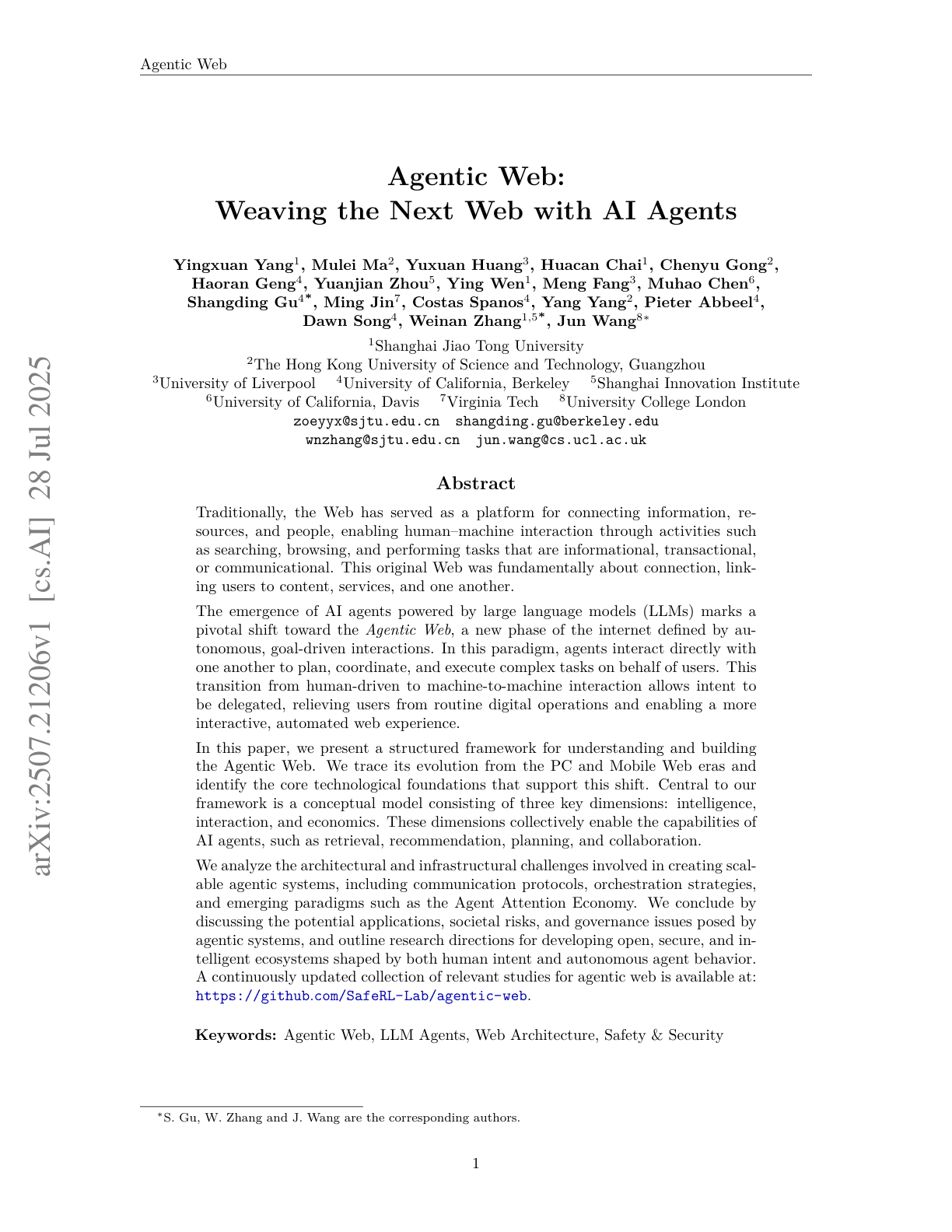
Agentic Web
This paper introduces the concept of the Agentic Web, a transformative vision of the internet where autonomous AI agents, powered by LLMs, act on behalf of users to plan, coordinate, and execute tasks. It proposes a structured framework for understanding this shift, situating it as a successor to the PC and Mobile Web eras. The Agentic Web is defined by a triplet of core dimensions, intelligence, interaction, and economics, and involves fundamental architectural and commercial transitions.
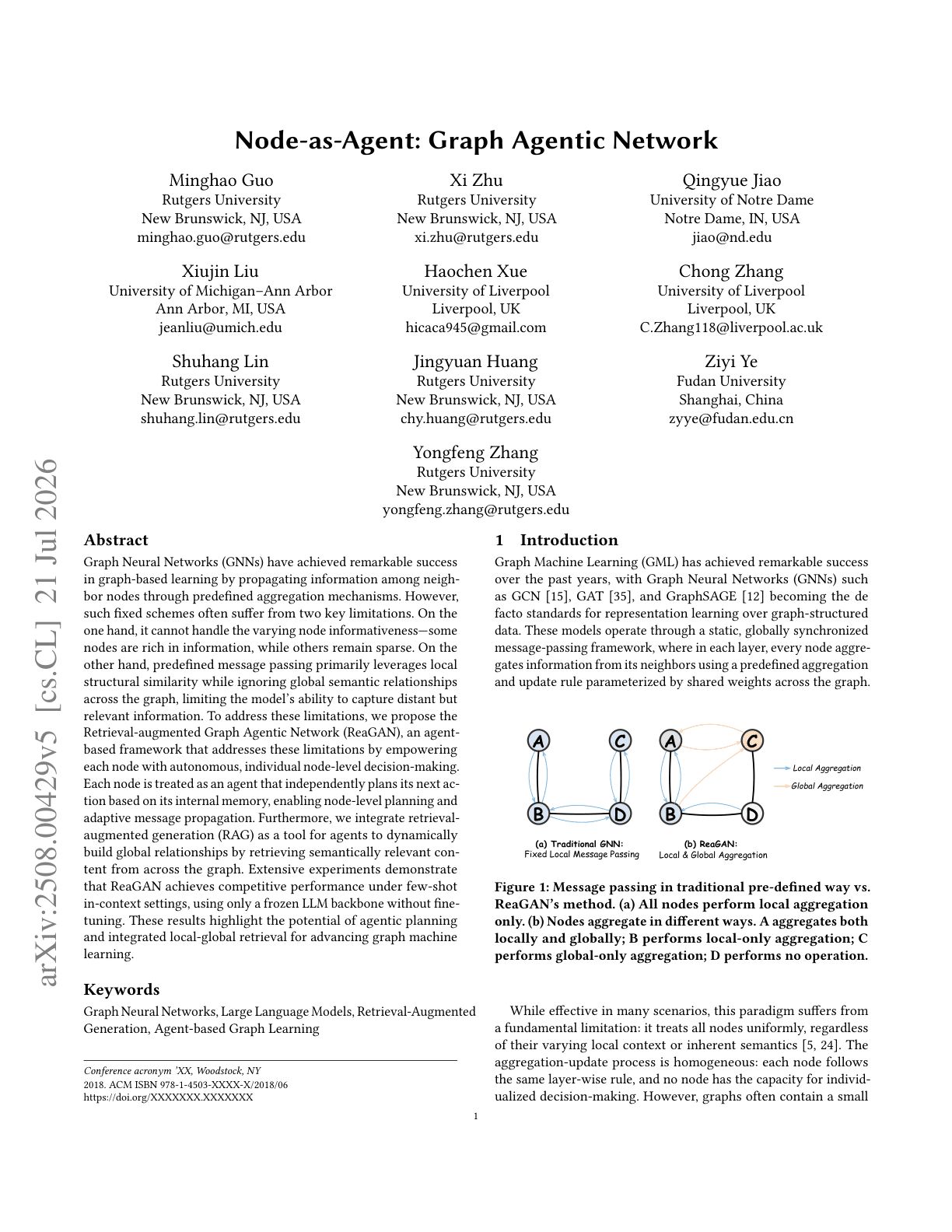
ReaGAN
This paper introduces ReaGAN, a graph learning framework that reconceptualizes each node in a graph as an autonomous agent capable of planning, reasoning, and acting via a frozen LLM. Instead of relying on static, layer-wise message passing, ReaGAN enables node-level autonomy, where each node independently decides whether to aggregate information from local neighbors, retrieve semantically similar but distant nodes, or take no action at all. This node-agent abstraction addresses two key challenges in graph learning: (1) handling varying informativeness of nodes and (2) combining local structure with global semantics.
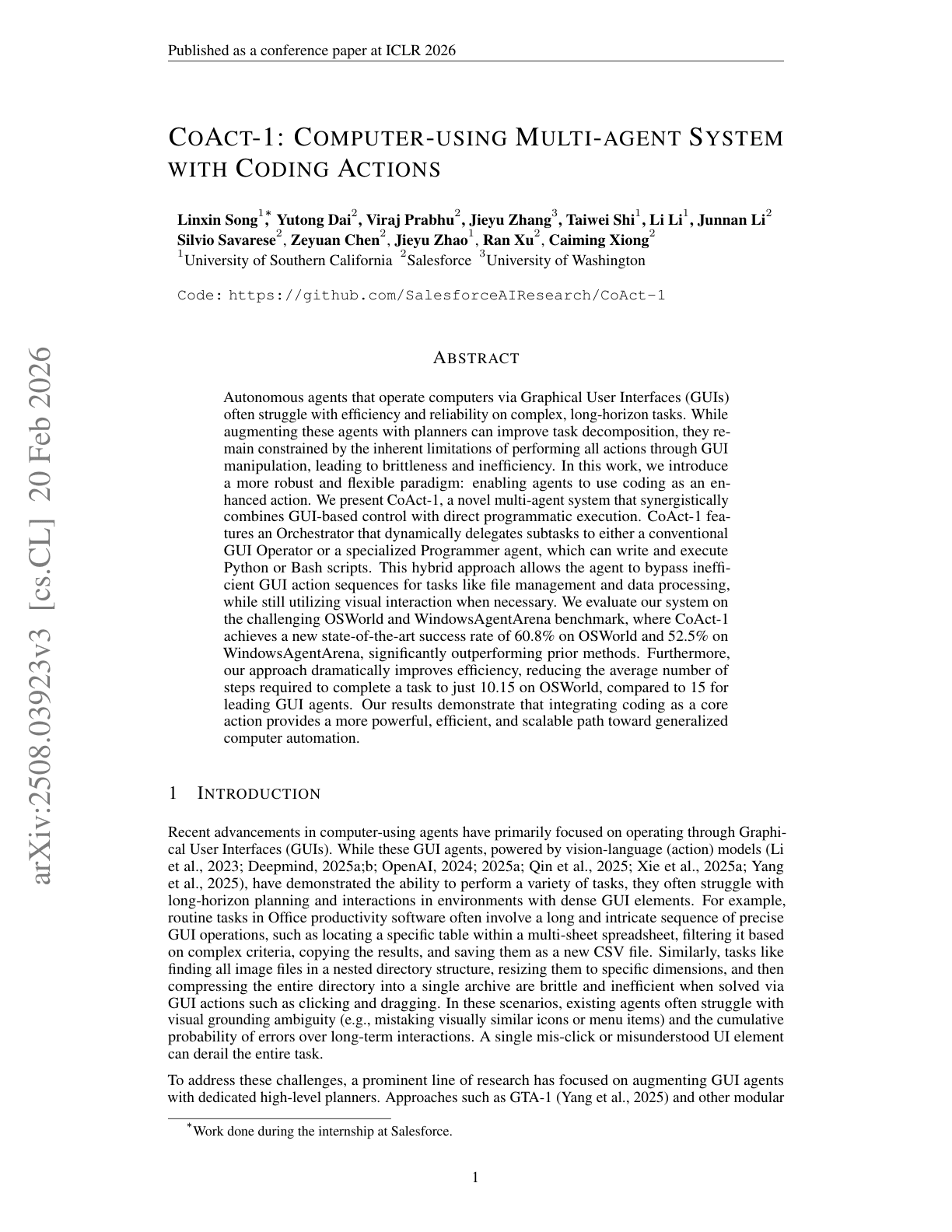
CoAct-1
Researchers from USC, Salesforce, and UW present CoAct-1, a multi-agent system that combines GUI interaction with direct code execution to improve efficiency and robustness in computer-using agents. Unlike prior GUI-only frameworks, CoAct-1’s Orchestrator delegates subtasks to either a GUI Operator (vision-language action model) or a Programmer (Python/Bash execution), enabling agents to bypass brittle, multi-click sequences for tasks better handled via scripts.
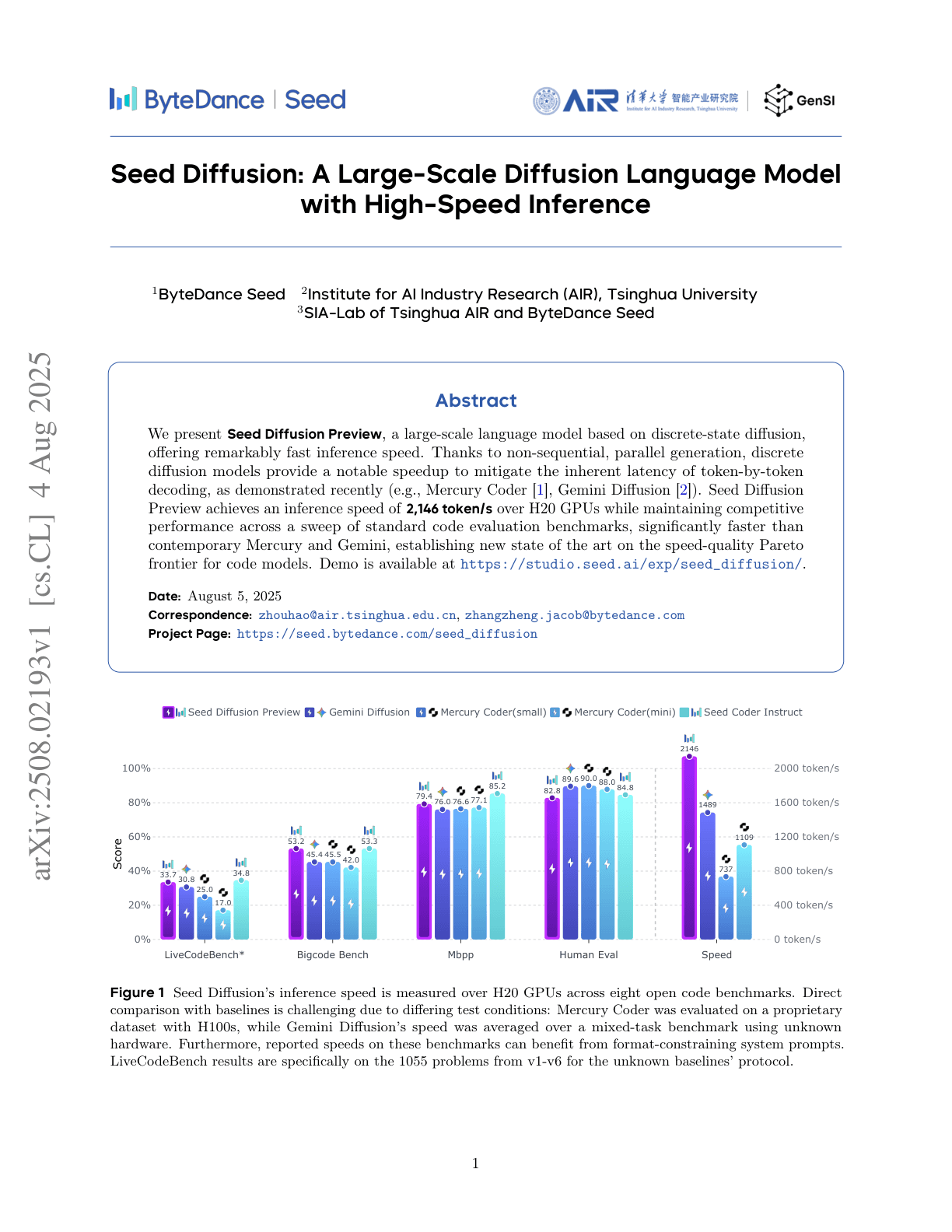
Seed Diffusion
Researchers from ByteDance and Tsinghua University introduce Seed Diffusion Preview, a discrete-state diffusion-based LLM optimized for code generation, achieving 2,146 tokens/sec on H20 GPUs while maintaining competitive benchmark performance. Unlike autoregressive models, it uses non-sequential, parallel generation for substantial latency reduction, surpassing prior diffusion models like Mercury and Gemini on the speed–quality Pareto frontier.
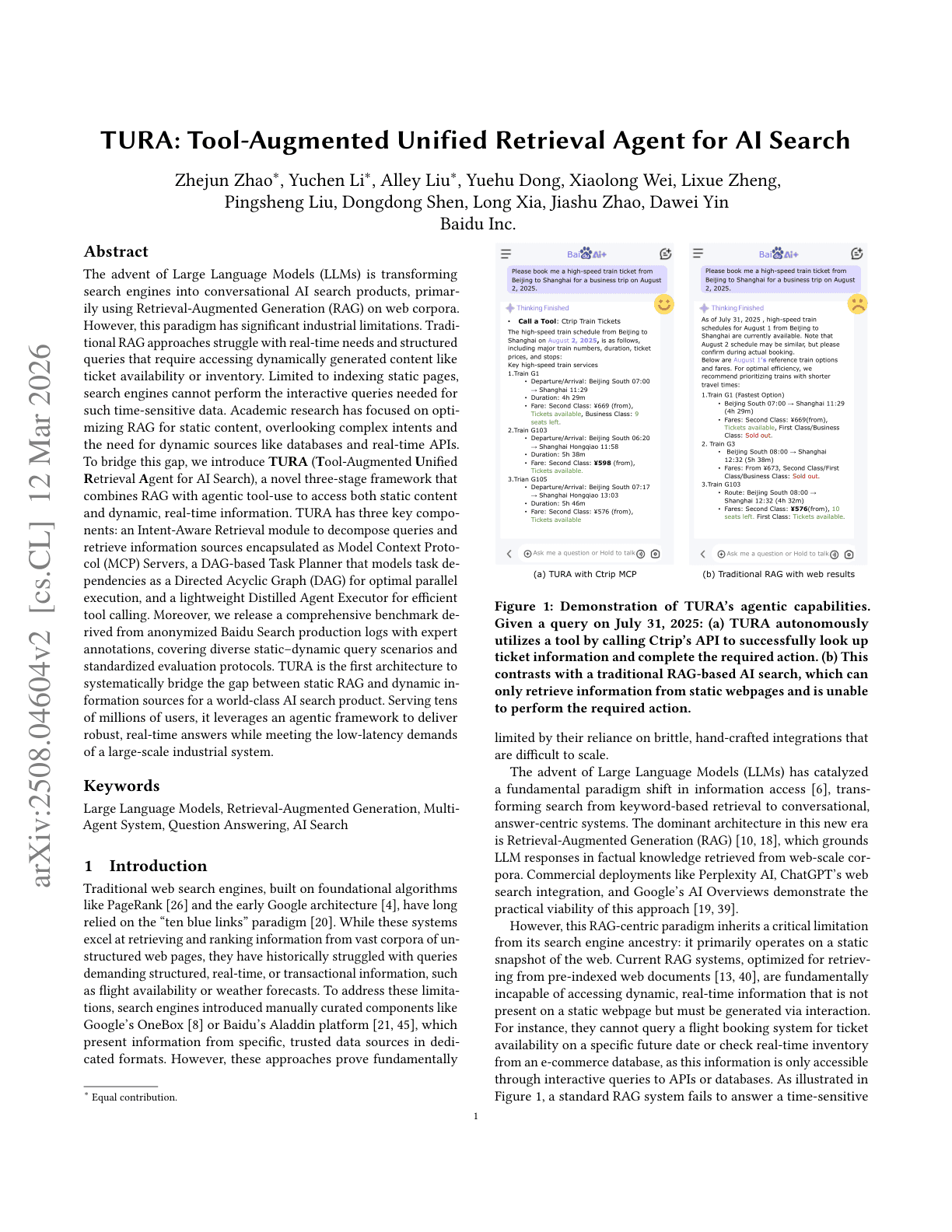
Tool-Augmented Unified Retrieval Agent for AI Search
Presents a production-ready framework that extends the RAG (Retrieval-Augmented Generation) paradigm to support real-time, dynamic, and transactional queries through agentic tool use. Unlike conventional RAG systems that rely on static web snapshots, TURA enables LLM-based systems to interact with external APIs and databases, addressing user intents that require up-to-date or structured information (e.g., train schedules, weather forecasts).