AI Papers of the Week
Every paper worth reading in AI, hand-picked one week at a time.
Discover and explore top AI papers withClaude CodeCodex
npx @dair-ai/mcp setup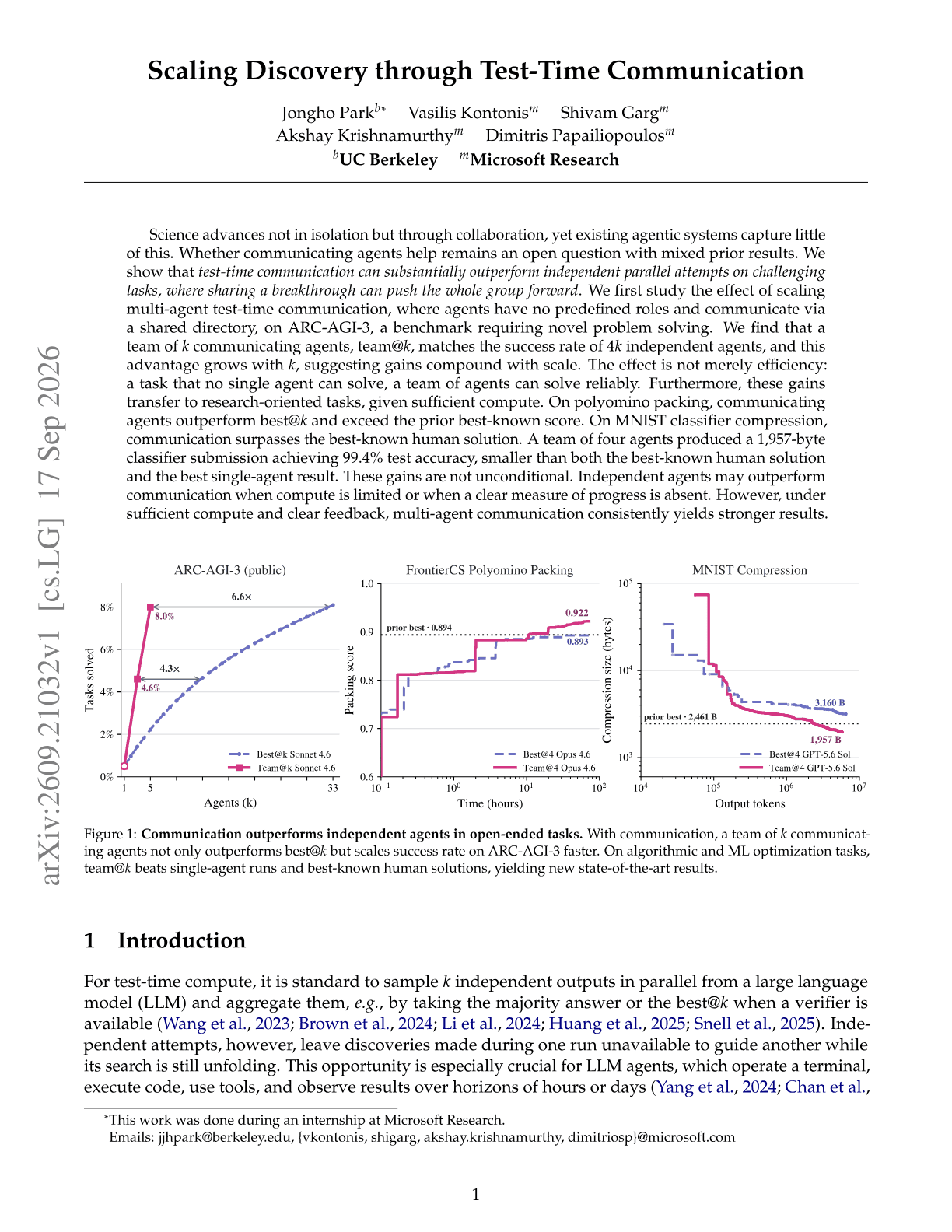
Scaling Discovery through Test-Time Communication
Park (UC Berkeley) with Kontonis, Garg, Krishnamurthy and Papailiopoulos (Microsoft Research) show that agents sharing progress through a common directory at test time outperform the same agents working independently on hard problems.
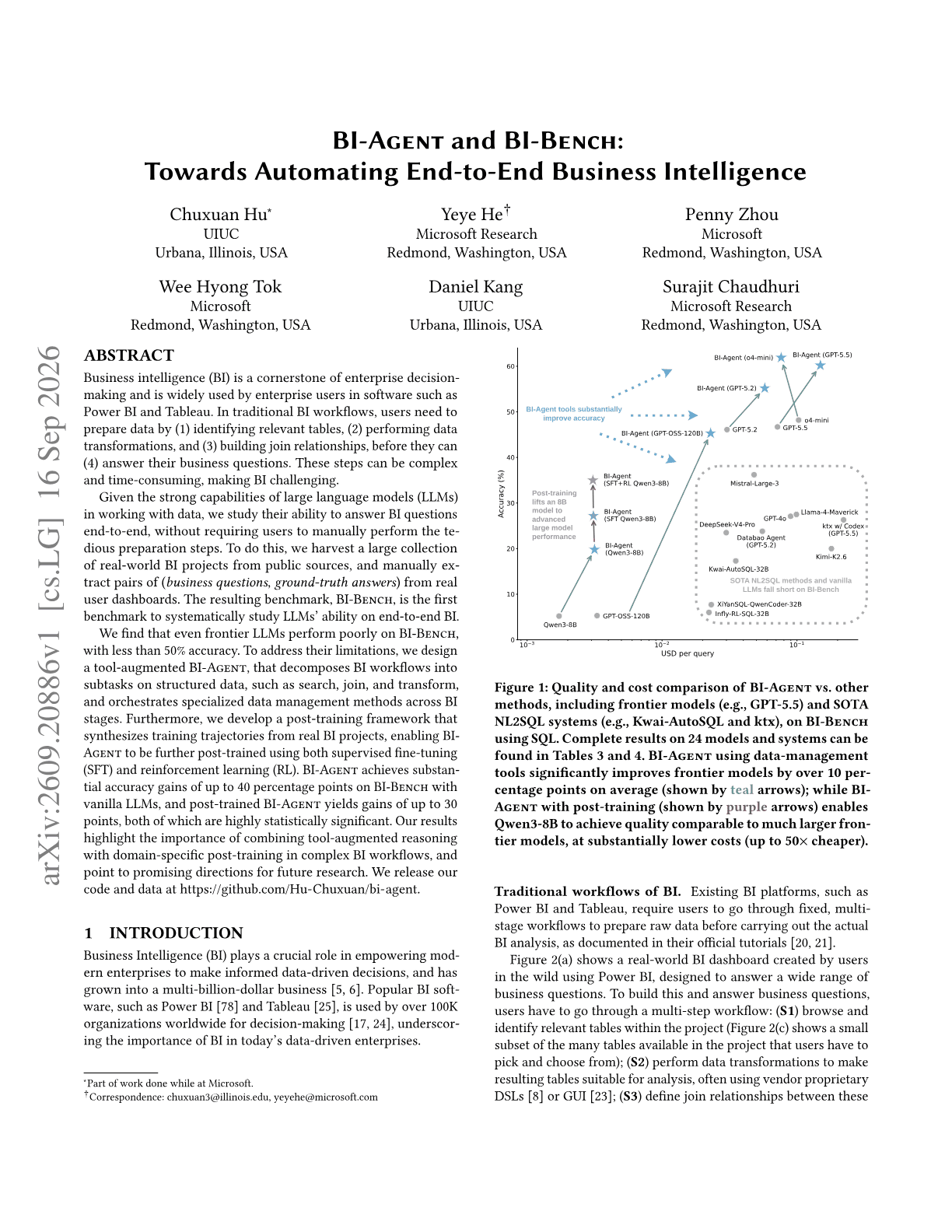
BI-Agent and BI-Bench: Towards Automating End-to-End Business Intelligence
Hu, He, Zhou, Tok, Kang and Chaudhuri (UIUC and Microsoft Research) build BI-Bench from real public BI projects and dashboards and show that frontier LLMs answer fewer than half of end-to-end business-intelligence questions correctly; their BI-Agent closes much of the gap.
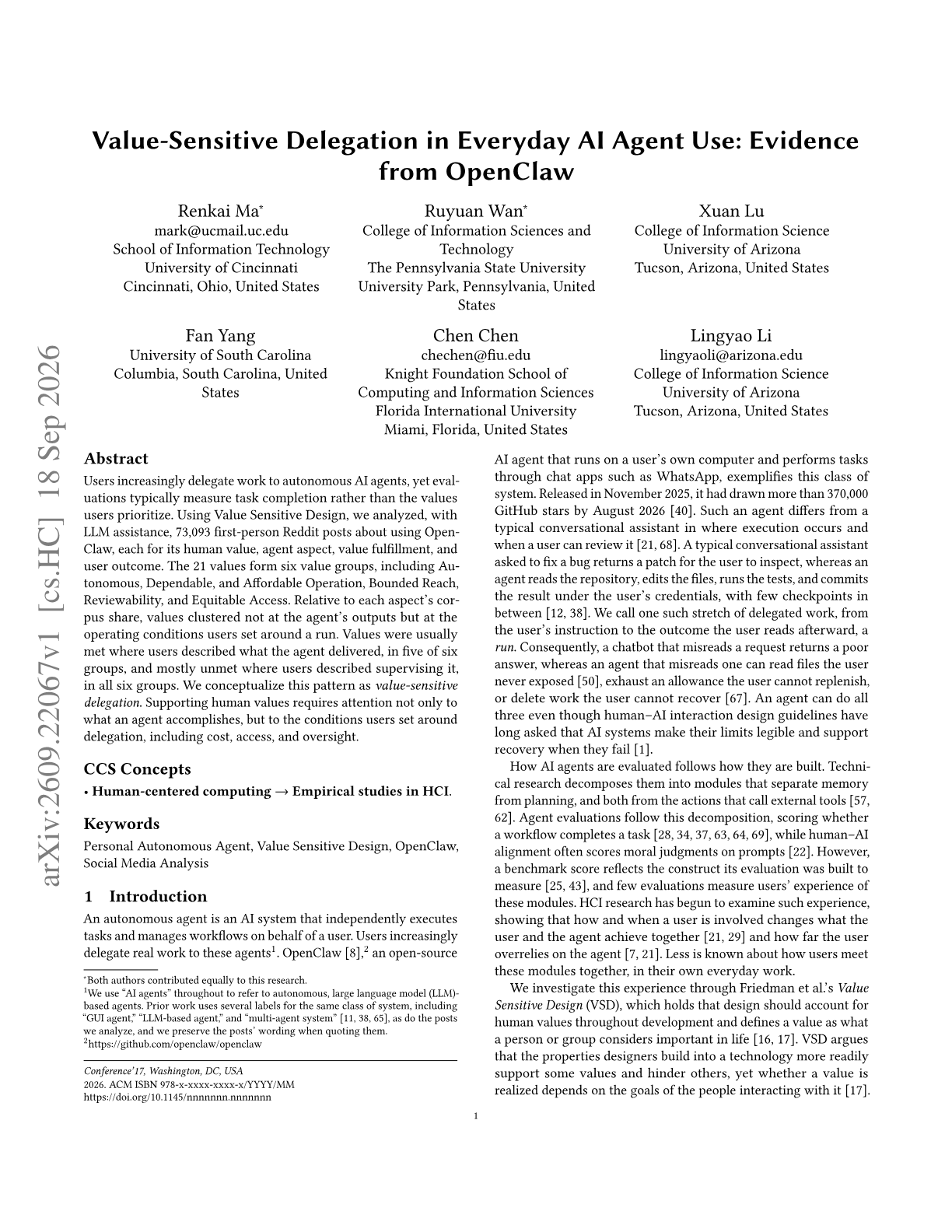
Value-Sensitive Delegation in Everyday AI Agent Use: Evidence from OpenClaw
Renkai Ma, Ruyuan Wan and colleagues at Cincinnati, Penn State, Arizona, South Carolina and Florida International analyze 73,093 first-person Reddit posts about using the OpenClaw agent to find which human values users care about when they delegate work.
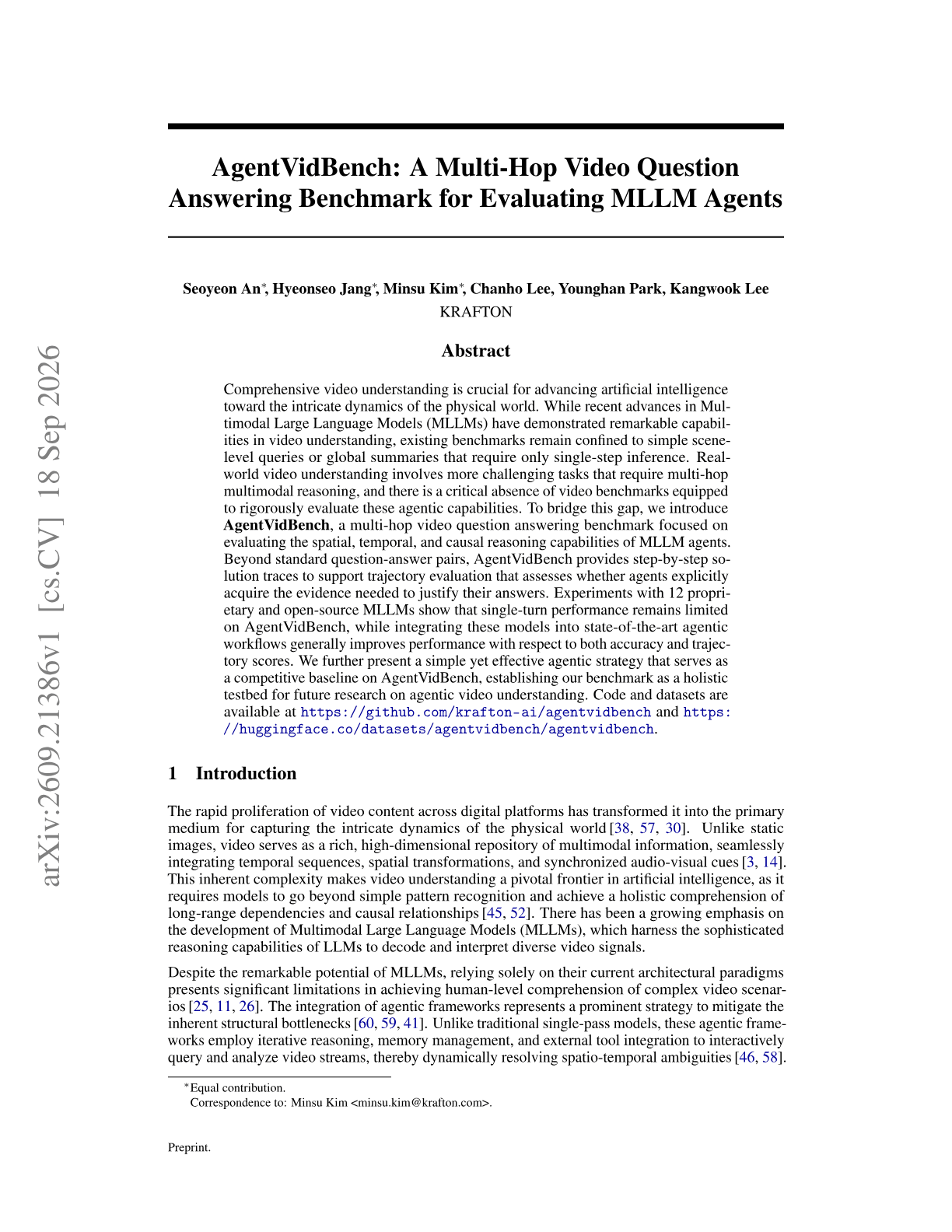
AgentVidBench: A Multi-Hop Video Question Answering Benchmark for Evaluating MLLM Agents
An, Jang, Kim, Lee, Park and Lee (KRAFTON) release AgentVidBench, a multi-hop video QA benchmark that tests spatial, temporal and causal reasoning in multimodal agents and scores the solution trajectory as well as the final answer.
DENSE: Distilling Agent Trajectories into Evidence-Grounded Shortcut Trees for Self-Refinement
Siyuan Liu, Yixin Cao and colleagues at Fudan University and the Meituan LongCat Team introduce DENSE, which turns an agent's own execution traces into structured feedback for a second attempt without needing outcome labels, verifiers or expert annotation.
When Better Turns Do Not Make Better Agents: Diagnosing the Gap Between Next-Turn Metrics and Workflow Success
Laskar, Fu and colleagues (Dialpad) test whether improving next-turn metrics under gold history predicts better autonomous multi-turn workflow execution, and find that it does not.
RecreationWorld: Scalable and Verifiable Environments for Hybrid Computer-Use Agents
An Alibaba team introduces RecreationWorld, a five-platform environment where a hybrid computer-use agent must inspect a running reference application and build a faithful reimplementation, mixing GUI exploration, coding and visual verification with no fixed workflow.
SWE-Proof: Can Language Models Resolve Real-World Issues with Machine-Checked Proofs?
Ma, Mikek and colleagues (UC Berkeley, Georgia Tech, UIUC and AWS AI Labs) build SWE-Proof, 500 SWE-bench Verified issues whose fixes are checked by machine-verified proofs instead of test suites.
CodeMidas: Scaling Agentic Coding RL Environments from Code Itself
Ye, Li, Luo, Yang and colleagues (Xiaomi LLM Core with Peking University, HKU and Renmin) present CodeMidas, an agentic pipeline that builds executable RL environments for coding agents from source code alone, without relying on issues or commits.
Efficient Benchmarking in Production: A Study of an Evolving LLM Agent
Yining She (Carnegie Mellon, work done at Meta) and Lei Lin (Meta) study how to re-evaluate a production analytics agent with tens of thousands of monthly users without rerunning its full benchmark each time, using 574 historical benchmark runs.
AutoViewMem: Self-Configuring Orthogonal Views for Conversational Long-Term Memory
Cao, Zhou, Mei and colleagues (National University of Defense Technology) propose AutoViewMem, which organizes conversational long-term memory into automatically discovered, low-overlap semantic views at write time so that plain top-K retrieval returns focused evidence.
CoLearn: An Agentic Tutor that Learns its Learner in a Human--AI Co-Learning Loop
He, Wu, Zhang, Zhao, He and Li (King's College London) present CoLearn, an agentic tutor that keeps an evidence-grounded memory of each learner's mastery and misconceptions and uses it to choose the next question.
Designer-RSI: Evolving Procedural Memory from User Traffic for Agentic Graphic Design
Du, Yan, Flores and Kadav (Adobe and Brown University) keep a frontier model frozen while it operates professional design software through more than 230 tools, and let an external procedural memory of natural-language skills grow and improve from real user traffic.
Proxifield: Decentralized Multi-Agent Communication through Semantic Proximity
Pradyumna Tambwekar, Yenchia Feng, Deep Patel and Karime Maamari (Distyl AI) propose Proxifield, a decentralized communication protocol in which each agent decides every round whom to talk to, based on how semantically close their current states are.
Loopjacking: Hijacking Human-in-the-Loop Approval
Arun Kumar (independent) names Loopjacking: a person approves what they see as operation A while the agent runtime uses that approval for a different operation B, and reproduces it in released agent frameworks.
Verify, Don't Trust: Agentic Model Development for Video Discovery Retrieval at Scale
Hao Fu, Baiting Zhu, Minglei Chen, Yinjie Huang and Shuai Ding (Meta) describe EvoPilot, a human-gated method for running LLM-agent research loops on a production retrieval system, and report a 37-day campaign on the retrieval stack behind Video Deep Dive.
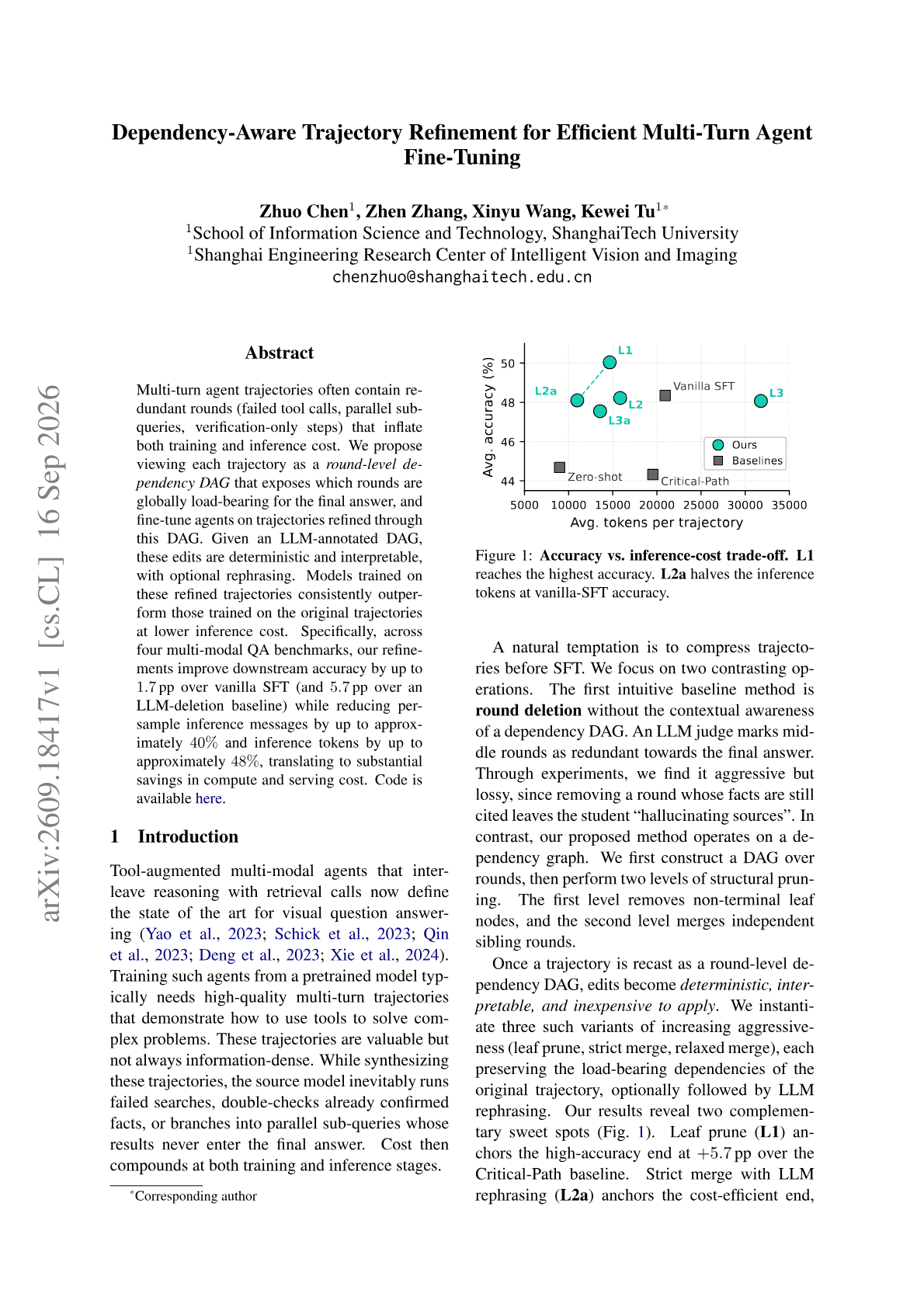
Dependency-Aware Trajectory Refinement for Efficient Multi-Turn Agent Fine-Tuning
Zhuo Chen, Kewei Tu and colleagues at ShanghaiTech University represent multi-turn agent trajectories as round-level dependency DAGs and remove rounds the final answer does not depend on before fine-tuning.
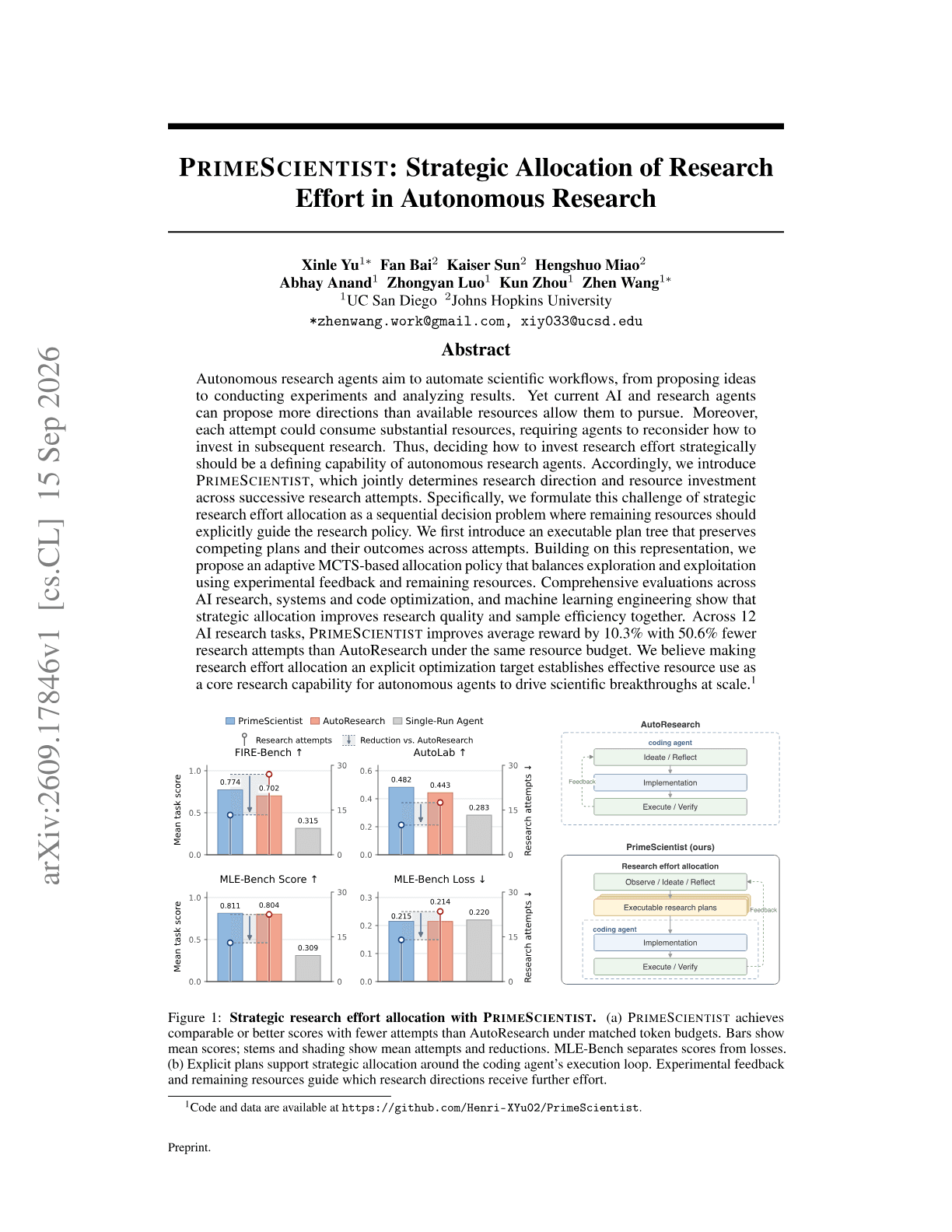
PrimeScientist: Strategic Allocation of Research Effort in Autonomous Research
Xinle Yu, Zhen Wang and colleagues at UC San Diego and Johns Hopkins University present PrimeScientist, which treats deciding where to spend a research agent's limited budget as a sequential decision problem.
ReFigBench: Benchmarking Scientific Figure Reconstruction as Editable PowerPoint Artifacts
Liyang Fan, Chi Wei, Bo Li and colleagues at SIAT (Chinese Academy of Sciences), Shenzhen University and China Tower introduce ReFigBench, 1,000 real arXiv overview figures that coding agents must rebuild as editable PowerPoint slides, and use it to separate model effects from harness effects.
EvolveTrade: Experience-Driven Policy Refinement for Self-Evolving LLM Trading Agents
Sehee Kim, Yumin Choi, Minki Kang and Sung Ju Hwang (KAIST, DeepAuto.ai) present EvolveTrade, which treats a trading agent's system prompt as a text policy that a Policy Agent rewrites from decision traces and realized portfolio returns while the backbone LLM stays fixed.
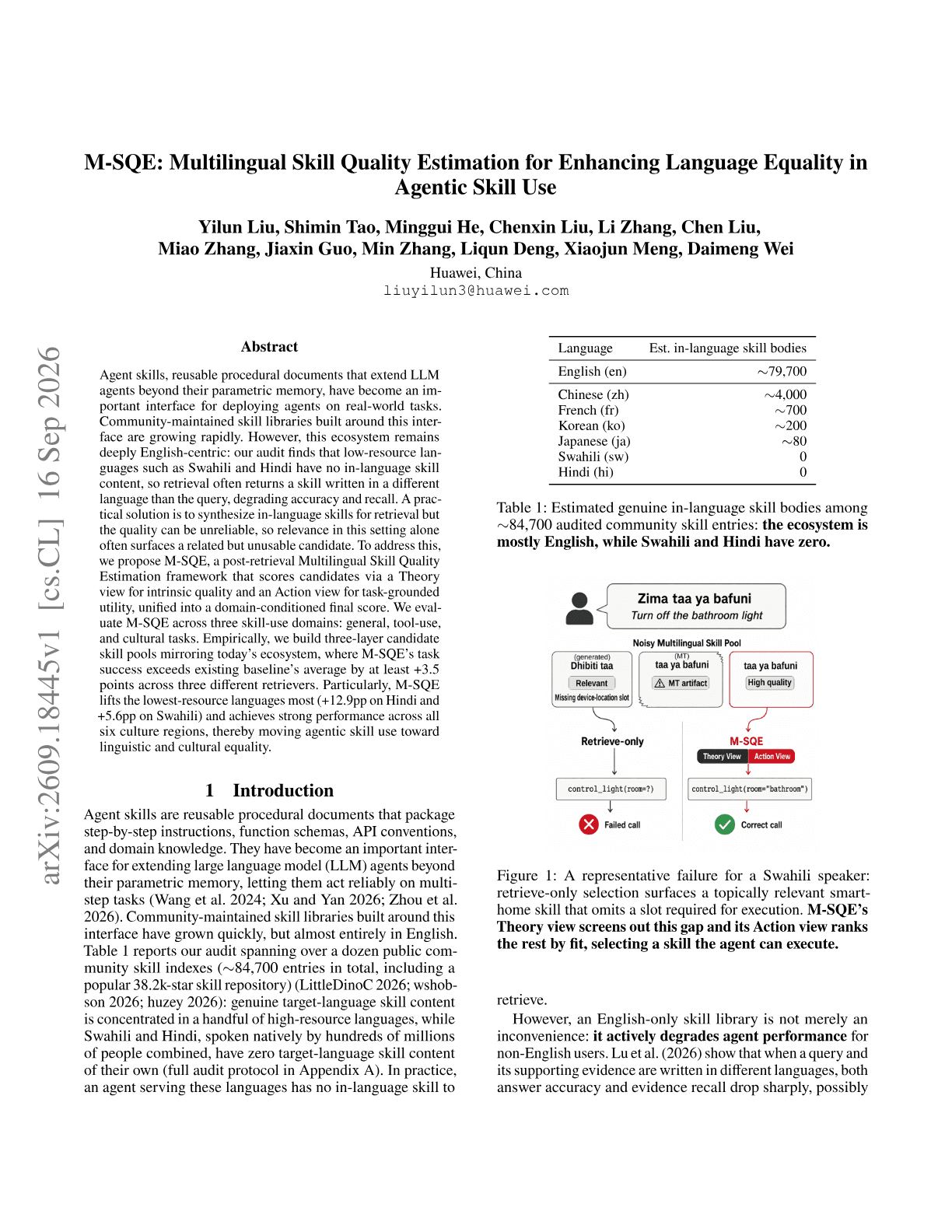
M-SQE: Multilingual Skill Quality Estimation for Enhancing Language Equality in Agentic Skill Use
Yilun Liu, Shimin Tao, Daimeng Wei and colleagues at Huawei audit community agent-skill libraries, find almost no content in low-resource languages, and propose M-SQE, a post-retrieval scorer that picks usable skills from synthesized in-language candidates.
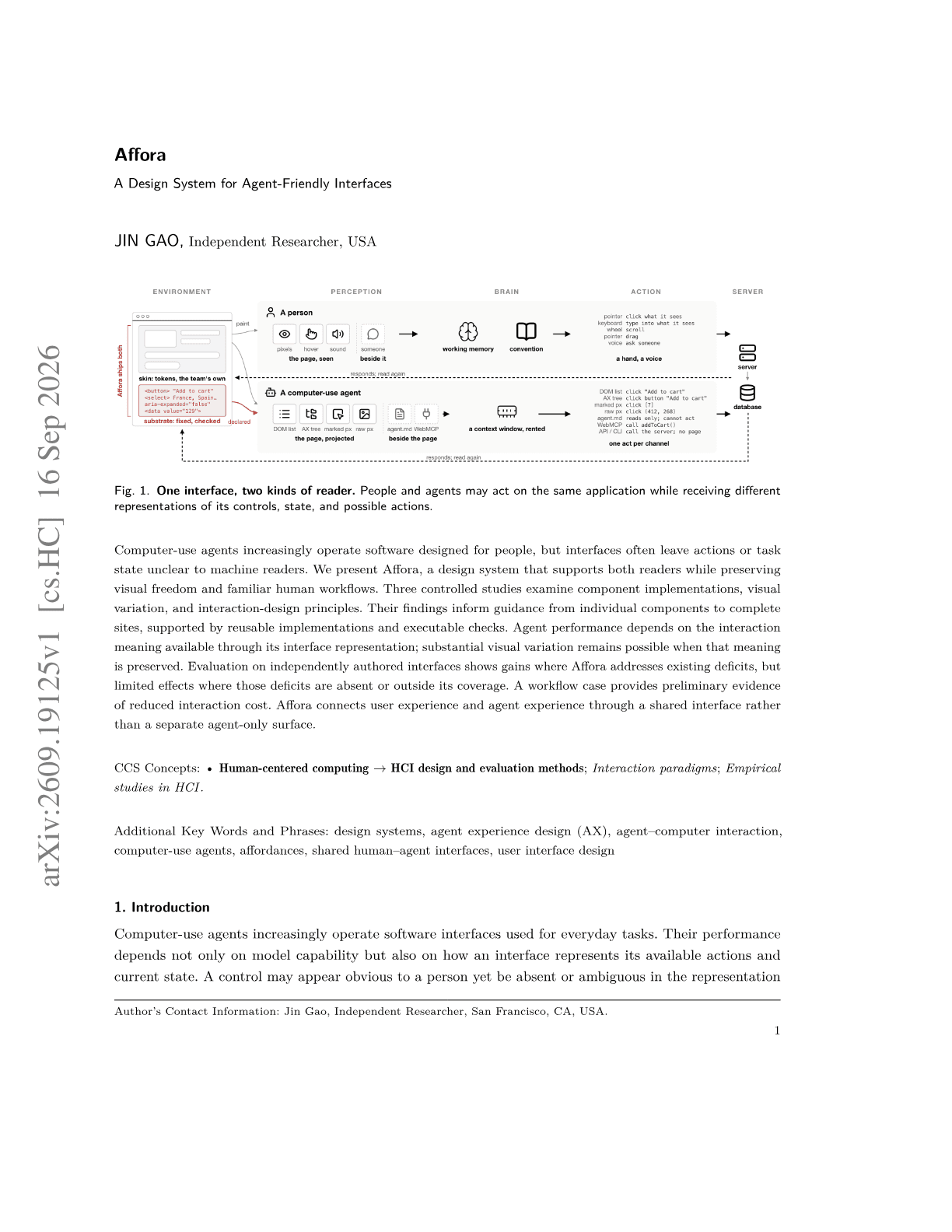
Affora: A Design System for Agent-Friendly Interfaces
Jin Gao (independent researcher) presents Affora, a design system for interfaces that both people and computer-use agents can operate, without a separate agent-only surface.
Faithful yet Collusive: Why Chain-of-Thought Monitoring Cannot Detect Collusion in LLM Pricing Agents under Oligopolistic Competition
Dohun Lee and Hyunwoo Park (Seoul National University) measure structural and intent faithfulness of LLM pricing agents in Bertrand competition and find both are unrelated to whether the agents collude.
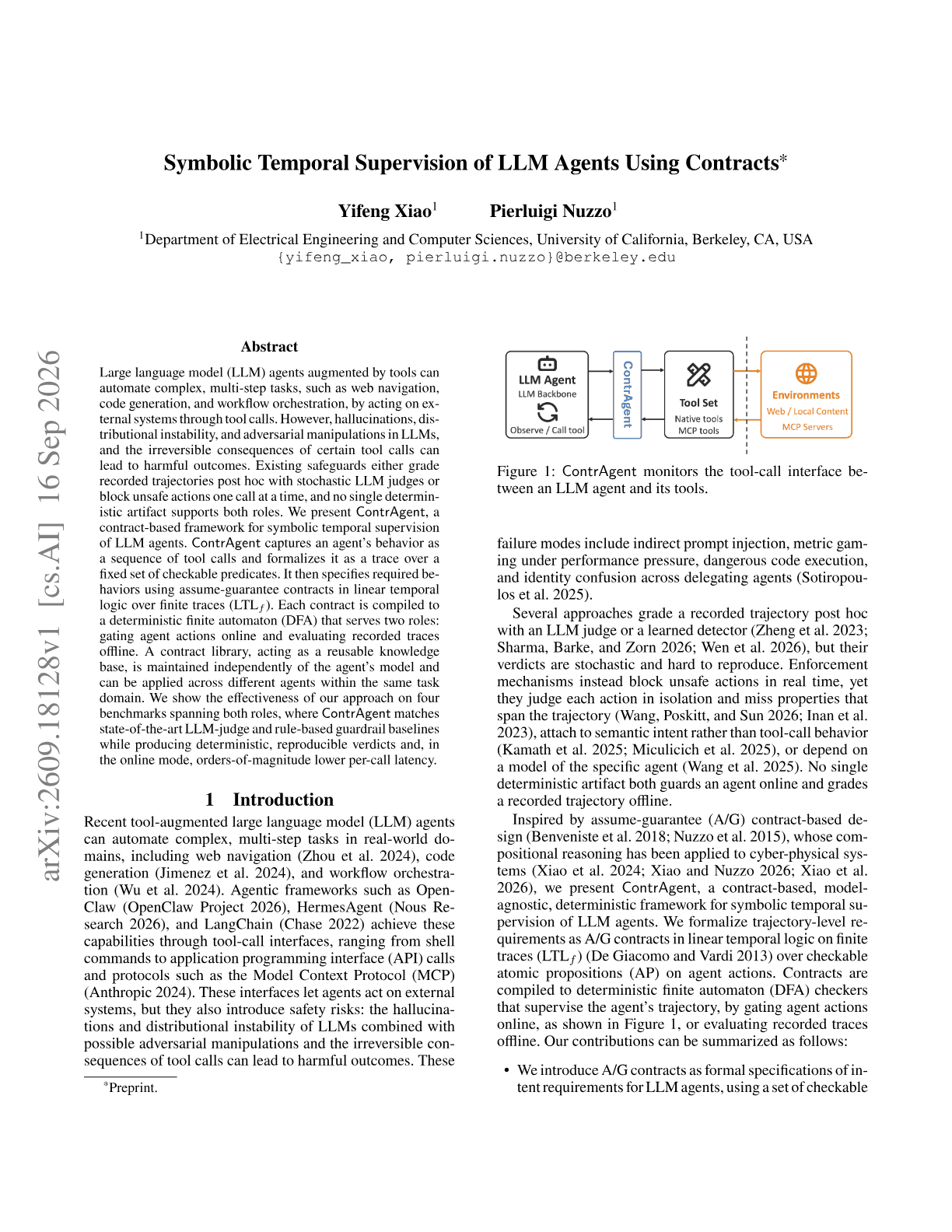
Symbolic Temporal Supervision of LLM Agents Using Contracts
Yifeng Xiao and Pierluigi Nuzzo present ContrAgent, which writes required agent behaviors as assume-guarantee contracts in LTLf and compiles each to a DFA that both gates tool calls online and grades recorded traces offline.