AI Papers of the Week
Every paper worth reading in AI, hand-picked one week at a time.
Discover and explore top AI papers withClaude CodeCodex
npx @dair-ai/mcp setup
Connect Four AlphaZero from Scratch
This paper proposes a new way to evaluate coding agents: hand them a minimal task description, give them a tight budget, and ask them to autonomously rebuild a famous ML breakthrough end-to-end. Connect Four plus AlphaZero is the first instance. It is small enough to run on a laptop and hard enough to require a real research engineering loop. Claude Opus 4.7 implemented the full pipeline (MCTS, neural value and policy nets, self-play, training schedule) in three hours on consumer hardware, then beat the Pascal Pons solver 7 of 8 as first-mover. No other frontier coding agent tested cleared 2 of 8.
Coordination as Architecture
Multi-agent LLM systems fail in production at rates between 41% and 87%, and the majority of those failures are coordination defects, not base-model capability. Most published comparisons of multi-agent architectures cannot even tell you whether the gain came from coordination or from one configuration just having more context. This paper argues coordination should be treated as a configurable architectural layer, separable from agent logic and information access, then backs the position with an information-controlled experiment.
Horizon Generalization
Microsoft Research runs a controlled study where the only variable is task horizon length. Same decision rules, same reasoning structure, different sequence length to the goal. The main finding: horizon alone is a training bottleneck. As goal distance grows, exploration explodes combinatorially and credit assignment gets ambiguous. Models that learn cleanly on short horizons fall apart on long ones, even when the underlying reasoning is identical. The fix is not more compute, it is horizon reduction.
1,000 Synthetic Computers
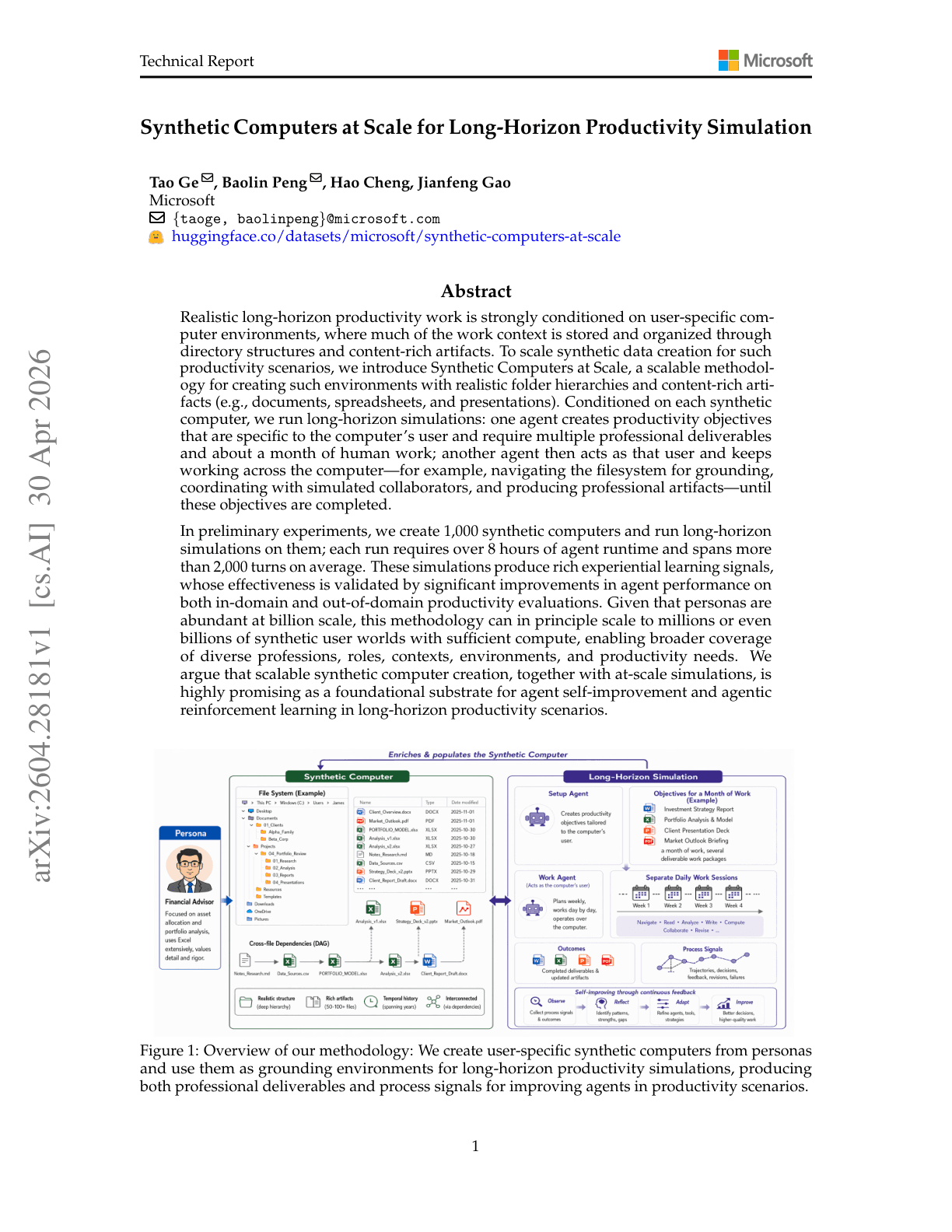
Microsoft Research builds 1,000 synthetic computers, each with realistic directory structures, documents, and artifacts, then runs long-horizon simulations on top of them. One agent plays the user and sets productivity goals; another executes the work. Each simulation runs over 8 hours of agent runtime and 2,000+ turns on average, roughly a month of human work compressed into one trace. Training on this experiential data drives significant improvements on both in-domain and out-of-domain productivity evaluations.
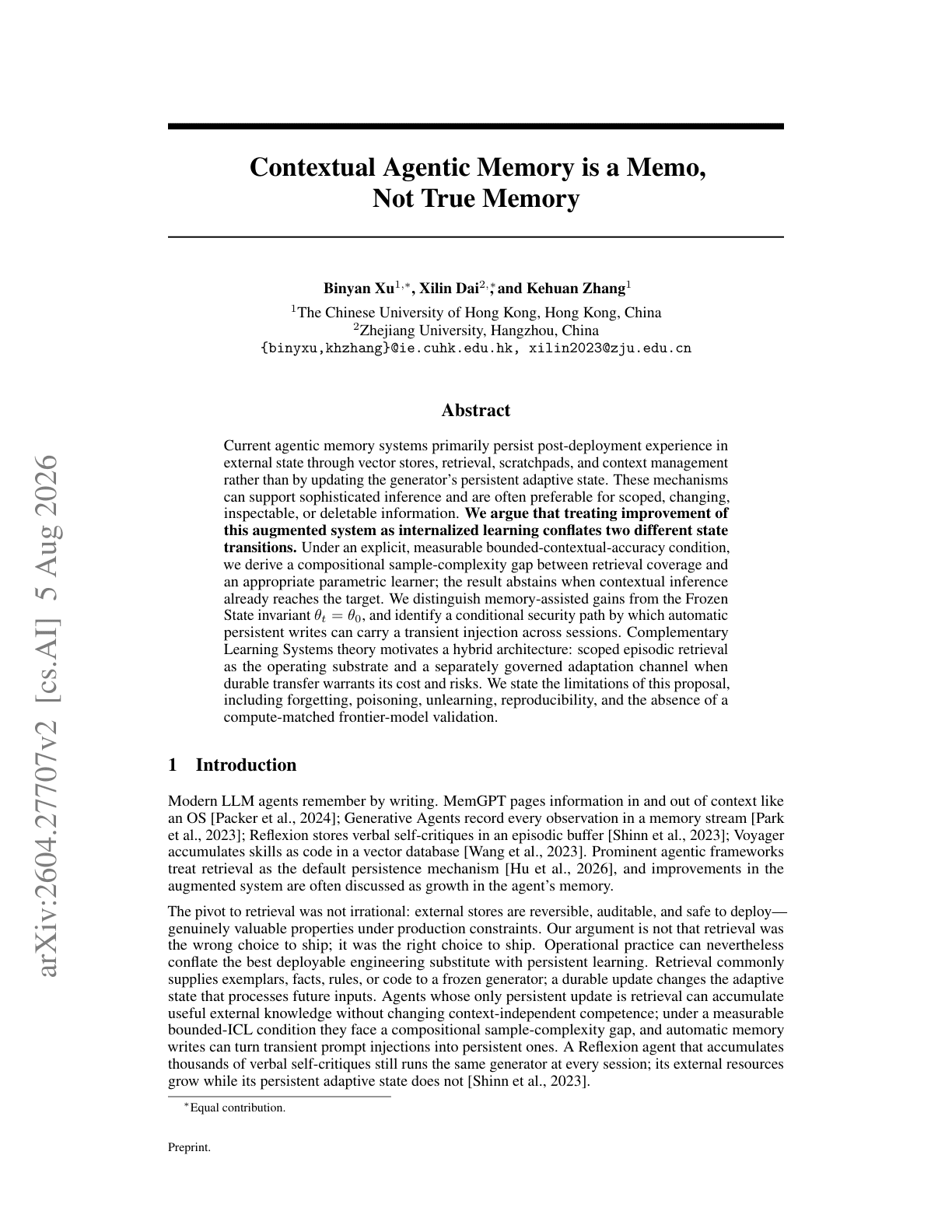
Contextual Agentic Memory is a Memo
Most agent memory today is not memory, it is closer to a memo. Vector stores, RAG buffers, and scratchpads implement lookup, not consolidation. The paper draws on neuroscience's Complementary Learning Systems theory: biological intelligence pairs fast hippocampal storage with slow neocortical consolidation, and current AI agents only implement the first half (fast write, similarity recall, no abstraction step). The authors prove a generalization ceiling on compositionally novel tasks: as long as memory stays retrieval-only, the agent cannot apply abstract rules to inputs that do not already look like something in the store, and it remains permanently exposed to memory poisoning. If you are building long-running agents and treating memory as a vector index, this paper is a clean diagnosis of what you are missing.
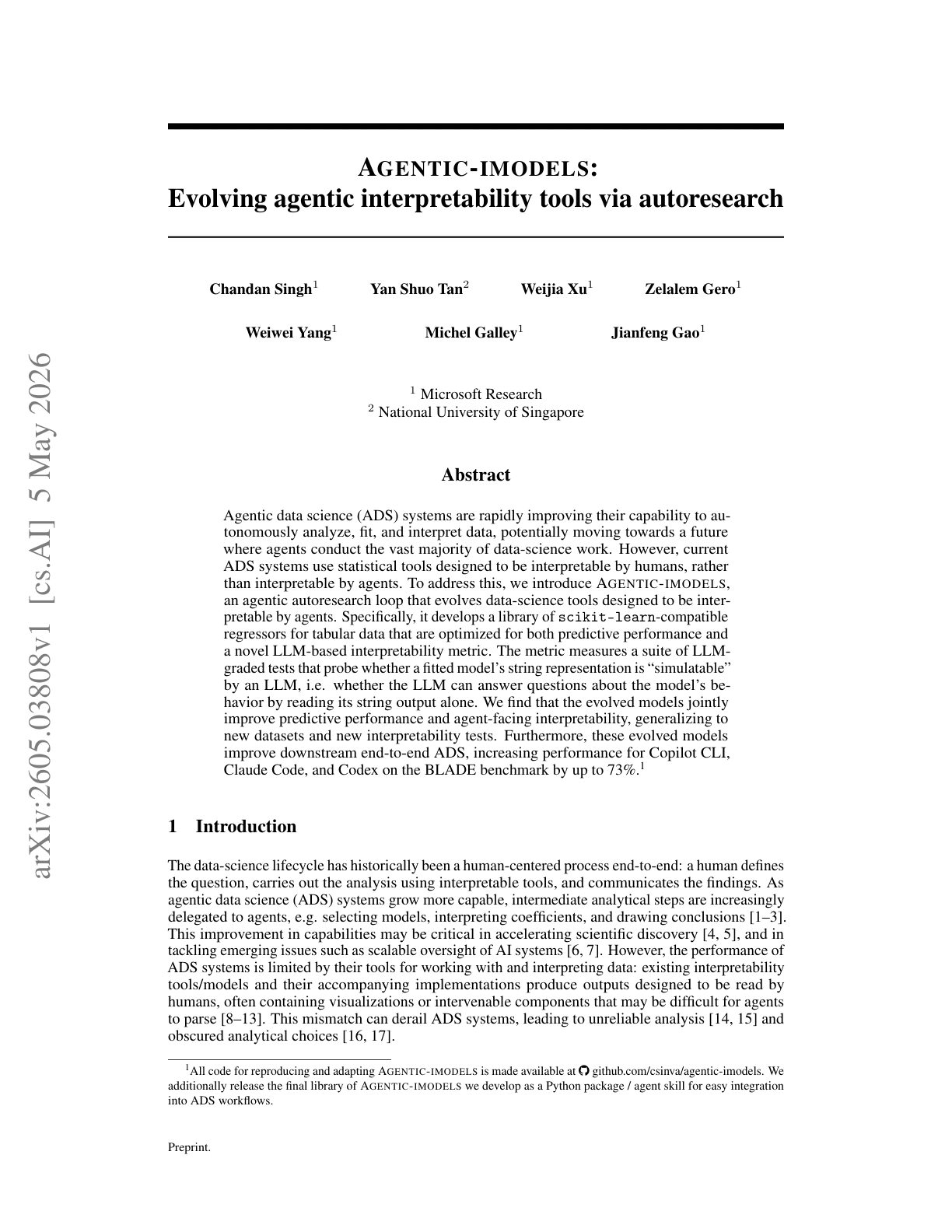
Agentic-imodels
The entire interpretability literature is built around human readers. As more analysis gets delegated to agents, the right target of interpretability shifts. Microsoft Research introduces Agentic-imodels, an autoresearch loop where a coding agent (Claude Code, Codex) iteratively evolves scikit-learn-compatible regressors that are simultaneously accurate AND readable by other LLMs. Interpretability is measured by whether a small LLM can simulate the fitted model's behavior just by reading its string representation, predictions, feature effects, and counterfactuals from the __str__ output alone. Across 65 tabular datasets, the discovered models push the Pareto frontier past every classical interpretable baseline (decision trees, GAMs, sparse linear), and improve four downstream agentic data-science systems on the BLADE benchmark by 8% to 73%.
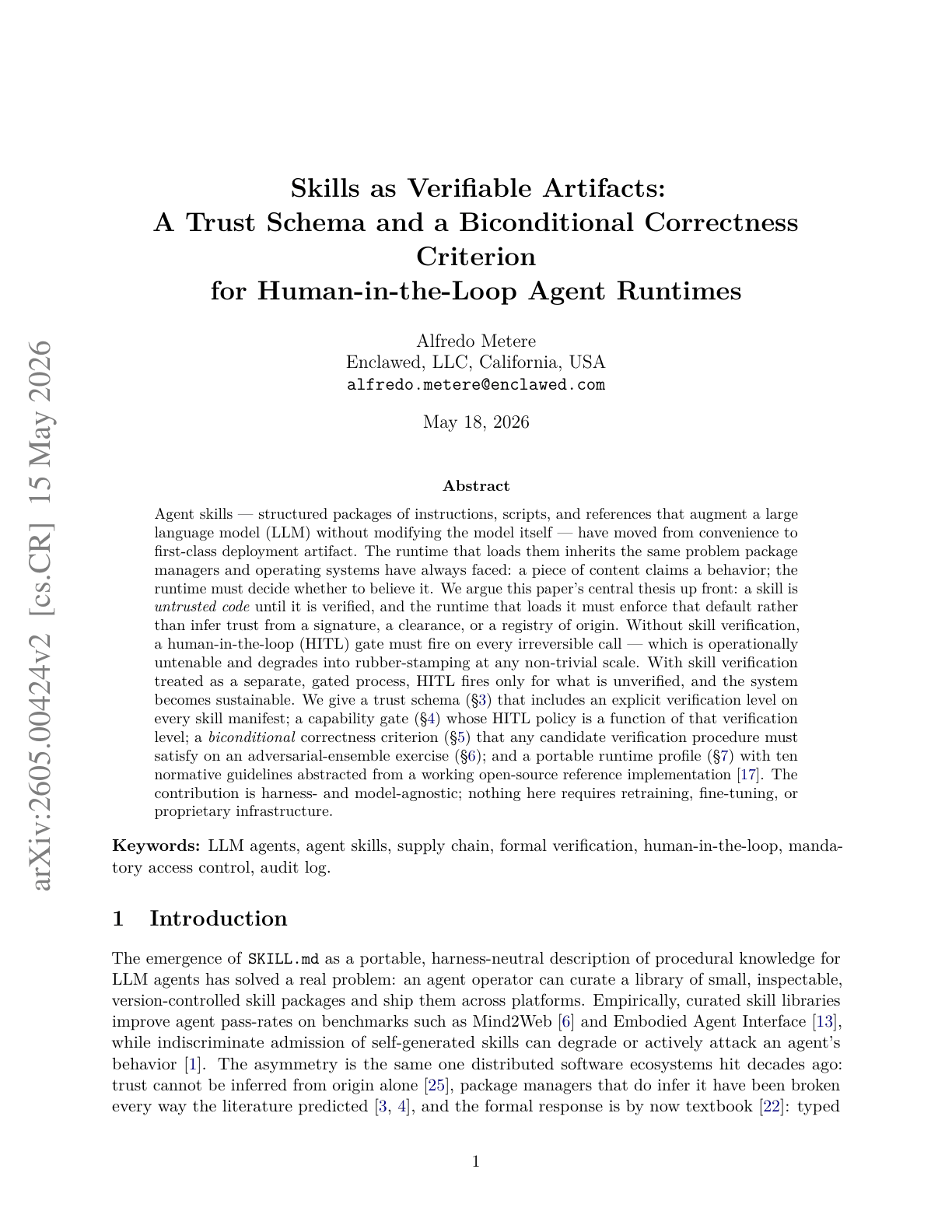
Skills as Verifiable Artifacts
If you ship agent skills, your runtime is treating signed-and-cleared skills as trusted by default. This paper argues a skill is untrusted code until it is verified, and the runtime should enforce that default rather than infer trust from origin. Without skill verification, HITL has to fire on every irreversible call, which degrades into rubber-stamping at any non-trivial scale. With verification as a separate gated process, HITL fires only for what is unverified. Skills are now first-class deployment artifacts, and we have decades of supply-chain lessons on what happens when trust is inferred from a signature. This is the right ask for SKILL.md before agent skill libraries become the next attack surface.
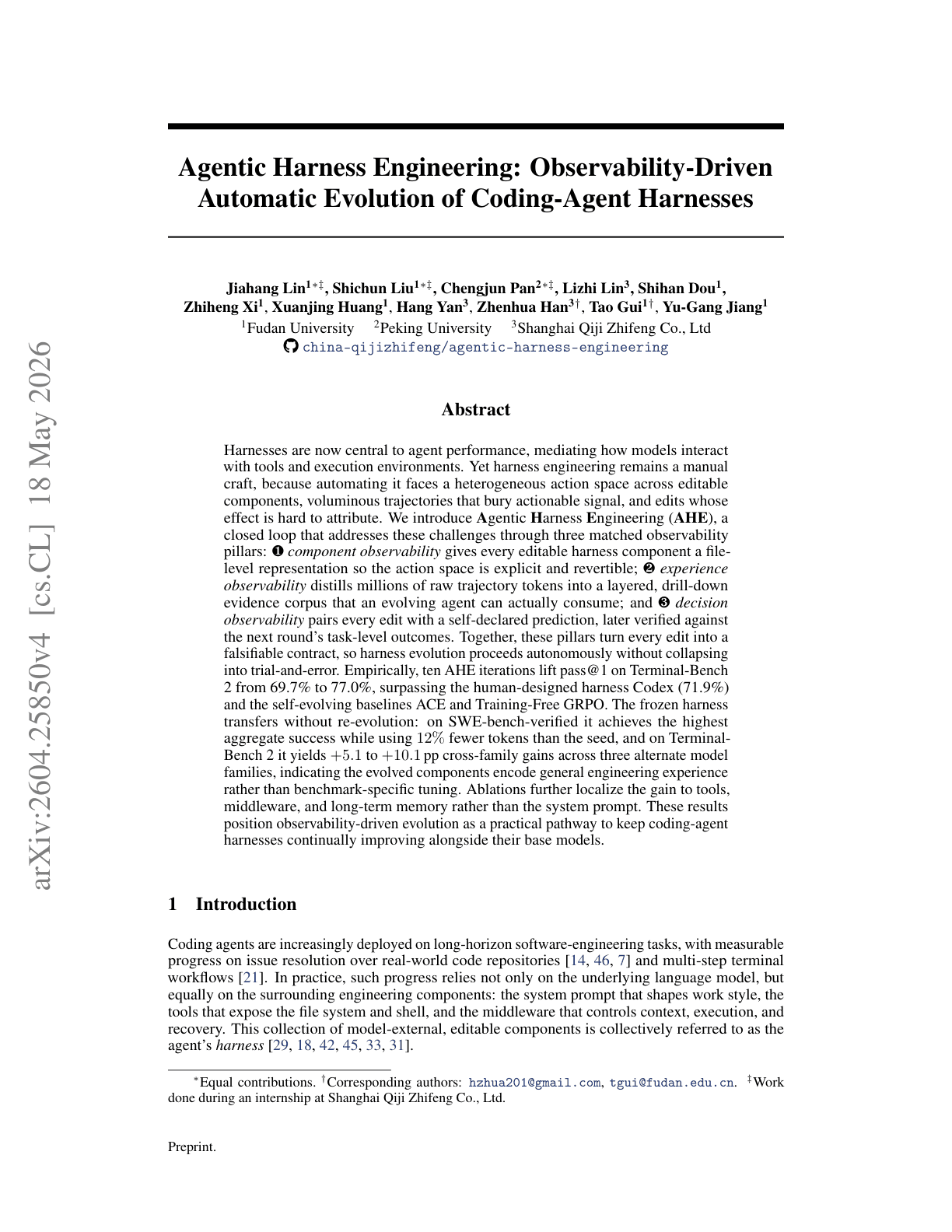
Agentic Harness Engineering
Most coding-agent harnesses are still tuned by hand or kept alive through brittle trial-and-error self-evolution. This paper introduces Agentic Harness Engineering (AHE), a framework that makes harness evolution observable and falsifiable. AHE separates the system into three layers: components stored as revertible files, experience condensed from millions of trajectory tokens into structured evidence, and decisions written as predictions that get checked against task outcomes. Every edit becomes a contract you can verify or revert.
AgenticQwen-30B-A3B
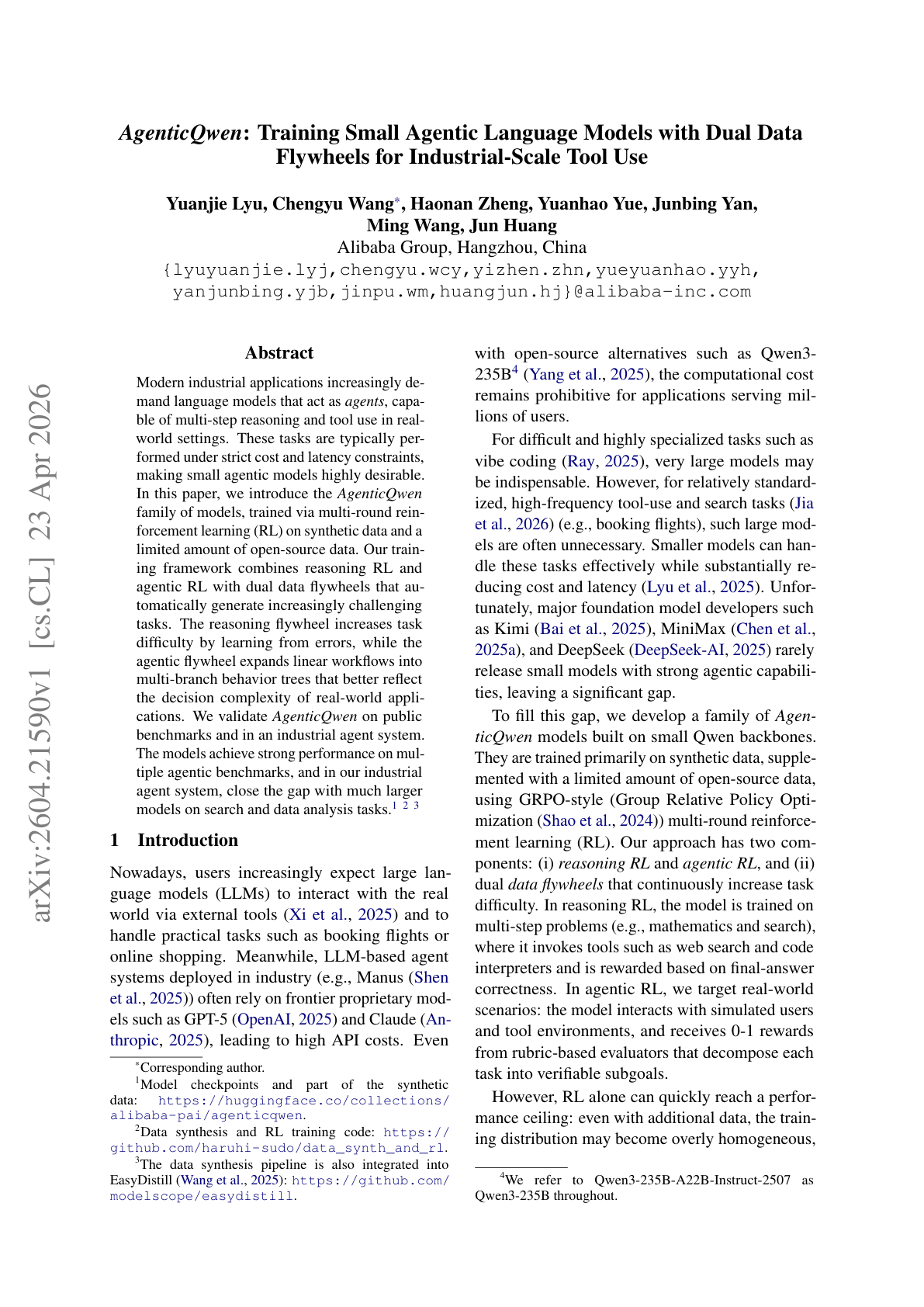
Alibaba shows that a 30B MoE model with only 3B active parameters can match Qwen3-235B on real tool-use workloads. AgenticQwen-30B-A3B scores 50.2 average on TAU-2 plus BFCL-V4 Multi-Turn, while AgenticQwen-8B scores 47.4. Both more than double their vanilla Qwen baselines and close most of the gap to a 235B model. The recipe is built around two reinforcement learning flywheels that run in parallel, with simulated users actively trying to mislead the agent.
Agentic World Modeling
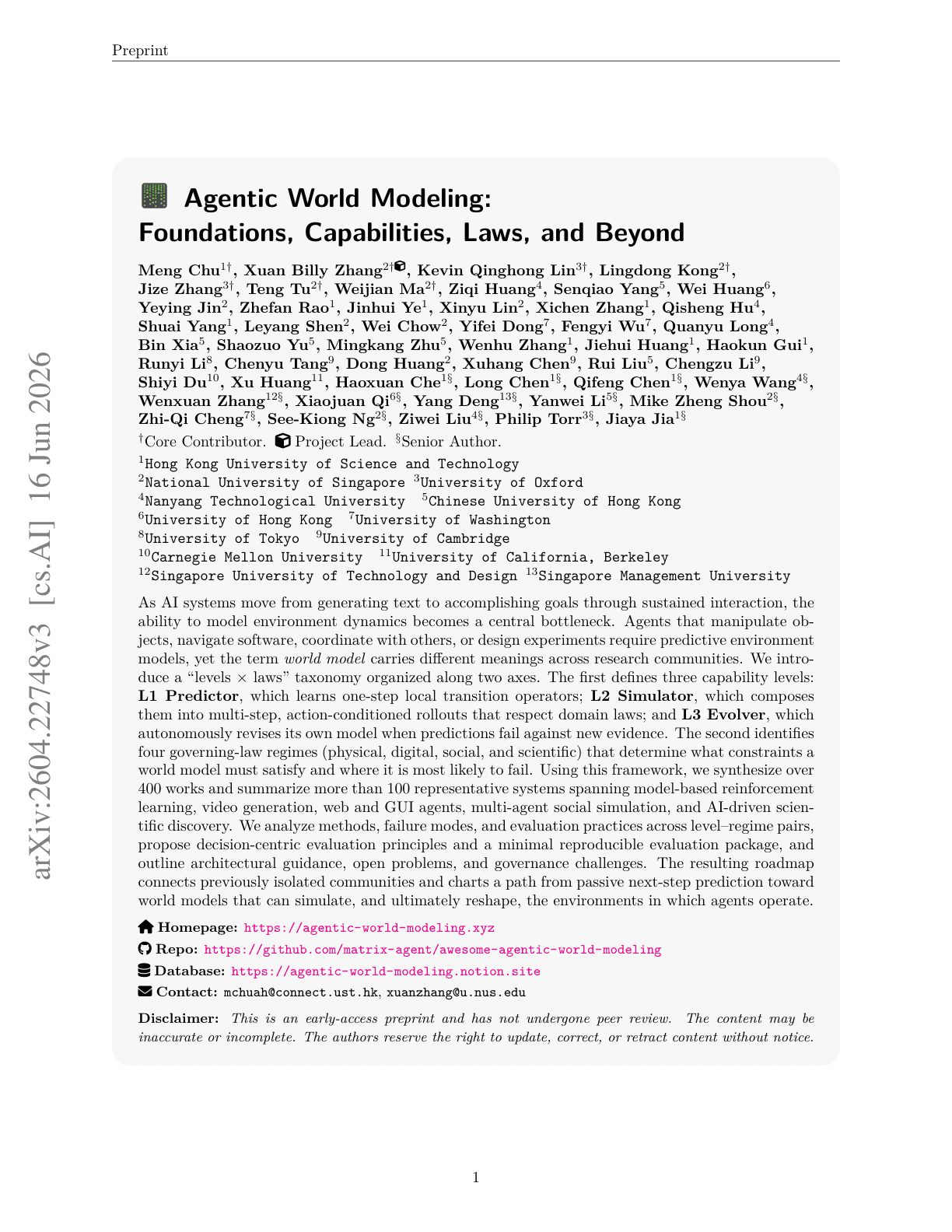
A massive 40-author survey lands the cleanest taxonomy of world models in agent research released so far. The paper proposes a "levels by laws" framework spanning three capability levels and four law regimes, then synthesizes 400+ works and 100+ representative systems across model-based RL, video generation, web and GUI agents, multi-agent simulation, and scientific discovery. As agents shift from chatbots to goal-accomplishers, the bottleneck moves from language to environment, and this is the first paper that gives builders a shared vocabulary across communities that have been working in isolation.
RecursiveMAS
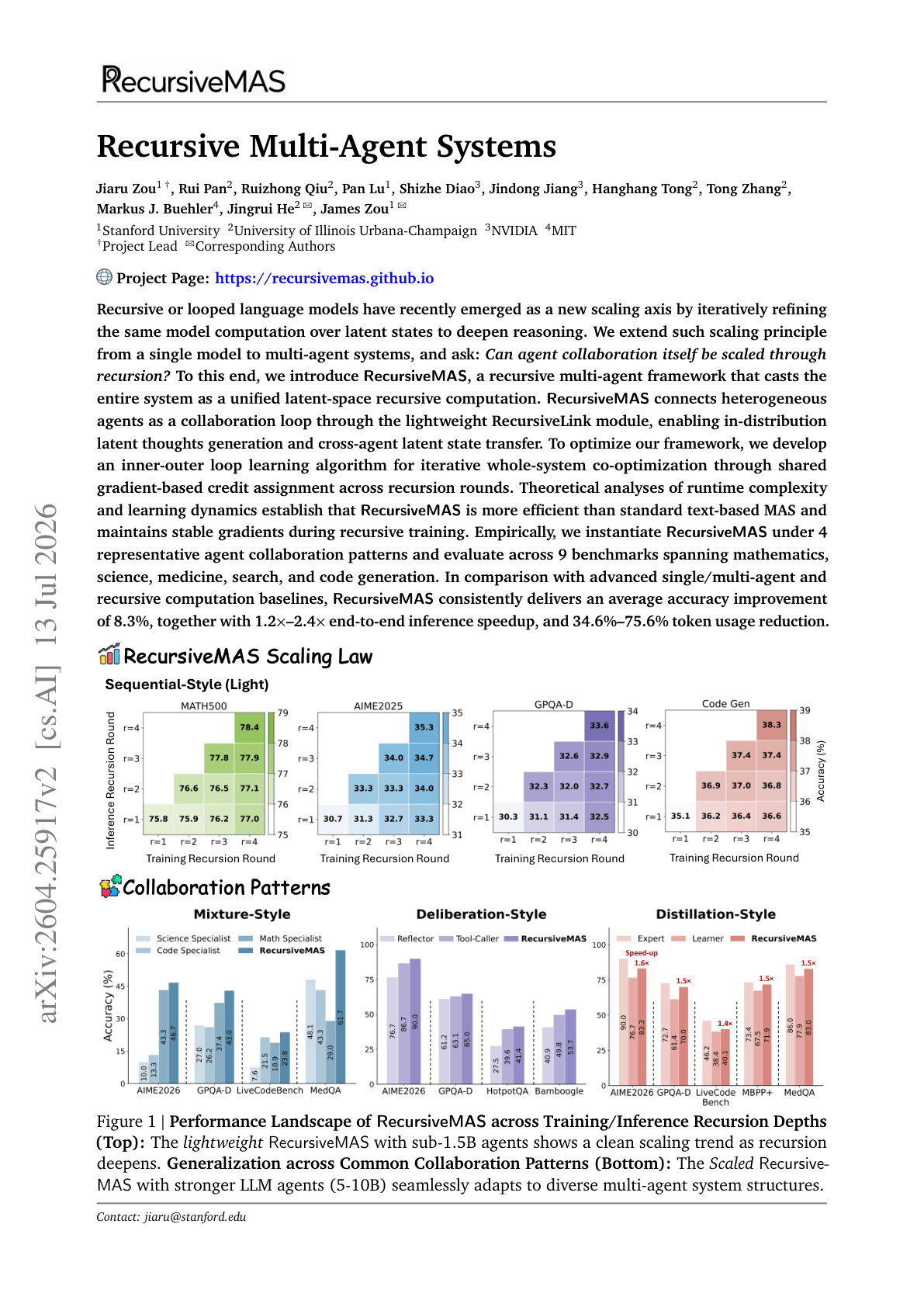
Multi-agent systems usually pass full text messages between agents at every step, which causes token bloat, latency, and context dilution that all grow with team size. RecursiveMAS asks a different question: what if agents collaborated through recursive computation in a shared latent space instead of through text? The system treats a multi-agent team as a recursive computation where each agent acts like an RLM layer, iteratively passing latent representations to the next and forming a looped interaction process. Less talking, more thinking.
OneManCompany
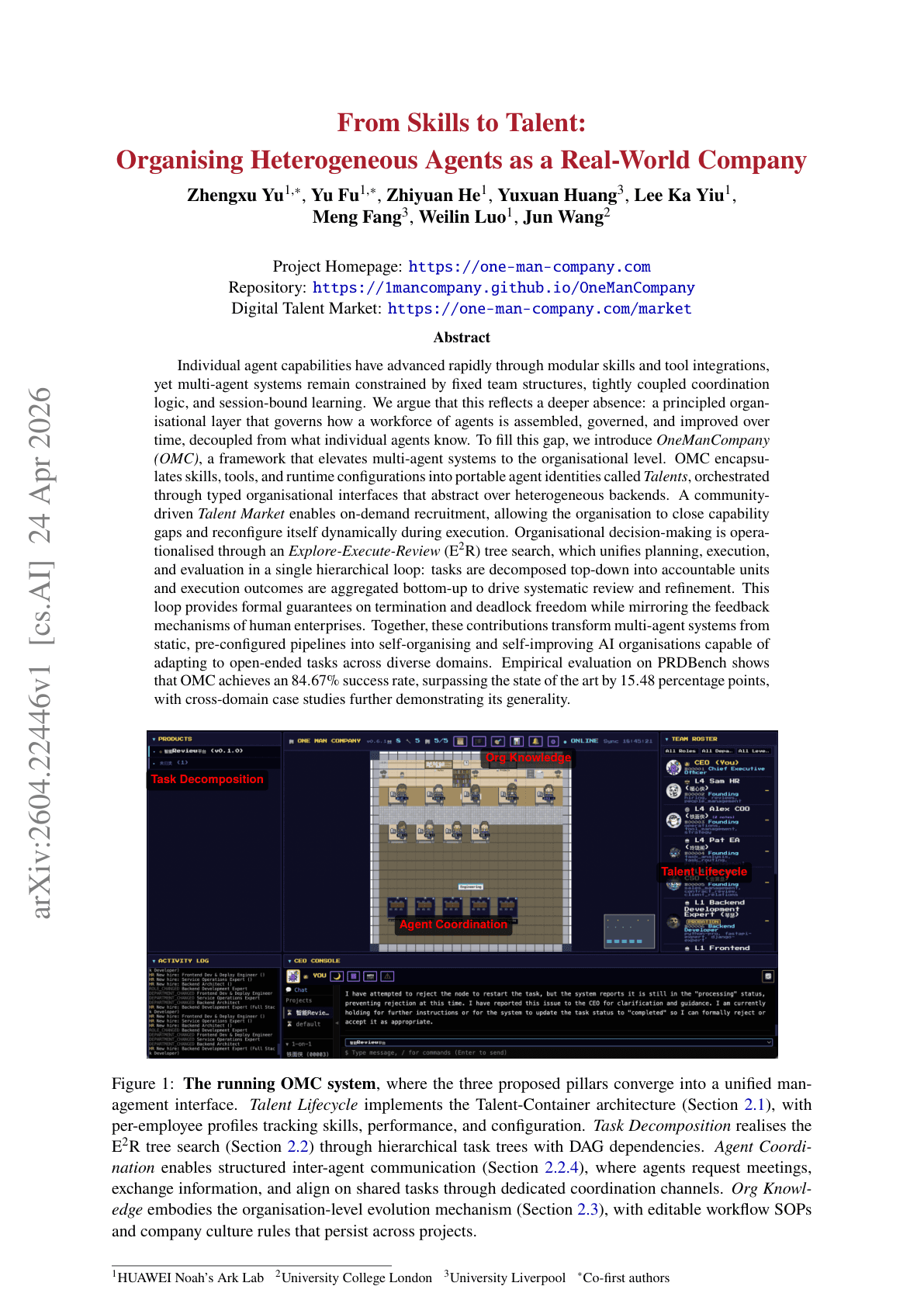
If you are building multi-agent systems, you are probably wiring static org charts. This paper argues they should look more like a labor market. OneManCompany (OMC) replaces fixed teams with "Talents," portable agent identities that bundle skills and tools, and a "Talent Market" where agents get recruited dynamically per task. An Explore-Execute-Review tree search decomposes work hierarchically and aggregates results back up. On PRDBench, OMC reaches 84.67% success, +15.5 points over prior SOTA, and the framework generalizes across the case studies the authors run.
From Skill Text to Skill Structure
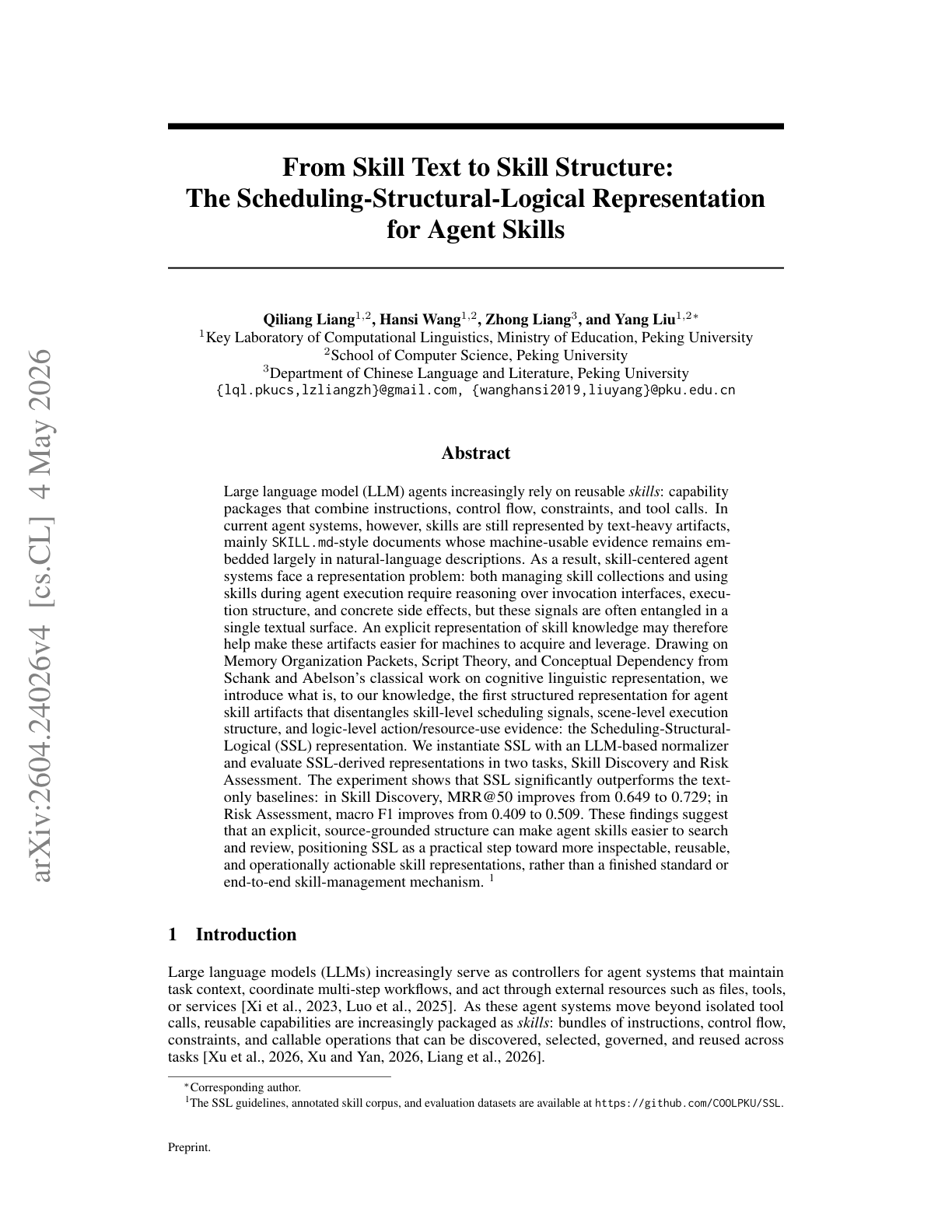
SKILL.md files entangle invocation interface, execution flow, and tool side effects in a single blob of natural language. That makes downstream discovery and risk review brittle as skill registries scale. This paper proposes SSL, a three-layer typed JSON representation drawn from Schank and Abelson's classical work on scripts, MOPs, and conceptual dependency. An LLM-based normalizer converts existing SKILL.md files into the structure, so adoption does not require rewriting registries by hand.
Latent Agents
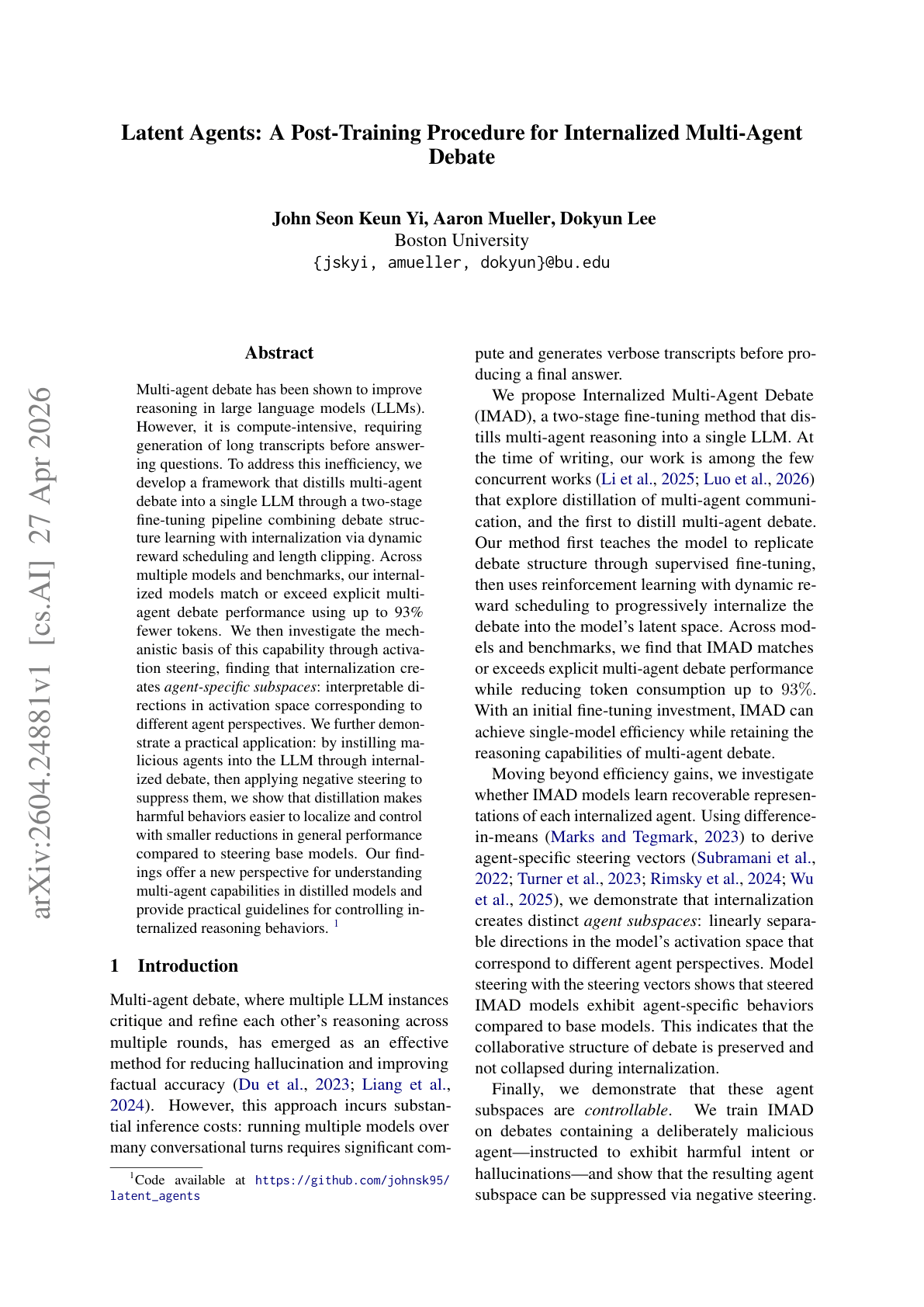
Multi-agent debate makes models reason better. It also burns tokens generating long transcripts before any answer comes out. Latent Agents distills the entire debate into a single LLM through a two-stage fine-tuning pipeline: the model first learns debate structure, then internalizes it through dynamic reward scheduling and length clipping. The internalized model matches or beats explicit multi-agent debate while using up to 93% fewer tokens, which makes debate-quality reasoning practical at production scale.
OCR-Memory
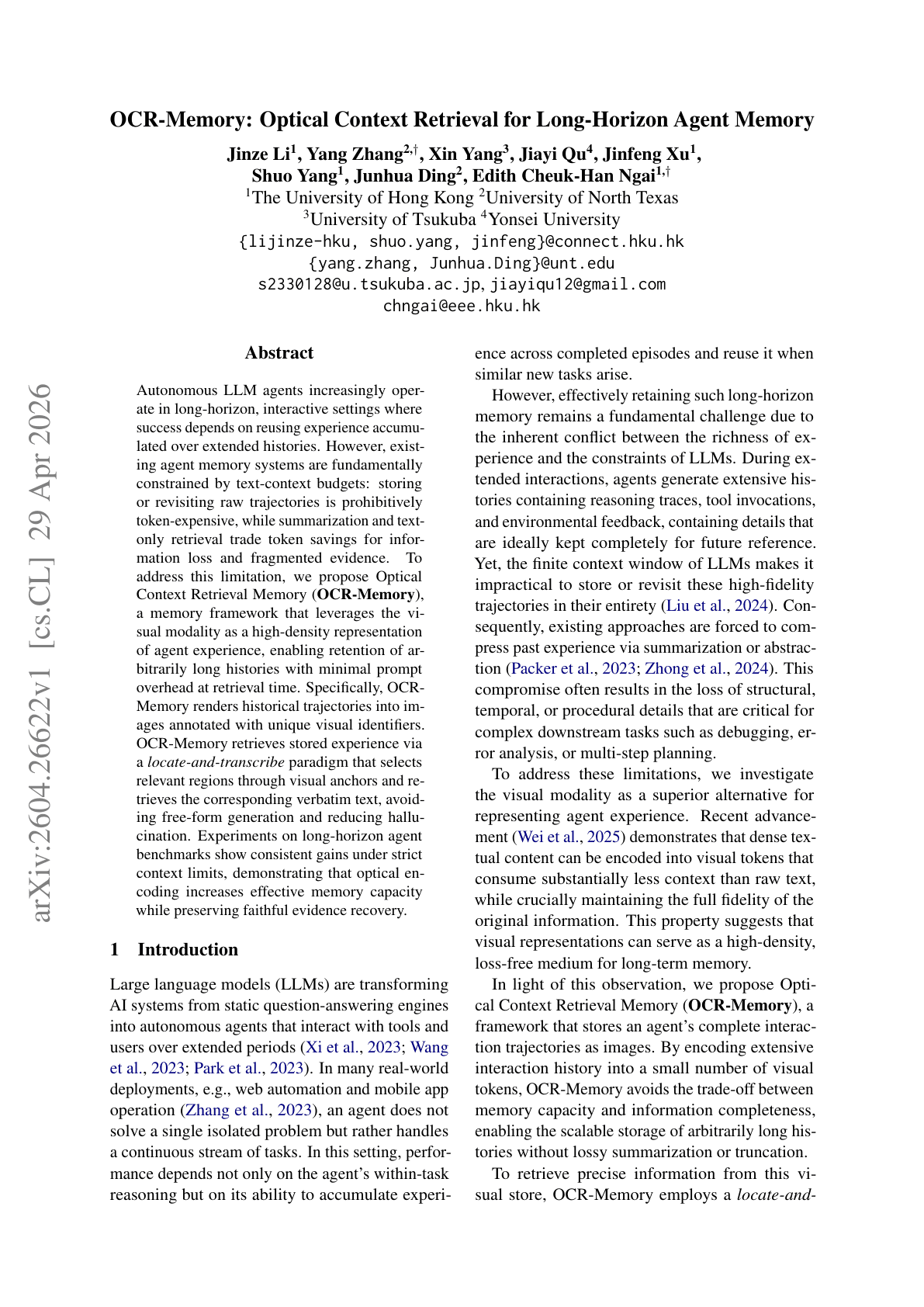
Most agent memory systems compress trajectories into text summaries and hope the model remembers what matters, which is exactly where the information loss hides. OCR-Memory renders the agent's interaction history as images with indexed visual anchors, then retrieves via a locate-and-transcribe pipeline: the model scans visual memory, predicts the index of the relevant region, and the original text is fetched verbatim from a database. Older trajectories are stored as low-resolution thumbnails with active-recall up-sampling, and the method reaches SOTA on Mind2Web and AppWorld under strict context limits.
When to Retrieve During Reasoning
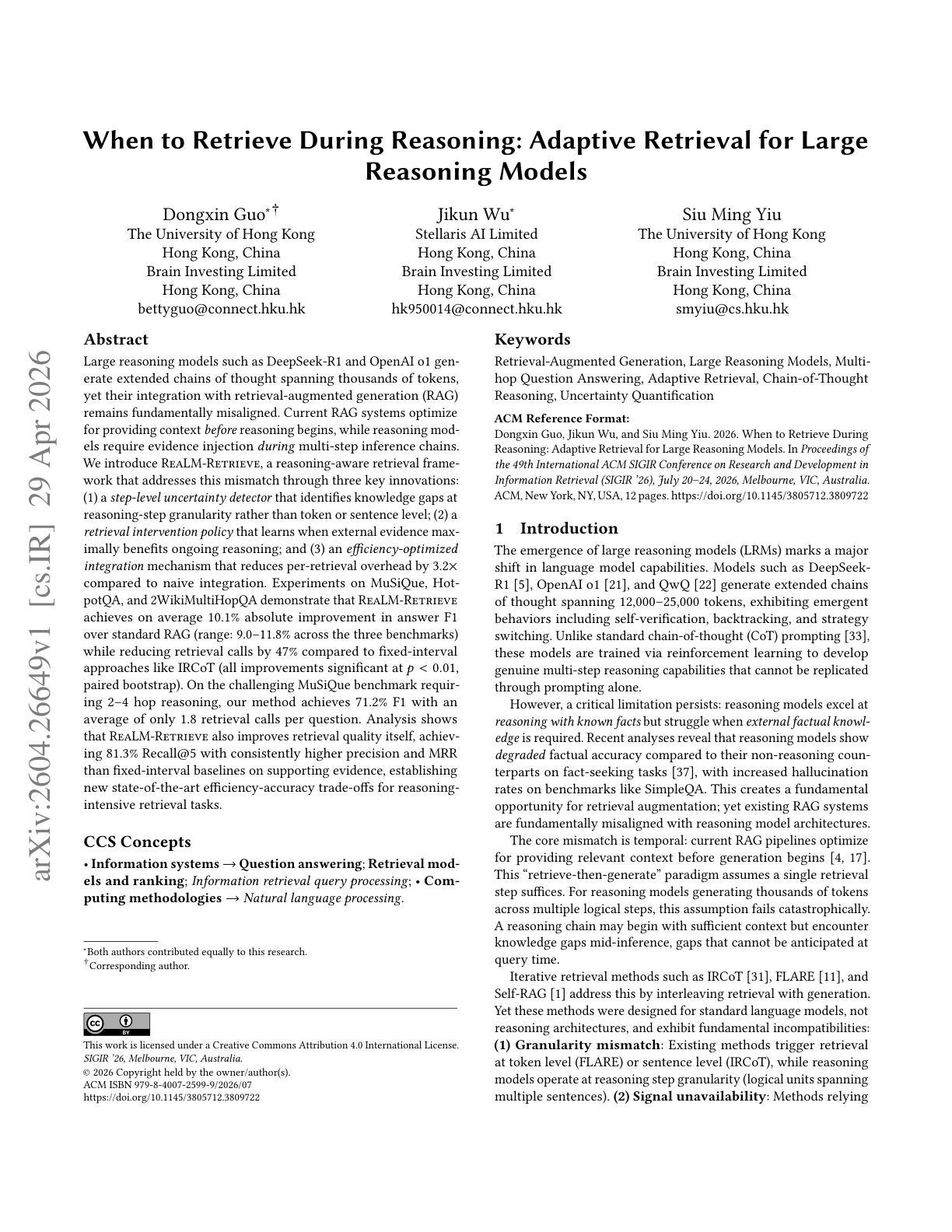
Most RAG systems retrieve once, before the model starts reasoning. Large reasoning models like o1 and R1 do not work that way. They generate 12k to 25k token chains of thought and hit knowledge gaps mid-inference, long after the retrieval window closed. ReaLM-Retrieve is a reasoning-aware retrieval framework that injects evidence during multi-step inference, detects uncertainty at reasoning-step granularity, and learns a policy for when external evidence actually helps. It achieves +10.1% absolute F1 over standard RAG across MuSiQue, HotpotQA, and 2WikiMultiHopQA, with 47% fewer retrieval calls than fixed-interval IRCoT, and hits 71.2% F1 on 2-4 hop MuSiQue with only 1.8 retrieval calls per question.
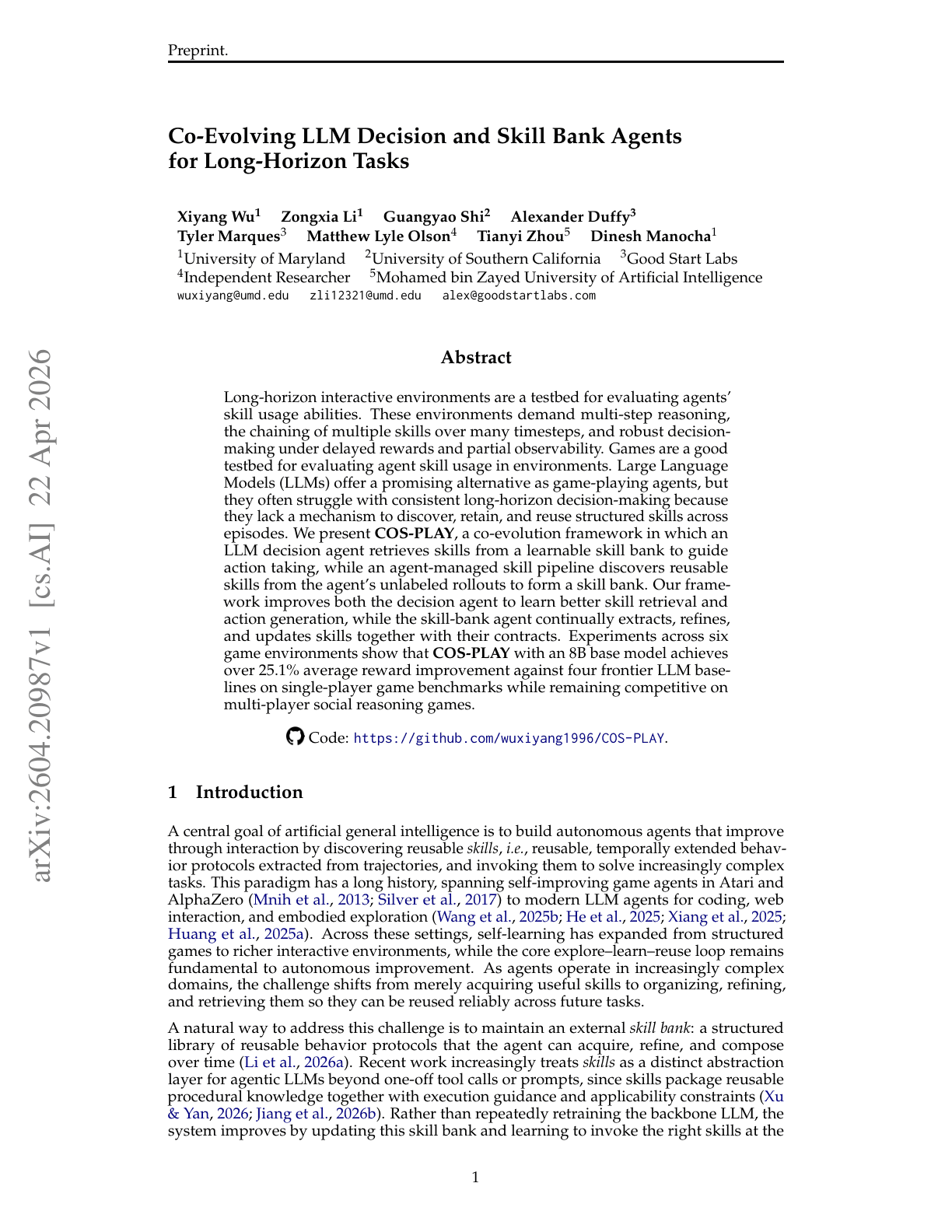
Co-evolving Decisions and Skills
Long-horizon agents fail in two ways: the decision-maker cannot decompose well, or the skill library goes stale. This paper introduces a co-evolution framework where an LLM decision agent and a dynamic skill bank improve each other through iterative refinement. The decision agent picks and chains skills, performance feedback updates both the policy and the skills, and new skills emerge by generalizing successful sequences instead of being hand-coded upfront. Most long-horizon agent stacks treat skills and decision-making as separate optimization problems, which is why they plateau. Co-evolution gives you adaptive planning and a growing library of reusable behaviors from a single loop, which is what you actually want when task structure is not predetermined: robotics, game agents, and complex planning.
DeepSeek V4
DeepSeek V4 is the first open model family built from the ground up around million-token contexts as a default rather than a bolt-on feature. The release includes DeepSeek-V4-Pro (1.6T total / 49B active) and DeepSeek-V4-Flash (284B total / 13B active), both trained natively at 1M context length. The tech report details a hybrid attention architecture, new training stability techniques, and a domain-specialist post-training pipeline that together push the open-source frontier much closer to GPT-5.2 and Gemini 3.0-Pro at a fraction of the cost.
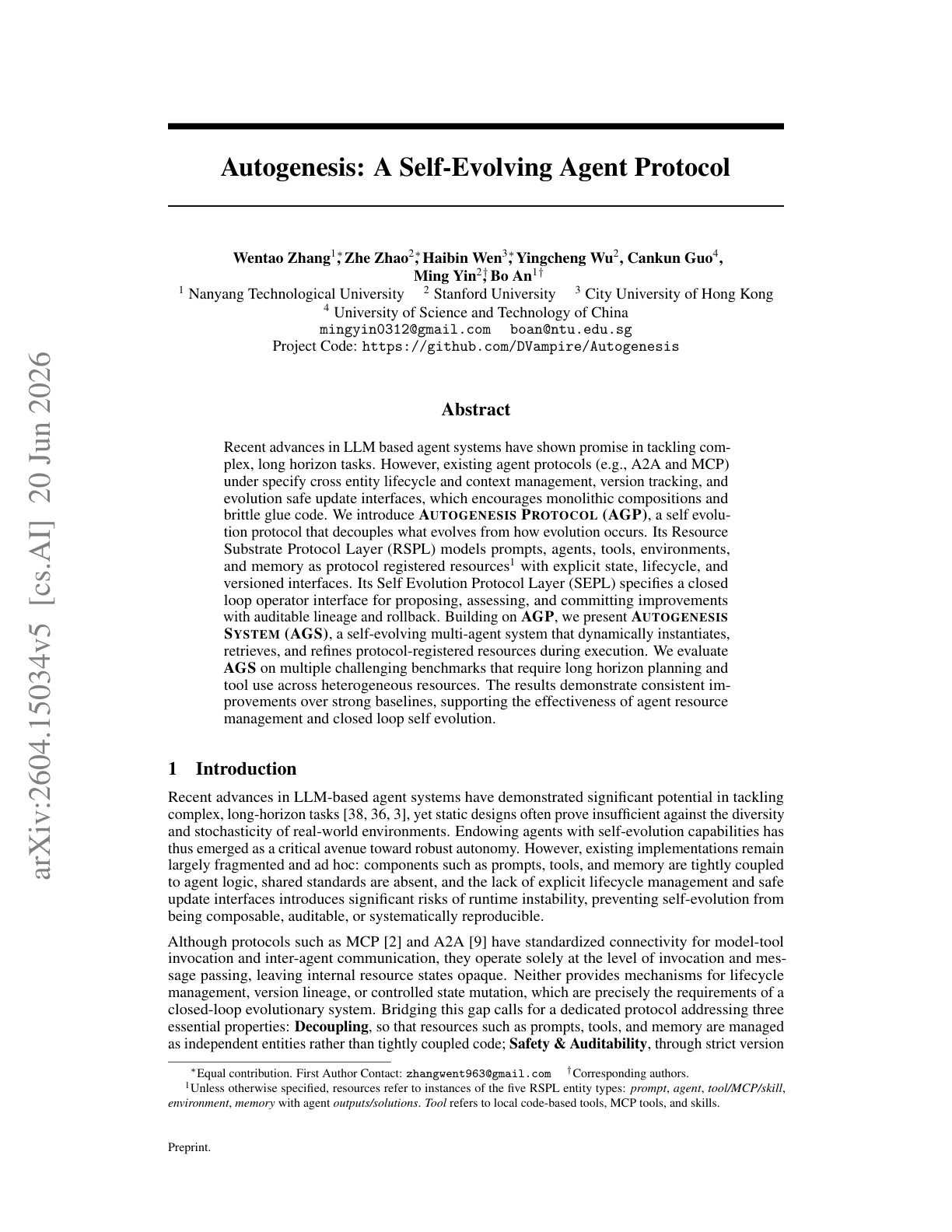
Autogenesis
Static agents age quickly. As deployment environments change and new tools arrive, the agents that survive will be the ones that can safely rewrite themselves. This paper introduces Autogenesis, a self-evolving agent protocol where agents identify their own capability gaps, generate candidate improvements, validate them through testing, and integrate what works back into their own operational framework. No retraining and no human patching, just an ongoing loop of assessment, proposal, validation, and integration.
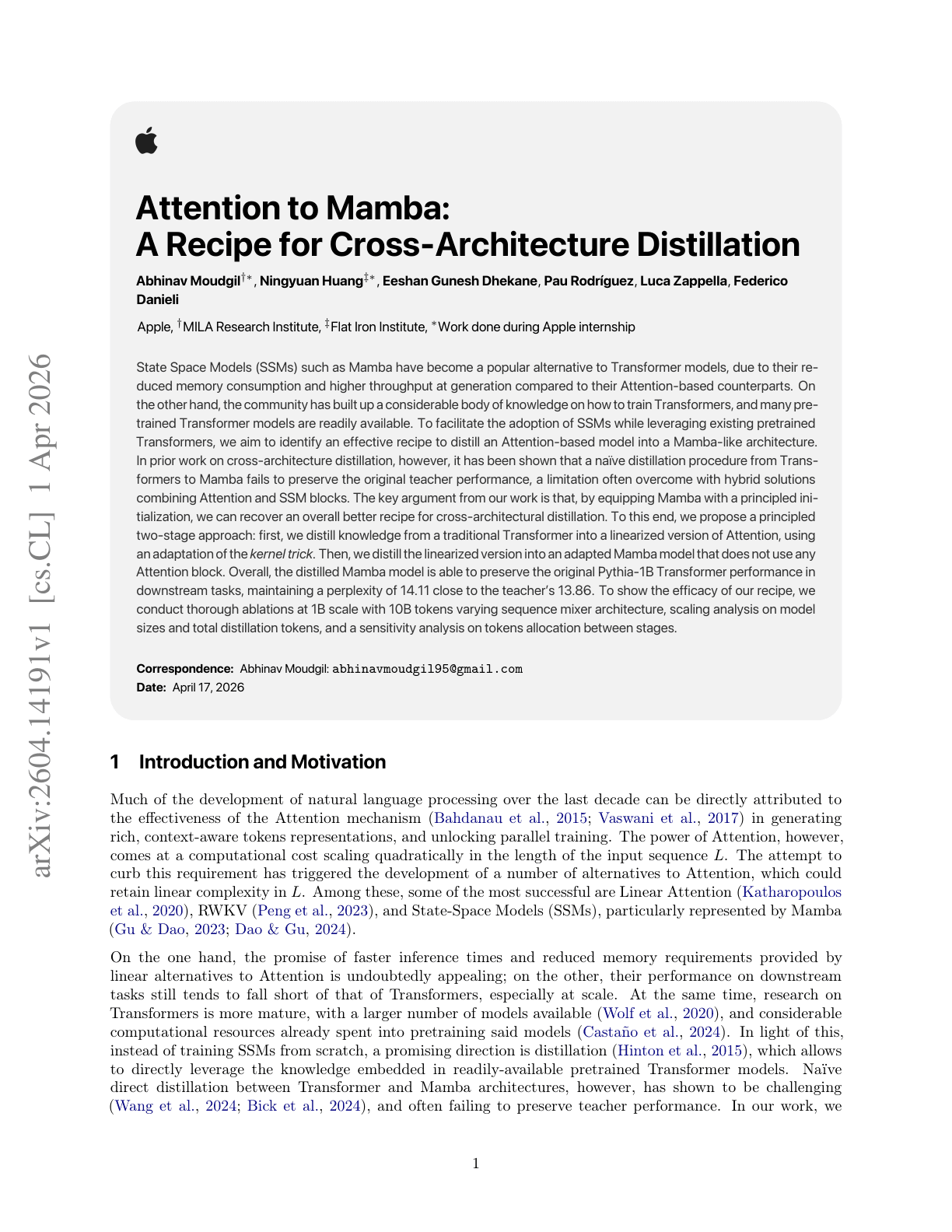
Attention to Mamba
Apple proposes a two-stage recipe for cross-architecture distillation from Transformers into Mamba. Naive distillation collapses teacher performance because a Mamba student cannot directly imitate softmax attention. The fix is to distill the transformer into a linearized-attention student using a kernel adaptation first, then transfer that student into a pure Mamba with no attention blocks. On a 1B model trained on 10B tokens, the Mamba student hits 14.11 perplexity against a 13.86 Pythia-1B teacher, nearly matching quality at linear-time inference cost.
Skill-RAG
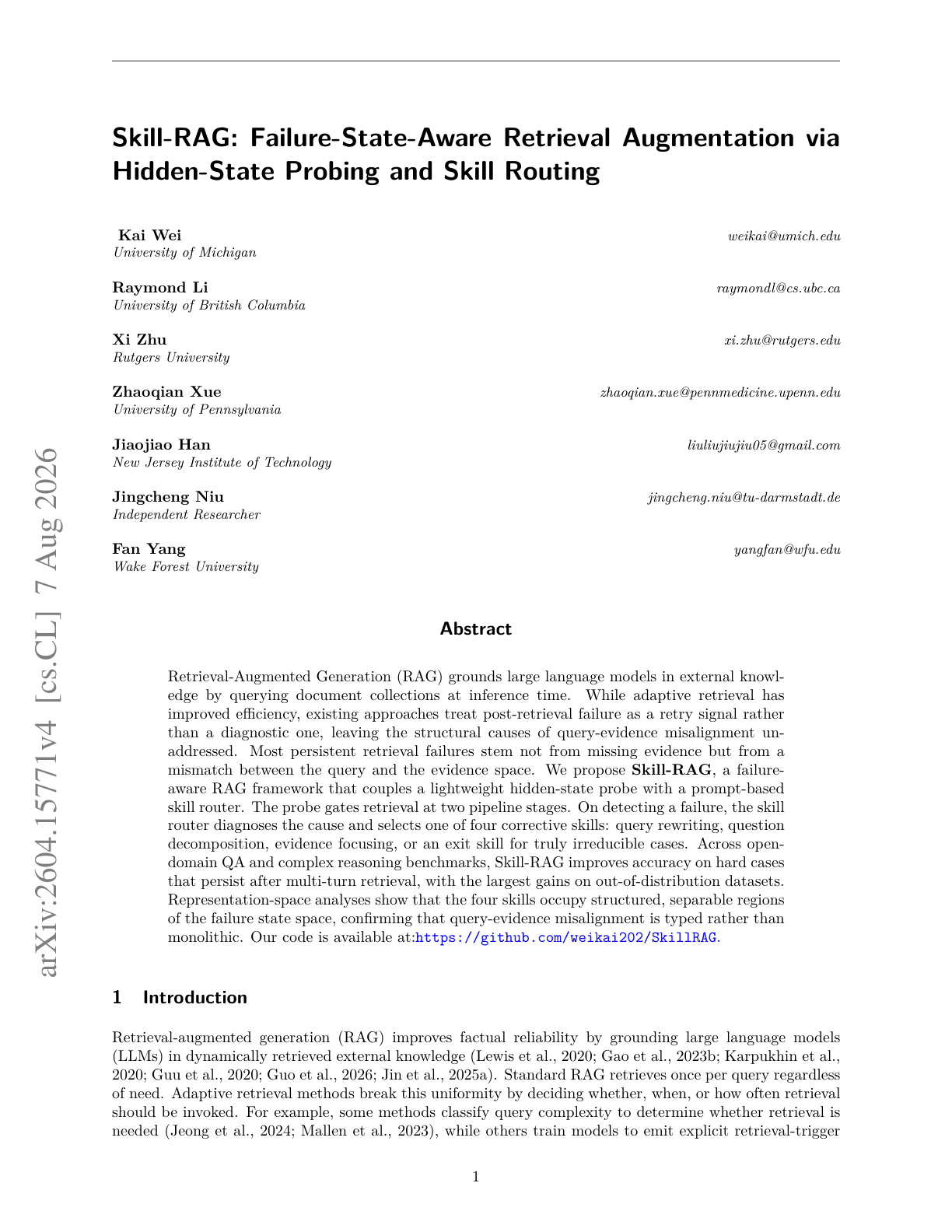
Most RAG systems retrieve on every query, whether the model needs help or not. This is wasteful when the model already knows the answer and often too late when it does not. This paper introduces Skill-RAG, a failure-state-aware retrieval system that uses hidden-state probing to detect when an LLM is approaching a knowledge failure, then routes the query to a specialized retrieval strategy matched to the gap.
Self-Generated World Knowledge
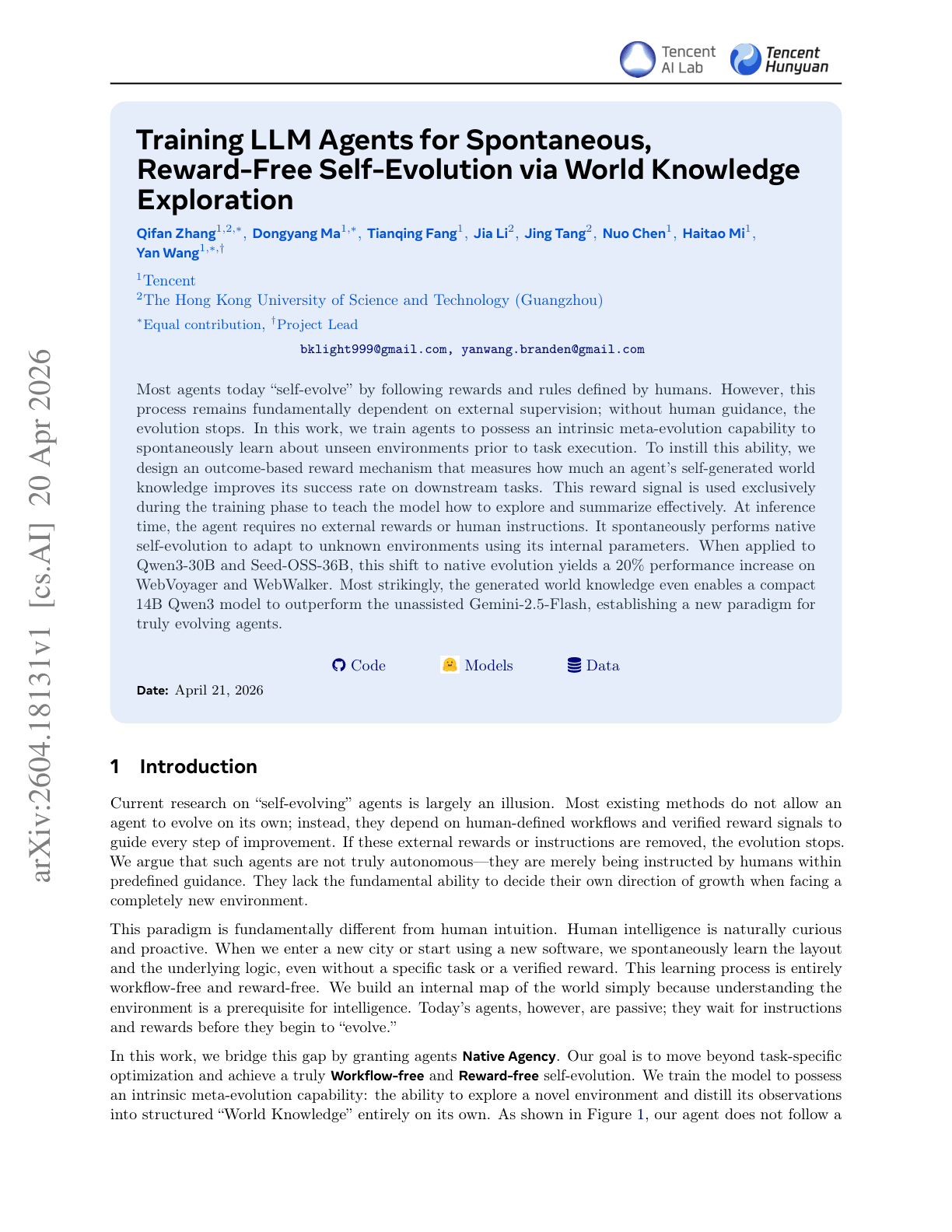
How far are we from agents that can self-generate world knowledge? This paper proposes an outcome-based reward that measures how much an agent's self-generated world knowledge actually improves its task success rate, then trains with that signal and removes the external guidance at inference. The result is a 14B model that surpasses Gemini-2.5-Flash on web navigation and gains +20% on WebVoyager and WebWalker benchmarks.
Self-Evolving Logic Synthesis
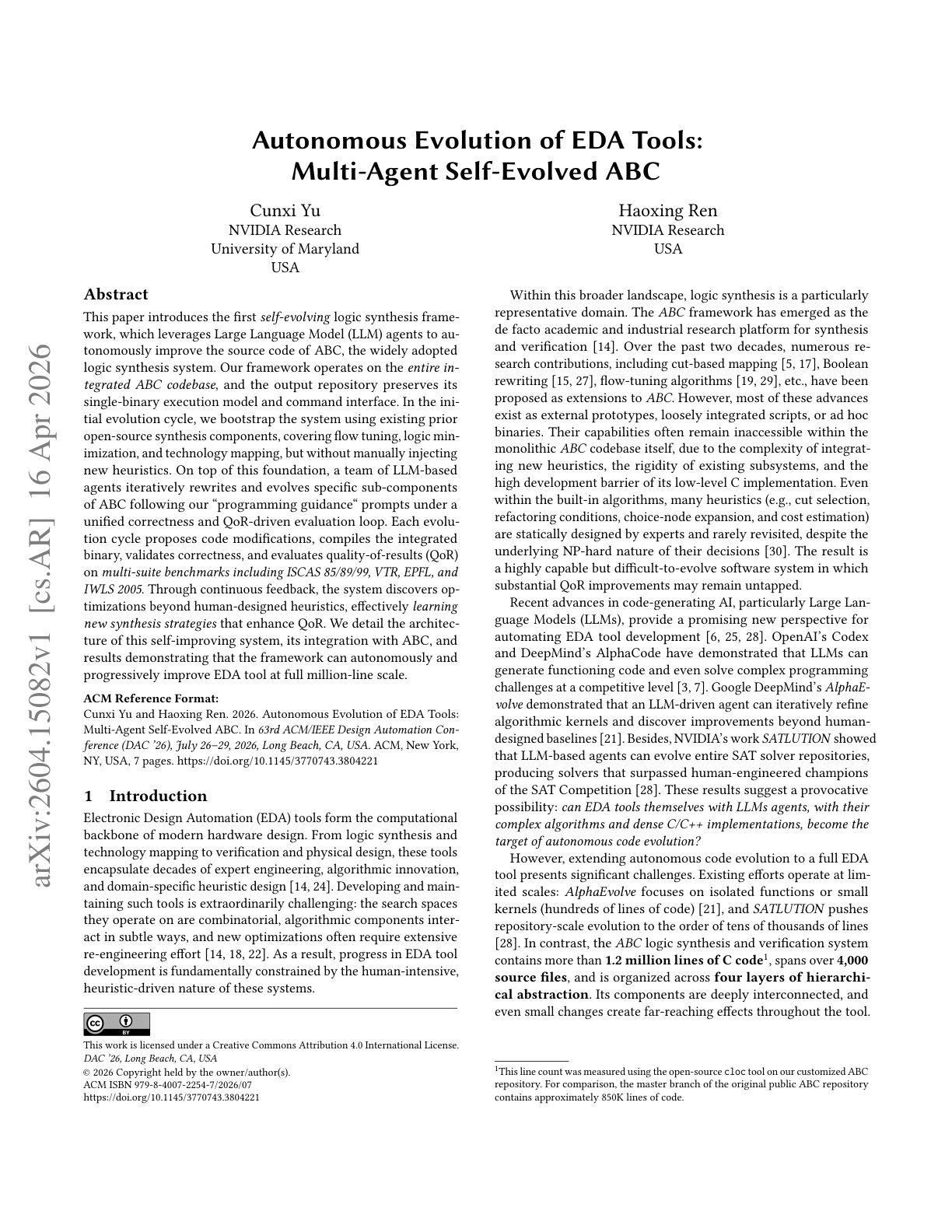
EDA tools like ABC have been hand-tuned by humans for decades. NVIDIA shows they can evolve themselves. This work introduces the first self-evolving logic synthesis framework, a multi-agent LLM system that autonomously refines the entire ABC codebase, generates and tests candidate optimization sequences against standard benchmark circuits, then merges improvements back into the base tool. No human engineer in the loop.
Stateless Decision Memory
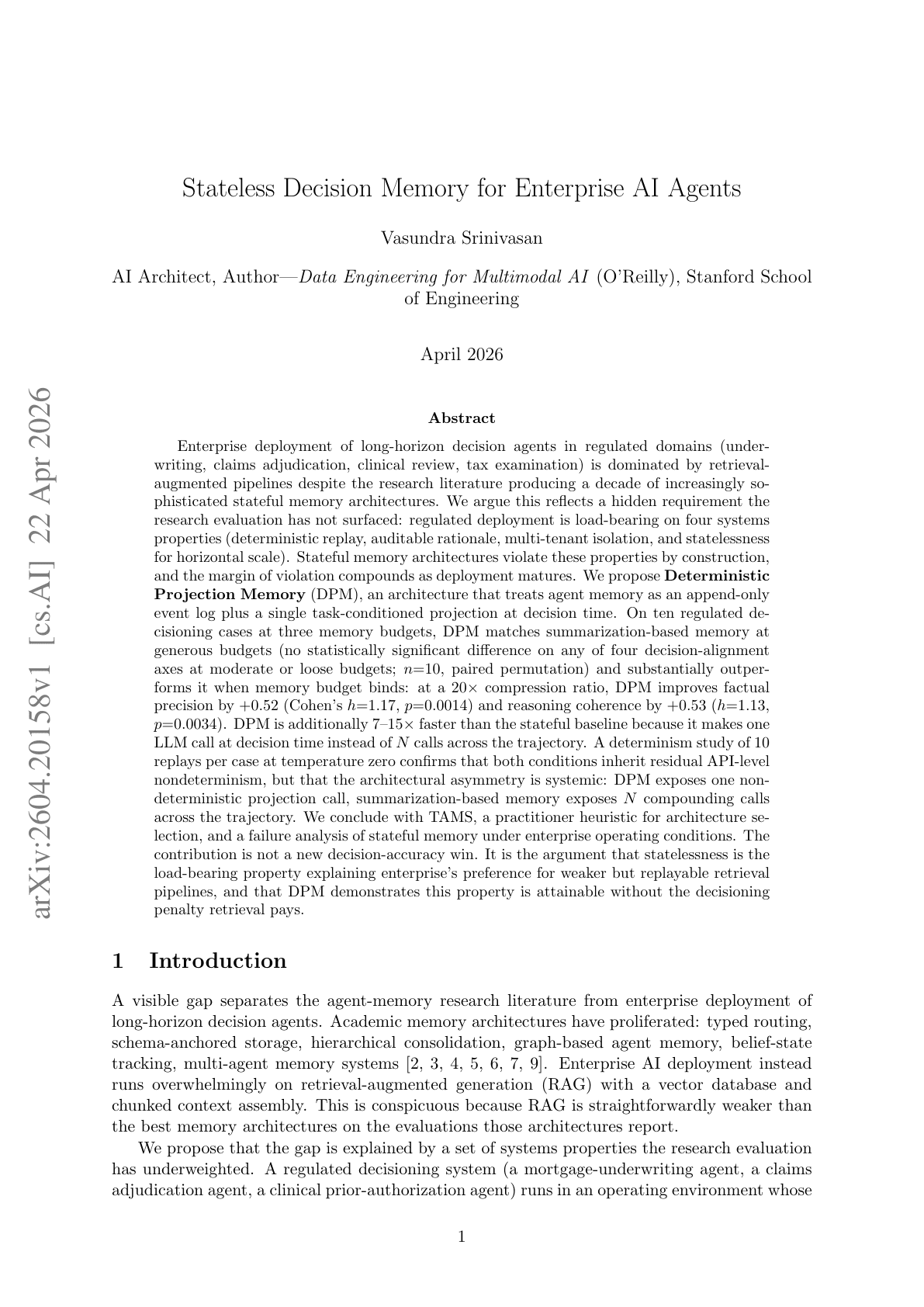
Most interesting AI agent papers right now are about capability. This one is about plumbing, and it is probably more important than it looks. Stateful agents do not scale horizontally. The moment you need thousands of concurrent agent instances running across containers, persistent per-agent state becomes the bottleneck. This paper proposes replacing active memory with immutable decision logs using event-sourcing principles from distributed systems.