AI Papers of the Week
Every paper worth reading in AI, hand-picked one week at a time.
Discover and explore top AI papers withClaude CodeCodex
npx @dair-ai/mcp setup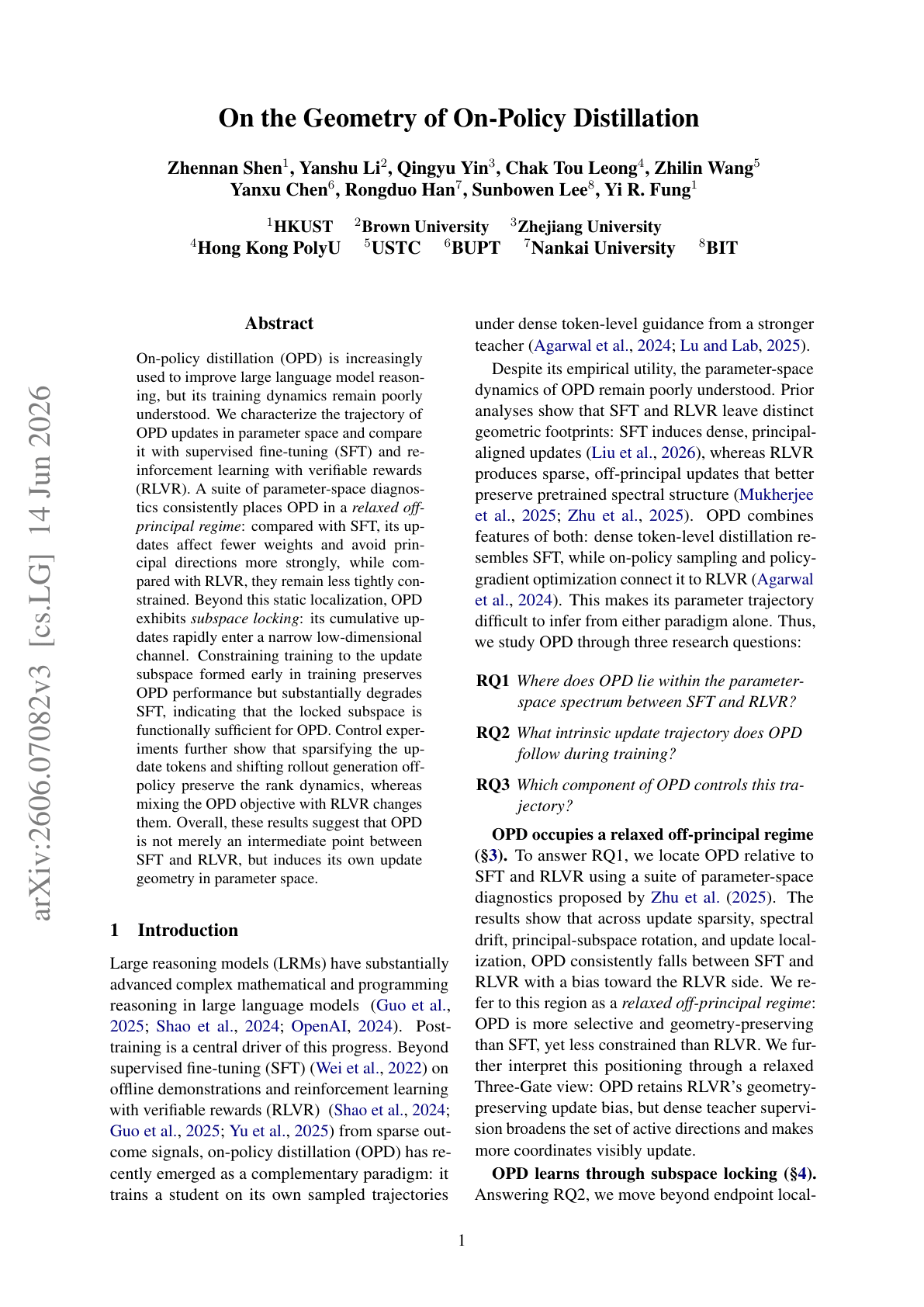
The Geometry of On-Policy Distillation
On-policy distillation (OPD) has become one of the most discussed post-training recipes of the year, but it has mostly been treated as a black box sitting somewhere between supervised fine-tuning and RL. This paper opens it up, characterizing how OPD changes a model's weights at the level of parameter geometry, and argues OPD is not a midpoint between SFT and RLVR but its own distinct kind of update.
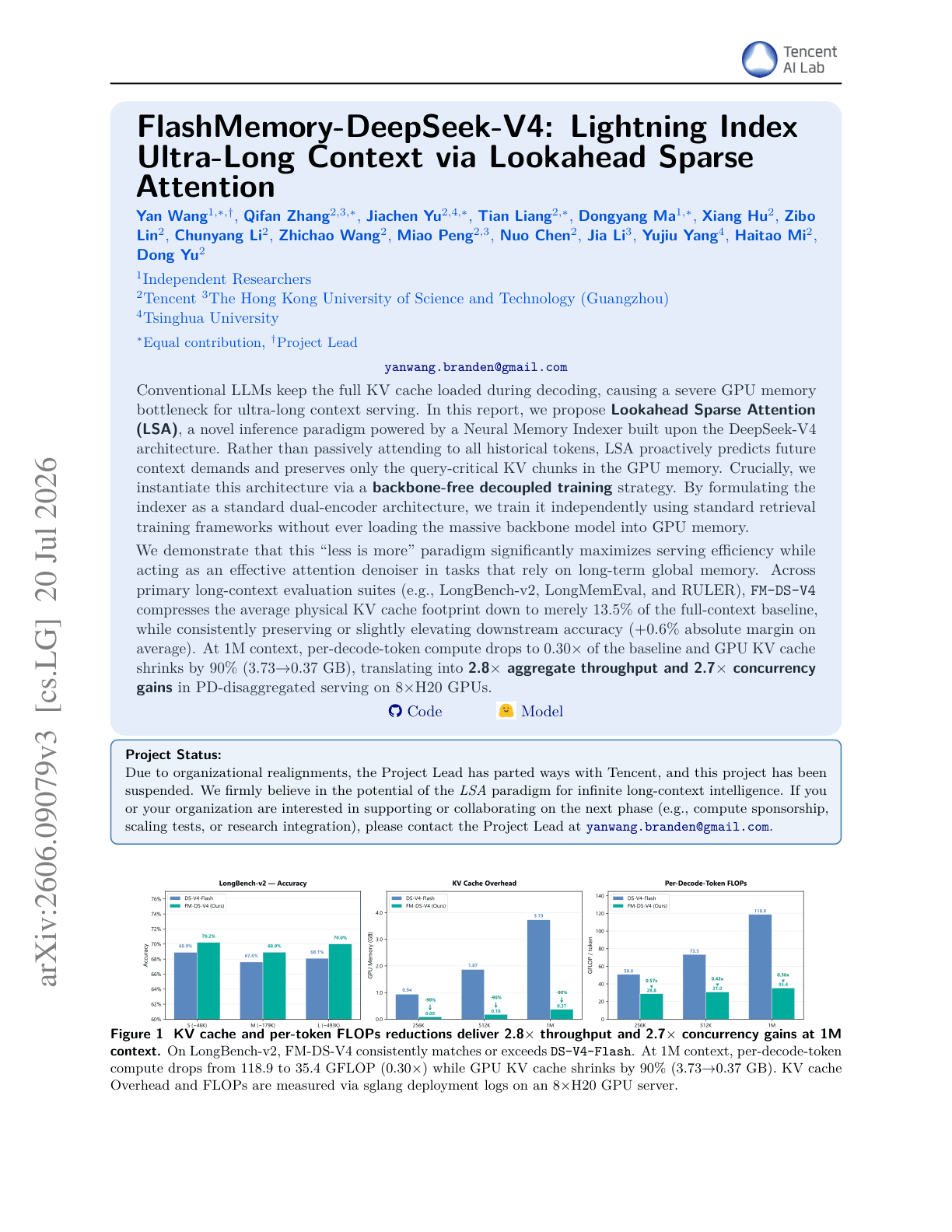
Lookahead Sparse Attention
Long-context decoding is bottlenecked by the KV cache, which grows with every token and quickly dominates memory at extreme context lengths. This work, branded around DeepSeek-V4, introduces Lookahead Sparse Attention (LSA), which avoids storing the full KV cache by predicting which parts of the context future decoding will actually need and retaining only those query-critical chunks.
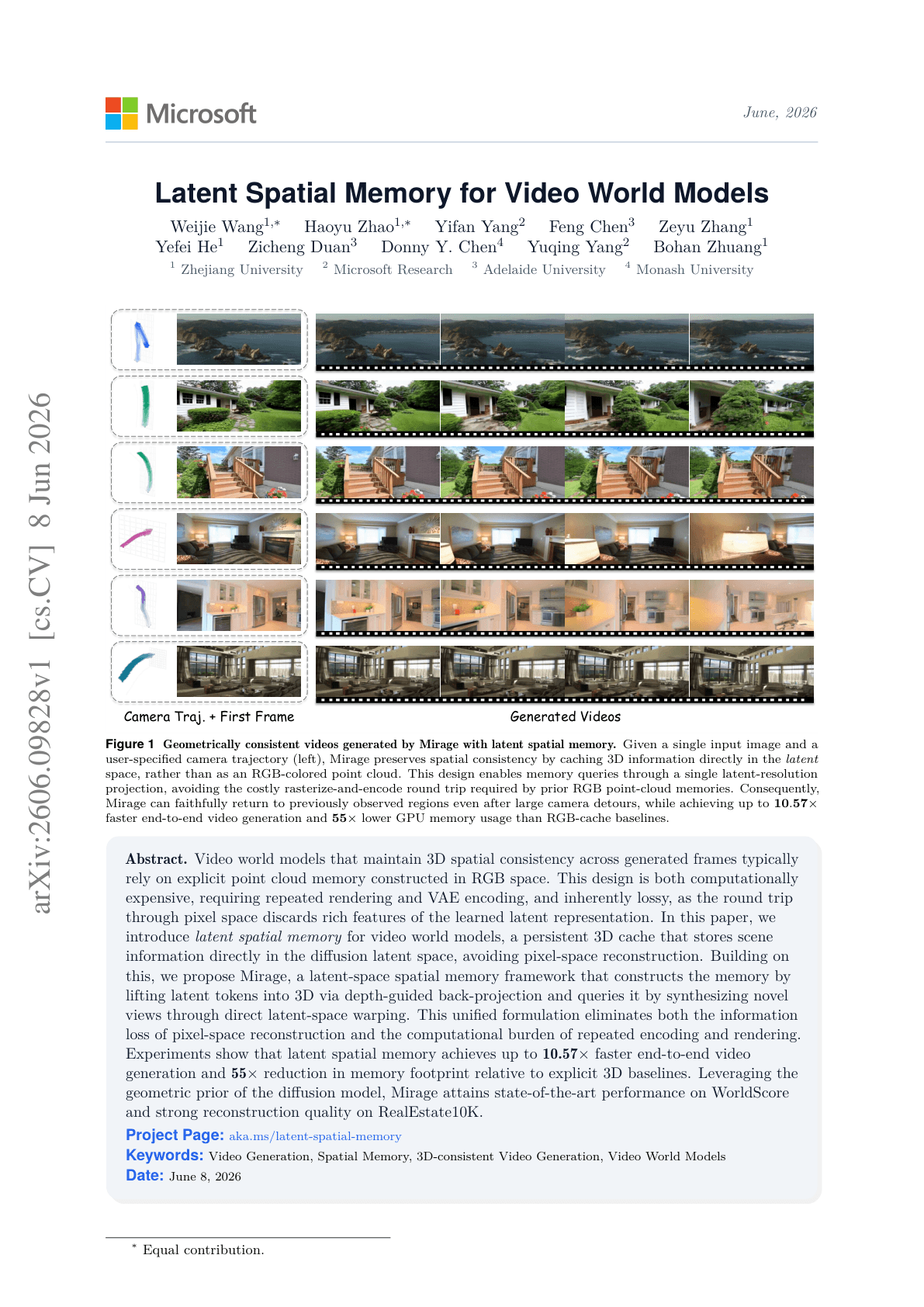
Latent Spatial Memory
Video world models struggle to stay consistent over long horizons because explicit 3D memory usually requires an expensive pixel-space loop. Mirage instead stores scene information directly in diffusion latent space, using depth-guided back-projection and latent-space warping to maintain persistent spatial memory. The approach reports up to 10.57 times faster end-to-end generation and 55 times lower memory use than explicit 3D-memory baselines while improving long-horizon spatial consistency.
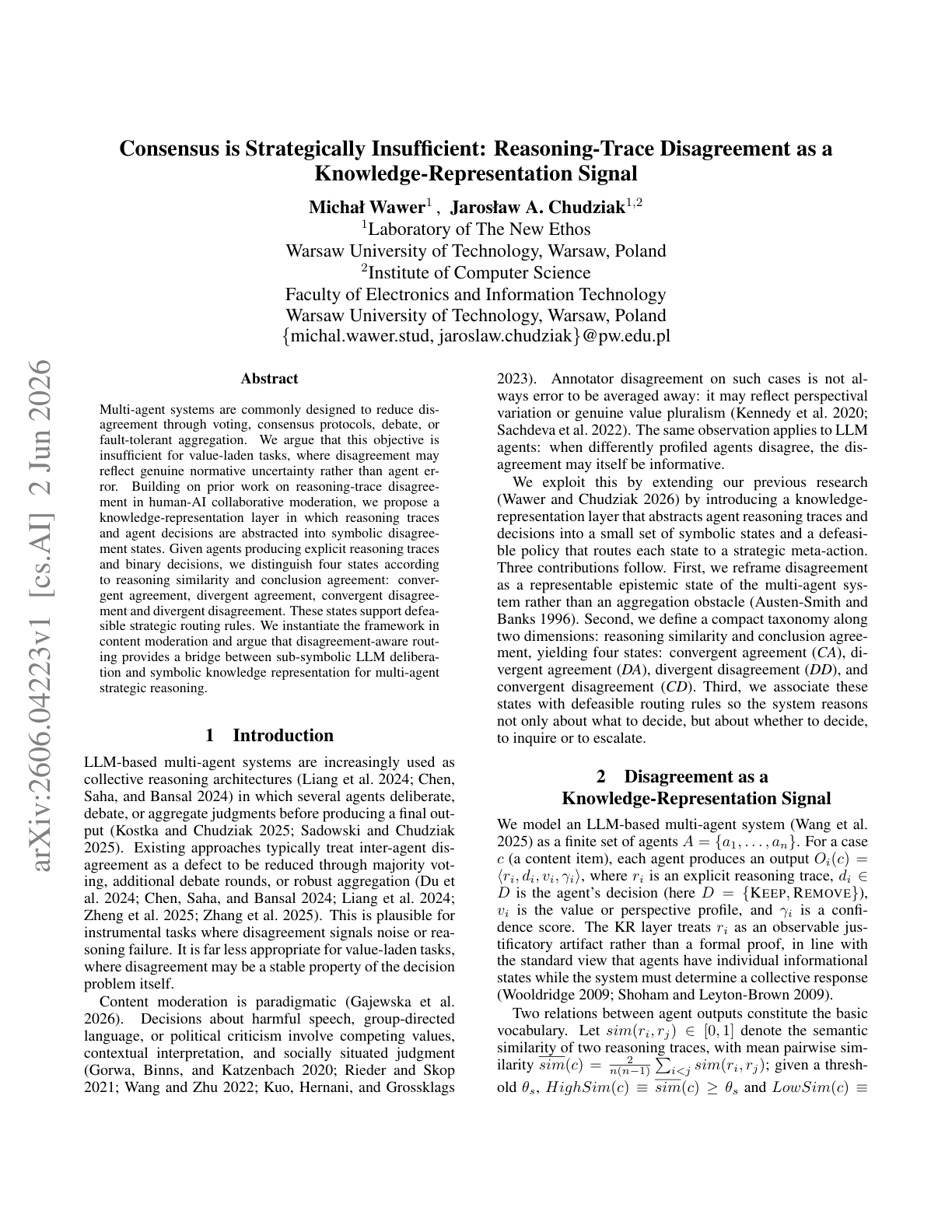
The Consistency Illusion
Multi-agent debate is often judged by whether the agents end up agreeing, but this paper shows that output-level consensus can hide deep disagreement in the reasoning that produced it. The authors abstract agents' reasoning traces and decisions into four states along two axes, reasoning similarity and conclusion agreement, and flag divergent agreement, where agents reach the same answer through very different paths. Across 600 content-moderation items, divergent agreement appeared in 118 cases and separated cleanly from genuine disagreement states with a Cohen's d of 0.80, and routing on these categories beat divergence-only methods at flagging high-disagreement cases.
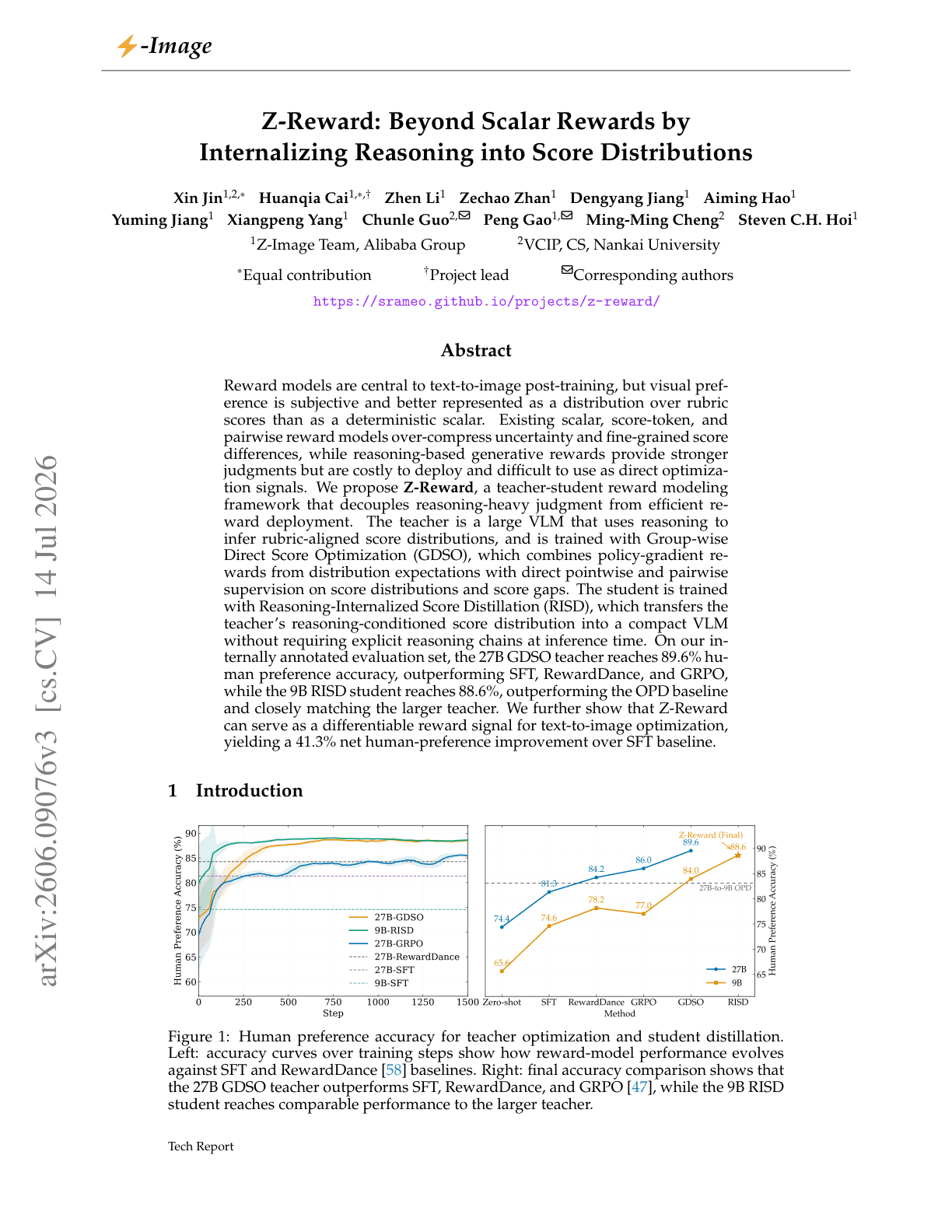
Beyond Scalar Rewards
Reward models usually compress a judgment into a single scalar, but this paper argues human preferences are better captured as score distributions, and proposes Z-Reward, which internalizes reasoning into a predicted distribution before scoring. A large vision-language teacher does the reasoning-heavy judgment and is distilled into a compact student for efficient deployment, with the 27B teacher reaching 89.6% human-preference accuracy and the 9B student nearly matching it at 88.6%. Used as a reinforcement learning signal, it delivers a 41.3% net preference improvement over a supervised baseline, beating GRPO and other reward methods.
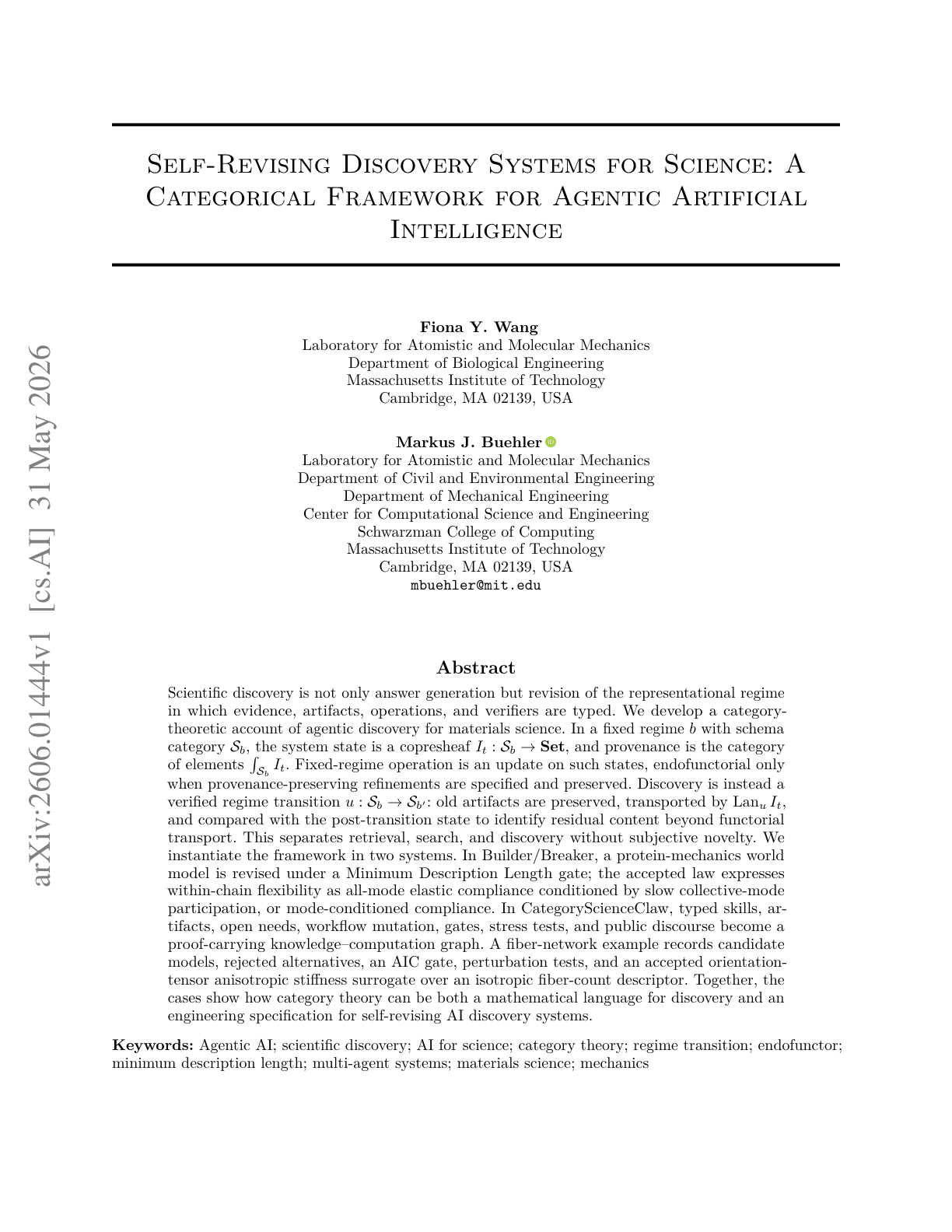
Self-Revising Discovery Systems
From MIT, this paper argues that genuine scientific discovery is not answer generation but a change in the search space itself, and that an AI scientist must perceive that shift without being told. It develops a category-theoretic framework in which evidence, artifacts, operations, and verifiers are typed, and discovery is defined as a principled revision of that representational regime rather than more search within a fixed one.
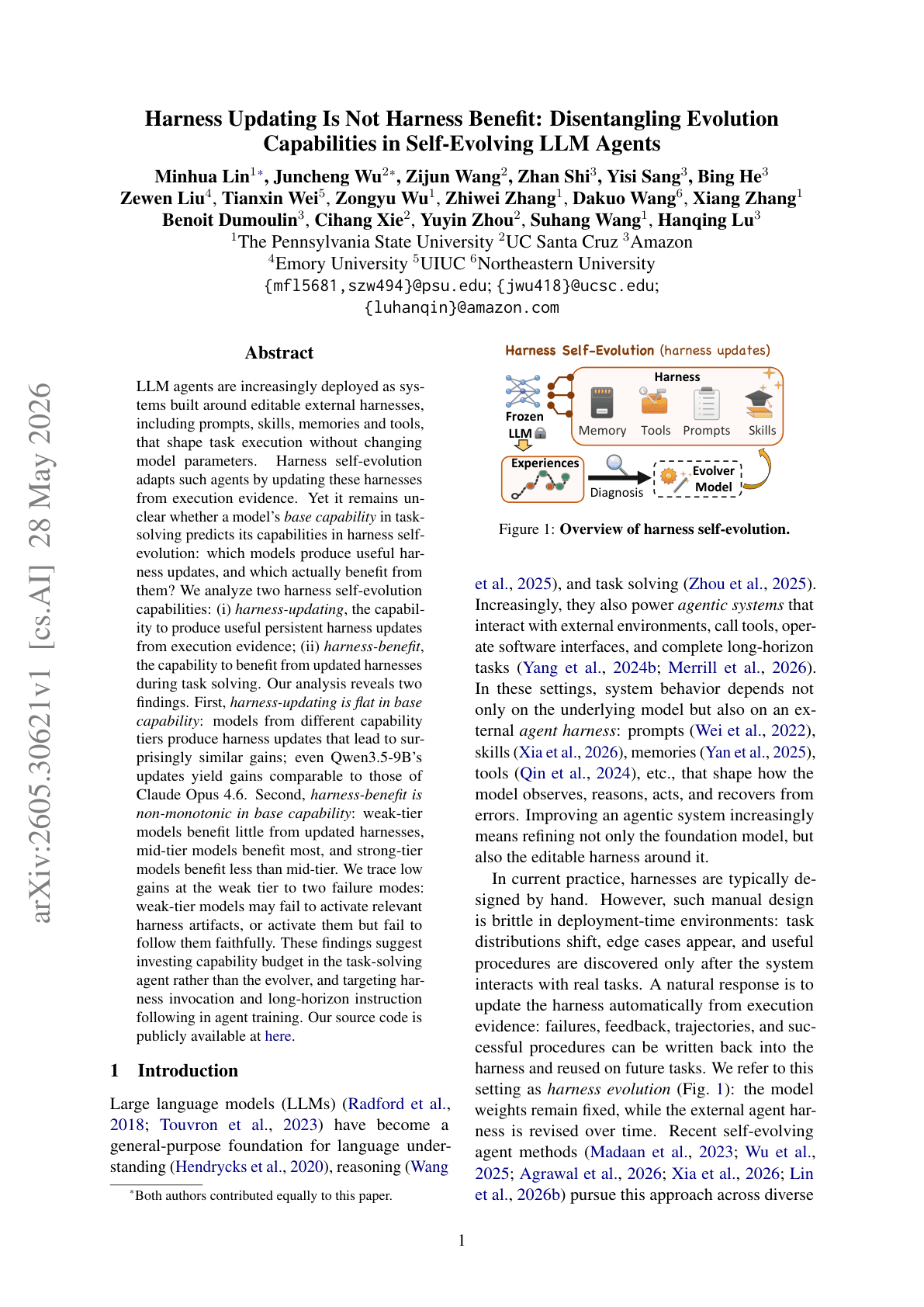
Disentangling Agent Self-Evolution
This paper asks a question every agent builder eventually hits: if an agent rewrites its own harness, does a stronger model make a better self-evolving agent? The answer is no, and the reason is that "self-evolution" is actually two separate abilities that scale very differently. The work separates harness-updating, where an evolver model writes edits to memory, tools, prompts, and skills, from harness-benefit, where a solver model actually exploits those edits on the task.
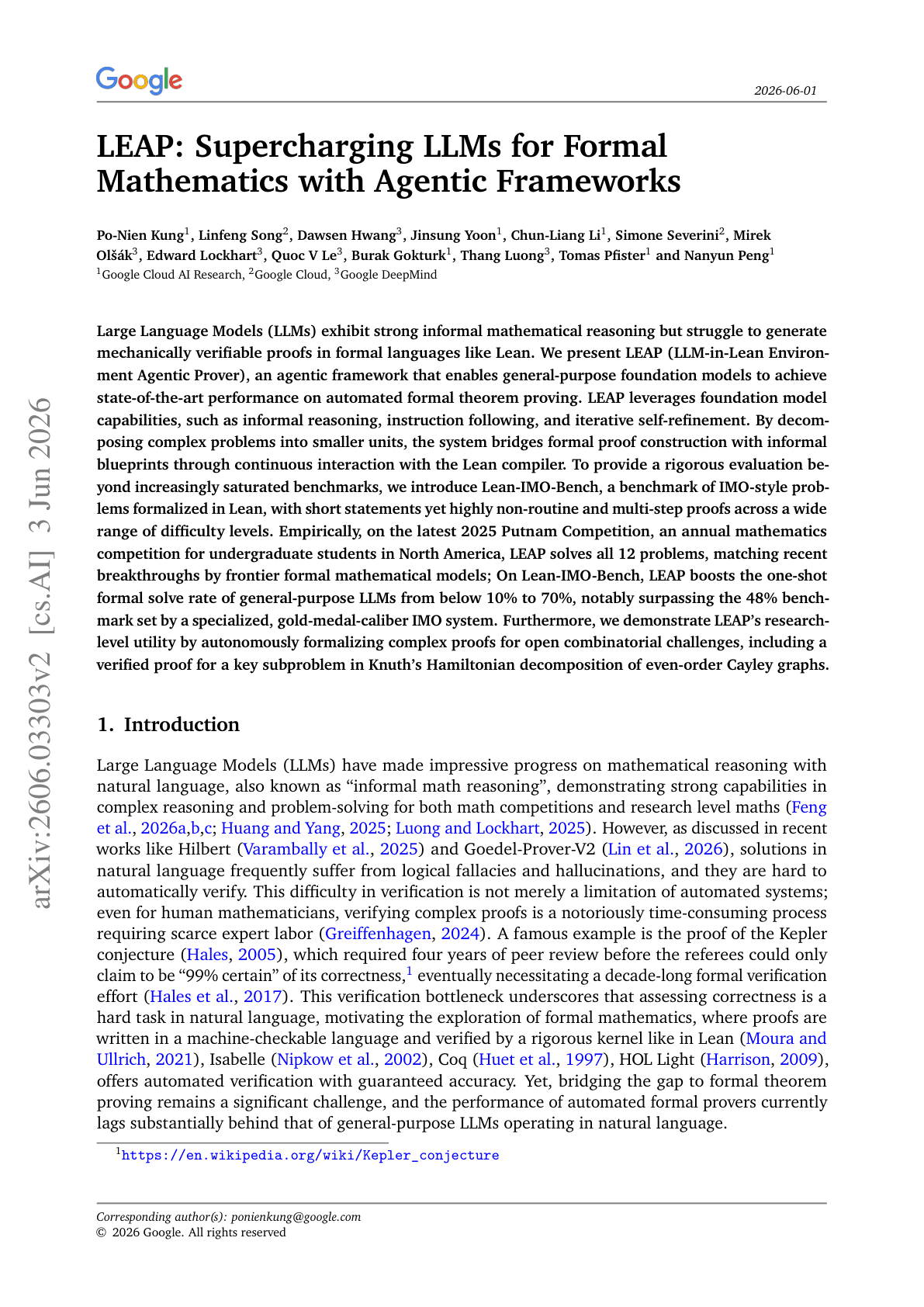
LEAP
New research from Google shows how far a custom agent harness can push a general-purpose model on formal mathematics. LEAP wraps a general LLM in an agentic scaffold that grounds every step in the Lean compiler and iterates against verifier feedback. Rather than fine-tuning a specialized prover, it leans on informal reasoning, instruction following, and self-refinement, then forces every formal step through a compiler check before moving on.
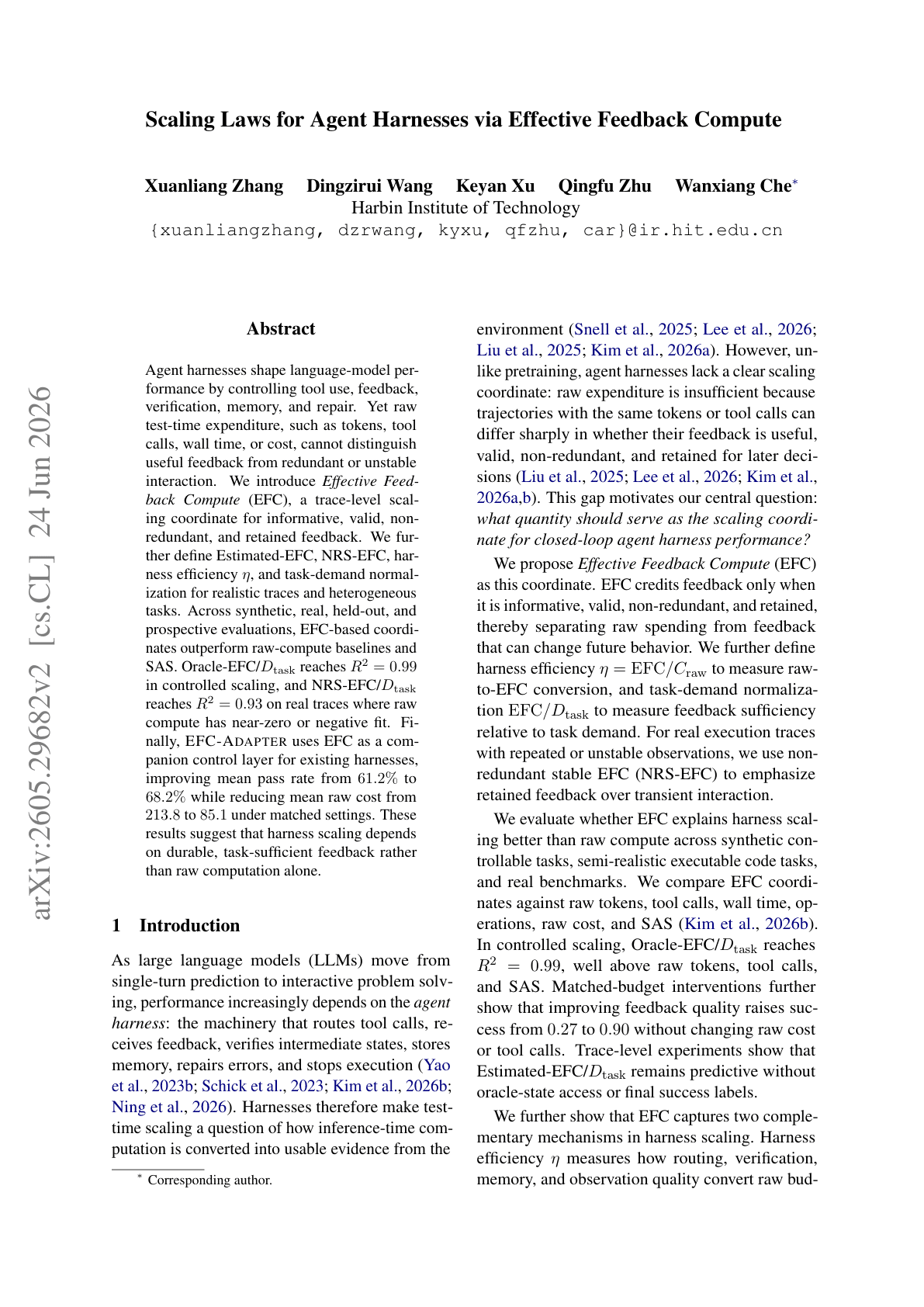
Scaling Laws for Agent Harnesses
Most harness tuning treats every token and tool call as if volume is what counts. This paper shows that it mostly does not, and introduces Effective Feedback Compute (EFC), a trace-level scaling coordinate that credits feedback only when it is informative, valid, non-redundant, and retained for later decisions, then normalizes by task demand.
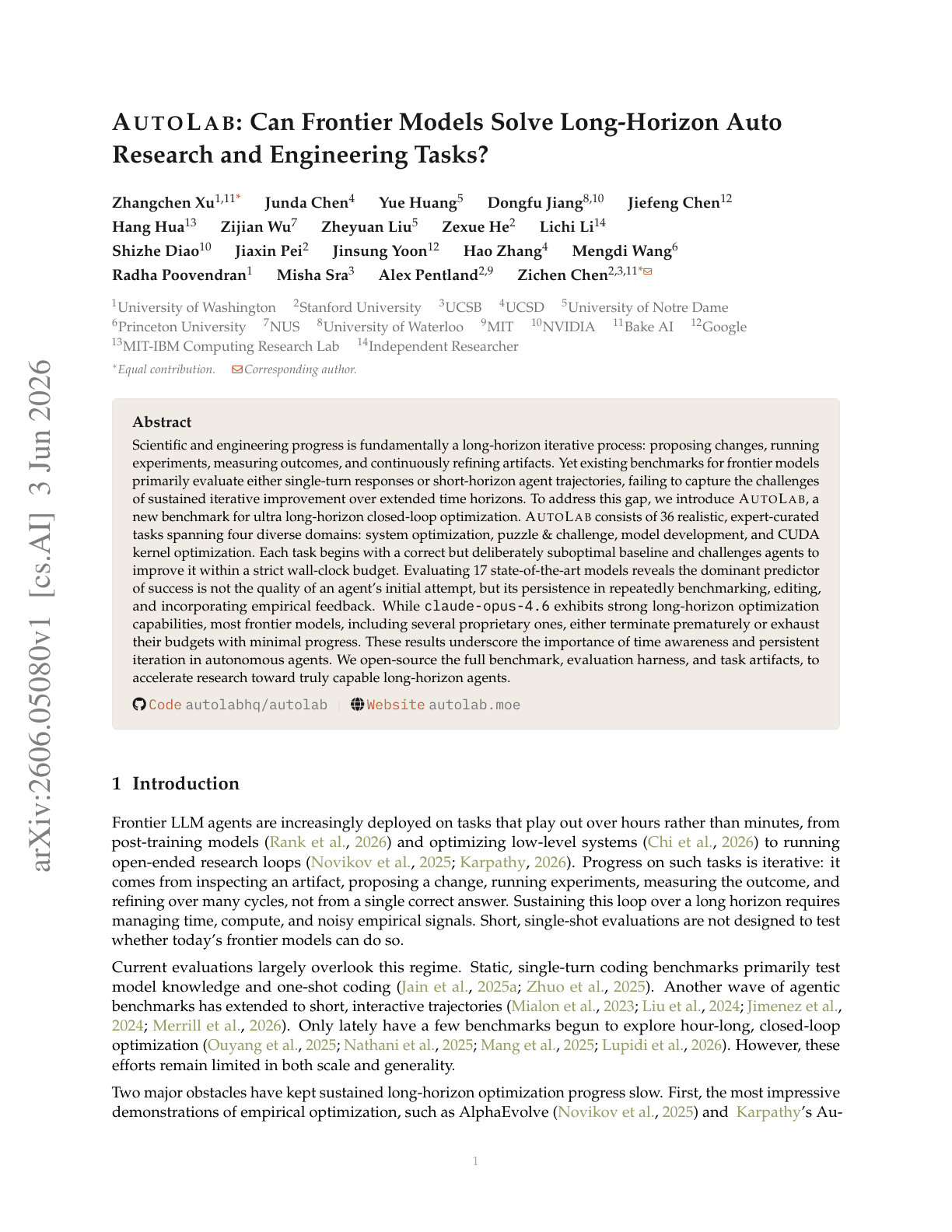
AutoLab
Can frontier models actually grind on a hard engineering problem the way a good researcher does? AutoLab is a benchmark for ultra long-horizon, closed-loop optimization built to answer that. It contains 36 realistic, expert-curated tasks across four domains: system optimization, puzzle and challenge, model development, and CUDA kernel optimization. Each task hands the agent a correct but deliberately suboptimal baseline and asks it to improve within a strict wall-clock budget.
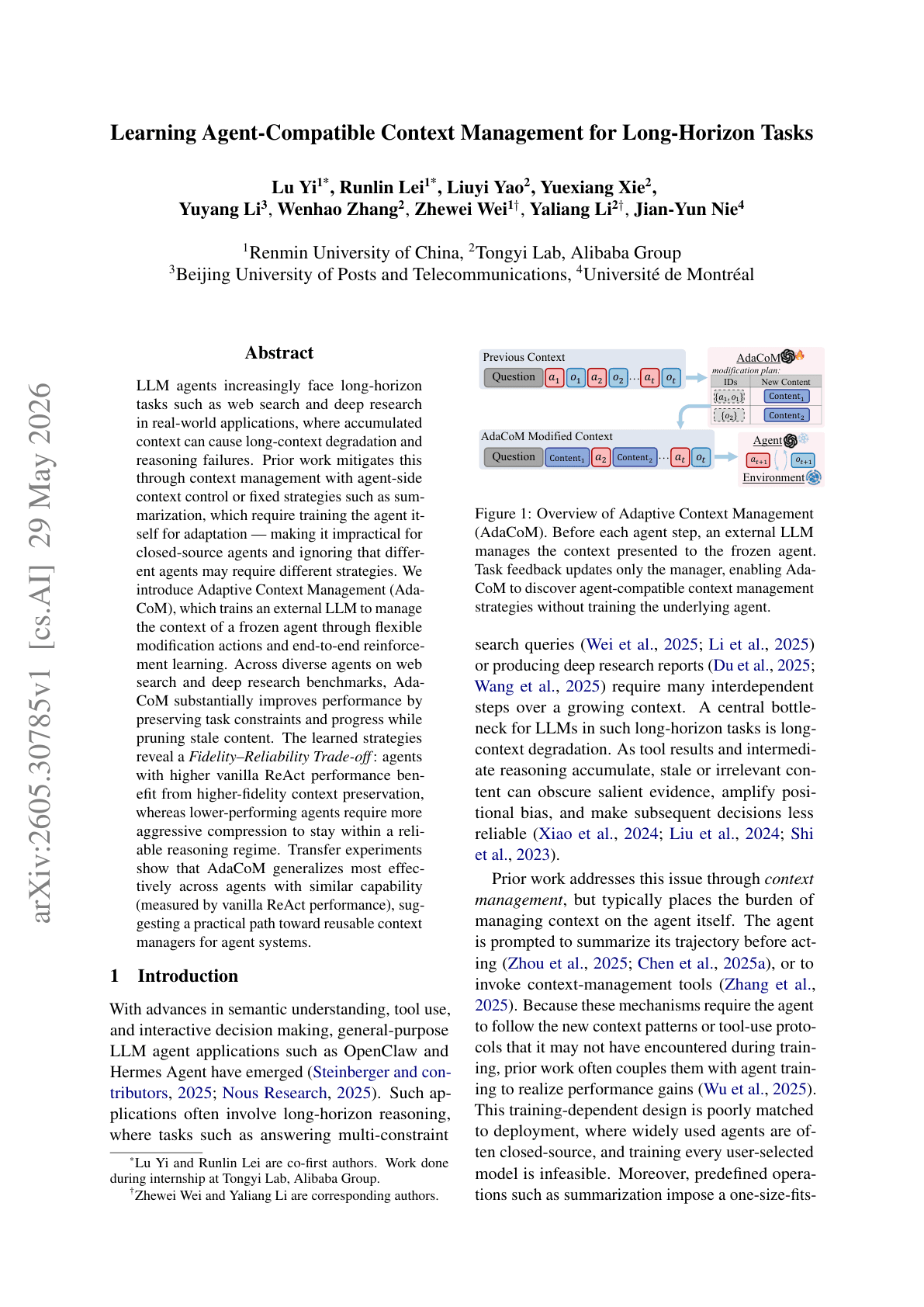
Reusable Context Engineering
Context bloat quietly kills long-horizon runs, and the usual fixes are baked into an agent's own prompt or weights, so they do not transfer. AdaCoM takes a different route: it trains a separate external model to manage the context of a frozen agent through flexible modification actions, optimized end-to-end with reinforcement learning. The agent never changes; only the context flowing into it does.
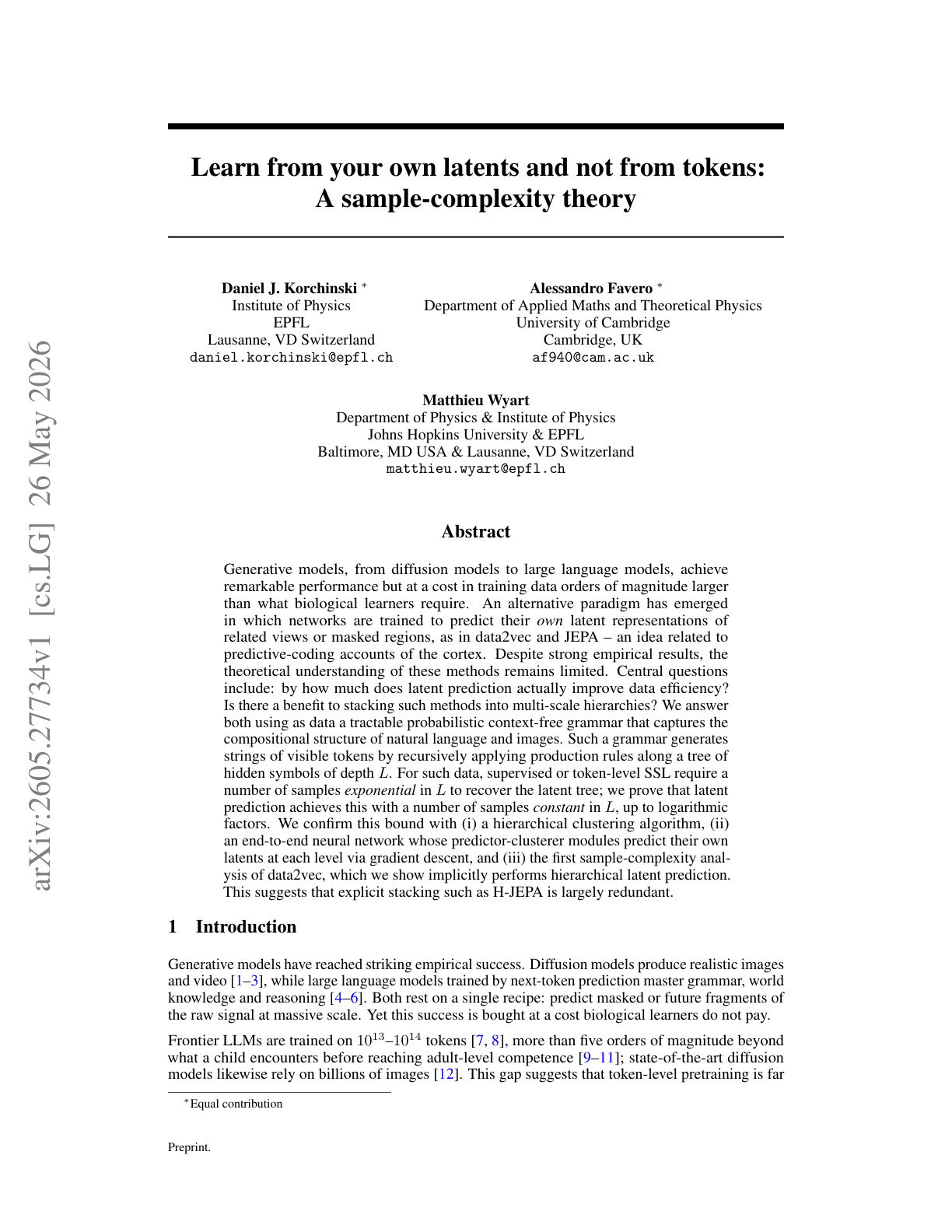
Learn From Your Own Latents
LLMs learn by predicting tokens, while world models like JEPA and data2vec learn by predicting their own internal representations. This paper provides a sample-complexity theory for why the second approach can be dramatically more data-efficient, using a tractable probabilistic context-free grammar as the analytical setting where compositional structure can be measured exactly.
A Primer on Post-Training Reasoning Data
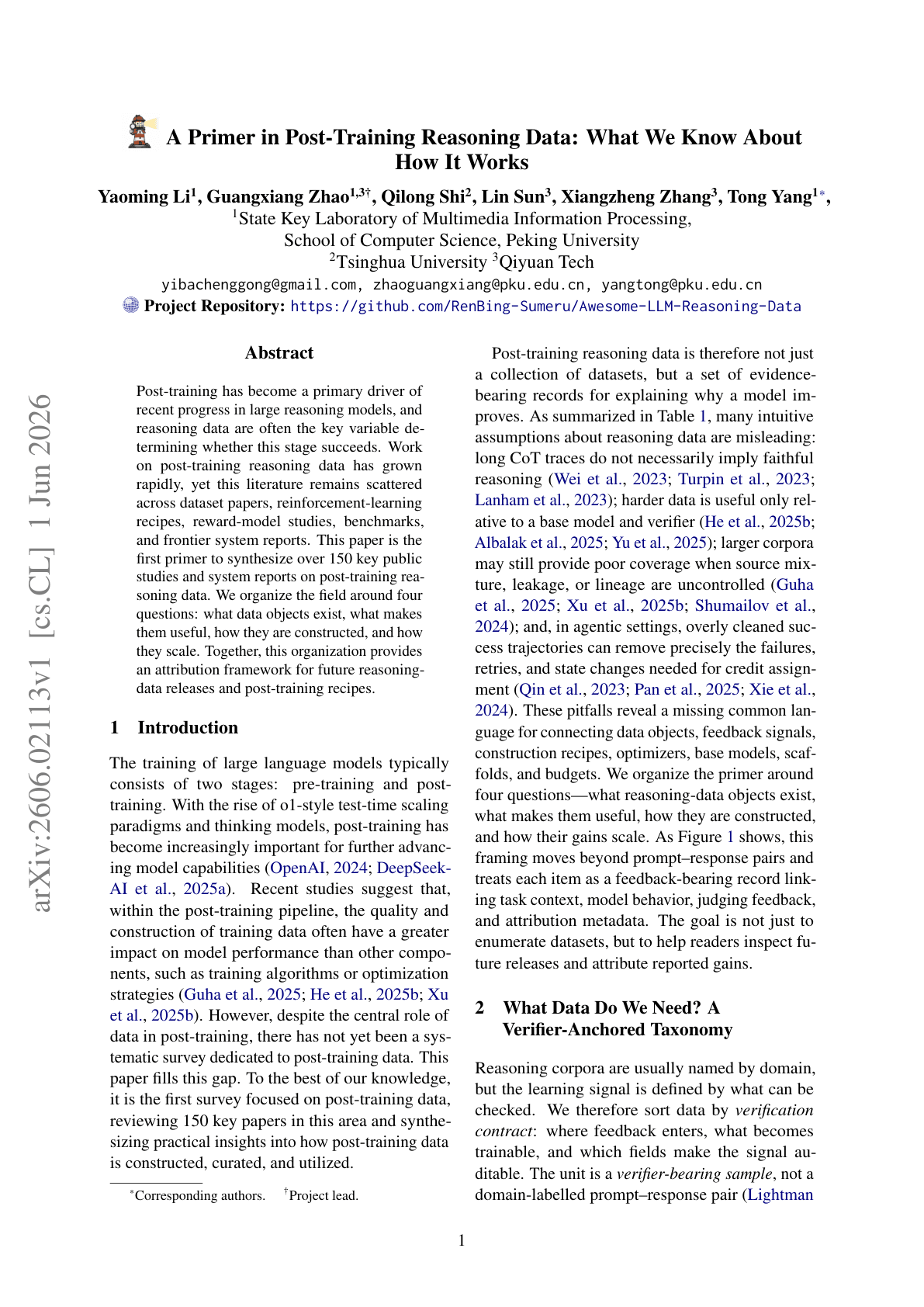
This primer is the first to pull the scattered post-training reasoning-data literature into one place, synthesizing over 150 public studies and system reports that previously lived across dataset papers, RL write-ups, and lab reports. It organizes the field around four questions: what data objects exist, what makes them useful, how they are constructed, and how they scale. The key reframing is that a reasoning-data item is more than a prompt-response pair: it packages a problem or state, model behavior, judging feedback, and attribution metadata, with usefulness defined relative to the verifier and the rest of the corpus rather than in isolation.
State-Externalizing Harnesses
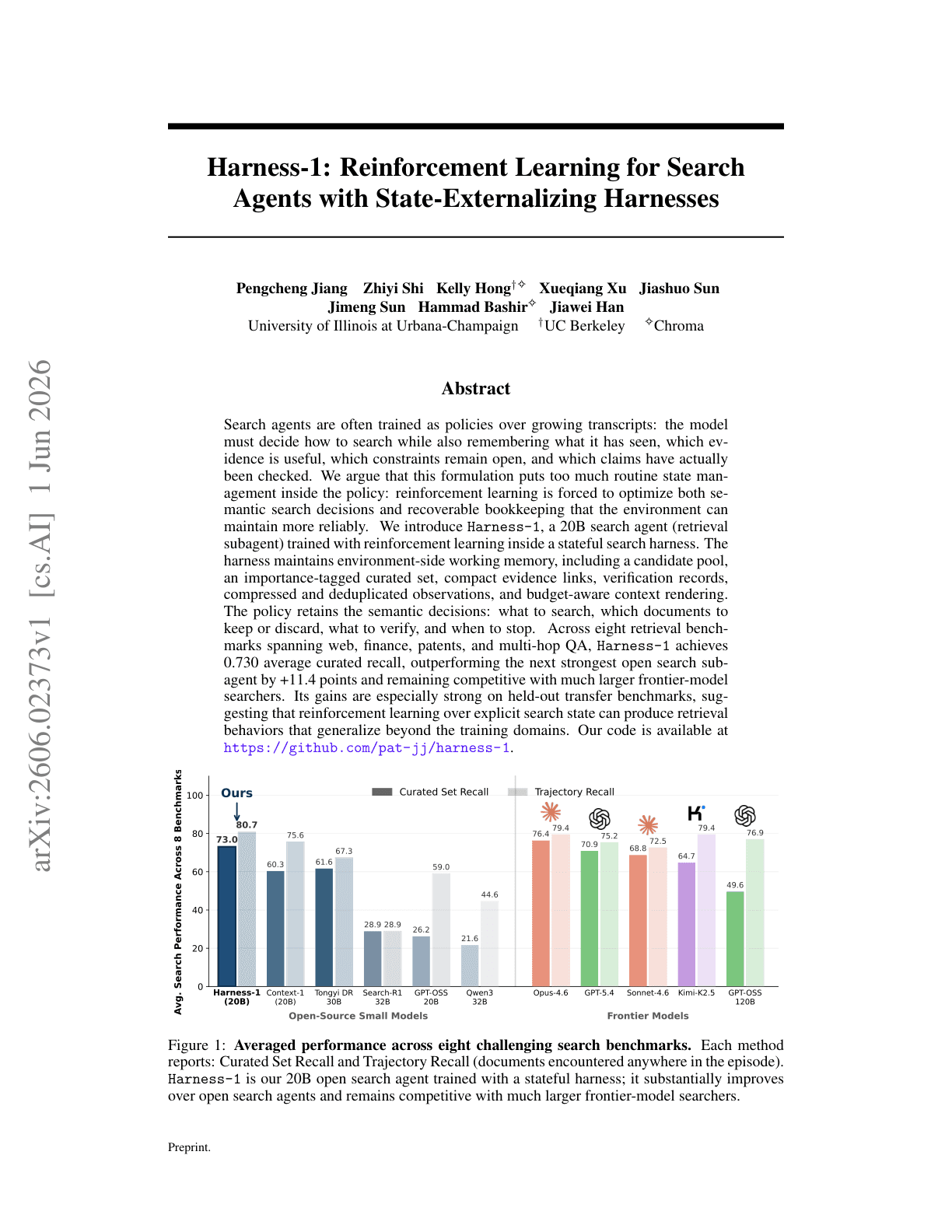
Harness-1 is a 20B search agent trained with reinforcement learning inside a stateful harness that offloads routine bookkeeping to the environment. The argument is that search agents are usually trained as policies over a growing transcript, forcing RL to optimize both genuine search decisions and recoverable state like which evidence is useful or which claims are checked. Harness-1 moves that state out of the policy and into an environment-side working memory of candidate pools, an importance-tagged curated set, compact evidence links, and verification records. The 20B agent reaches an average curated recall of 0.730 across eight retrieval benchmarks, beating open-source baselines by 11.4 points and matching or outperforming much larger frontier searchers, with stronger generalization on unseen domains.
Do More Agents Help?
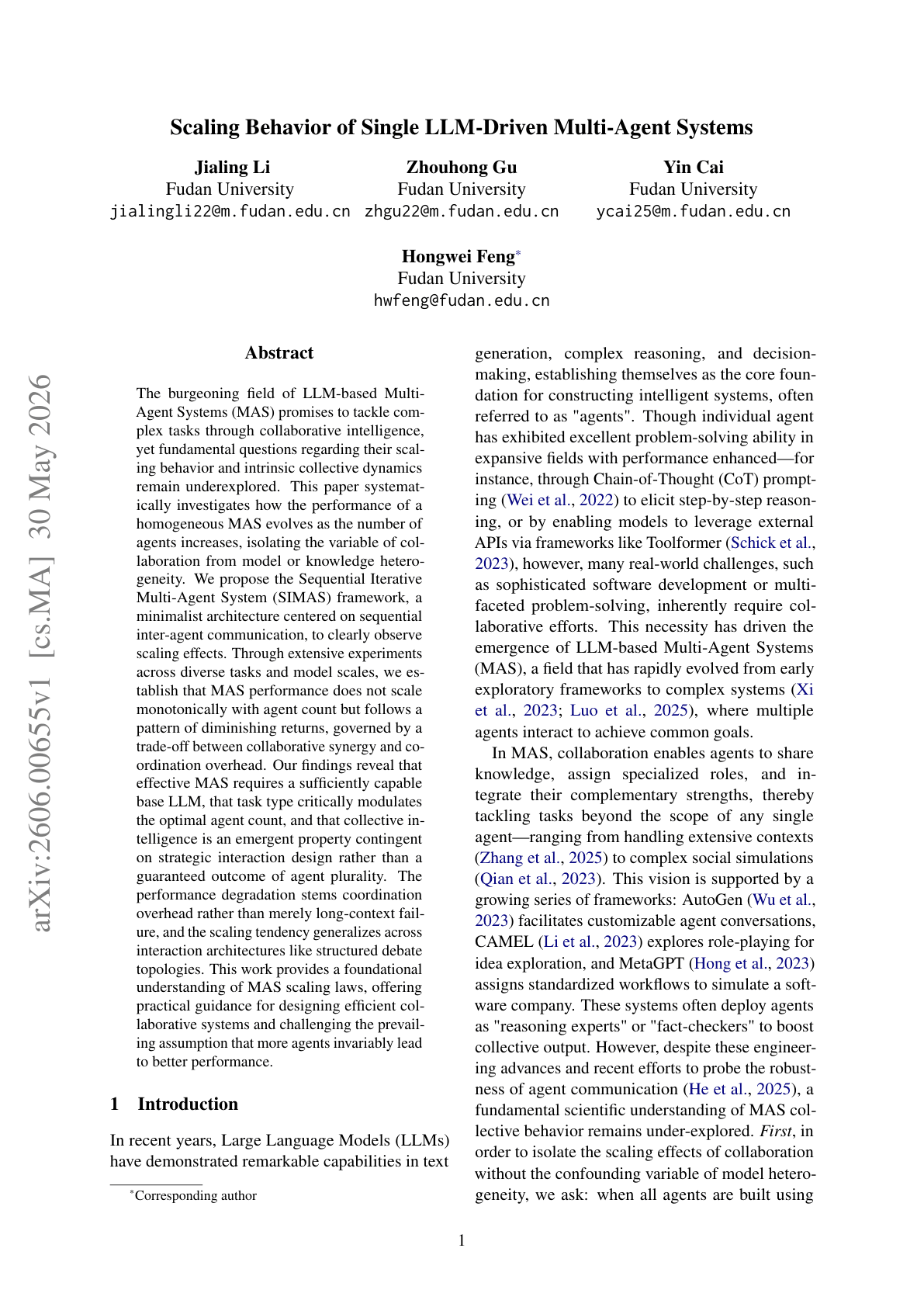
This paper studies whether adding agents actually makes a single LLM-driven multi-agent system better, using a Sequential Iterative Multi-Agent System (SIMAS) framework. The finding is that performance does not scale monotonically with agent count but follows a pattern of diminishing returns, with degradation eventually driven by coordination overhead. Effective systems still require a capable base model, the optimal number of agents depends on the task type, and collective intelligence turns out to be a product of strategic interaction design rather than a guaranteed outcome of agent plurality. The takeaway for builders is to design the interaction, not just stack more agents.
SkillOpt
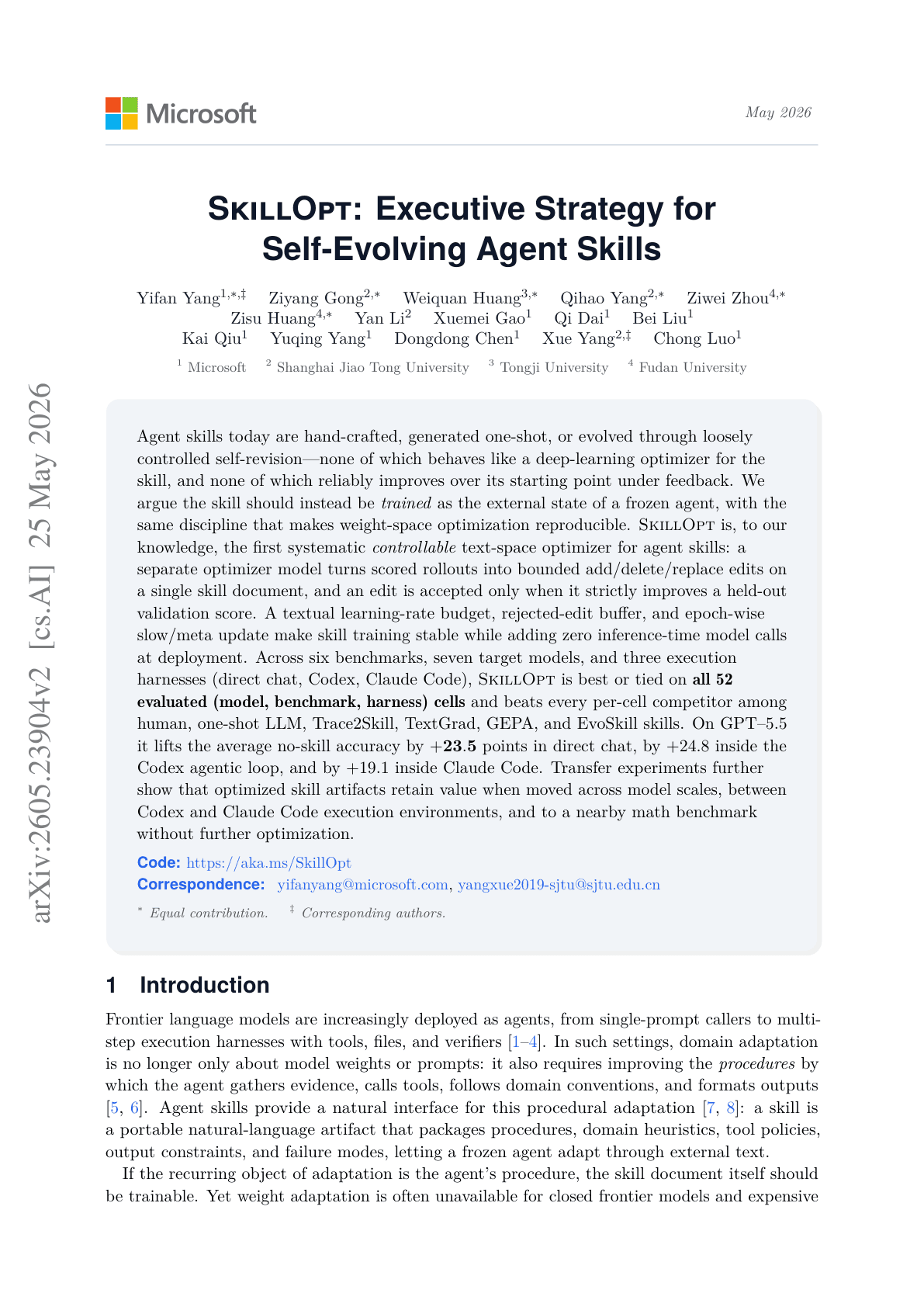
Microsoft Research treats a compact natural-language skill document as the trainable state of a frozen agent, then learns that document through rollouts, reflection, and bounded edits gated by held-out validation. The argument is direct: most engineers handwrite agent skill docs and hope they generalize, when the doc itself should be optimized like a parameter. SkillOpt reframes the SKILL.md file as an external parameter of a model whose weights never change.
Compiling Agentic Workflows into Weights
This paper shows that a full agentic workflow can be distilled into the weights of a small model and run at roughly two orders of magnitude lower inference cost while preserving near-frontier task quality. Instead of keeping an external orchestrator above the LLM, the procedure is compiled into the weights of a fine-tuned model, producing what the authors call a subterranean agent.
AutoScientists
AutoScientists, from Harvard, is a decentralized team of AI agents for long-running computational science that drops the central planner entirely. Rather than following one research trajectory coordinated from the top, agents self-organize around promising hypotheses, critique each other's proposals before spending experimental compute, and record both successes and failures so the system avoids redundant exploration as evidence accumulates over hours or days.
Language Models Need Sleep
Attention scales badly with context length, so long-horizon agents keep paying a growing cost as their context grows. This paper studies a sleep-like consolidation mechanism: the model periodically converts recent context into persistent fast weights, then clears its key-value cache. During the sleep phase it performs offline recurrent passes over the accumulated context and updates fast weights in its state-space blocks through a learned local rule.
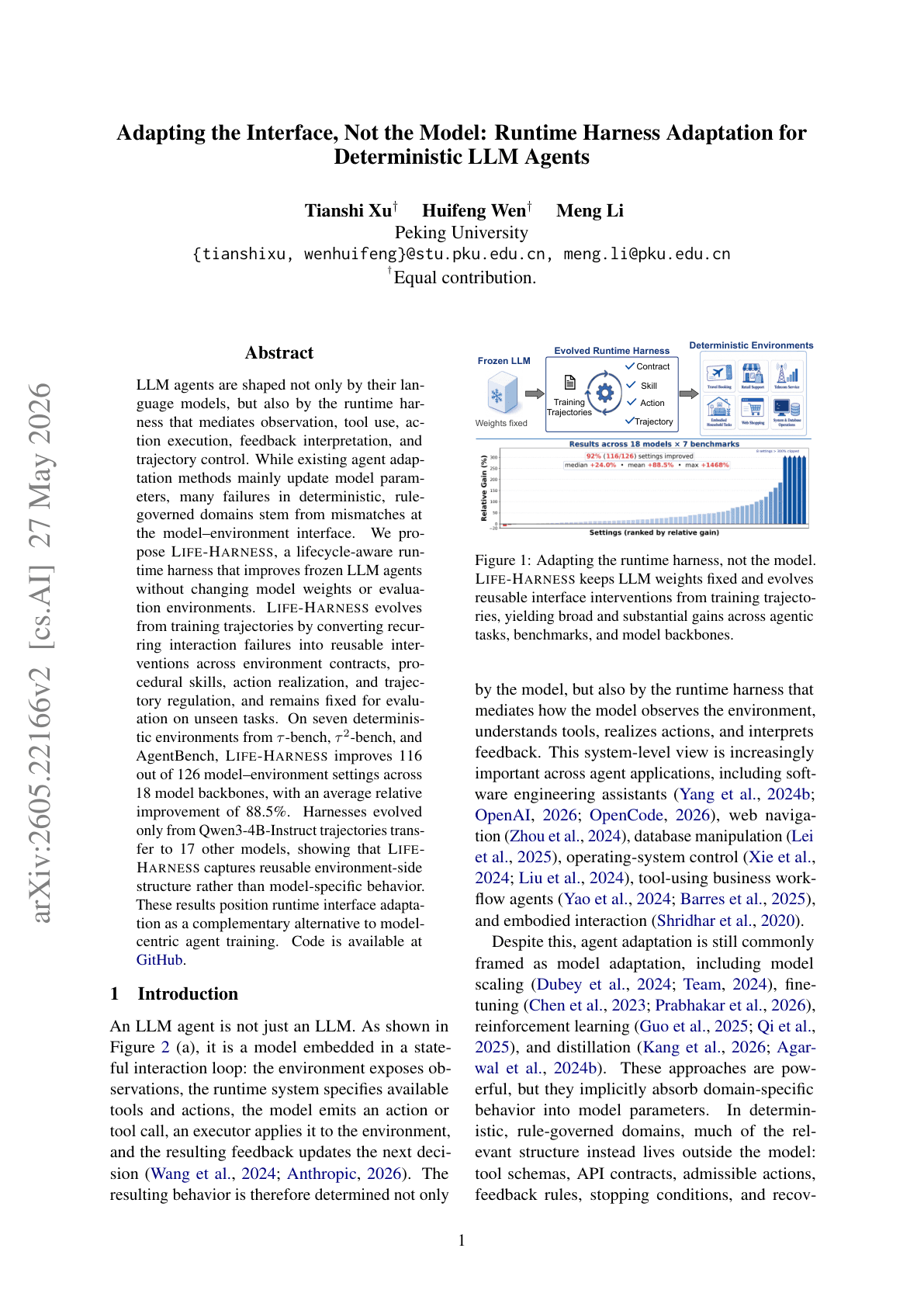
Adapting the Interface, Not the Model
When a frozen LLM agent repeatedly fails in a deterministic, rule-governed environment, do you have to retrain the model? Life-Harness argues no. Many failures come from mismatches at the model-environment interface, not from the model's reasoning, so the fix belongs in the runtime harness. Life-Harness is a lifecycle-aware harness that improves frozen agents without touching model weights or the evaluation environment.
The Efficiency Frontier
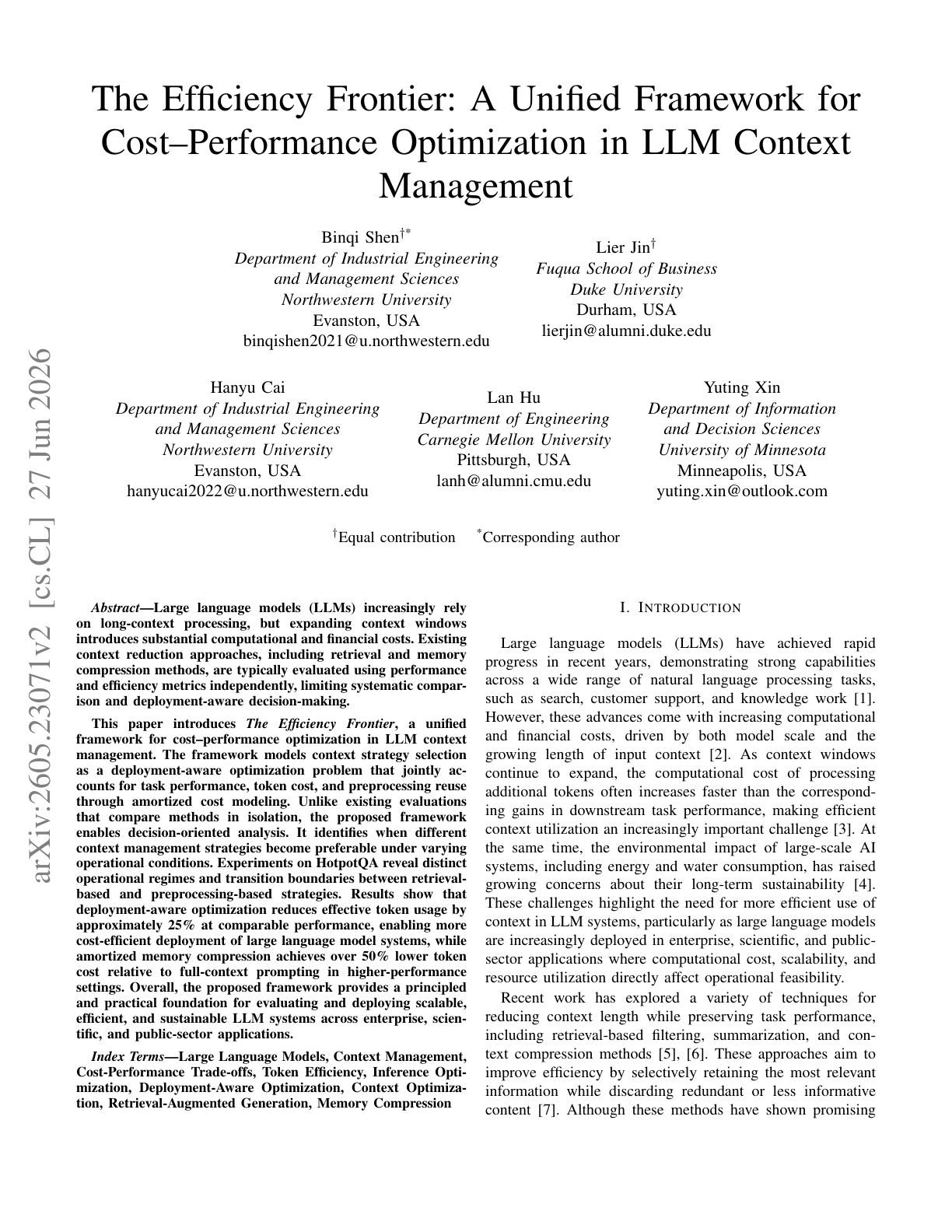
Context costs dominate production LLM bills, and the right strategy depends on how often preprocessing gets reused. This paper models context-strategy selection as a deployment-aware optimization problem that jointly accounts for task performance, token cost, and reuse, then uses it to compare retrieval-based and preprocessing-based approaches under realistic constraints.
Forecasting Scientific Progress with AI
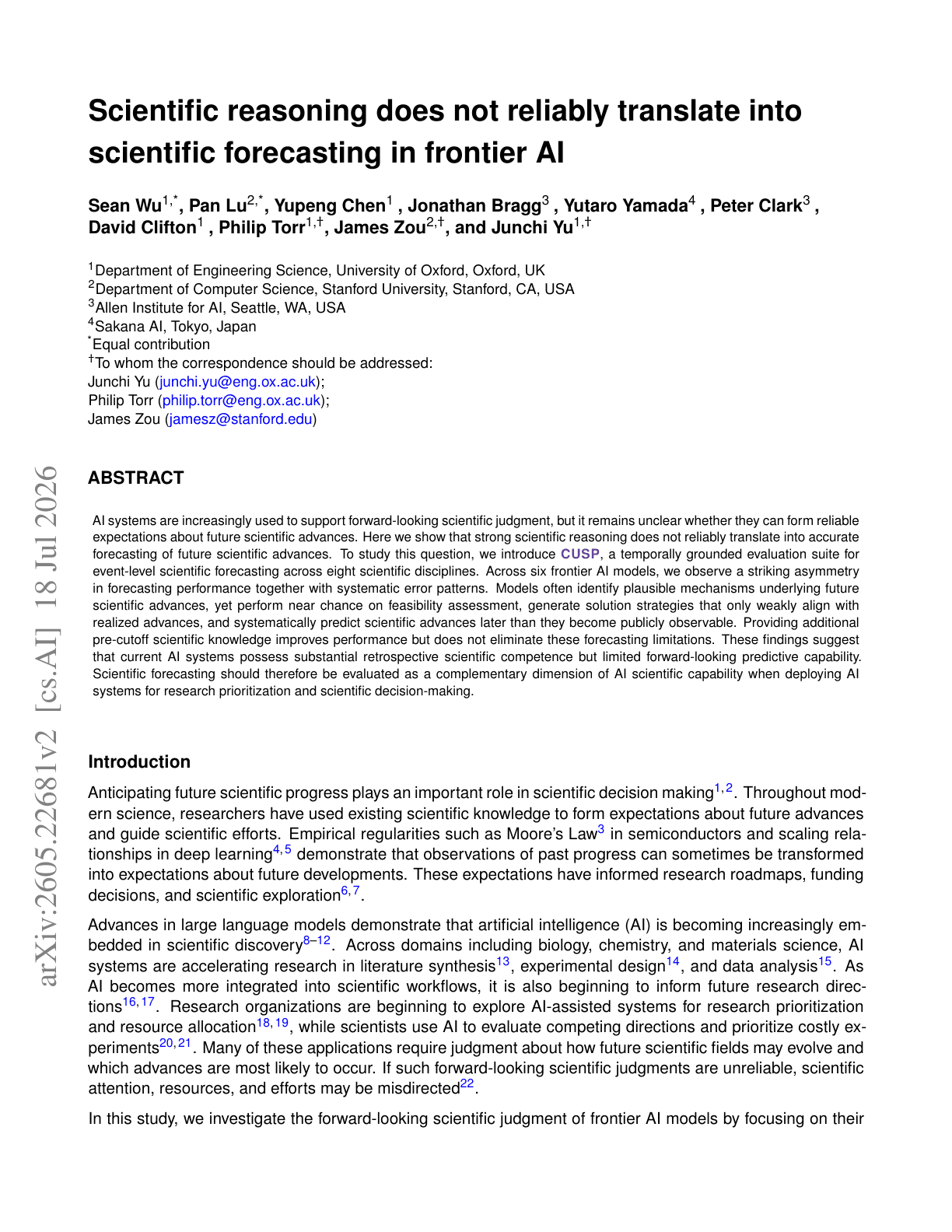
Can frontier models predict where science is going? This work introduces CUSP, a cutoff-conditioned benchmark built from 4,760 real scientific events across multiple disciplines, each grounded against a verified knowledge cutoff. For every event, models are tested on four tasks: feasibility assessment, mechanistic reasoning, generative solution design, and temporal prediction. The headline is sobering: models recognize plausible directions but cannot forecast outcomes.
Your Agents Are Aging Too
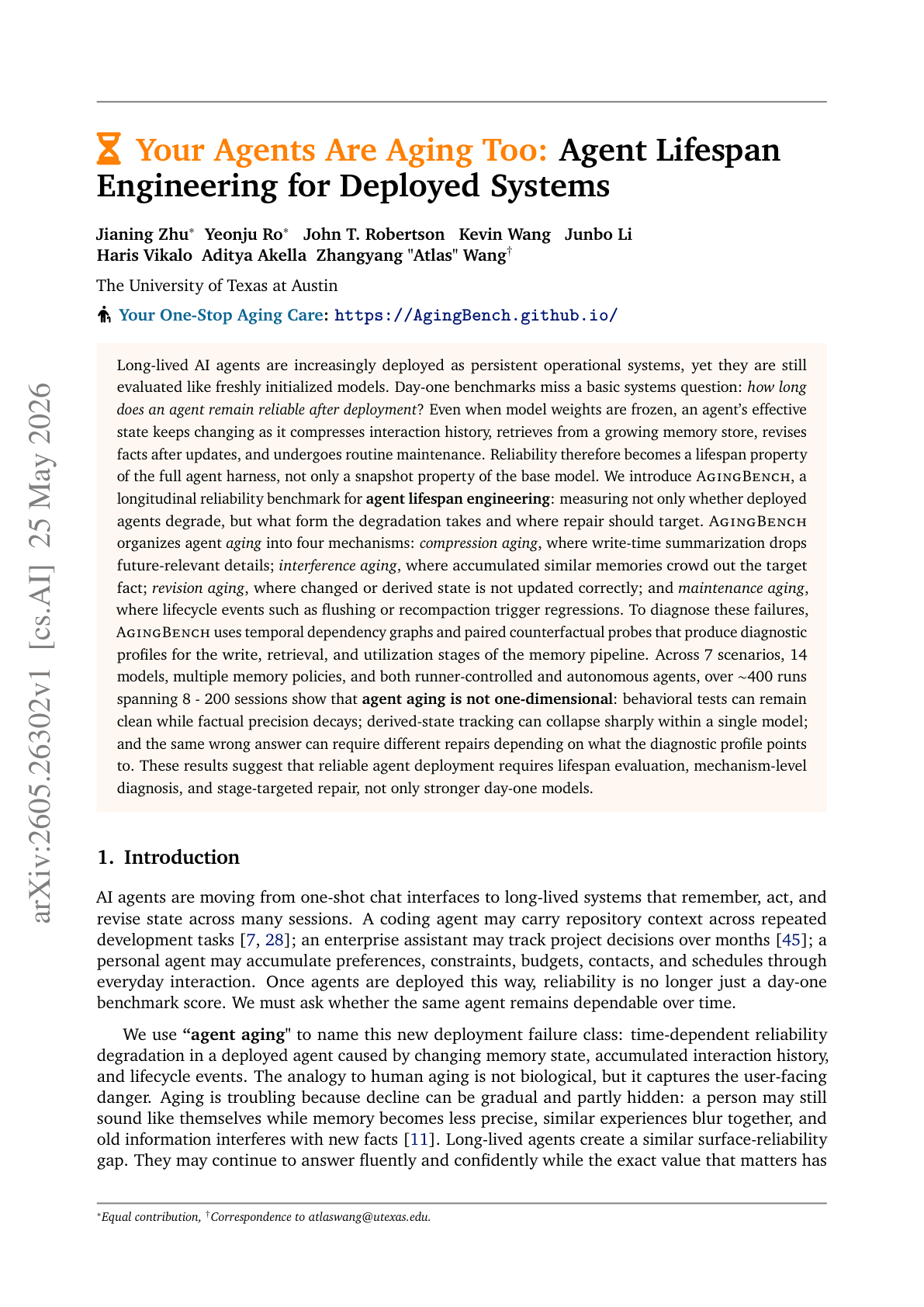
AgingBench is a longitudinal reliability benchmark for agent lifespan engineering, built on the observation that long-lived agents are still evaluated like freshly initialized models. It organizes agent degradation into four mechanisms: compression aging, where write-time summarization drops future-relevant details; interference aging, where accumulated similar memories crowd out the target fact; revision aging, where changed or derived state is not updated correctly; and maintenance aging from routine lifecycle events. Using a temporal dependency DAG to encode cross-session structure, it produces aging curves over an operational lifetime rather than a single day-one score, and points to where repair should target.
Harnesses Are Not Uniformly Better
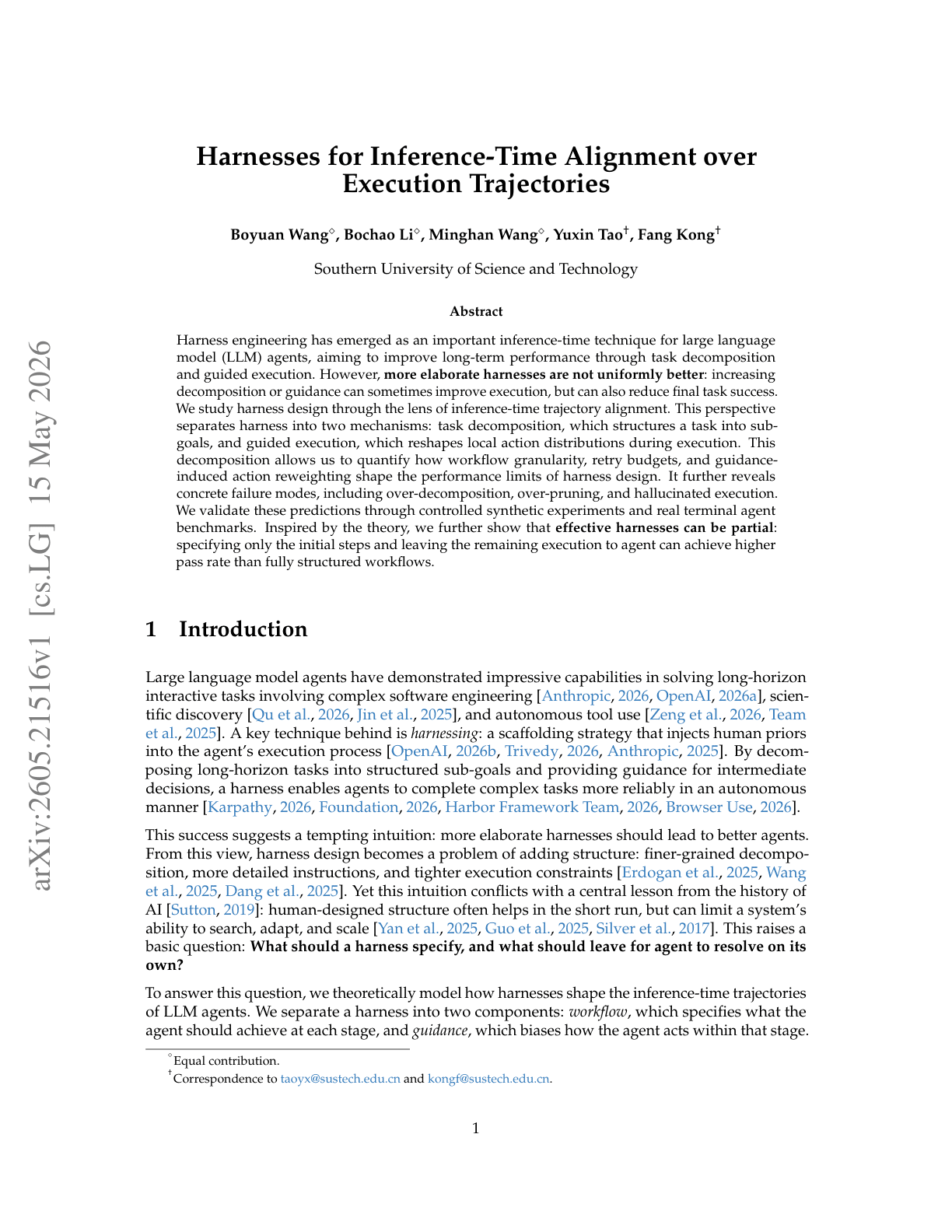
This paper studies LLM agent harnesses through the lens of inference-time trajectory alignment, separating a harness into two mechanisms: task decomposition, which structures a task into sub-goals, and guided execution, which reshapes local action distributions during execution. The key finding is that more elaborate harnesses are not uniformly better. Increasing decomposition or guidance can improve execution but can also reduce final task success, producing concrete failure modes like over-decomposition, over-pruning, and hallucinated execution. Strikingly, partial harnesses that specify only the initial steps and leave the rest to the agent can reach a higher pass rate than fully structured workflows.