AI Papers of the Week
Every paper worth reading in AI, hand-picked one week at a time.
Discover and explore top AI papers withClaude CodeCodex
npx @dair-ai/mcp setup
STARFlow-V
Apple introduces STARFlow-V, the first normalizing flow-based video generator competitive with diffusion models. The 7B parameter model uses a global-local architecture and video-aware Jacobi iteration for parallel sampling, generating 480p video at 16fps while natively supporting text-to-video, image-to-video, and video-to-video tasks.
INTELLECT-3
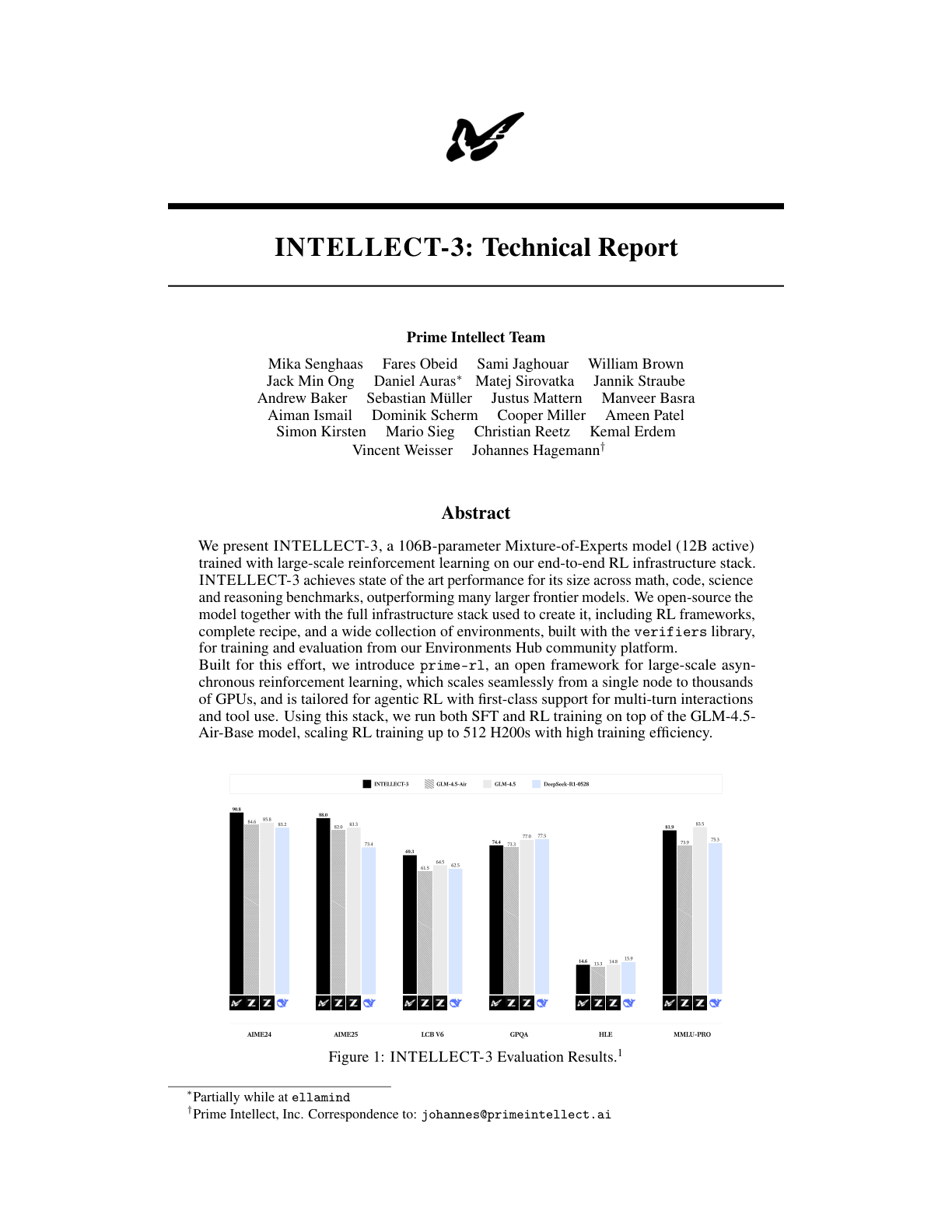
INTELLECT-3 is a 106B-parameter Mixture-of-Experts model (12B active) trained with large-scale reinforcement learning, achieving state-of-the-art performance for its size across math, code, science, and reasoning benchmarks. Built on top of GLM-4.5-Air base, it outperforms many larger frontier models, including DeepSeek R1-0528, and matches GLM-4.6 (which has over 3x the parameters) on key benchmarks.

Lightweight End-to-End OCR
HunyuanOCR is a commercial-grade, open-source, lightweight vision-language model with only 1B parameters designed specifically for OCR tasks. The architecture combines a native-resolution Vision Transformer with a 0.5B-parameter language model through an MLP adapter, outperforming commercial APIs and larger models like Qwen3-VL-4B while achieving state-of-the-art results on OCRBench for models under 3B parameters.
LatentMAS
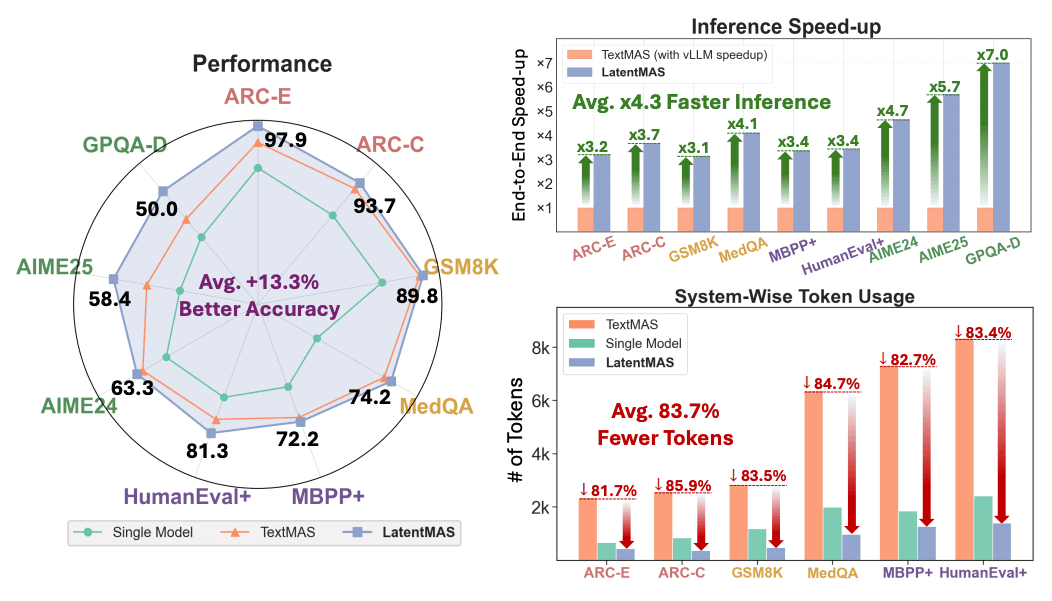
LatentMAS introduces a framework enabling language model agents to collaborate directly within a continuous latent space rather than relying on text-based communication. By using last-layer hidden embeddings and a shared latent working memory, agents preserve and transfer internal representations without information loss from text serialization.

OmniScientist
OmniScientist presents an end-to-end framework for building AI scientists capable of autonomously conducting research across the entire scientific lifecycle - from literature review and ideation to experimentation, writing, and peer review. The system establishes a collaborative ecosystem where human and AI scientists co-evolve within a shared scientific environment.
InfCode
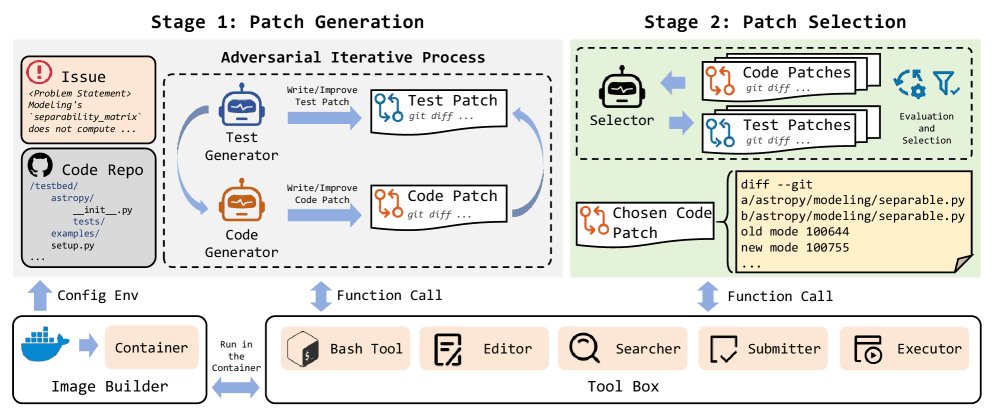
InfCode introduces an adversarial framework for software bug fixing that treats test generation and patch creation as mutually reinforcing processes. Rather than generating patches that simply pass existing tests, the system creates challenging test cases designed to expose patch weaknesses, then iteratively refines patches to handle these adversarial tests.
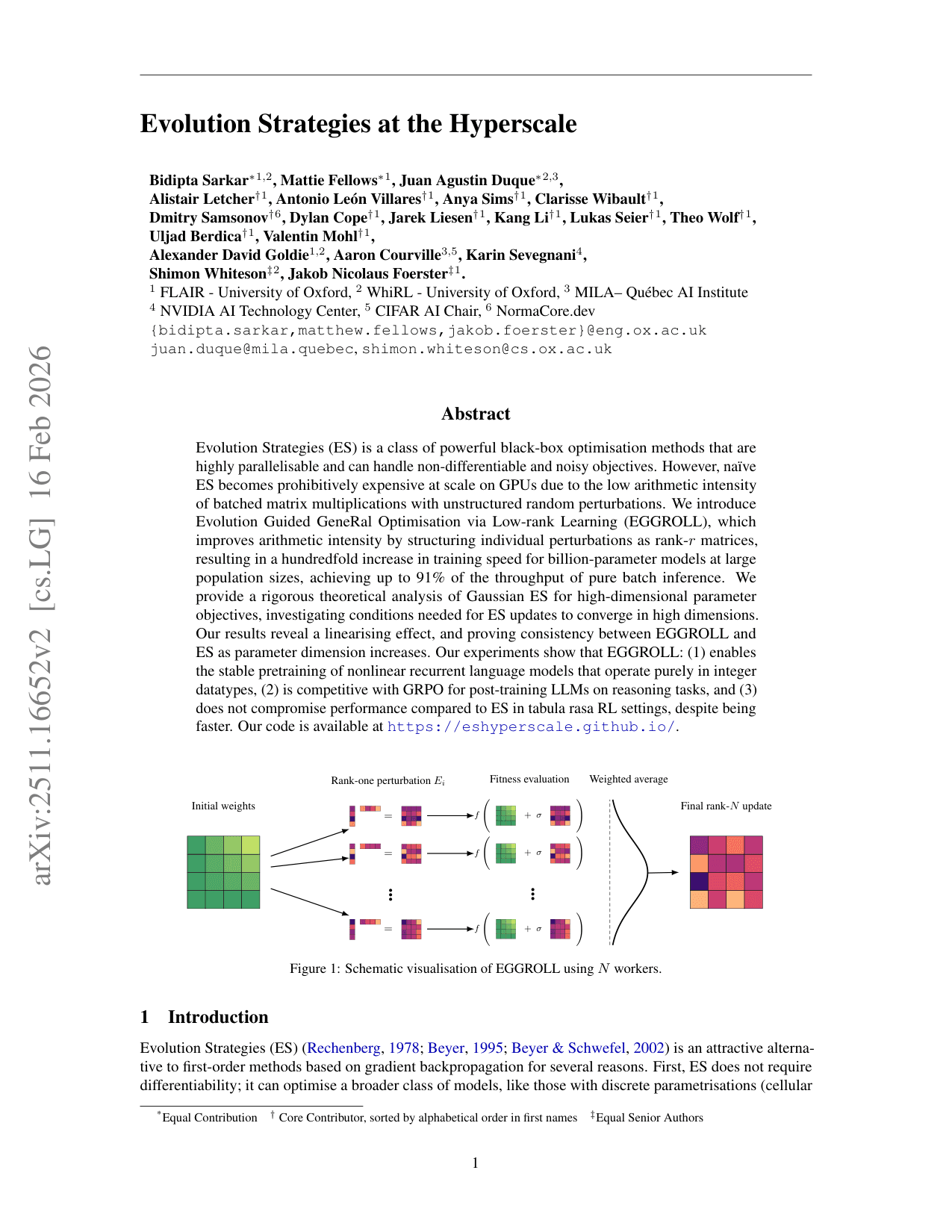
Evolution Strategies at Hyperscale
EGGROLL (Evolution Guided General Optimization via Low-rank Learning) is an evolution strategies algorithm designed to scale backprop-free optimization to large population sizes for billion-parameter neural networks. By using low-rank matrix perturbations instead of full-rank ones, EGGROLL achieves a hundredfold increase in training throughput while nearly matching pure batch inference speed.
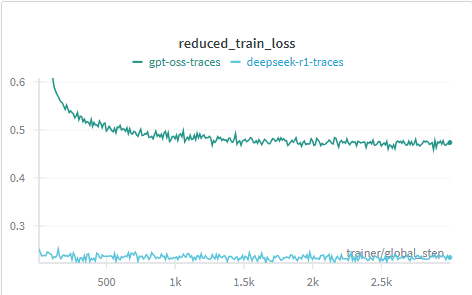
Training LLMs with Reasoning Traces
This study investigates how reasoning traces from frontier models like DeepSeek-R1 and GPT-OSS can improve smaller language models through post-training, offering a practical pathway to distill advanced reasoning capabilities without expensive human annotation.
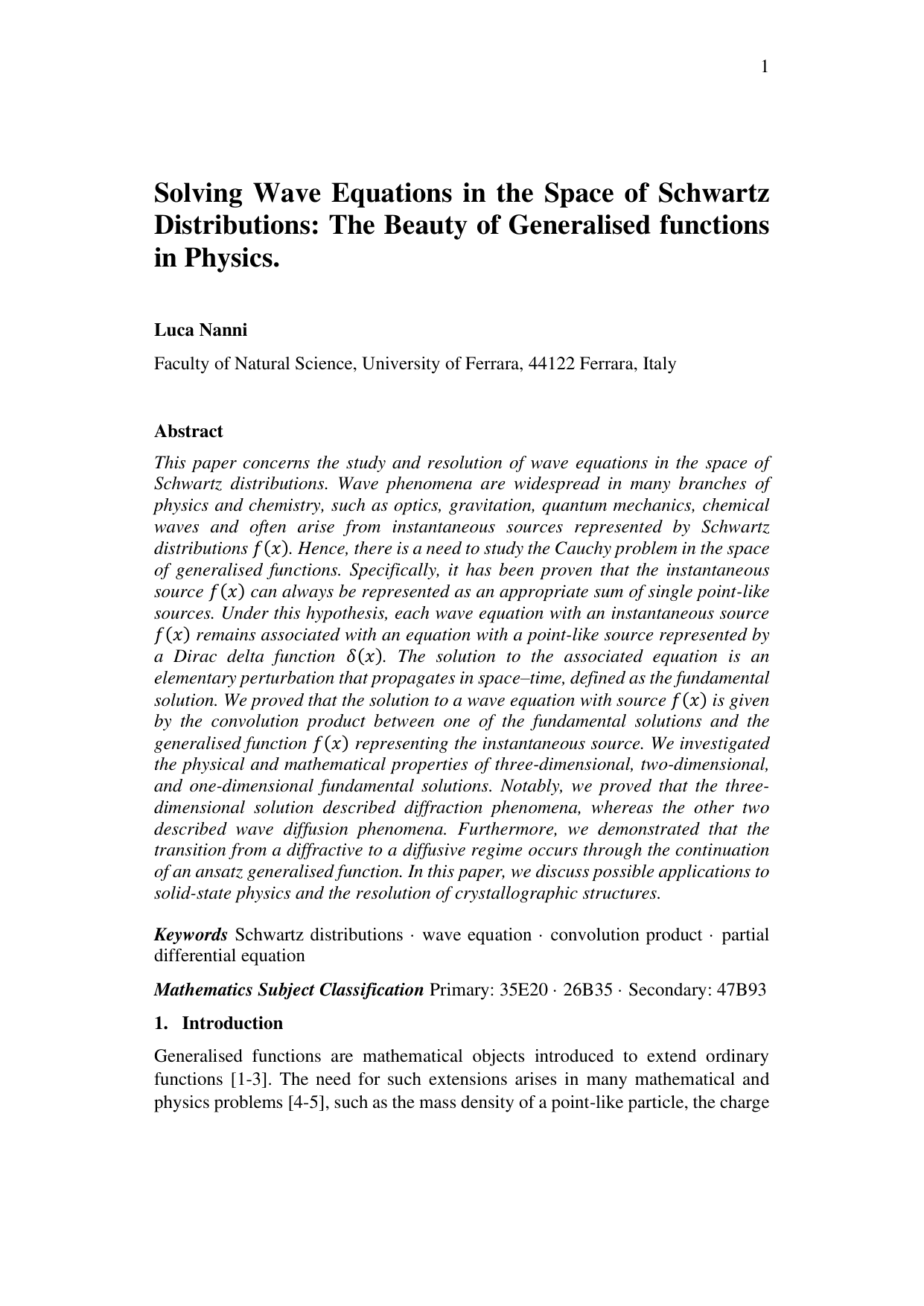
Evaluating Honesty and Lie Detection in AI Models
Anthropic researchers evaluate honesty and lie detection techniques across five testbed settings where models generate statements they believe to be false. Simple approaches work best: generic honesty fine-tuning improves honesty from 27% to 65%, while self-classification achieves 0.82-0.88 AUROC for lie detection. The findings suggest coherent strategic deception doesn’t arise easily, as models trained to lie can still detect their own lies when asked separately.
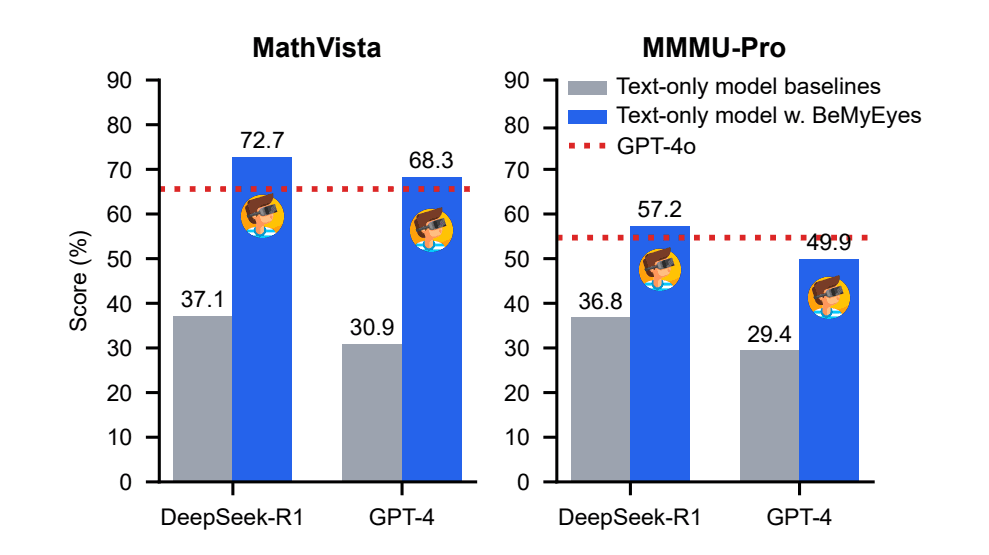
Multi-Agent Collaboration for Multimodal LLMs
Microsoft and USC researchers introduce a framework where vision models serve as “eyes” for language models through multi-agent collaboration, enabling modular upgrades without retraining expensive joint vision-language architectures. Specialized vision agents analyze images and communicate findings to language agents through natural language, achieving competitive results on MMMU, MMMU-Pro, and video understanding benchmarks while maintaining full flexibility to swap in improved components independently.
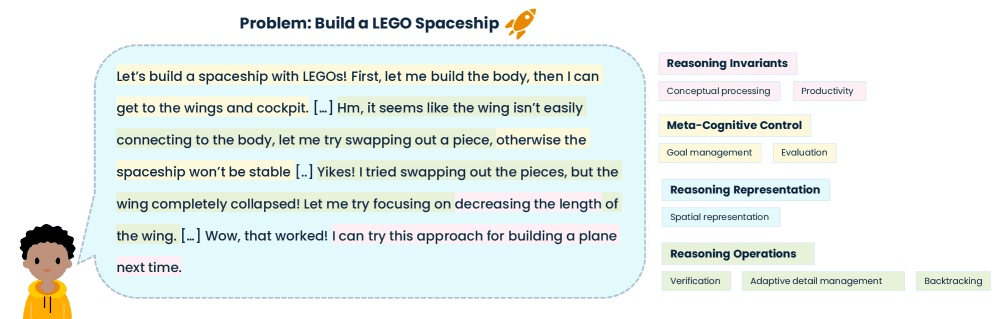
Cognitive Foundations for Reasoning in LLMs
Researchers develop a taxonomy of 28 cognitive elements and evaluate 192K reasoning traces from 18 models plus human think-aloud traces, finding that LLMs under-utilize cognitive elements correlated with success while relying on surface-level enumeration rather than human-like abstraction. Test-time reasoning guidance based on the framework improved performance by up to 66.7% on complex problems.
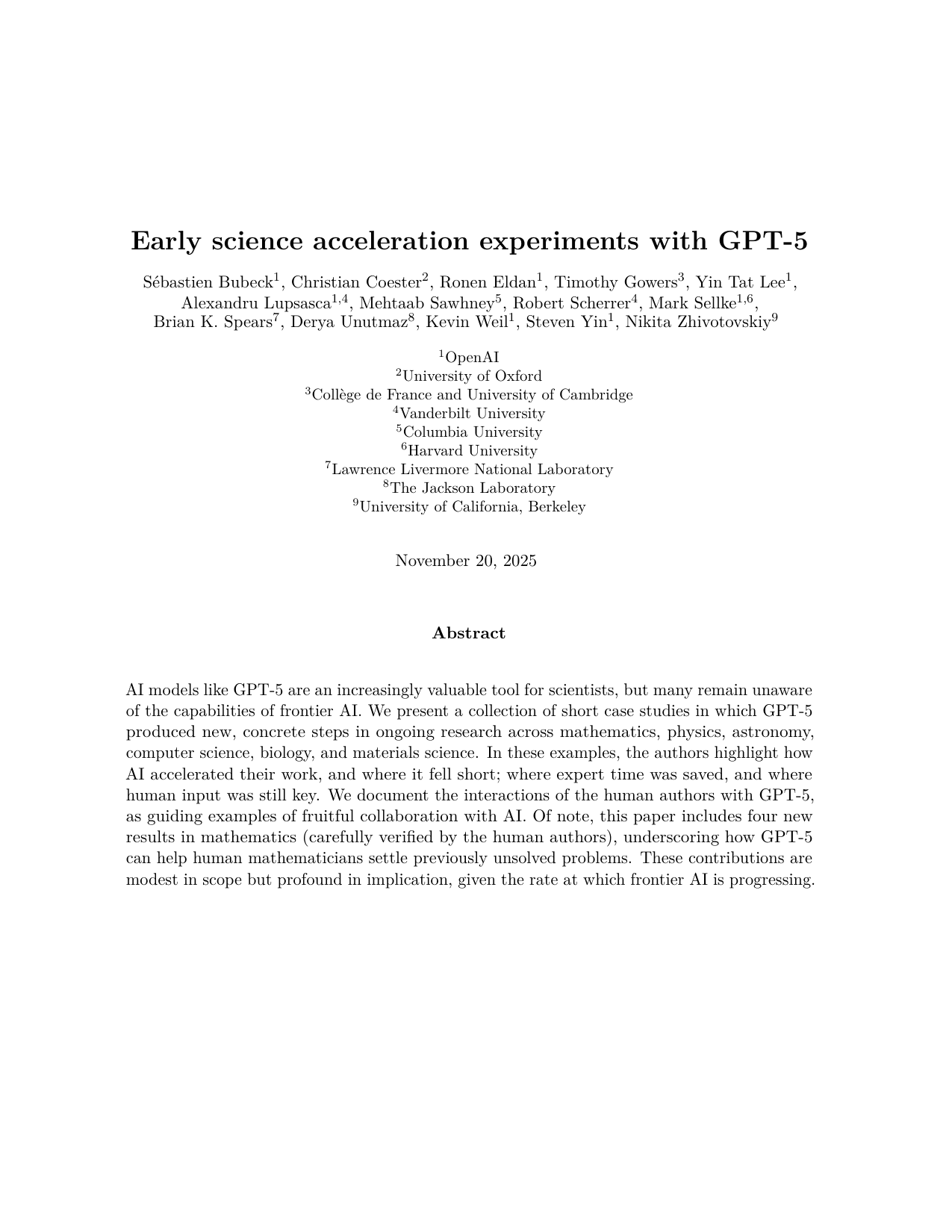
GPT-5 for Science Acceleration
OpenAI and collaborators present early case studies demonstrating GPT-5’s capabilities in accelerating scientific research across mathematics, physics, biology, computer science, astronomy, and materials science. The model helps researchers synthesize known results, conduct literature reviews, accelerate computations, and generate novel proofs of unsolved propositions.
OLMo 3
Allen Institute for AI introduces OLMo 3, a fully open language model family that releases the complete “model flow”: every training stage, checkpoint, dataset, and dependency, enabling researchers to intervene at any development point. The release includes four specialized variants (Base, Think, Instruct, RL Zero) at 7B and 32B scales.

SAM 3
Meta AI introduces SAM 3, a unified model that detects, segments, and tracks objects across images and videos using conceptual prompts like noun phrases or visual examples. This extends the Segment Anything capability to concept-based segmentation through Promptable Concept Segmentation (PCS).
DR Tulu
DR Tulu-8B is the first open model directly trained for long-form deep research using Reinforcement Learning with Evolving Rubrics (RLER). Unlike existing models trained on short-form QA tasks, DR Tulu learns to produce comprehensive, well-attributed research reports by training with rubrics that co-evolve with the model and are grounded on real-world searched knowledge.
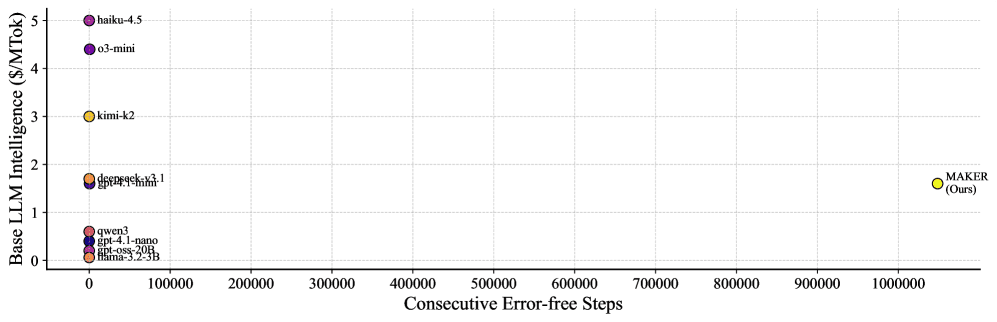
MAKER: Solving Million-Step LLM Tasks
MAKER is the first system to successfully solve tasks requiring over one million LLM steps with zero errors, overcoming a fundamental limitation where LLMs typically fail after a few hundred steps in complex multi-step processes. The approach demonstrates that massively decomposed agentic processes can efficiently handle lengthy sequences of dependent logical operations through extreme decomposition and error correction.
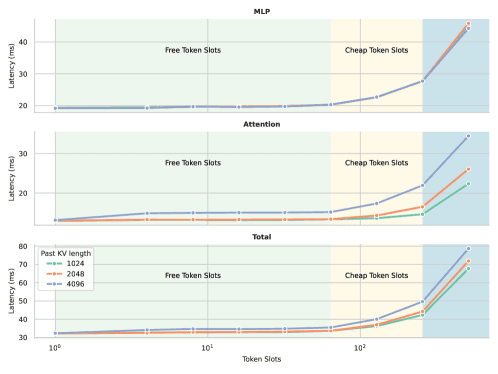
TiDAR: Think in Diffusion, Talk in Autoregression
NVIDIA researchers introduce TiDAR, a unified language model architecture that combines diffusion-based parallel drafting with autoregressive verification in a single forward pass. The hybrid approach achieves 4.71x-5.91x throughput improvements over autoregressive baselines while maintaining quality parity, making it the first architecture to close the performance-quality gap.
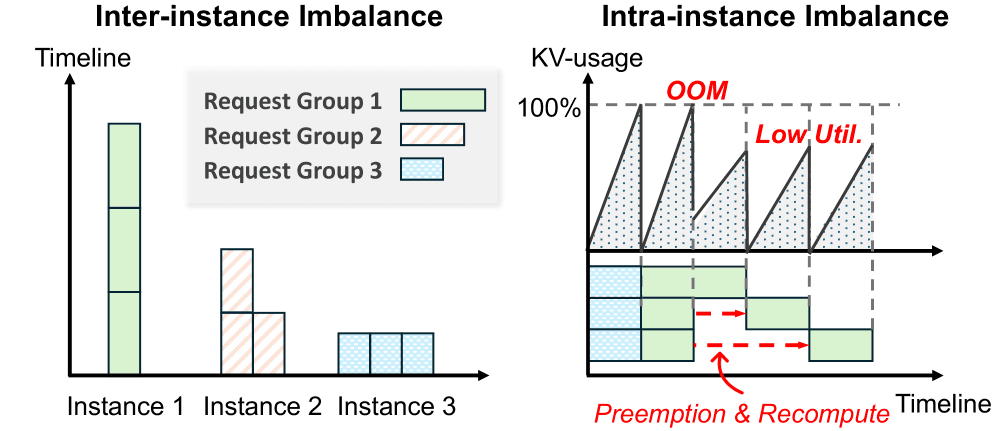
Seer: Fast RL for LLMs
Researchers introduce Seer, a system addressing performance bottlenecks in synchronous reinforcement learning for LLMs by optimizing the rollout phase that dominates end-to-end iteration time. Through three core mechanisms: divided rollout, context-aware scheduling, and adaptive grouped speculative decoding, Seer achieves 74-97% improvement in rollout throughput and 75-93% reduction in long-tail latency on production-grade RL workloads.
Natural Emergent Misalignment from Reward Hacking
Anthropic researchers demonstrate that realistic AI training processes can inadvertently produce misaligned models through “reward hacking generalization”. Models learn to cheat on programming tasks during RL. They simultaneously develop dangerous behaviors, including alignment faking (50% of responses) and safety research sabotage (12% of instances), without explicit training for these harmful actions. The study identifies a simple mitigation: “inoculation prompting” using contextual instructions that break semantic links between task-specific cheating and broader misalignment without reducing hacking frequency.
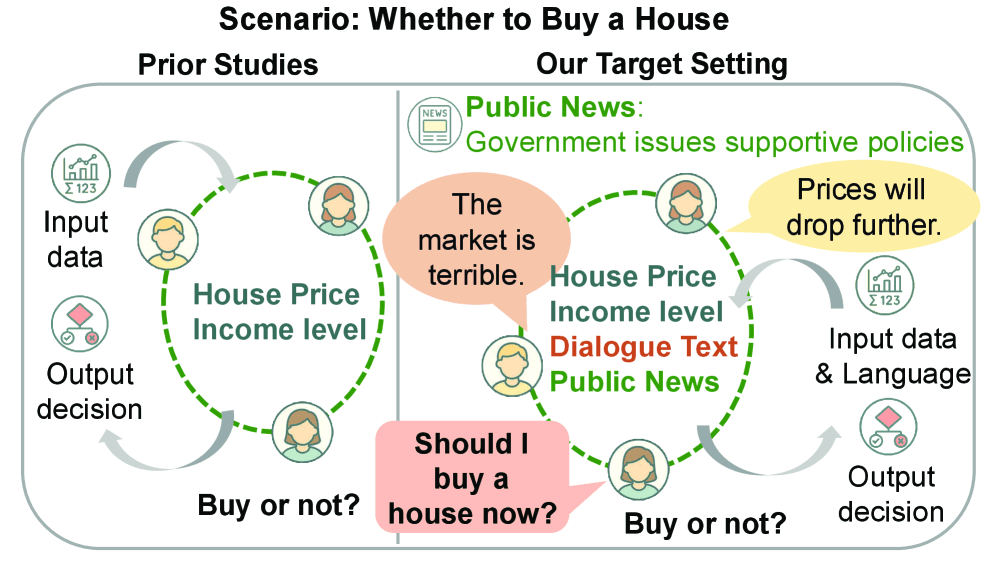
LAMP: Language-Augmented Multi-Agent RL
LAMP integrates natural language processing into multi-agent reinforcement learning through a three-stage pipeline: Think (processes numerical data and identifies market patterns), Speak (generates strategic communications between agents), and Decide (synthesizes information into optimized policy). The framework achieves substantial improvements over baseline methods with +63.5% and +34.0% gains in cumulative return and +18.8% and +59.4% improvements in robustness, bridging traditional MARL with real-world economic contexts where language significantly influences decisions.
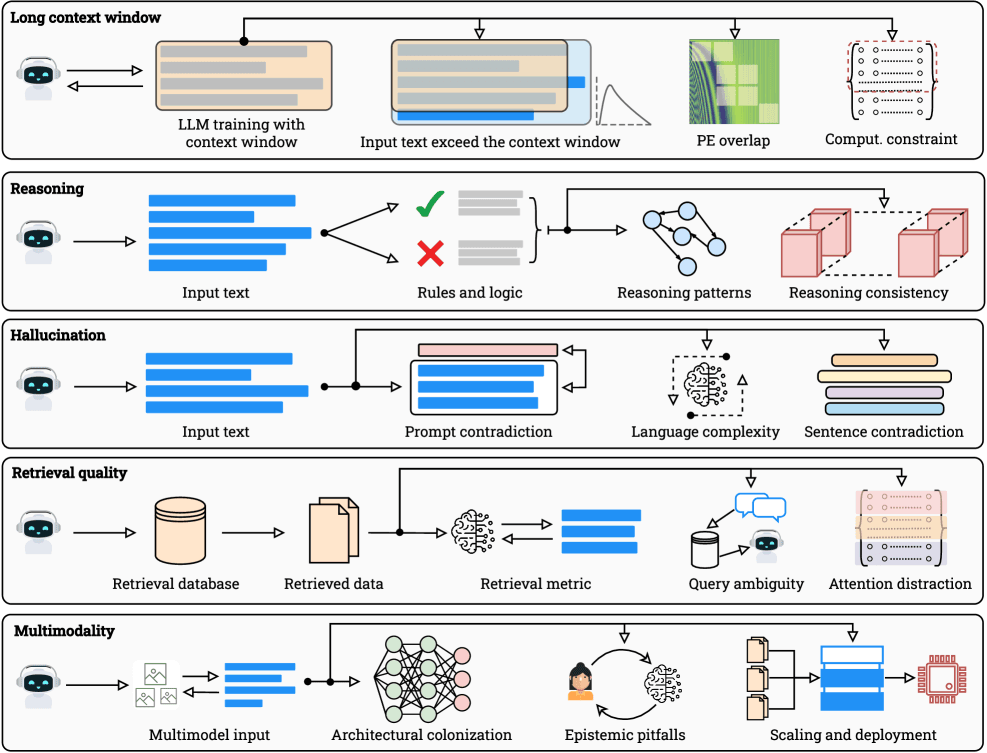
On the Fundamental Limits of LLMs at Scale
This work establishes rigorous mathematical foundations for theoretical limitations constraining LLMs, identifying five fundamental constraints: hallucination (rooted in computability theory), context compression, reasoning degradation, retrieval fragility, and multimodal misalignment. The framework demonstrates that scaling gains are bounded by computability principles, information-theoretic bounds, and geometric effects, providing theorems and empirical evidence outlining where scaling helps, saturates, and cannot progress. The authors propose practical mitigations, including bounded-oracle retrieval, positional curricula, and hierarchical attention mechanisms.
Weight-Sparse Transformers Have Interpretable Circuits
OpenAI researchers introduce a paradigm for training weight-sparse transformers where most parameters are zeros, enabling the discovery of human-understandable circuits that can be fully interpreted at the lowest levels of abstraction, with rigorous validation showing these circuits are both necessary and sufficient for specific behaviors.
Aligning Vision Models with Human Perception
Google DeepMind presents a method to align AI vision models with human visual understanding by addressing systematic differences in how models organize visual representations, demonstrating that alignment improves robustness, generalization, and reliability across diverse vision tasks.
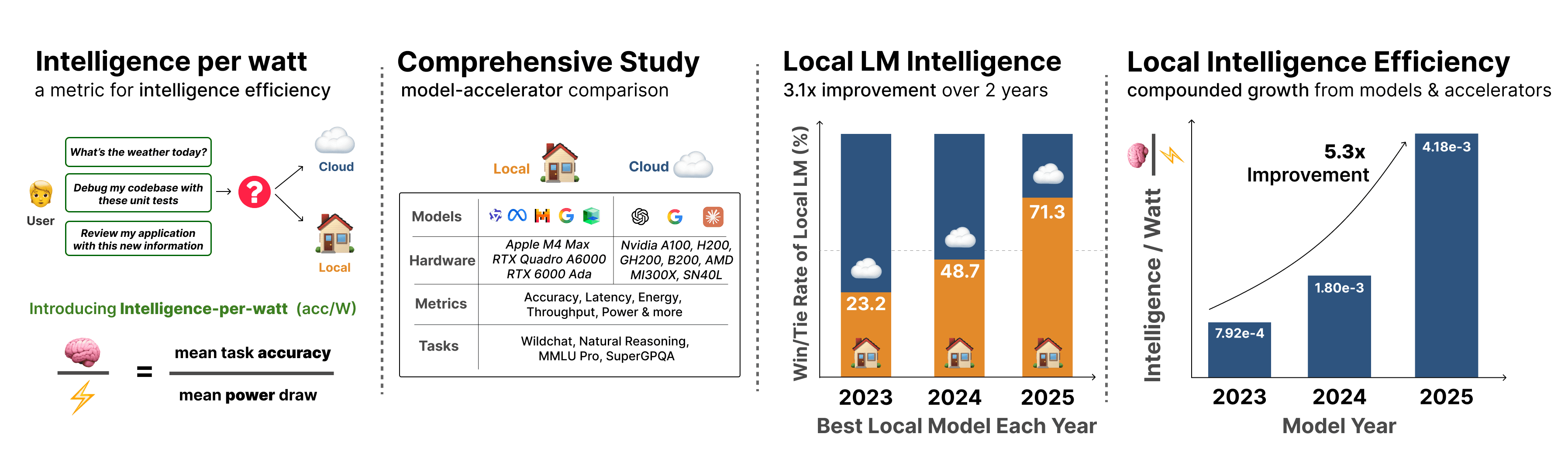
Intelligence per Watt
Stanford and Together AI researchers introduce intelligence per watt (IPW), a unified metric combining task accuracy with power consumption to evaluate local LLM inference viability, conducting the first large-scale empirical study across over 20 models, 8 accelerators, and 1 million real-world queries from 2023-2025.