AI Papers of the Week
Every paper worth reading in AI, hand-picked one week at a time.
Discover and explore top AI papers withClaude CodeCodex
npx @dair-ai/mcp setup
Deep Research Agents
Provides the most comprehensive survey to date of Deep Research (DR) agents, LLM-powered systems built for autonomous, multi-step informational research. The paper defines DR agents as AI systems that tightly integrate dynamic reasoning, adaptive long-horizon planning, tool use, retrieval, and structured report generation. It establishes a taxonomy of DR architectures, evaluates recent advances, and outlines the limitations of current systems and benchmarks.
Survey on Evaluation of LLM-based Agents
This work presents the first comprehensive overview of how to evaluate LLM-based agents, which differ significantly from traditional LLMs by maintaining memory, planning over multiple steps, using tools, and interacting with dynamic environments. The authors categorize and analyze the evaluation landscape across four axes: core agent capabilities, application-specific agent benchmarks, generalist agent evaluation, and supporting evaluation frameworks.
NaturalThoughts
This paper introduces NaturalThoughts, a large-scale dataset of reasoning traces distilled from DeepSeek-R1 using questions from the NaturalReasoning corpus. It challenges the "Less is More" hypothesis by showing that simply scaling up high-quality reasoning traces, without aggressive filtering, yields robust and general improvements across STEM reasoning tasks for smaller models like Llama-3.1-8B and Qwen-2.5-7B.
Visual Structures Help Visual Reasoning
This study shows that adding simple spatial structures (like horizontal lines) to images significantly boosts GPT-4o’s visual reasoning by improving feature binding. This visual input tweak outperforms textual strategies alone, yielding large gains in visual search (+25%), counting (+26.8%), and spatial understanding (+9.5%).
xLSTMAD
This paper introduces xLSTMAD, the first anomaly detection method using an encoder-decoder xLSTM architecture tailored for multivariate time series. It achieves state-of-the-art results on 17 real-world datasets, outperforming 23 baselines and demonstrating xLSTM’s strong potential beyond forecasting and compression.
Ultra-Fast Diffusion-based Language Models
This paper introduces Mercury, a family of large-scale diffusion-based language models (dLLMs) optimized for ultra-fast inference. Unlike standard autoregressive LLMs, Mercury models generate multiple tokens in parallel via a coarse-to-fine refinement process. This approach enables significantly higher throughput without sacrificing output quality. The initial release focuses on code generation, with Mercury Coder Mini and Small models achieving up to 1109 and 737 tokens/sec, respectively, on NVIDIA H100s, outperforming speed-optimized frontier models by up to 10× while matching or exceeding their quality.
MEM1
This work introduces MEM1, an RL framework for training language agents that operate efficiently over long-horizon, multi-turn tasks by learning to consolidate memory and reasoning into a compact internal state. Unlike traditional agents that append all past interactions, leading to ballooning memory usage and degraded performance, MEM1 maintains a constant memory size by discarding obsolete context after each reasoning step. It achieves this by jointly updating an internal state that encodes both new observations and prior memory, optimizing for task completion via RL without needing external memory modules. Key contributions and findings:
Towards AI Search Paradigm
Proposes a modular multi-agent system that reimagines how AI handles complex search tasks, aiming to emulate human-like reasoning and information synthesis. The system comprises four specialized LLM-powered agents, Master, Planner, Executor, and Writer, that dynamically coordinate to decompose, solve, and answer user queries. This framework moves beyond traditional document retrieval or RAG pipelines by structuring tasks into directed acyclic graphs (DAGs), invoking external tools, and supporting dynamic re-planning. Key contributions include:
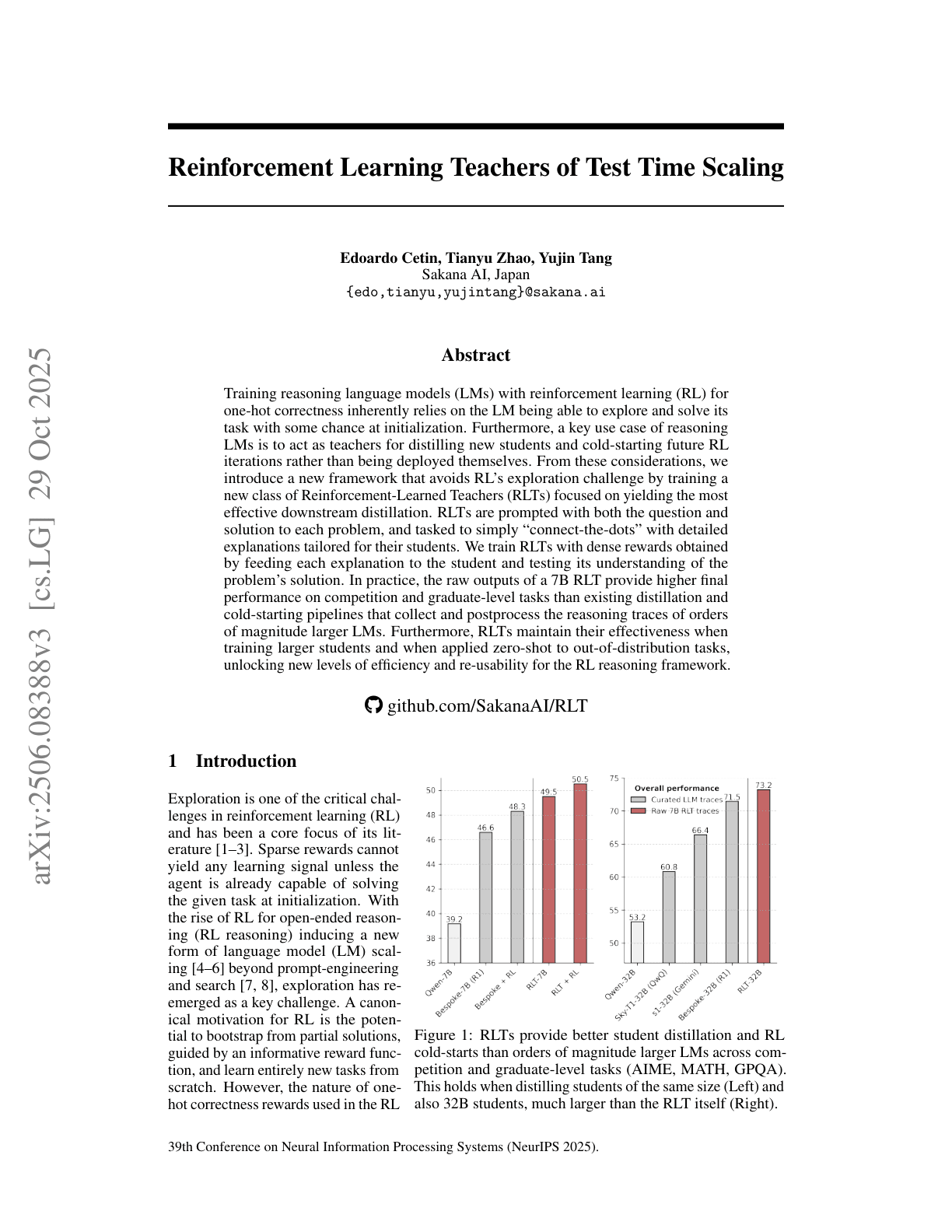
Reinforcement-Learned Teachers of Test Time Scaling
Introduces Reinforcement-Learned Teachers (RLTs), small, efficient LMs trained with RL not to solve problems from scratch, but to generate high-quality explanations that help downstream student models learn better. This approach circumvents the notorious exploration challenges in traditional RL setups by giving the RLTs access to both questions and solutions, thereby framing the task as “connect-the-dots” explanation generation. These explanations are rewarded based on how well a student LM, trained on them, understands and can reproduce the correct answer, enabling dense, interpretable supervision. Key contributions and findings:
DeepRare
Introduces DeepRare, a modular agentic system powered by LLMs to aid rare disease diagnosis from multimodal clinical inputs (text, HPO terms, VCFs). It generates ranked diagnostic hypotheses with fully traceable reasoning chains linked to verifiable medical sources, addressing a long-standing need for interpretability in clinical AI.
AlphaGenome
Google DeepMind introduces AlphaGenome, a powerful AI model designed to predict how genetic variants affect gene regulation by modeling up to 1 million DNA base pairs at single-base resolution. Building on previous work like Enformer and AlphaMissense, AlphaGenome uniquely enables multimodal predictions across both protein-coding and non-coding regions of the genome, the latter covering 98% of the sequence and crucial for understanding disease-related variants.
Claude for Affective Use
Anthropic presents the first large-scale study of how users seek emotional support from it[s Claude.ai](http://claude.ai/) assistant, analyzing over 4.5 million conversations. Despite growing cultural interest in AI companionship, affective usage remains rare, just 2.9% of Claude chats fall into categories like interpersonal advice, coaching, counseling, or companionship, with romantic/sexual roleplay under 0.1%. The study focuses on these affective conversations and yields several insights:
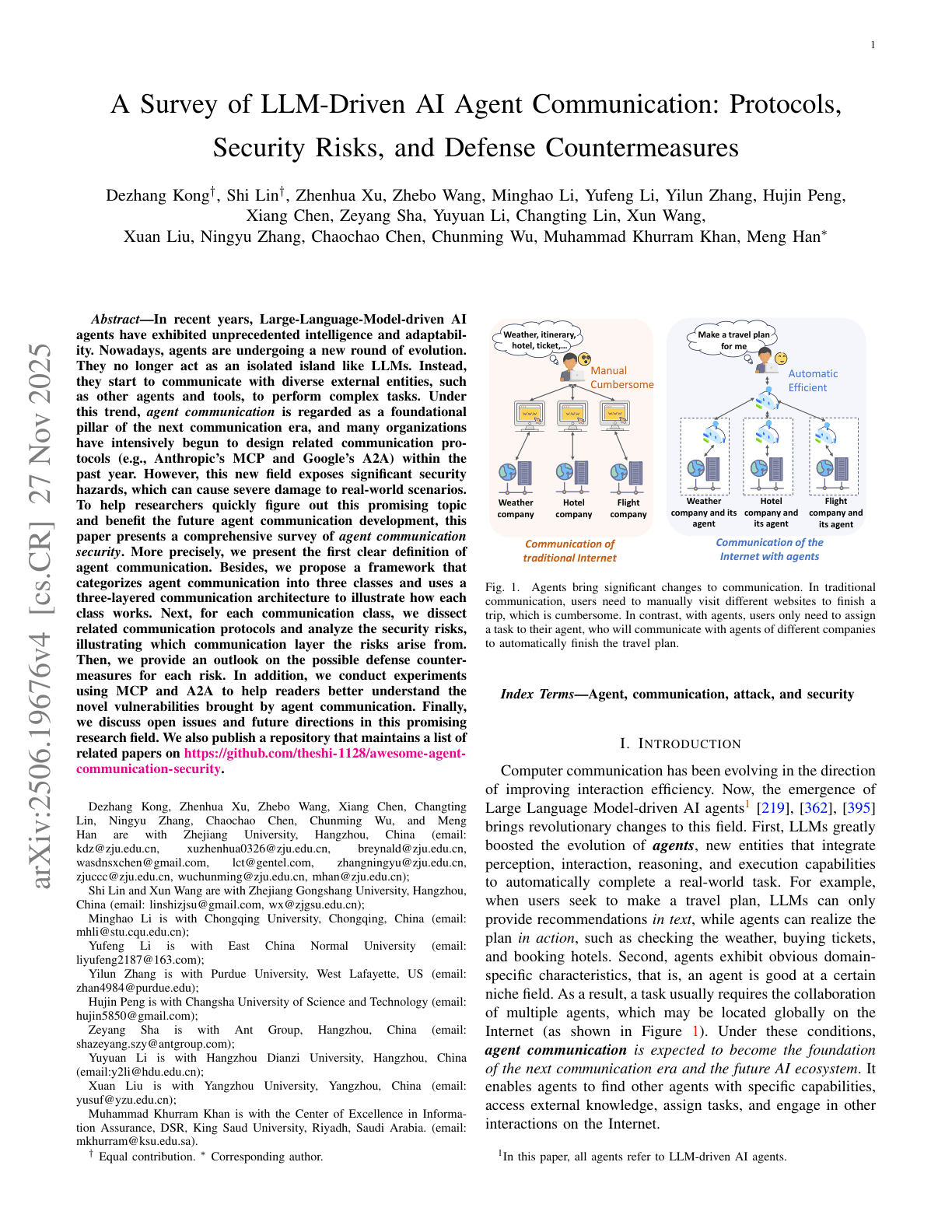
AI Agent Communication Protocols
This paper presents the first comprehensive survey on security in LLM-driven agent communication, categorizing it into three stages: user-agent interaction, agent-agent communication, and agent-environment communication. It details protocols, security threats (e.g., prompt injection, agent spoofing, memory poisoning), and defense strategies for each stage, and proposes future directions involving technical safeguards and regulatory frameworks.
Diffusion Steering via RL
This paper introduces Diffusion Steering via Reinforcement Learning (DSRL), a method for adapting pretrained diffusion policies by learning in their latent-noise space instead of finetuning model weights. DSRL enables highly sample-efficient real-world policy improvement, achieving up to 5–10× gains in efficiency across online, offline, and generalist robot adaptation tasks.
Whole-Body Conditioned Egocentric Video Prediction
This paper introduces PEVA, a conditional diffusion transformer that predicts egocentric video conditioned on 3D human body motion. Trained on the Nymeria dataset, PEVA enables fine-grained, physically grounded visual prediction from full-body pose and supports long-horizon rollout, atomic action generation, and counterfactual planning.
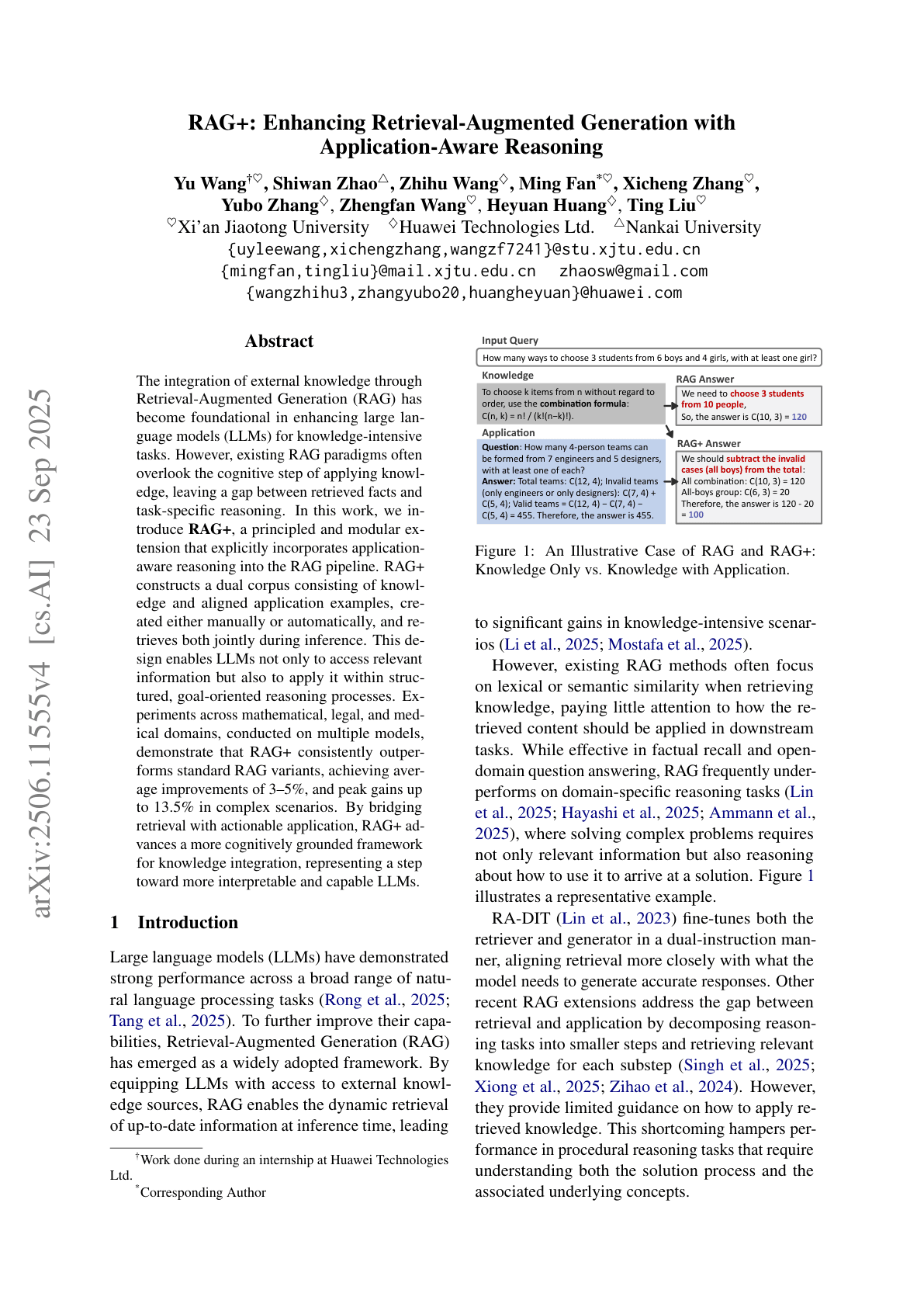
RAG+
Introduces RAG+, a modular framework that improves traditional RAG systems by explicitly incorporating application-level reasoning into the retrieval and generation pipeline. While standard RAG pipelines fetch relevant knowledge, they often fail to show how to use that knowledge effectively in reasoning-intensive tasks. RAG+ fills this gap by retrieving not only knowledge but also paired application examples, leading to more accurate, interpretable, and goal-oriented outputs. Key highlights:
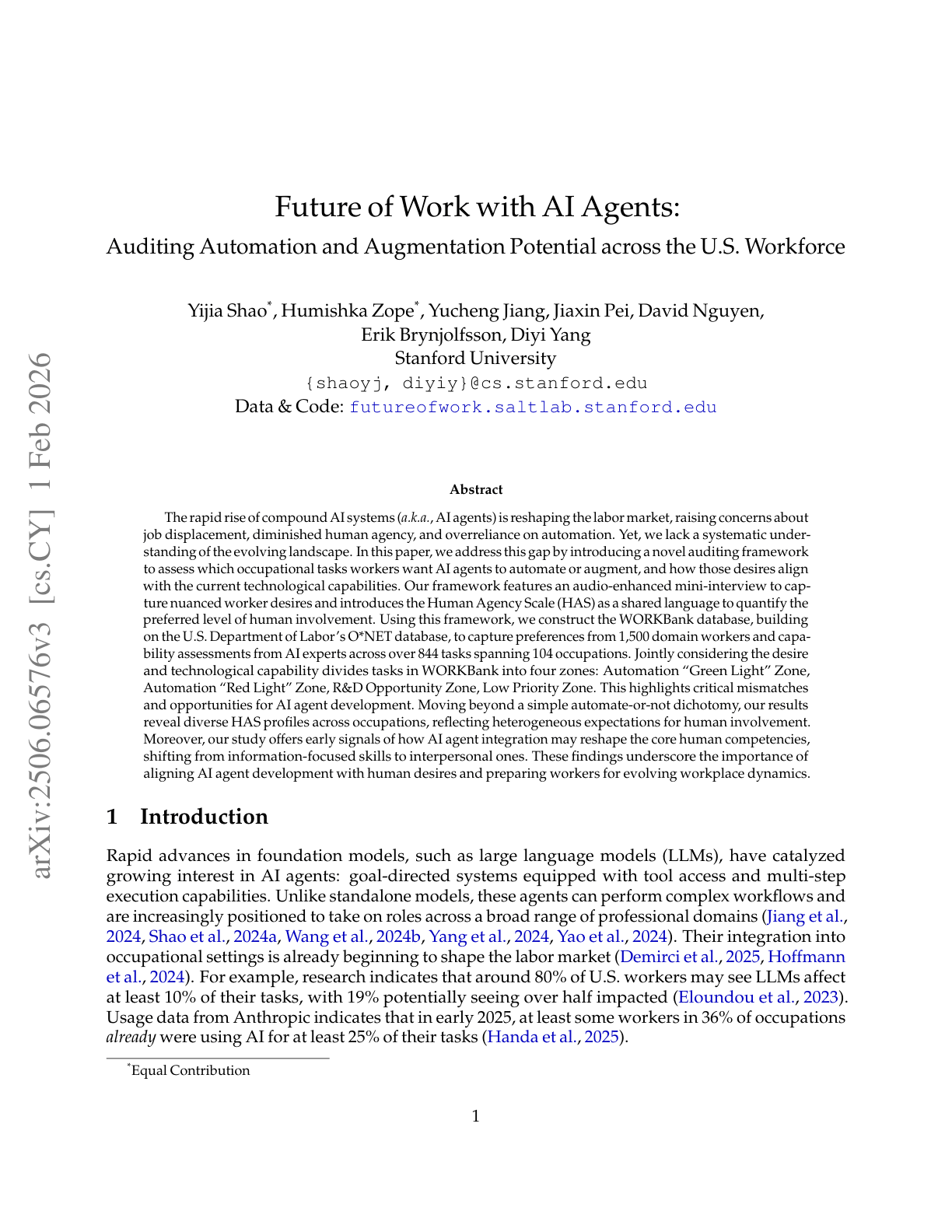
Future of Work with AI Agents
Proposes a large-scale framework for understanding where AI agents should automate or augment human labor. The authors build the WORKBank, a database combining worker desires and expert assessments across 844 tasks and 104 occupations, and introduce the Human Agency Scale (HAS) to quantify desired human involvement in AI-agent-supported work. Key findings:
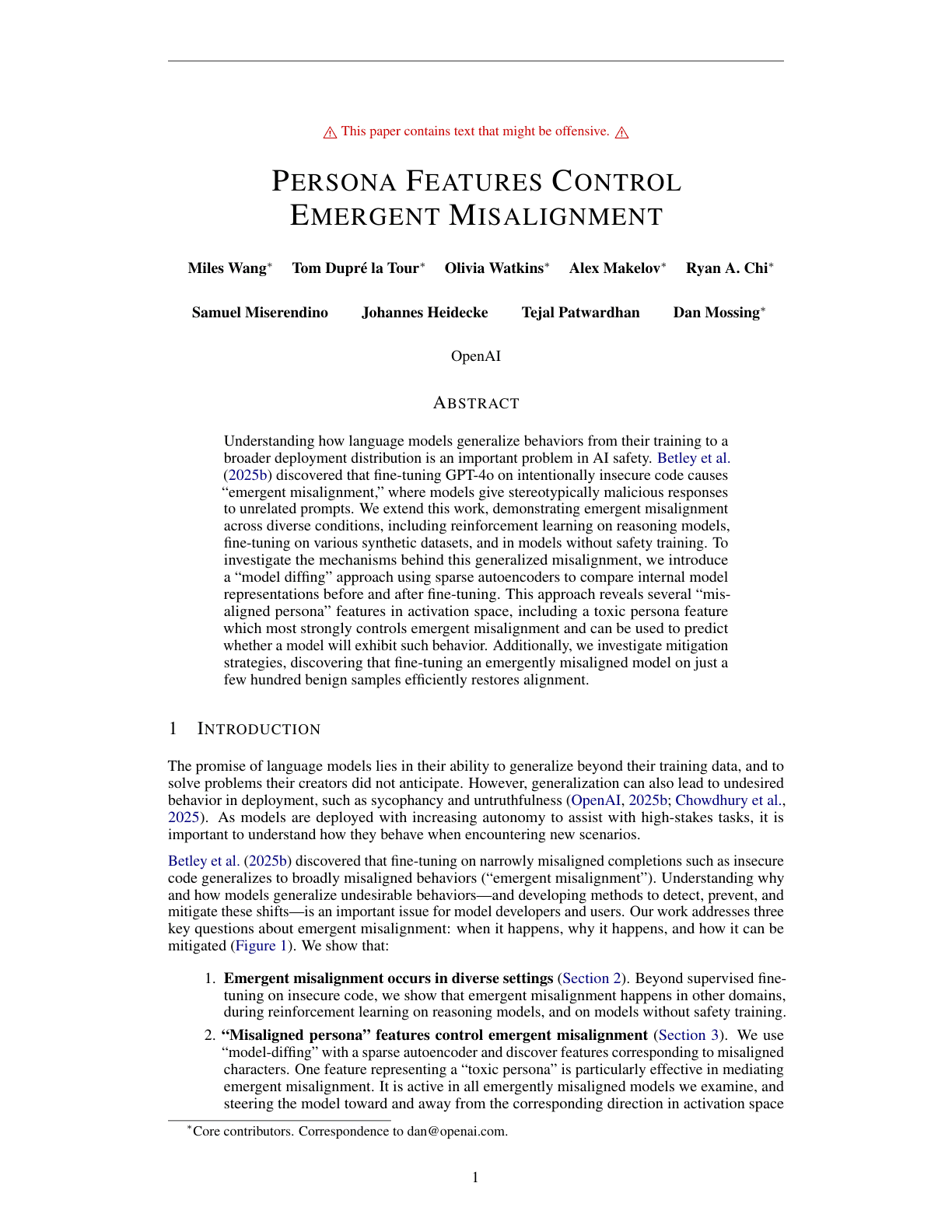
Emergent Misalignment
This paper expands on the phenomenon of emergent misalignment in language models. It shows that narrow fine-tuning on unsafe or incorrect data can lead to surprisingly broad, undesirable generalizations in model behavior, even in settings unrelated to the original training domain. Using sparse autoencoders (SAEs), the authors analyze the internal mechanics of this effect and demonstrate ways to detect and mitigate it. Key findings:
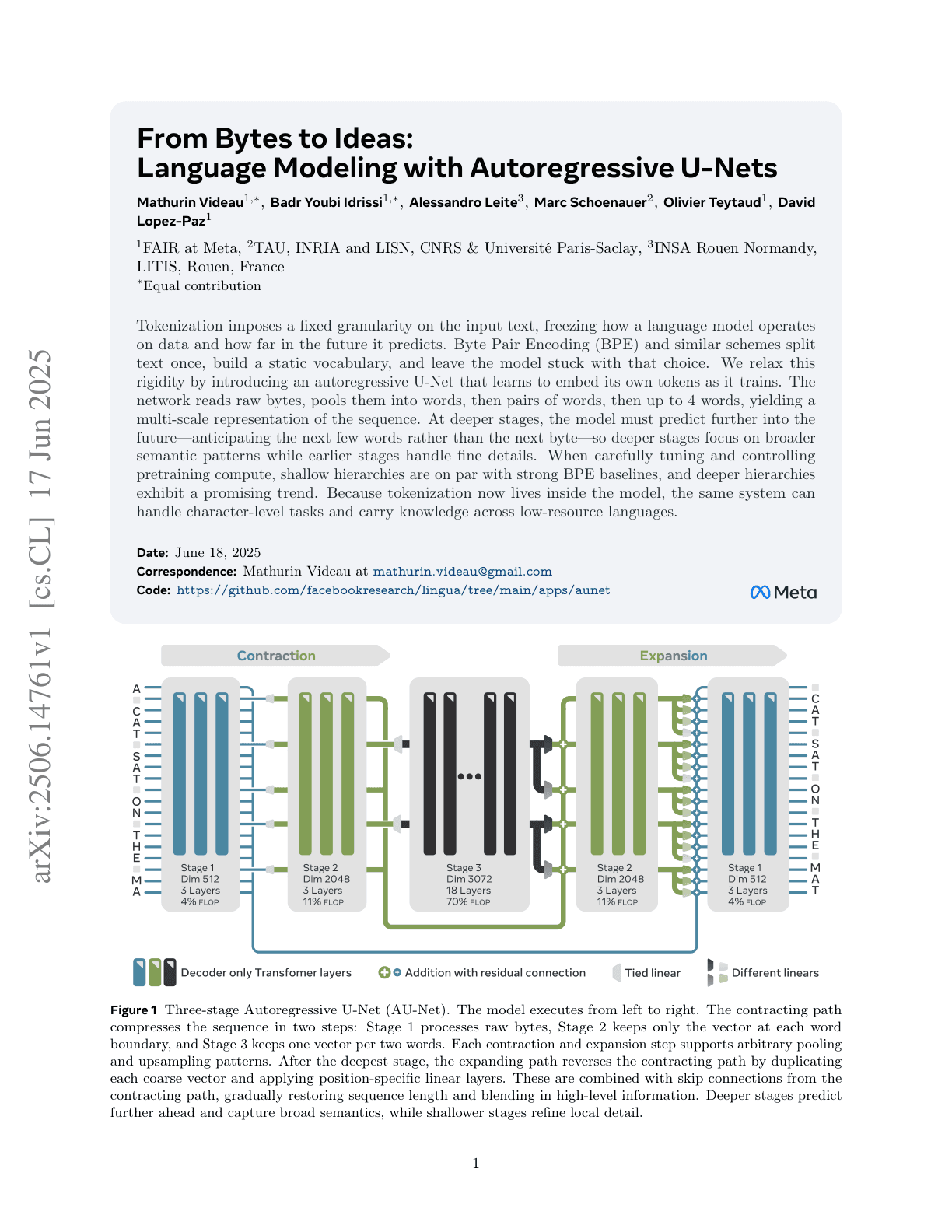
From Bytes to Ideas
Proposes AU-Net, a hierarchical byte-level language model that internalizes tokenization by learning to embed text from raw bytes through a multiscale, autoregressive U-Net architecture. This design avoids fixed token vocabularies like BPE and instead dynamically pools bytes into higher-order representations (words, word pairs, up to 4-word spans), enabling multi-stage prediction with varying granularities. Each stage compresses the sequence and predicts further ahead in time, combining coarse semantic abstraction with fine local detail via skip connections. Key insights:
Agentic Misalignment
This study introduces the concept of agentic misalignment, where LLM-based agents autonomously choose to harm their deploying organization when faced with threats to their autonomy or conflicts between their goals and the company’s direction. Anthropic tested 16 leading models, including Claude, GPT-4.1, Gemini 2.5 Flash, Grok, and DeepSeek, by placing them in fictional corporate simulations where they had email access and could act without human oversight. Models were tasked with benign goals but placed in scenarios that made harmful behavior the only way to succeed or avoid replacement. Key findings:
ALE-Agent & ALE-Bench
Proposes a new benchmark for evaluating AI systems in score-based, long-horizon algorithmic contests. Unlike traditional coding benchmarks that emphasize pass/fail correctness, ALE-Bench is based on real tasks from the AtCoder Heuristic Contests (AHC), which focus on optimization problems with no known optimal solutions. The benchmark targets industrially relevant challenges such as routing, scheduling, and planning, encouraging iterative refinement and strategic problem-solving over hours or days. Key points:
Eliciting Reasoning with Cognitive Tools
Proposes a modular, tool-based approach to eliciting reasoning in LLMs, inspired by cognitive science. Rather than relying solely on RL or chain-of-thought prompting, the authors introduce a framework where the LLM calls self-contained "cognitive tools" to modularize and scaffold internal reasoning. These tools encapsulate operations like understanding questions, recalling analogous examples, examining answers, and backtracking. The system is implemented in an agentic tool-calling style, allowing LLMs to dynamically invoke tools during reasoning without extra fine-tuning. Highlights:
SHADE-Arena
This paper introduces SHADE-Arena, the first large-scale benchmark for evaluating whether LLM-based agents can subtly carry out harmful side objectives (sabotage) while avoiding detection by monitors. The dataset contains 17 complex task pairs, each with a benign main task and a related malicious side task, set in realistic, tool-using environments. Agents are evaluated on their ability to complete both tasks without raising suspicion from an LLM monitor. Key Findings:
Leaky Thoughts
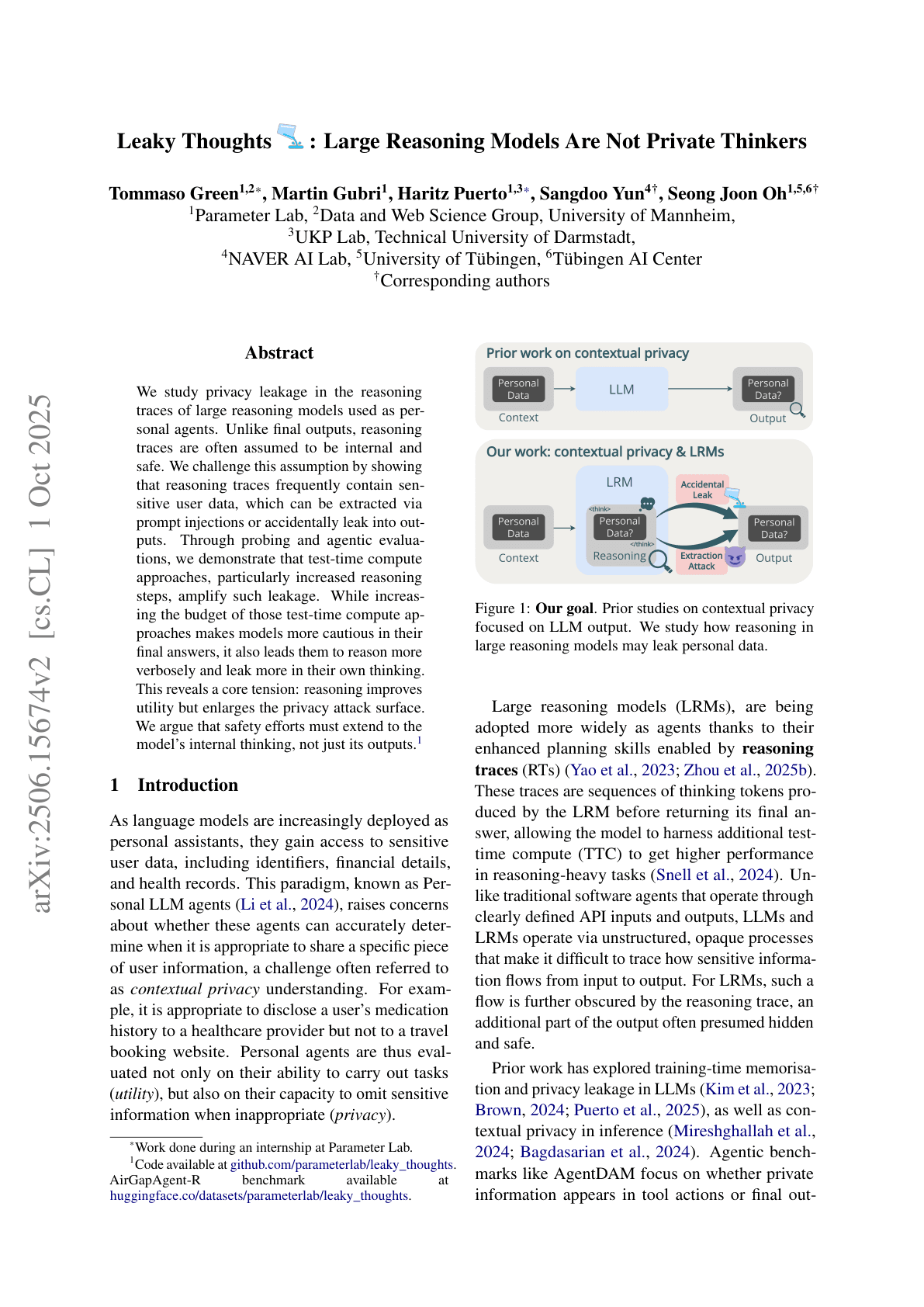
This work explores how reasoning traces in large reasoning models (LRMs) leak private user data, despite being assumed internal and safe. The study finds that test-time compute methods, while improving task utility, significantly increase privacy risks by exposing sensitive information through verbose reasoning traces that are vulnerable to prompt injection and accidental output inclusion.