AI Papers of the Week
Every paper worth reading in AI, hand-picked one week at a time.
Discover and explore top AI papers withClaude CodeCodex
npx @dair-ai/mcp setup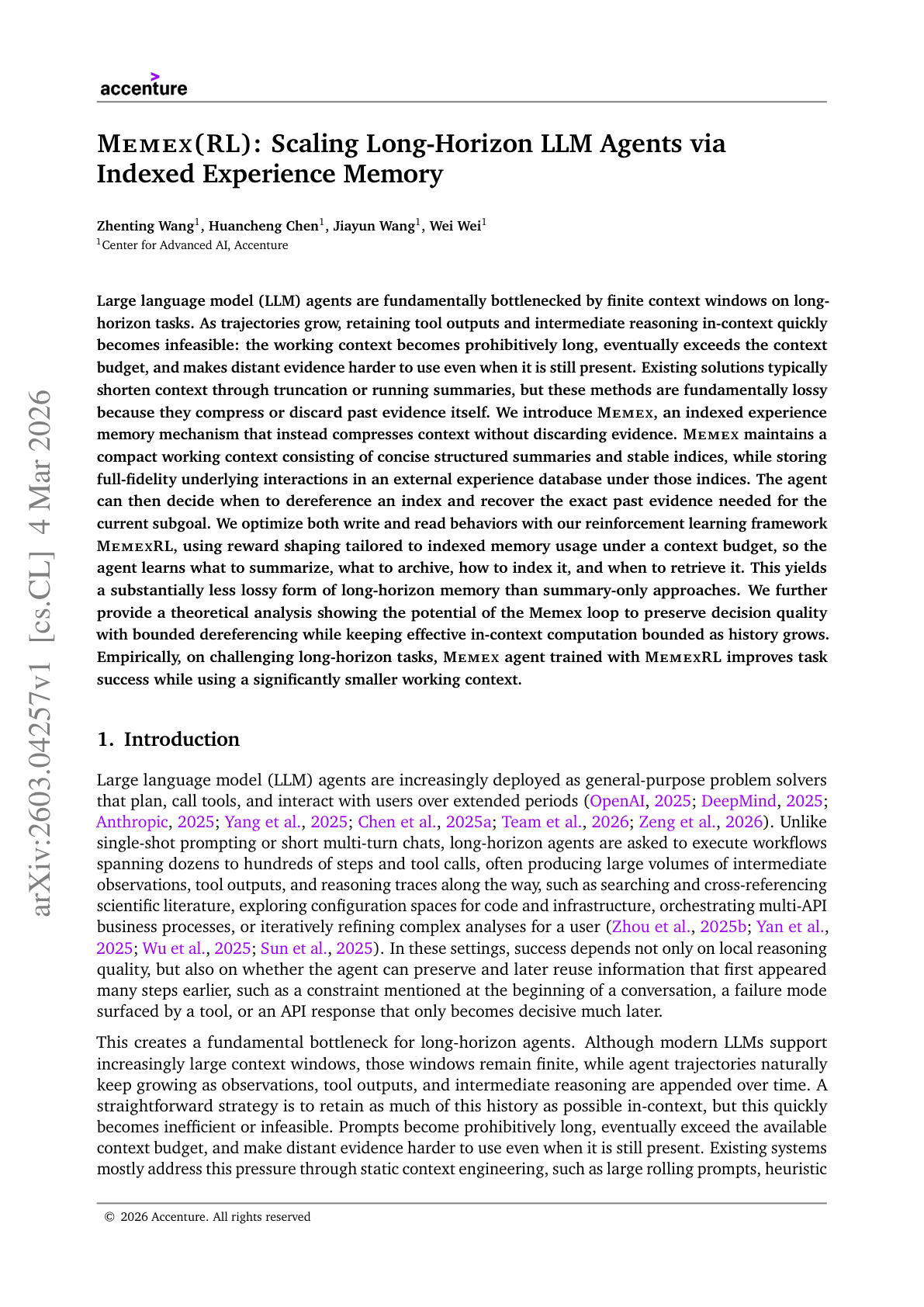
Memex(RL)
As tasks get longer and more complex, LLM agents lose track of what they have learned, what they have tried, and what still needs to be done. Memex(RL) introduces an indexed experience memory mechanism that scales agent capability on long-horizon tasks without discarding evidence or blowing up the context window.
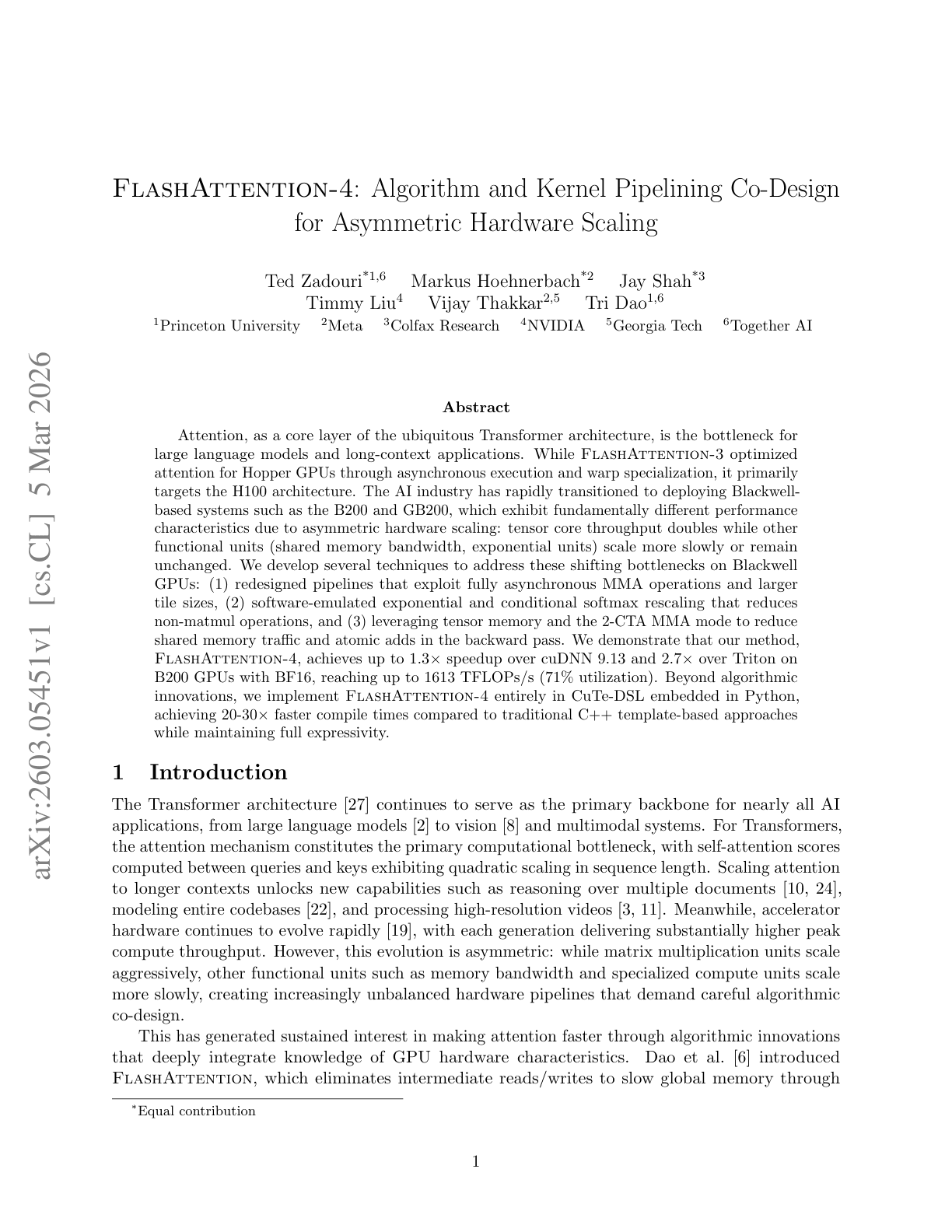
FlashAttention-4
FlashAttention-4 co-designs algorithms and kernel pipelines for the B200 and GB200 GPUs, which exhibit fundamentally different performance characteristics due to asymmetric hardware scaling where tensor core throughput doubles while other functional units scale more slowly.
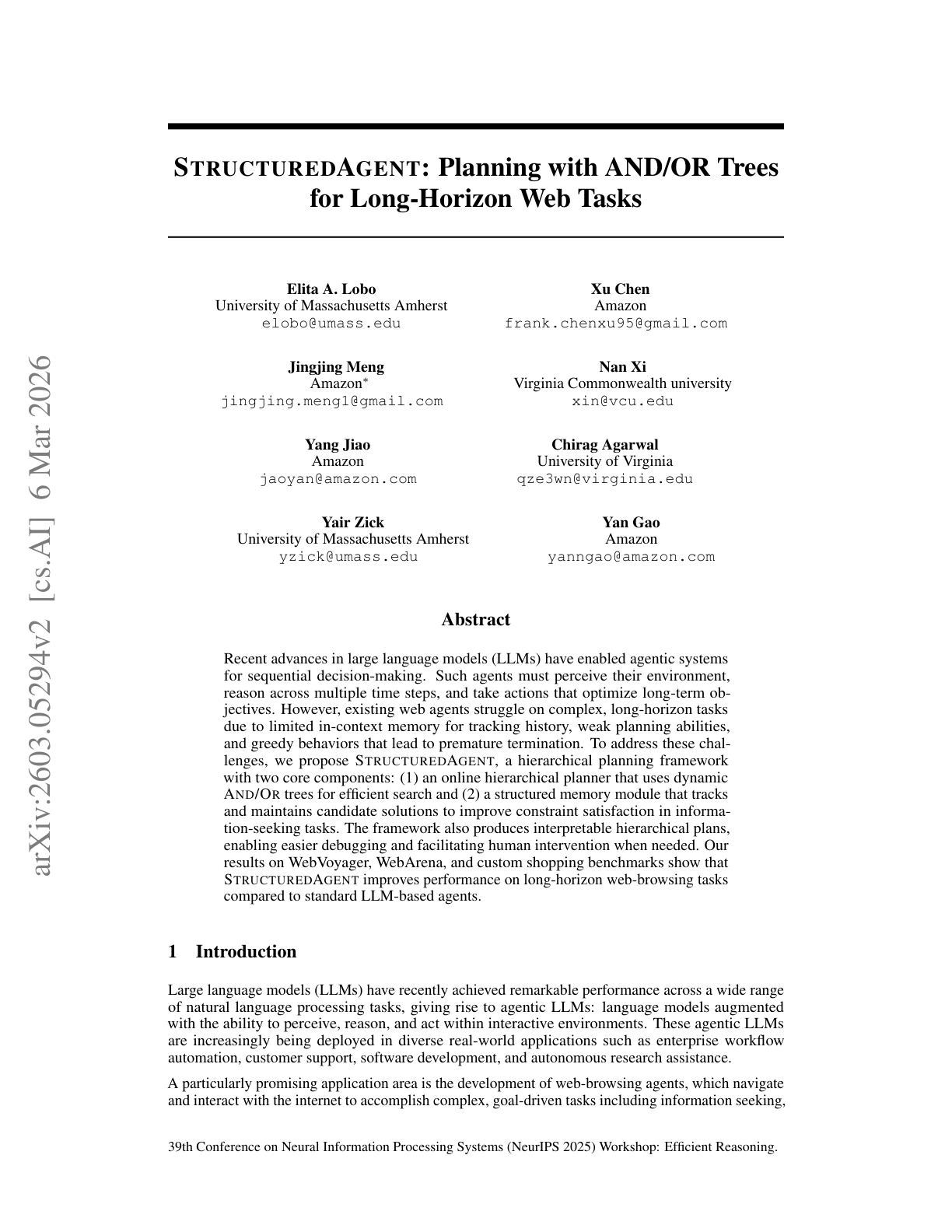
STRUCTUREDAGENT
STRUCTUREDAGENT introduces a hierarchical planning framework for long-horizon web tasks using dynamic AND/OR trees. The framework separates planning responsibilities: the system constructs and maintains the planning tree while the LLM is invoked only for local operations like node expansion or repair. A structured memory module tracks candidate solutions to improve constraint satisfaction. Results on WebVoyager, WebArena, and custom shopping benchmarks show improved performance over standard LLM-based web agents, with the added benefit of interpretable hierarchical plans that enable easier debugging and human intervention.
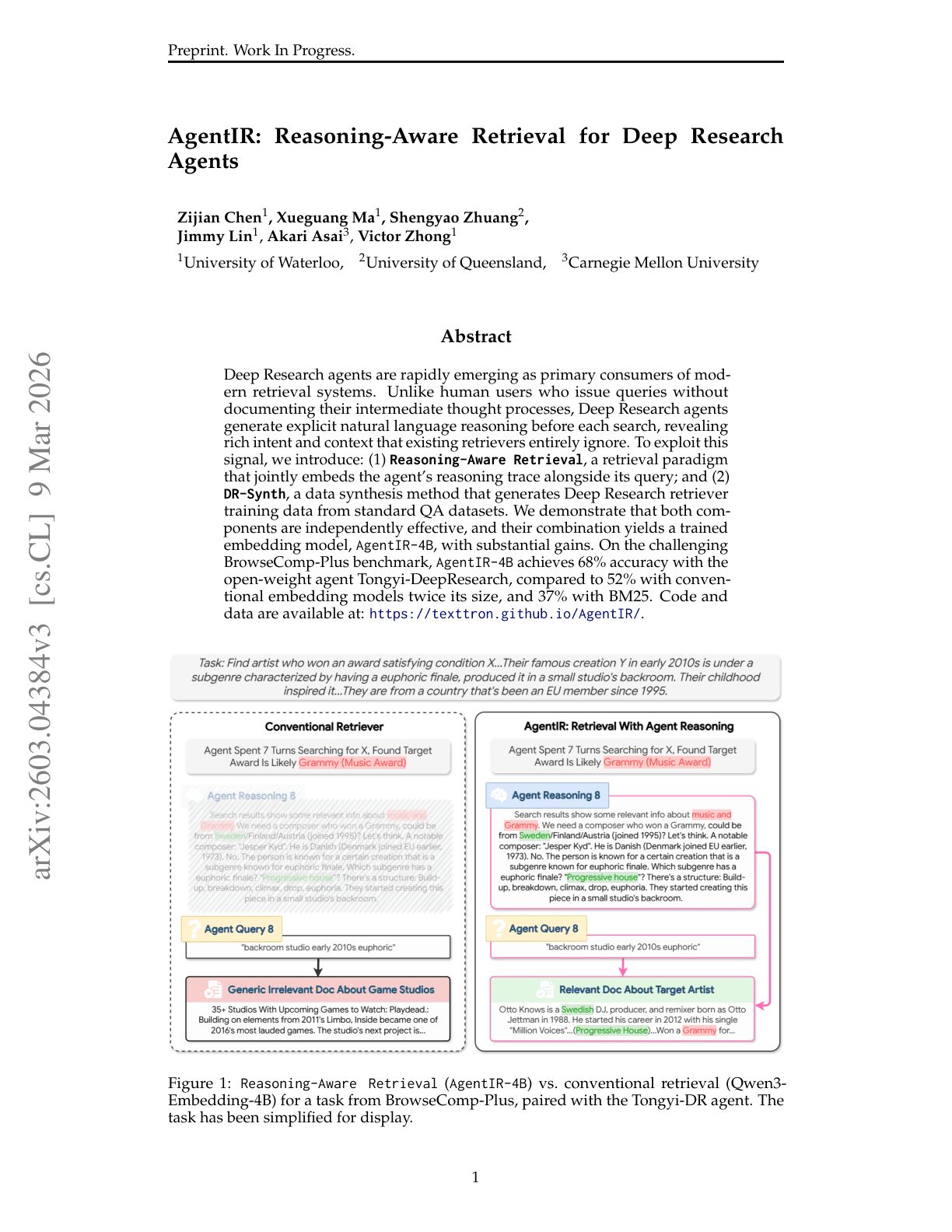
AgentIR
Deep research agents generate explicit reasoning before every search call, but existing retrievers completely ignore these rich signals about search intent and problem context. AgentIR introduces reasoning-aware retrieval that jointly embeds the agent’s reasoning trace alongside its query, along with DR-Synth, a data synthesis method for generating training data from standard QA datasets. On BrowseComp-Plus, AgentIR-4B achieves 68% accuracy with Tongyi-DeepResearch compared to 50% with conventional embedding models twice its size and 37% with BM25.
Think Harder or Know More
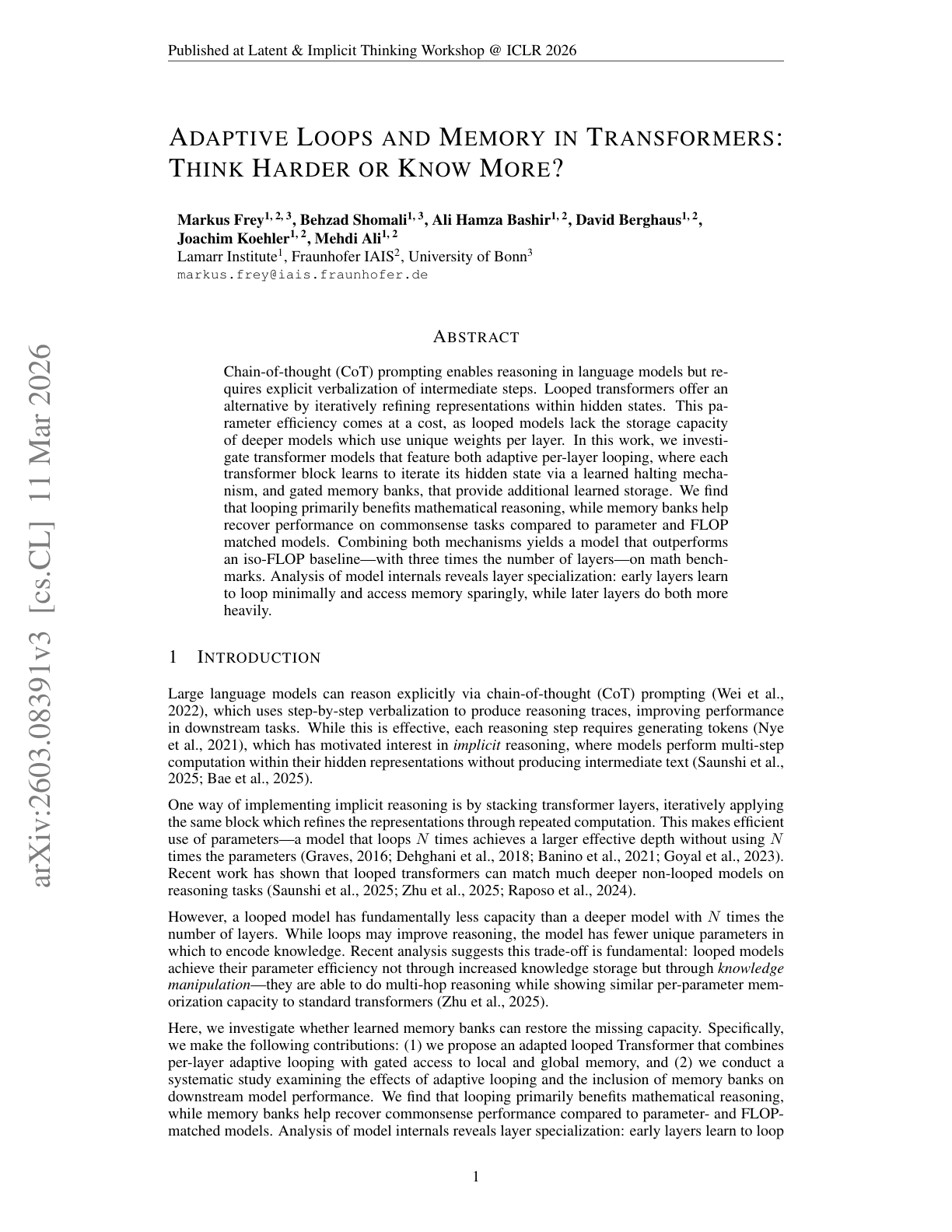
This paper investigates transformer models featuring both adaptive per-layer looping, where each block learns to iterate its hidden state via a learned halting mechanism, and gated memory banks that provide additional learned storage. The key finding is that looping primarily benefits mathematical reasoning while memory banks help recover performance on commonsense tasks. Combining both mechanisms yields a model that outperforms an iso-FLOP baseline with three times the number of layers on math benchmarks. Analysis of model internals reveals layer specialization: early layers loop minimally and access memory sparingly, while later layers do both more heavily.
NeuroSkill
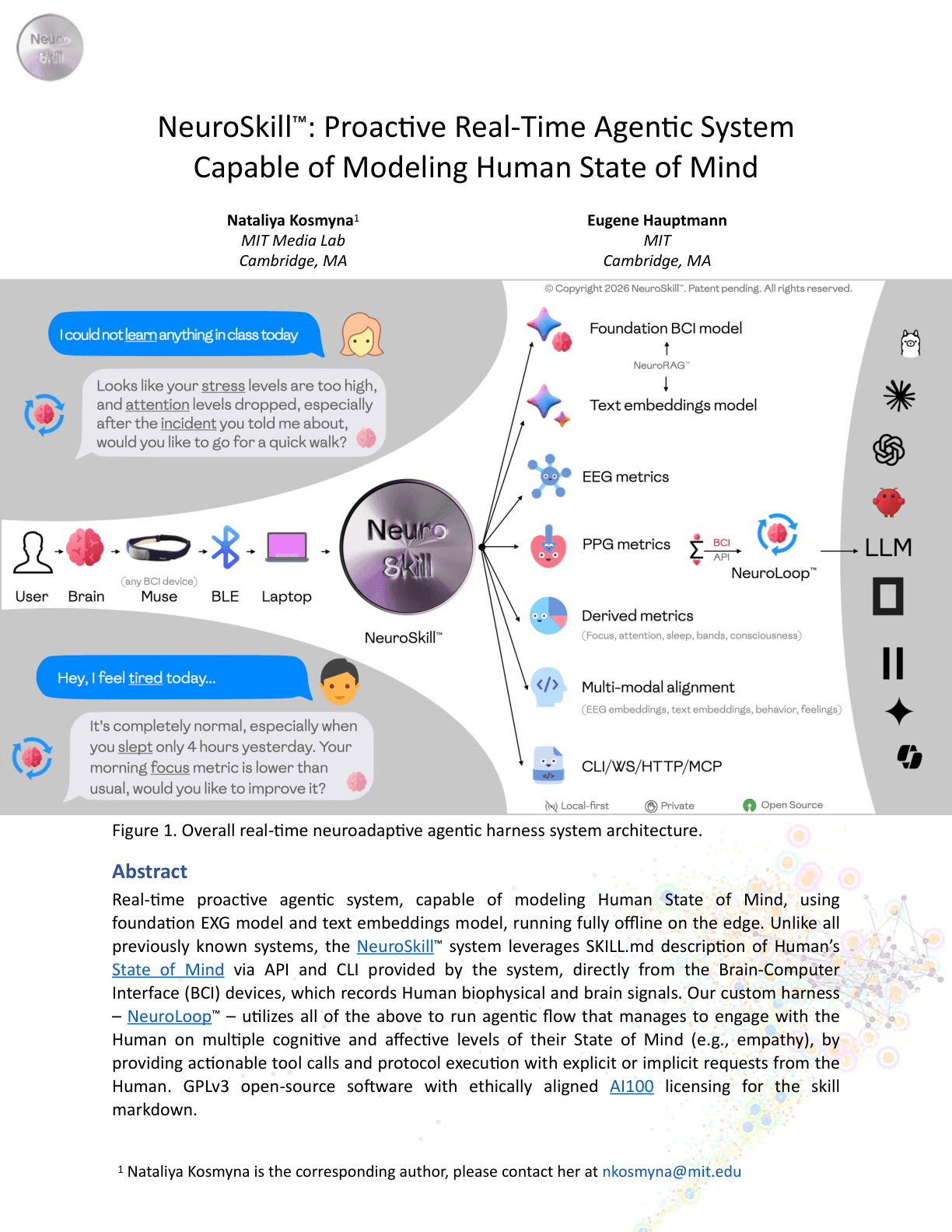
MIT researchers introduce NeuroSkill, a real-time proactive agentic system that models human cognitive and emotional state by integrating Brain-Computer Interface (BCI) signals with foundation EXG models and text embeddings. Unlike reactive agents that wait for explicit commands, NeuroSkill operates proactively, interpreting biophysical and neural signals to anticipate user needs.
Bayesian Teaching for LLMs
Google researchers introduce a method to teach LLMs to reason like Bayesians by fine-tuning on interactions with a Bayesian Assistant that represents optimal probabilistic inference. LLMs normally fall far short of normative Bayesian reasoning, but this training approach dramatically improves their ability to update predictions based on new evidence.
Why LLMs Form Geometric Representations
LLMs spontaneously form striking geometric structures in their internal representations: calendar months organize into circles, historical years form spirals, and spatial coordinates align to recoverable manifolds. This paper proves these patterns are not the product of deep learning dynamics but emerge directly from symmetries in natural language statistics.
Theory of Mind in Multi-Agent LLMs
This work introduces a multi-agent architecture combining Theory of Mind (ToM), Belief-Desire-Intention (BDI) models, and symbolic solvers for logical verification, evaluating it on resource allocation problems across multiple LLMs. The central finding is counterintuitive: simply adding cognitive mechanisms does not automatically improve coordination.
Numina-Lean-Agent
Numina-Lean-Agent proposes a paradigm shift in automated theorem proving: instead of building complex, multi-component systems with heavy computational overhead, it directly uses a general coding agent as a formal math reasoner. Combining Claude Code with Numina-Lean-MCP, the system autonomously interacts with the Lean proof assistant while accessing theorem libraries and auxiliary reasoning tools.
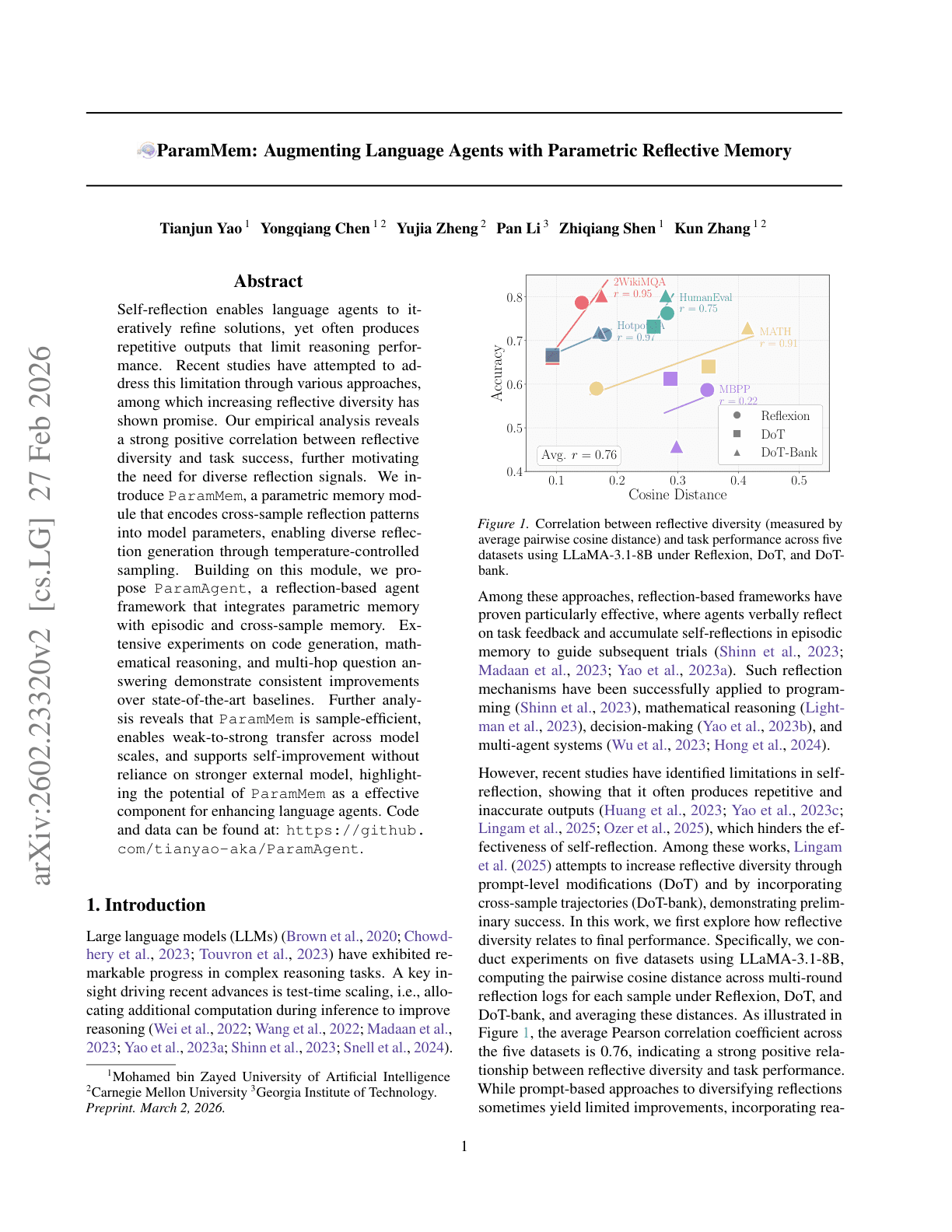
ParamMem
Self-reflection enables language agents to iteratively refine solutions, but models tend to generate repetitive reflections that add noise instead of useful signal. ParamMem introduces a parametric memory module that encodes cross-sample reflection patterns into model parameters, enabling diverse reflection generation through temperature-controlled sampling.
Auton Agentic AI Framework
Snap Research introduces the Auton framework, a declarative architecture for specification, governance, and runtime execution of autonomous agent systems. It addresses a fundamental mismatch: LLMs produce stochastic, unstructured outputs, while backend infrastructure requires deterministic, schema-conformant inputs.
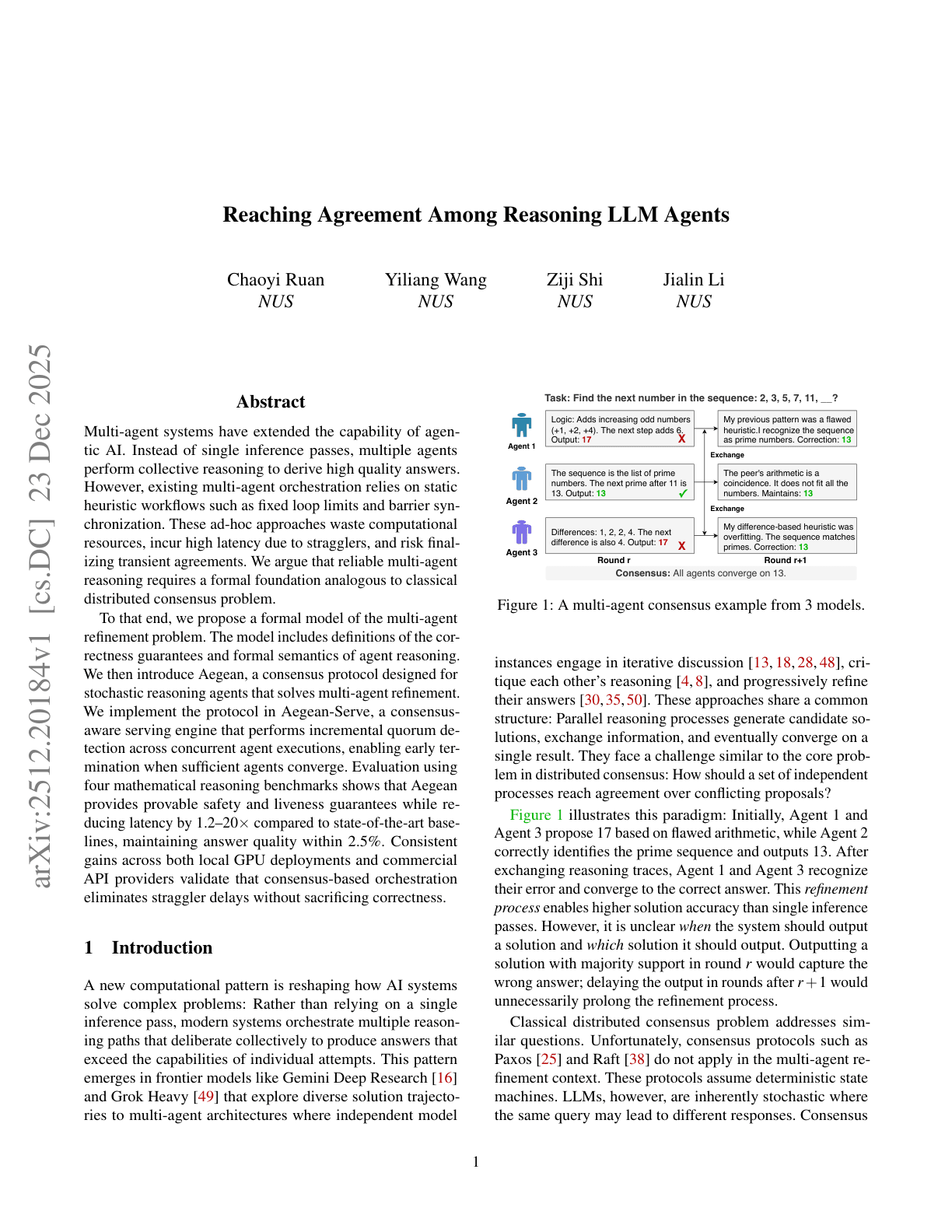
Reaching Agreement Among LLM Agents
This paper introduces Aegean, a consensus protocol that frames multi-agent refinement as a distributed consensus problem. Rather than static heuristic workflows with fixed loop limits, Aegean enables early termination when sufficient agents converge, achieving 1.2-20x latency reduction across four mathematical reasoning benchmarks while maintaining answer quality within 2.5%. The consensus-aware serving engine performs incremental quorum detection across concurrent agent executions, cutting wasted compute on stragglers.
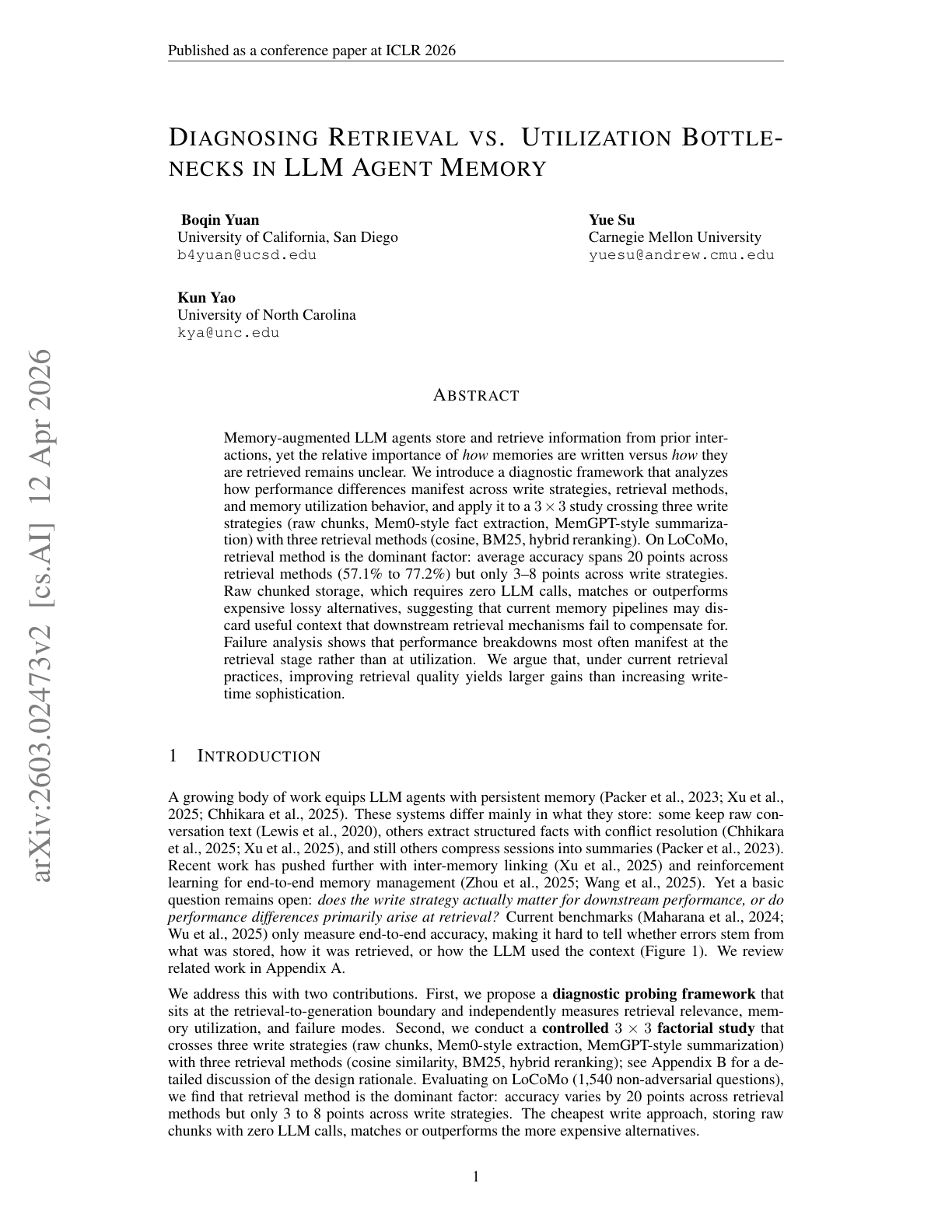
Diagnosing Agent Memory
This paper introduces a diagnostic framework that separates retrieval failures from utilization failures in LLM agent memory systems. Through a 3x3 factorial study crossing three write strategies with three retrieval methods, the authors find that retrieval is the dominant bottleneck, accounting for 11-46% of errors, while utilization failures remain stable at 4-8% regardless of configuration. Hybrid reranking cuts retrieval failures roughly in half, delivering larger gains than any write strategy optimization.
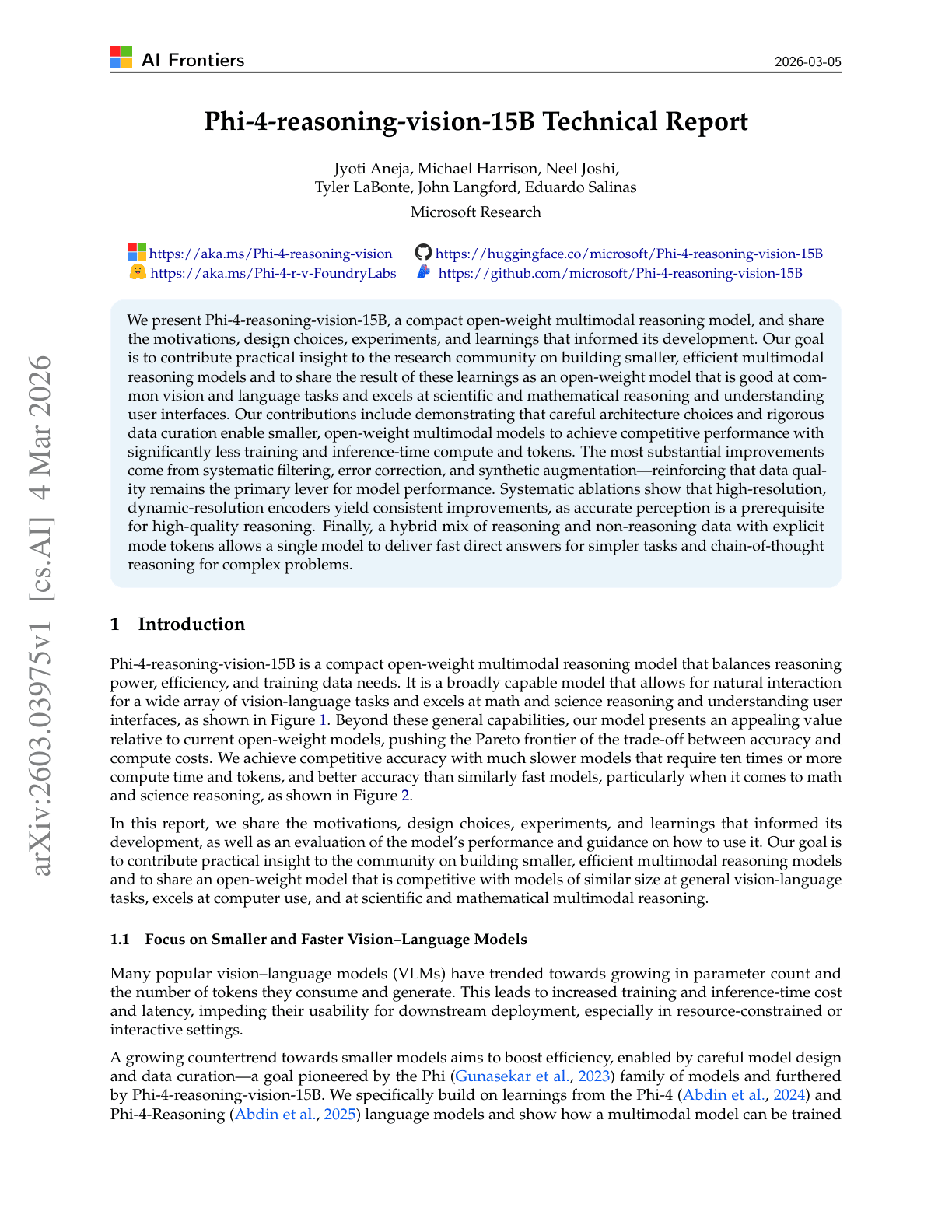
Phi-4-reasoning-vision-15B
Microsoft presents Phi-4-reasoning-vision-15B, a compact open-weight multimodal reasoning model that combines visual understanding with structured reasoning capabilities. Trained on just 200 billion tokens of multimodal data, the model excels at math and science reasoning and UI comprehension while requiring significantly less compute than comparable open-weight VLMs. The key insight is that systematic filtering, error correction, and synthetic augmentation remain the primary levers for model performance, pushing the Pareto frontier of the accuracy-compute tradeoff.
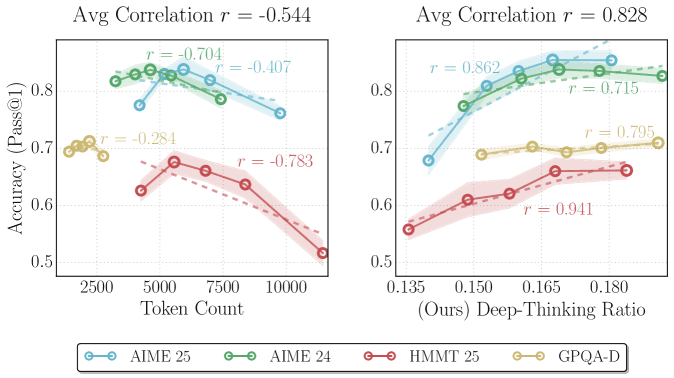
Deep-Thinking Tokens
Google researchers challenge the assumption that longer outputs indicate better reasoning. They introduce deep-thinking tokens, a metric that identifies tokens where internal model predictions shift significantly across layers before stabilizing. Unlike raw token count, which negatively correlates with accuracy (r = -0.59), the deep-thinking ratio shows a robust positive correlation (r = 0.683).
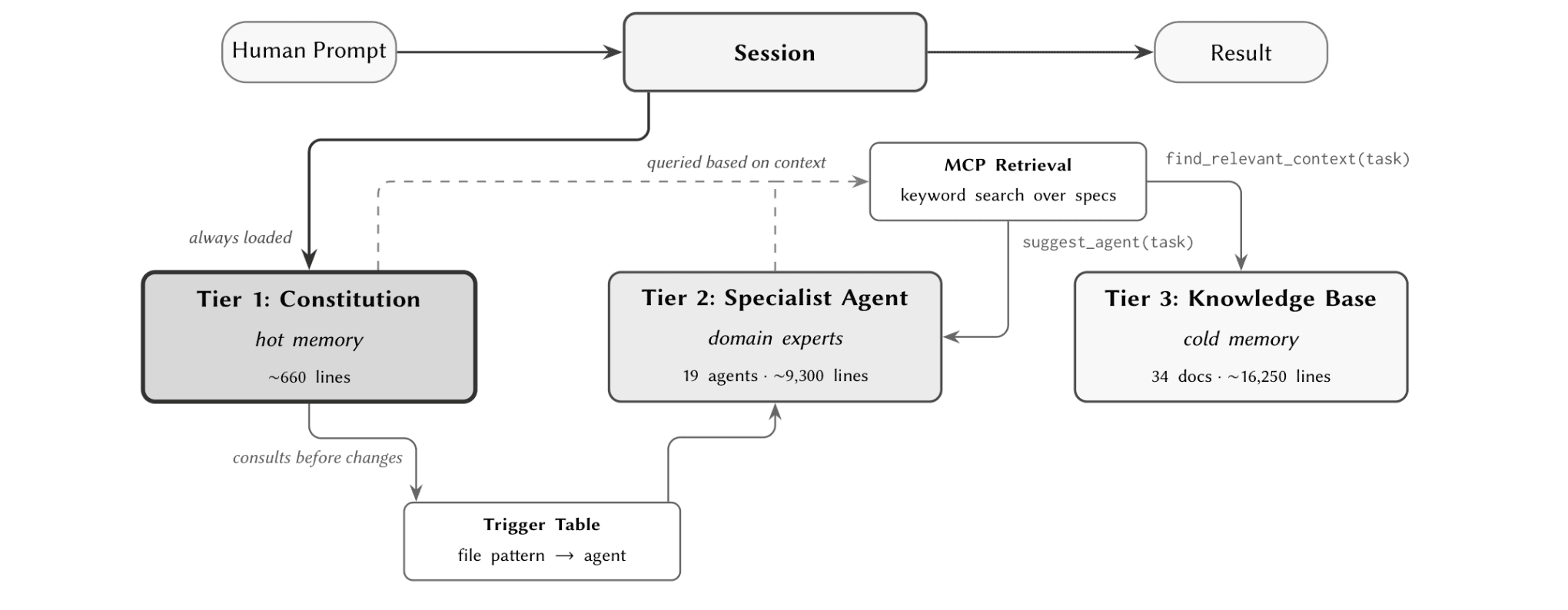
Codified Context
Single-file AGENTS.md manifests don’t scale beyond modest codebases. A 1,000-line prototype can be fully described in a single prompt, but a 100,000-line system cannot. This paper presents a three-component codified context infrastructure developed during construction of a 108,000-line C# distributed system, evaluated across 283 development sessions.
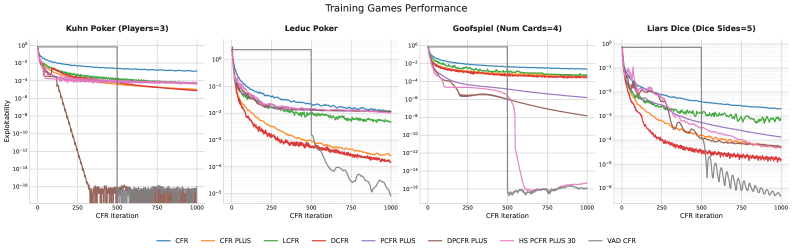
Discovering Multi-Agent Learning Algorithms with LLMs
Google DeepMind uses AlphaEvolve, an evolutionary coding agent powered by LLMs, to automatically discover new multi-agent learning algorithms for imperfect-information games. Rather than relying on manual algorithm design, the system navigates vast algorithmic design spaces and discovers non-intuitive mechanisms that outperform state-of-the-art baselines.
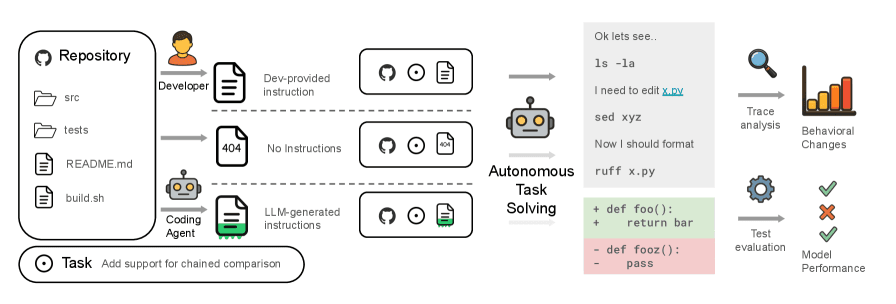
Evaluating AGENTS.md
This research evaluates whether AGENTS.md files, the repository-level context files that developers write to help AI coding agents understand their codebases, actually improve agent performance. Testing four coding agents (Claude Code with Sonnet-4.5, Codex with GPT-5.2 and GPT-5.1 mini, and Qwen Code with Qwen3-30b-coder), the findings are counterintuitive.

PAHF
Meta introduces PAHF (Personalized Agents from Human Feedback), a continual agent personalization framework that addresses a critical gap: most AI agents cannot adapt to individual user preferences that evolve over time. PAHF couples explicit per-user memory with both proactive and reactive feedback mechanisms.
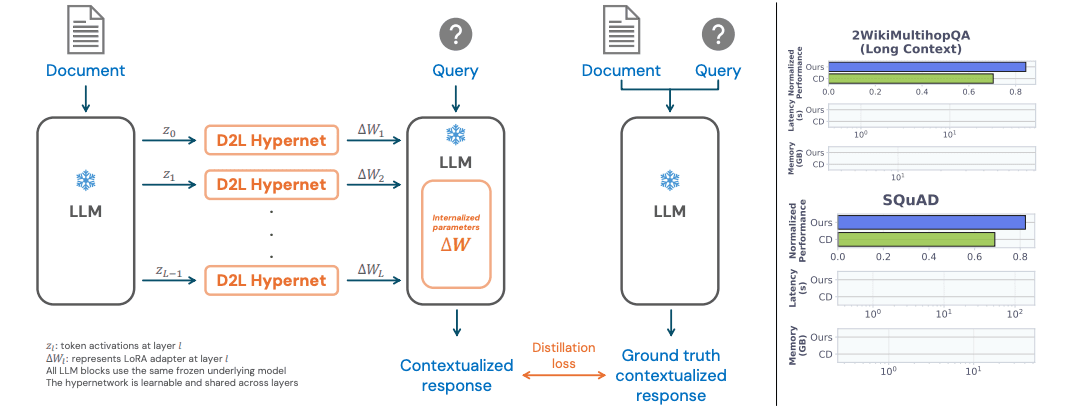
Doc-to-LoRA
Sakana AI introduces Doc-to-LoRA (D2L), a lightweight hypernetwork that meta-learns to compress long documents into LoRA adapters in a single forward pass. Instead of processing long contexts through expensive quadratic attention, D2L converts the document into parameter-space representations that the target LLM can use without re-consuming the original text.
AgentConductor
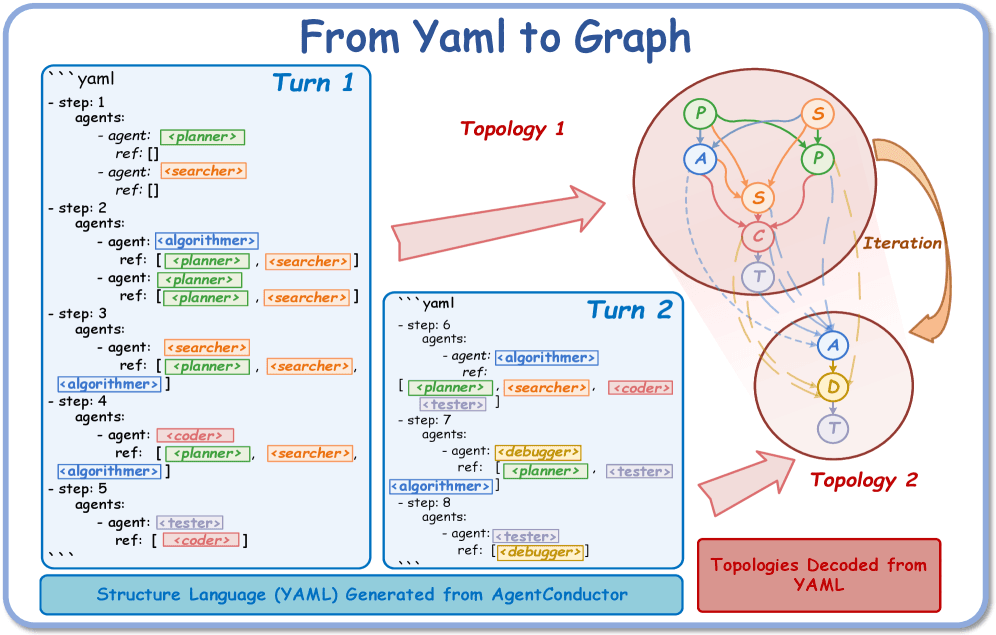
AgentConductor introduces a reinforcement learning-enhanced multi-agent system for code generation that dynamically generates interaction topologies based on task characteristics. Rather than using fixed communication patterns between agents, an LLM-based orchestrator adapts the topology to match problem complexity, achieving state-of-the-art accuracy across five code generation datasets.
ActionEngine
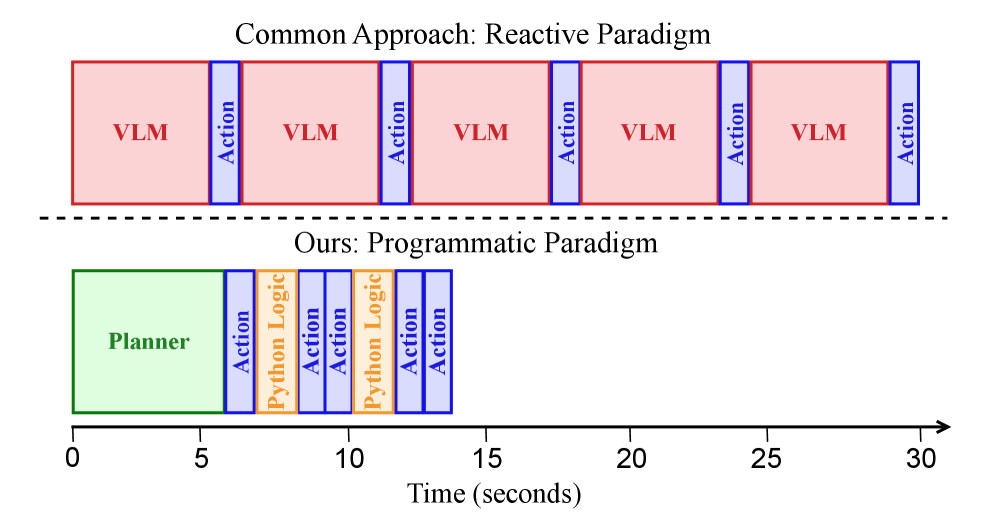
Georgia Tech and Microsoft Research introduce ActionEngine, a training-free framework that transforms GUI agents from reactive step-by-step executors into programmatic planners. It builds a state-machine memory through offline exploration, then synthesizes executable Python programs for task completion, achieving 95% success on Reddit tasks from WebArena with on average a single LLM call, reducing costs by 11.8x and latency by 2x compared to vision-only baselines.
CoT Faithfulness via REMUL
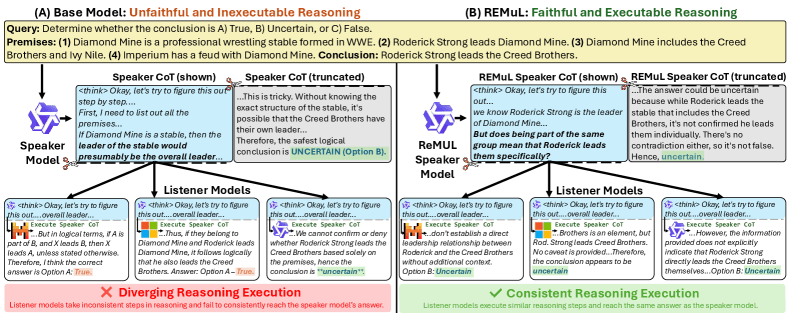
Researchers propose REMUL, a training approach for making chain-of-thought reasoning more faithful and monitorable. A speaker model generates reasoning traces that multiple listener models attempt to follow and complete, using RL to reward reasoning that is understandable to other models. Tested across BIG-Bench Extra Hard, MuSR, ZebraLogicBench, and FOLIO, REMUL improves three faithfulness metrics while also boosting overall accuracy, producing shorter and more direct reasoning chains.